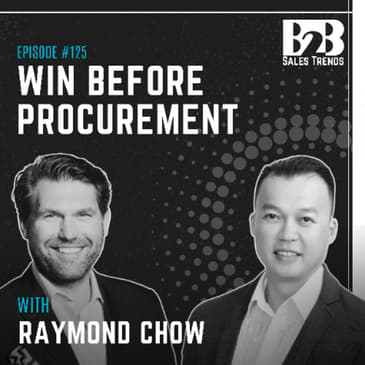
[00:00:00] My lovely people, welcome to another fabulous episode of the B2B Sales Trends Podcast. Now, today is a super interesting topic for anybody who has to deal with professional buyers. Now, most deals aren't lost in procurement. They're lost long, long before that. By the time an RFP lands, the rules have been already written, the specs are set,
[00:00:25] and if you weren't part of that process, you are just another name on the list to make up the numbers. On the B2B Sales Trends Podcast, we give you a sneak peek into the strategies of the world's best CROs and go-to-market leaders. We share with systems and secret ingredients they are using so you don't have to figure it out the hard way.
[00:00:49] So, if you're interested in increasing your win rates, reducing sales cycles, and learning from the best in B2B selling, this podcast is for you, my lovely people. Today's guest is Raymond Chow. Raymond is a senior sales leader based in Singapore and where procurement, especially in APEC, where procurement has become more and more influential and buying decisions are increasingly complex.
[00:01:18] So, the real question we're unpacking today is, what do the best teams do before procurement even takes control? Raymond, welcome to the B2B Sales Trends Podcast. Thank you so much, Harry. Very happy to be here. Thank you for having me. Raymond, when you look at how deals are won nowadays or how they're lost in actual fact,
[00:01:45] where do you see things breaking down most often for sales teams? So, I'll take a step back. If we take a few years back, we used to sell to users and they were the decision makers. They were the ones who were out there looking for what they want to buy and they have the finances to do that and they go out and buy them. But things have changed as per your introduction earlier.
[00:02:09] And we are seeing procurement getting a lot more influential in a lot of the work that they do. And what we tend to see nowadays is we get in a little too late. We are not there with the relationship. We are not there to make sure that we know where the funds are coming from. We are not there where the technical specs are being written. We are not there to understand exactly what they are trying to get in terms of return on their investments.
[00:02:37] And I think all of that put together is where we tend to lose if we do not link all these dots together. Any point in there, if we're not there from the very beginning, puts us at a very, very disadvantage. So, that's interesting. And so, when you think about how buying decisions are made today, who, in your opinion, tends to have the most influence?
[00:03:06] And how has that evolved over time? Like I stated earlier, it used to be the user who had the most influence. They were the ones who were out there saying, this is what I want and this is what I want to get. Nowadays, we have the economic buyer. We have the technical buyer. And we also have the financial buyer. And all of them are looking at very different aspects.
[00:03:34] And we need to understand exactly what actually makes each of them tick. And there's no right or wrong answer as to where or who would be the most influential because they all look at a very different aspect. And we have to look at it as a very holistic package. And we need to go in there to make sure that we satisfy every one of these requirements from these different groups.
[00:04:01] And so, I do think having that holistic look at all these stakeholders is where we need to now continue to work on. And all sales teams need to make sure that they're on top of this because I do not see one individual being the one that is able to actually make that most influence in that purchase.
[00:04:22] Having said that, in Asia Pacific, we do see in certain quarters, in certain countries, there is a veto power. And that veto power comes from a particular group. And that group could be the purchasing group. It could be the user or it could be the finance group that is looking at, okay, if we need to make a final decision and we are at a deadlock, and I will be the one person who can veto any decision that's being taken to say this is what we're going to buy.
[00:04:52] So, I think understanding how the purchase is going to be made, whether there is a veto power, to your point, who will make that most influence, or otherwise it's going to be quite equally spread across all these different groups. That's interesting. Now, so let's talk about handling these different stakeholders now before we talk a little bit more about RFPs and so forth.
[00:05:17] Because my experience is that sellers tend to gravitate to the conversations that they like to have. Now, we're talking about very different stakeholders, right? The economic stakeholder, the technical stakeholder, the financial. Nobody is comfortable with every single one of those conversations.
[00:05:41] What would be your advice to sellers who really have to ensure that they are engaging with all of the stakeholders now? Yes. And I will have to say selling now is no longer an individual game. It is more a team sport. When I say a team sport, I do not think that it is an individual who goes in and say,
[00:06:08] I will meet each and every one of these people and be able to influence them individually. And we may not be able to put all of them in a room and have the same speech, be able to reach each of them and touch each of them in terms of what they're looking for. So where it comes down to is we need to make sure that we look at the stakeholder mapping and you get that stakeholder mapping right.
[00:06:32] And we look at people within our teams who is able to then relay every single message that we want to have to these different groups of people. It could be a salesperson going down to the procurement team. It could be a very technical, clinical person who will then go down to the user
[00:06:54] and be able to share what the particular equipment can do and what benefits they can get from getting that particular equipment. And we may need to get a finance person to be able to go out and look at what's the total cost of ownership. How do we make sure that the total cost of ownership over the seven years, that they're going to be having that equipment is going to make sense to the finance department and the buyer side. And I think those are areas that we need to look at.
[00:07:22] And like I said, no longer an individual game is definitely a team sport now. You know, that's interesting. The other day I read a stat, I forgot the exact source what it was, but it was something like 52, 53 percent. It was around half, right? Half of sellers don't map out the stakeholders in their deals. What does that stat tell us?
[00:07:49] I think it tells us that we're not prepared to be able to go in and address what is required. And to the point that you made at the very beginning, and I reiterated again the very first question, if we have not mapped this out and we are not there prior to them coming out with an RFP, coming out with a tender, you've already lost that particular deal. You definitely need to be able to know very well in advance.
[00:08:19] Who do we need to talk to? When do we need to get all these ready and be able to address everything that's required way before any of these requests for proposals come out, any tenders coming out? And I think that's what the stat's telling you. And that's where we're seeing where those losses are coming from because they're not well prepared. Hey, a quick pause here because if you're leading a sales team right now, you will want to hear this.
[00:08:47] We've just released our new report, The 26 Sales Trends for 2026. It's pulled from the conversations we've had with senior leaders on this very podcast. The themes, the shifts and the realities shaping how customers buy and how teams need to sell in the new year. It's practical, it's concise and it's built to help you make better decisions faster.
[00:09:17] You can download it for free at the link in this description box or at globalperformancegroup.com. Now, let's get back to the conversation. It's a really good one. Let's talk about that RFP tender process, that sort of structured evaluation process, right? Now, in many deals and many opportunities, there is that moment when suddenly this thing hits your desk, right? This RFP tender, you know, RFI, whatever it is, right?
[00:09:47] They all have its purpose and they all have its structure, of course. What typically happens, in your opinion, and I'm happy to share a stat too that I've heard recently. What typically happens, in your opinion, to a seller's chance or the chances once that progress or that process, shall I say, reached that stage?
[00:10:13] So once the RFP lands on your desk, what's the chances really of a seller winning that deal at that stage? What do you think? I would say if you have not engaged and you had no idea that you were going to receive that RFI or that RFP, the chances drops down to almost a 10% range. And you definitely have no way of being able to reach all the different stakeholders, be prepared to address all of them.
[00:10:43] If I were to take a step back, the things that we need to do prior to that is where we need to go out and be able to put up a speech that's able to highlight what we can achieve for each of these different buying profiles, each of these stakeholders. Because when the RFP comes out, everything has been written in there and you had no way of influencing what was going to be put into that RFP.
[00:11:10] And you will not be able to go and meet each and every one of these people because usually as part of the requirement in the RFP, you're no longer allowed to go meet any of these people. You're not allowed to meet the user, nor the procurement, nor anybody who's involved in that purchasing process. So if you are not prepared, you've not done anything prior to the RFP landing on your desk,
[00:11:36] I think that percentage has dropped to a very low percentile. And then you may have stats to share with that. Yeah. And we're very close. That stat, it comes from a procurement professional we're working with. We run for some organizations, we run a framework we call Dealing with Procurement. It sort of educates salespeople on how procurement thinks, how they act, how they create a buying strategy and so forth.
[00:12:04] Everything to give them a sneak peek on the other side of the table. And it's delivered by former chief procurement officers. And that individual former chief procurement officer said to me that the average win rate of a RFP that you haven't been involved prior to its release is 7%. So you're really close with your estimation.
[00:12:35] But for me, this is like, you know, and I asked the guy the question, I said, what is it that you need to do, right? Is it the fact that you turn away the RFP? He was very clear. He said, if they haven't engaged with you and you just lands on your desk and says, please, can you respond to this? You're just benchmarking. That's it. That's right. Right? Exactly. I think they're basically just expecting you to submit something.
[00:13:03] And I don't think it's going to make any difference to how the evaluation is going to happen. And I think, yeah, the 7% and 10%, I think really close. That's my experience as well, where the win rates drop dramatically. It's interesting. Now, if the real leverage is before that formal process begins, right?
[00:13:29] How do you approach getting involved early in those deals? What does that look like in practice? Right. Actually, it involves quite a lot of things. And I already stated quite a few of them. And I think to start off, you may have software that can help you look at all these different opportunities way before they are even being listed out there.
[00:13:56] You are able to use Excel if you do not have this sophisticated software. And part of what is required in the different lists that you're looking at are what these opportunities are. What are they looking for? And then stakeholder mapping. Mapping who are the different stakeholders within each of these opportunities. When are we expecting it to happen? Where's the money coming from? And when are they expecting to close?
[00:14:24] And be able to then map who we have on our team who is able to go out and work with these different stakeholders. And most of that is done way in advance because this happens even before the buyer has the money to actually go out and do any of these purchasing.
[00:14:43] Because most of the time when the buyers are trying to buy something, they would have to do a request to the board, to the senior management to say, we need some money to actually purchase something. And they will need all these information that we will be providing to be able to help them do a lot of the justification for getting those finances through. And so a lot of that work would have been done way in advance.
[00:15:09] And we have to map exactly what needs to happen, who are these stakeholders, and also very importantly, what is the buying process? What process are they actually using? So we spoke about RFPs. We spoke about Tendis. Two very different systems. But we also have different systems in different countries. And I'm giving examples here in Asia Pacific. In different countries, all of them run different processes.
[00:15:36] And we need to be very, very sure what that buying process is and then determining who do we need to work with. And if I could just elaborate a little longer. Many of the times there are competing priorities between these different stakeholders. Obviously, if you speak to the procurement team, they're going to tell you, we are going to be looking at who is going to give me the cheapest price.
[00:16:04] If you speak to the technical buyer, the engineers or the users, they're going to say, I'm going to be looking at the product that's going to give me everything that I want. All the functionalities that I'm looking for, everything that I need to do, the work that I want to do. And that's the reason why I'm buying this product. If you look at the finances, the team from the finance group will come back and say, I'm going to look at the total cost of ownership.
[00:16:30] What is purchasing this equipment going to help me in making sure that I'm also going to be delivering on the returns on that investment? Because it's money that I'm putting out there. What am I going to be getting out of that? So these competing priorities tend to mean we as sellers need to go out and address them very differently. And we need to have different pitches and we need to break them up and not do them together as one team.
[00:16:57] We need to make sure that we pitch whatever they want to hear separately and then make sure that we form a cohesive understanding that every point that they're looking at, we are able to deliver.
[00:17:10] You know, in the seller's mindset, the dealing with the financial buyer or let's say procurement for the sake of an example, is often seen as a very tough part in what they do.
[00:17:27] Right. So how do you what advice would you give to people when it comes to how to engage with procurement in a way that's more constructive and not combative? Because as you mentioned, right, procurement is there to drive, you know, a financial deal and they're trained to also put you a little bit on the back foot from the beginning.
[00:17:54] So how do you approach engaging with procurement in a way that's more constructive and not really, you know, combative? Yeah, I think the first important point that all of us have to understand is that we need to listen to them because the procurement is working between two groups of people.
[00:18:16] The buyer, which is the user or the technical buyer who wants this product and they have specified very clearly what they want in terms of those technical specs. And the seller, the one who's going to be providing a lot of these products to them. And the way that we need to approach it is to understand exactly where the procurement team, the purchasing team is standing,
[00:18:41] whether they are going to fulfill every single technical aspect that the user is looking for, or are they going to compromise on what they are going to buy so that they can actually reduce the cost of purchasing that particular product. So we need to make sure that we have very good listening skills, make sure that we have very good communication skills and maintain that relationship to continuously approach them and understand if things have changed,
[00:19:08] if it hasn't changed, what do we need to do as a seller to continue to be able to get more information before the purchasing group puts out the RFP. So very, very important is that relationship that we keep with them and making sure that we understand and listen to how they want us to actually be working with them rather than, to your point, be combative and say, the users want these products. You know, if you don't give it to them, we're going to be in trouble.
[00:19:37] So I think being able to be that moderator, and if I could use a different word, be a facilitator in facilitating that particular purchase. I like it. That's a little bit of a different take to the typical sort of competitive element to it, but really facilitate and sort of pull the different strings of the different stakeholders. I like the term.
[00:20:01] Now, you mentioned that we have to stay close, right, to these procurement professionals. Now, what does that ongoing engagement actually look like? You mentioned we've got to listen. You mentioned we've got to really understand them and so forth.
[00:20:18] Is there anything, in your opinion, that people should be really conscious of for this ongoing engagement prior to the RFP being released? Yep. In fact, it should not even be a relationship that happens only because there's an RFP.
[00:20:42] We have to ensure that there is a continuous communication and that relationship is an ongoing relationship that we continue to have. Whether they're purchasing anything, whether they are going to release an RFP in the near future, I think that's something that we need to continue to have and to be able to engage with them.
[00:21:04] And that's where that stakeholder mapping is really important and where if you are a salesperson, this should be the primary role that you play, that you continue to go in and find out. Because if you remember, I spoke about getting that list of opportunities. Sometimes that list of opportunities comes from this group of procurement purchasing officers and they will say, yeah, we have certain departments who are looking for certain equipment.
[00:21:34] It may not happen so soon. And you have that in your list right now. And then, you know, you keep asking, when is it happening? What are they looking for? How can we help? I think that relationship is very important. If I could add another point, and this is from the experience that I've had, we've lost a very important tender before. This is an RFP that happened. We lost it because price-wise, we were just not competitive.
[00:22:02] And I and my team did not back out and say, okay, we are not going to see another RFP in the next seven years because they're going to use that equipment for the next seven years. What we did was we went through with them because they've offered the purchase order to a competitor. We still followed through to say, when is the competitor delivering? When are they installing it? You know, how are they installing it?
[00:22:31] Have they done the site surveys? And we followed through. And then when they did the installation, we were with the users to understand how are they finding the equipment? And we continued to say, oh, you know, we can help you with certain things. And throughout the years that they've had a competitive product, we were there.
[00:22:48] And when they were releasing their next RFP to purchase the next product, we were first in mind because they found that we were there, even though we were not the winning party in that particular RFP. They decided that we were the group of people that they wanted to work with if they were to purchase another one. Interesting. So you've got to stay engaged with these procurement professionals all the time. That's a good tip.
[00:23:18] For any sales leader out there listening to this podcast and somebody who wants to improve win rates in these complex deals, what are the one or two things that they can implement immediately when it comes to this? Yes. First of all, I would say we need to be very prepared. I think it goes back. The most important thing is be prepared.
[00:23:44] And that prep work is where we make sure that we get that buying process, the stakeholder mapping and the list of opportunities very ready. And we need to make sure that we're able to map our team to who these people are on the buying side. I think that's the very first thing that we need to do, because once you have that, you are almost 90 percent ready to be able to tackle anything that comes through.
[00:24:11] And second, if we are to go out and work with these purchasing groups, with the user groups, with the finance group, we use this word facilitator. We need to be very sure that we are facilitating their purchase and not out there just selling. I say this very much to the teams that I work with very often. And many companies tend to say, we have a product, go out and sell the product. Right.
[00:24:39] I tend to tell the team, go to your customers, understand what they need and then find a product for them. So we are fulfilling what they're looking for rather than taking a product and shoving it down their throats to say, this is what you need. We need to understand exactly what they need and then we fulfill that need with what we can actually provide. And I think those two things are very important ones.
[00:25:06] And I do think if you have all these right, you obviously would put yourself on the front foot most of the time. Like it. I've just come up due to your prompting for a new term for salespeople. It's the deal facilitator, right? Interesting. Raymond, are you up for a quick fire? A few questions with quick answers? Sure. I'll try. All right.
[00:25:35] So what is one mistake that sales teams or people make when dealing with procurement? What's that one mistake that they're making, in your opinion? No, I think it's not listening. We tend to put a lot of assumptions. We say this is the procurement team. We put an assumption that they have made up their minds.
[00:25:57] And I think we tend to make that mistake of putting a lot of assumptions in front of us and not listening to how we can go out and actually make things happen for the procurement team. I think they are very much like us as a selling team. They want to make a very, very useful purchase for the users. And every single time we go in and we find that they are the enemy, which shouldn't be the case.
[00:26:26] They should be a partner that we want to have on our end when it comes to a purchasing cycle. And I do think that's the one thing that we tend to forget, that they should be a partner with us and not be the enemy between us and the user. What's one signal that a deal is already too late to win, in your opinion? That you did not hear about the deal until the RFP comes up.
[00:26:53] So the usual signal is if all of a sudden you get it in your email or you get a folder in front of you to say, can you quote this? You've already lost because you should already have worked on all of that even before all of that have come to you. And what's one habit that separates teams that consistently win complex deals? I can give you two very good habits.
[00:27:23] I'll start with the first one. I spoke about this a little earlier, is to be very prepared. Most of the time we don't prepare enough. We don't have the right technical knowledge. We don't have the right knowledge of how the purchasing cycle or the buying cycle or the buying process is. We do not know who we should be working with. Who is the person responsible for the decision? Whether there is a veto right within that purchasing process.
[00:27:50] So all of these makes us very well prepared. And I think that preparedness helps us go out and actually be a lot more, I guess, successful in the sales cycle. And the second one, it comes from a book from Amanda Duckworth and this is called Grit. And I think as a seller, as a salesperson, we have to have that grit.
[00:28:15] It's very easy for someone to say, I've already decided don't come back and look for me again. And I think as a seller, you need to continuously knock on the doors, make sure that you're there, make sure that they see you, make sure that you don't give up. And I think that's something that I think most salespeople should have. And I don't see that a lot nowadays.
[00:28:41] And I had a mentor once say this to me. You know, if you go out to a buyer and they kick you out the door, what you do is you climb in through the window and you meet the same person again. And I think that's what we need to have. We need to say, OK, that was behind me. You know, he yelled at me. He kicked me out. I'm still going to go back in and make sure that he hears me this time.
[00:29:10] So I think those two things are what makes, I think, a very successful salesperson. Love it. Raymond, my last question on every podcast since about 120 episodes now is the following. What are the three skills or traits that define truly elite salespeople today? Right. And again, you may have heard this multiple times. I think one is to always listen.
[00:29:40] We tend to, as salespeople, want to talk a lot more because we say we have this product. We want to come out and we want to sell to you. But I do think what is really important as a important communication tool. And although I use communication is actually listening skill. I feel that is a very important skill that everyone should have, which is to always make sure that you listen.
[00:30:07] And when you listen, you learn a lot more and you listen to understand so that you're able to deliver on what is required. Because we have, like we mentioned earlier, different stakeholders. They're all looking at very different things and we need to listen to exactly what makes them tick. And then we're able to deliver to what they're asking for. Another one is to make sure that we continuously learn.
[00:30:30] We get to a point where we feel we know everything and we feel that there isn't anything else that I can learn out there. And we started off this podcast by saying things have changed. And if we're not continuously learning, we're not continuously updating ourselves with how purchasing patterns have changed. People have changed and how the money is actually going to be used have changed.
[00:30:56] And we need to continuously learn to make sure that we're on top of things. And that also includes making sure that we update a lot of the opportunities that we have, how we update the products that we have, how we make sure that we are relaying the right information to the right people. And I think the last one was something I mentioned a little earlier, which was grit. And I think for people who are interested maybe to go read the book, it talks about how you don't ever give up.
[00:31:26] I think it's something that really, really strong and successful salespeople have always had, that you have that grit within you to want to succeed and you don't ever give up until you succeed. And I think those are my three areas that I think are habits that makes a salesperson successful. My lovely people listening and listen intentionally, continuous learning and never giving up attitude.
[00:31:56] Those are the top three things that Raymond has shared that top elite salespeople need to execute really well in nowadays B2B selling world. Raymond, you've been a tremendous guest. Thank you for your time. Our listeners will appreciate your insights and your thought leadership. Thank you for taking the time. Thank you so much, Harry. Thanks for having me. My lovely people, if you're showing up when the RFP is already out, you're not really selling.
[00:32:25] You're competing and you're making up benchmarks and you're making up the numbers, basically. By that point, the requirements are all set. The stakeholders are all aligned and your ability to influence the deal is extremely limited. So this isn't about better procurement conversation. This is about the system behind them. Who are you staying close to before the deal really exists?
[00:32:55] How are you mapping out these key stakeholders? And how you are consistently part of those conversations early? Because the teams that win consistently don't rely on luck. They follow a playbook in a way. And if you don't have one, you're figuring it out the hard way. Well, we'll see you next time.
[00:33:20] If you like that conversation, like this episode, share with somebody else you think would benefit from that, go to our YouTube channel, B2B Sales Trends Podcast. Give us a subscribe, a like and a share. Until the next time, my lovely people, take care of yourself, your loved ones, and of course, your B2B customers. All the best. Bye-bye. If you'd like to put yourself or someone you know forward to be a guest on our show, there is a quick form in the show notes to complete.
[00:33:47] It only takes a minute and it helps us to find voices and opinions that shape the future of B2B selling. Thank you. We appreciate it.