[00:00:00] My lovely people, if your sales team is full of technical experts but is struggling to engage at a business level, you've got a gap. Pretty big gap and it continues to grow that gap. Customers aren't buying features anymore. They are making decisions based on outcomes, financial impact and long term value. On the B2B Sales Trends podcast, we give you a sneak peek into strategies of the world's business.
[00:00:30] Best CROs and Go-to-Market Leaders, these systems and playbooks they are using so you don't have to figure it out the hard way. So if you're looking to increase win rates, reduce sales cycles and learn from the best of B2B selling, this podcast my lovely people is for you.
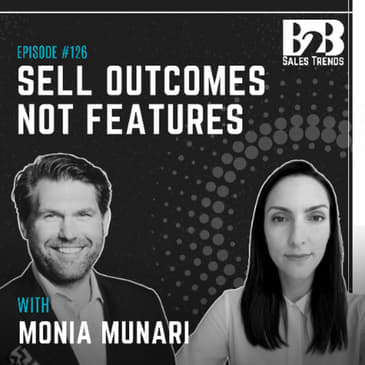
[00:00:49] My guest today is Monia Munari. Monia is the SVP of Sales at Siemens Energy, where she is leading a global sales transformation focused on evolving the mindset and skillset of a highly technical seller and sales organizations and is shifting that. Monia, welcome to the show. Thank you for having me, Harim.
[00:01:17] Monia, you're working in a highly technical environment where expertise has traditionally been the foundation of how teams sell. Now, where does that start to break down nowadays? And what happens if organizations don't evolve the way their sales teams engage customers?
[00:01:38] Thank you, Harim. You are completely right. Technical expertise is and will be the key. However, that's not enough. That's what makes us enter the room. What keeps the engagement with the customer is something different. The world outside is evolving faster and also the profiles of the leader that we find around the negotiation table is changing.
[00:02:02] They have not only procurement and engineering priority, but also finance, risk, sustainability, cybersecurity. So in that direction, also our sales organization need to change to address the pain points of those leaders that are in conversation with us.
[00:02:24] What happens if we don't do it? Well, the discussion moves to a very transactional thing that moves your organization not to a partner but to a mere supplier. When you leave the table of the strategic discussion, that's where you start losing relevance as an organization. And that's the risk that nobody can run in this moment.
[00:02:53] You know, it's interesting that you mentioned the strategic discussion. And especially when you have these different functions, procurement, finance, different topics, sustainability, cybersecurity, and so forth, what you have just shared. Those strategic discussions sort of take salespeople a little bit out of their depth because there are so many stakeholders, right? Is that what you're seeing as well?
[00:03:16] Correct. We have always more different players up to the C-level, of course, that are decision makers strongly into the larger projects. So when you stepped into this role, you were tasked with evolving how your sales team engage with customers. Now, what were the first two or three things you focused on changing initially and what made the biggest impact?
[00:03:43] I would say that's a journey. So let's start with the clarity. Let's address in a very simple manner for all our sales community, which are the strategic goal of the organization. That helps a lot focusing on portfolio elements or projects that are maybe not big in magnitude, but really strategically relevant for the organization.
[00:04:10] That's the very first point I would make for an evolving sales organization, followed by a simplification. We work with a very big number of tool, information, CRM, first of all for a sales organization and how to embed the simplification into the daily life so that the technology is supporting the team. That's also a key.
[00:04:36] If I were a really good seller, which I'm not, if I were joining your sales team today, how would you expect me to prepare for, let's say, a customer conversation differently and in a different way than only a few years ago? What would you say to that? Definitely. That's one of my preferred topics. So if we said at the beginning, the technical know-how was the base and still is really relevant in the discussion.
[00:05:04] Today, before talking with the customers, we need to understand much better their balance sheets, for example. We need to understand much better in which market segment they move, which are those things that moves their business. And only by that we can then engage in a discussion that brings value rather than product services or solutions.
[00:05:29] You know, it's really interesting because when you understand these items, you know, when you understand the customer's balance sheet, you understand what market segment they're in and what is driving that market segment. Maybe what's the benchmark in that market segment. Only then I can have a conversation based on your business outcomes, right? And the impact I can have and the value that I can provide and so forth.
[00:05:55] And for me, it's astounding a lot of the times that a lot of sellers are still not paying that attention to those vital preparation parts of that. What do you think? That's really the substantial difference from the past. If we want to move from a strategically relevant partner and not a supplier, we need to be able to engage in the value we bring in that conversation.
[00:06:23] So the ideal closure of the discussion is not, please send me a quotation for what you are proposing, but let's sit and co-create the value. Co-creating the right solution together and co-creating the outcomes and the impact and the value as you shared. I think it's, you really, you can't do without that anymore. Going in and just pitching something is just not going to work. It's interesting. It's interesting.
[00:06:52] Now, when your teams engage with senior stakeholders, Mamiya, how do you guide them to connect what you're offering now to these customer business outcomes? What does that look like in practice? Senior stakeholders are having more and more their own focus very clear. And if not, we can also discuss about that for sure.
[00:07:17] But the guiding principle or question that every salesperson should have in mind are why is a change needed into the organization? So which is the pain point that that organization is trying to solve? Is it a topic of go-to-market, so delivery time in our case? Is it a revenue? Is it a cost? Is it a sustainability?
[00:07:44] All these questions are really essential to engage into the creation of a value or at least to start thinking from a sales perspective in which direction the solution could be to support the customer. We have then the timing. So why is the topic relevant now? If the topic is not urgent, most probably is something that can be discussed further on.
[00:08:09] So the right timing of the engagement is also really, really essential for a successful negotiation. And why is, in our case, Siemens Energy, the company that is sitting at the table? So which is the value add that we can bring in that discussion with the customer? If in the past we were preparing with brochures and technical presentation, now the discussion would be based in one business case.
[00:08:37] Hey, a quick pause here, because if you're leading a sales team right now, you will want to hear this. We've just released our new report, the 26 sales trends for 2026. It's pulled from the conversations we've had with senior leaders on this very podcast. The themes, the shifts and the realities shaping how customers buy and how teams need to sell in the new year.
[00:09:06] It's practical, it's concise and it's built to help you make better decisions faster. You can download it for free at the link in this description box or at globalperformancegroup.com. Now, let's get back to the conversation. It's a really good one. It's interesting when you say that about the timing and about, you know, is this really an opportunity for us? And why are we at the table?
[00:09:34] You know, I always, I truly believe that qualifying in and qualifying out, is this an opportunity? Do they have a problem that's big enough to solve? Is the timing aligned with it? You know, are we aligned with all the key stakeholders? There are only a few elements that are really critical to qualifying an opportunity.
[00:10:00] But if I don't have them, the problem is that a lot of salespeople sort of live in the land of hope to want to continue the sales process. But instead of saying, you know what, there's some misalignment, the timing isn't right or the budget isn't right or the stakeholder alignment isn't right or the necessity to change for that particular prospect isn't right. Let's qualify that out. As soon, qualifying in and out is equally important.
[00:10:30] Do you agree with that? Definitely. We go back to the, maybe one of the initial points we touched. Giving the clarity on what we want to achieve as an organization helps already a lot a sales organization in focusing on the right opportunities. So we are not talking about the magnitude of opportunity, but really on the selection of the right one for the success of the business. And also the right engagement of the resources.
[00:10:58] You cannot just keep on floating the market with offering if they are not successful. That's a very low efficiency that in this moment in time, no organization can afford. A lot of the time when you build these processes and lead into this transformation, it has a lot to do with confidence and competence, right?
[00:11:24] How do you help your sellers build the confidence and the capability to operate at that much more commercial business focused level? Well, we are not expecting somebody to wake up and to be a financial analyst when we talked about the competence. No, you're not? Oh, no. Maybe with improvement from AI, we can reach something.
[00:11:53] But still, our is a human, human-based work. And it's based on the interaction in between people. So you have several, several things that you can do. First of all, giving the tools, like the basic knowledge into the frame of conventional and non-conventional trainings.
[00:12:15] Now we see more and more trainings based on role play to pre-experience this kind of new question and answer that in the past were considered reserved to the very high level of management, for example.
[00:12:31] And also the initial quick wins that get enabled by those learning are, I would say, the biggest support of a transformation journey. So giving the right tools together with rewarding every small win so that those new habits become operationalized.
[00:12:57] You've worked in the past in sales excellence and now you are senior go-to-market leadership at Siemens Energy. Now, where do you typically see a gap between how sales processes are designed and how they're actually used in customer conversation, especially between these two roles, sales excellence and go-to-market leadership? I would say the biggest difference is the intent of those processes.
[00:13:27] If from a sales excellence operation perspective, processes are there to control the system and the organization. In real life, processes should be designed and have to be designed to support exactly those milestones, as we call them during the process evolution that you were touching upon.
[00:13:50] For example, the moment in which we decide if the deal is the right one for us to engage in and to invest our resources. If the risk profile of that specific deal is the one that we want to have, if we are offering the tailored solution for our customer.
[00:14:07] So the key for me is really that we bring the processes from a governance perspective into a real life enabler so that every sales person can leverage the processes for their daily organization and goal achievement,
[00:14:27] rather than being pushed to fill in tools that is normally the miracle of the Friday when the CRM gets cleaned of all the things that actually happened during the week. You've mentioned earlier the AI tool and these sort of enablers, right? And there's a lot of focus on that, digital tools, AI in sales and sales processes and helping salespeople to do that.
[00:14:55] I'm big passionate about the fact that these things can support all of that, but we are still doing human to human selling. So that human interaction, in my opinion, is even more important than ever now. Have you taken a look at that? I know you have. How have you structured their role so they can actually support sales team instead of adding complexity? And I'm talking about digital tools and AI right now.
[00:15:23] How have you achieved that? We are still on a very long journey, but our pillars for that is to integrate rather than multiply the initiatives. So AI should be a collector of everything that needs to be automatized and can bring additional value rather than posing additional challenges to the organization.
[00:15:49] Of course, we ask every salesperson and not only sales, everybody in the organization to get familiar with the use of the AI enabler that we have. And as they are enabler, they should automatize every process that is not valued.
[00:16:08] Everything that is strongly repetitive, that gets cleaned out of the daily activity of a salesperson, need to be moved to an AI-supported activity. While the valued activities are still fundamentally human. That's where we find the value of a sales organization that, as we discussed in our initial call for me, is the end goal of a value creation organization.
[00:16:39] So this high level of interaction, human interaction. And of course, we have also a support in what we said. Nobody wakes up being super familiar with the stock market. However, AI and agents built to create the bigger picture of our customer environment are for sure a better data analyzer, collector and enabler for the daily job.
[00:17:06] And of course, we talked about the skills that need to change. We talked about the process that's necessary to do that. The outcome that we need to achieve with all these processes. What mindset shift has to happen for this kind of change to really take a hold across the whole sales organization? Because, you know, if you have skill set and no mindset, then it doesn't work.
[00:17:35] If you have mindset and no skill set, then it doesn't work. What mindset shift has to happen, in your opinion? How I see it, the real mindset shift is from I'm selling something to my customer to I'm responsible of my customer outcome, of an account outcome.
[00:17:56] When the sales people, regardless of which is their portfolio element focus, start reasoning in terms of account they are jointly managing, rather than how much I can sell in one or the other portfolio. That's really how the mindset change into the organization.
[00:18:18] You know, what I really, really like what you said is, and I noted this down, is that sellers really have to be responsible for the customer outcomes. I haven't actually heard it in this way. And I think it's really a shift that they have to say, you know what, I have to take ownership for this. I'm not just selling something to you. I have to take ownership and I have to be responsible for the customer outcomes.
[00:18:45] You know, that for sure will shift that mindset 100%. We are heading to that direction. Let's see in a short term which additional value we can bring to our customers. And you outlined it at the beginning. It's a journey, right? It's a journey and these things don't fall out of the sky. It's a journey, step by step. And that's clear. When does it land for a seller, in your opinion?
[00:19:14] When do they move from this is just another initiative that corporate is pushing to me to actually changing how they work? When does it click for them, do you think? I think the change happened when after the initial struggle in preparing differently for a meeting, the conversation with the customer opened up a completely different landscape of opportunities.
[00:19:42] So if before you were entering with your technical background and package of information, trying to seal that specific deal, now you enter with a lot of questions, actually, that need to be validated together with the customer. And you leave the room most probably with two, three times the number of opportunity in mind that you had at the beginning when you joined the meeting.
[00:20:07] And that's then mirrored one-to-one into the daily also achievement of the sales organization. What's one thing, in your opinion, leaders should start doing if they want to make a transformation like that? One thing they should start doing? Joining a customer conversation. Of course, what we are discussing is very nice and is very theoretical and might look awkward or might look super clear.
[00:20:35] But until the moment in which the leaders are sitting with the customer, getting confirmation or completely different, even opinion of what was prepared, the feeling of the work that has been done by the organization is not there. Yeah, absolutely. Join the customer conversation and then you can truly co-innovate the solution together. Love it. What's one thing they should stop doing?
[00:21:05] Opening up more and more initiative. Especially for a sales organization that has also sales number to be achieved. We have a lot of different initiatives around the year. The start of the year, mid of the year, refocusing. So rather than opening always new buckets, a very focused activity under different frames, for example,
[00:21:32] key results is something we are using into the organization to focus the activity. Even a certain fixed objective, how to roll out the key result always in direction of that objective all along the year. So not to be too much dispersed with the request we make to the organization. And what's one thing they should keep doing? Celebrate successes.
[00:21:57] So there's nothing more important for a sales organization to celebrate the achievement of each and every team member, regional organization, vertical organization, if we talk about the specific go-to market. But especially those successes that are maybe smaller in volume,
[00:22:18] but really put a flag on a very strategic goal that we all together wanted to achieve and now materialize. So to start joining the customer conversation, my dear leaders, to stop just running initiatives for the sake of it without any focus around it and keep celebrating the successes so you keep motivation going. I love it. The fabulous input.
[00:22:46] My last question on every single podcast is the one around the top three skills. So what, in your opinion, are the top three skills that define truly elite salespeople today? That's the magic recipe, I would say, of a sales human, but also of the sales organization. We said that we want so much more from this organization.
[00:23:16] We want them to learn, to engage in discussion. And if you ask my opinion on that is curiosity. Without a genuine business curiosity, you will not be able, or it will be a big burden for you as a human, to learn all these new things and to explore. So curiosity is, in sales, like in leadership actually,
[00:23:41] one of the key skills that I would boost into my organization. We also have empathy, because we are indeed a human-related business, and without human engagement with the counterpart, there's no result that can be achieved.
[00:24:07] And after this curiosity and empathy that are very nice and very, I would say, open for different interpretation, we need a bit of discipline. Discipline into the execution itself. Because we have learning that needs to be achieved. We have a certain methodology also in the engagement with the customer. And we have all the follow-up, the pipeline management,
[00:24:34] the evaluation of our KPIs up to the achievement of the order intake. So in a nutshell, I would say, business curiosity, empathy, and the discipline execution. I love it. And I couldn't agree more with you. Monia, you've been an excellent guest on this episode. I know all the leaders listening to this will very much appreciate your thought leadership and insight in this.
[00:25:04] Thank you for making time and thank you for your contribution. We really appreciate it. Thank you very much. It was a pleasure to be with you. My lovely people, technical expertise is no longer enough. Customers don't buy what you know. They buy what you help them achieve. And like Monia said, responsible for customer outcomes. That's what sellers need to be. If your sales team can't connect to business outcomes,
[00:25:33] if they stay stuck in product conversations, if digital tools don't change behavior, nothing really changes. The shift is this, from product expert to business partner, from technical conversation to outcome-based selling. If you want that transformation, it's a journey, it's a journey, as Monia has referred to. If you want more conversations like this, my lovely people,
[00:26:01] subscribe to our YouTube channel, or listen wherever you get your podcasts from. Until the next time, take care of yourself, your loved ones, and of course, your B2B customers. Bye-bye. If you'd like to put yourself or someone you know forward to be a guest on our show, there is a quick form in the show notes to complete. It only takes a minute, and it helps us to find voices and opinions that shape the future of B2B selling. Thank you. We appreciate it.