
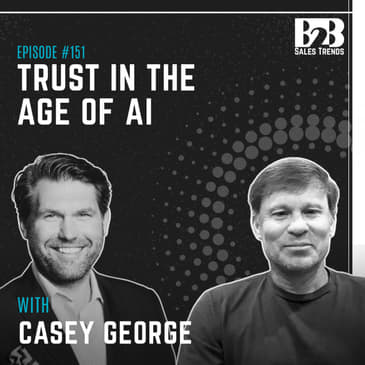
[00:00:00] My lovely people, welcome to another fabulous episode of the B2B Sales Trends Podcast. Now, it feels like every company is trying to answer the same question right now, which is, what does AI actually mean for us?
[00:00:15] Not just in theory and not just in a few years from now, but really today. And while everyone's focused on technology, sales leaders are facing a different question entirely really with this. How do you lead people through a market that is changing faster than the playbook can keep up?
[00:00:38] On the B2B Sales Trends Podcast, we give you a sneak peek into the strategies of the world's best CROs and go-to-market leaders, the systems, the playbooks they are using so you don't have to figure it out the hard way. So if you are interested in increasing win rate, shorten sales cycles and learn from the best of B2B selling, this podcast is for you. Today, we're talking about leading sales through the AI revolution.
[00:01:10] My guest today is Casey George. Casey is the Chief Revenue Officer at Monday.com. And I'm super pleased to have Casey on the show today. Welcome to the B2B Sales Trends Podcast, Casey. Thank you. Great to be here. Good to see you, Harry. Give us a quick intro about yourself, about Monday.com, how you help your customers for our audience that will be fab.
[00:01:36] I think it's in the pretext, right? And when you read it, it kind of hits home for me. I've been doing this for three decades, which, you know, you don't think about it that way. I almost think about things in quarters, right? I think this is my 117th quarter in this business. I probably remember only three of them. So anyway, you know, I spent a lengthy amount of time at IBM, 20 plus years.
[00:02:03] I stepped out of IBM and have soon did a couple of different leadership CRO roles. And most recently, obviously, here at Monday. I've been here a little over a year. And it's a it's a real interesting place. I'd say by far the most interesting opportunity I've ever had. Right. You think about Monday.com, their evolution. They're relatively a young company, 14 years old, started as a PLG business.
[00:02:29] And we've grown up into an enterprise, you know, SaaS company. And that that evolution is really just getting started. So, you know, we're roughly 1.4, 1.5 billion in revenue. Again, heavy contribution from PLG, but aggressively moving up market where that's representing the majority now of our revenue. We're in an interesting market in work management, as they would call it.
[00:02:56] And we help, you know, companies manage their work. We're really an orchestration platform for for users to go and and deploy their projects, manage their projects. But we've also expanded. And this is the the other compelling part about Monday. We're a very innovative company. We build products. We build products that people want to use, that they like. They're very intuitive. And we took that foundation and build the CRM platform. We built a service platform.
[00:03:25] Now that we have all of these, you know, value generators for customers to deliver to the market, it's just going to accelerate our move of market because we're able to get more of what our customers want. We appreciate the intro. Let's talk about AI because it's everybody's thought process at this stage. Depending on who you talk to, either AI is going to replace everybody and everything or change absolutely nothing. Depends who you talk to, right?
[00:03:54] What do you think people are getting wrong about that conversation right now? So I'm going to take a risky, not so risky opinion on this. It's somewhere in the middle. I do believe and I've seen as most everyone has that this is some very compelling technology. Yeah. Right. I think the real question now is how do you use this technology? What do you use it for?
[00:04:21] And how does it deliver value for you, your company, organization, et cetera? And that's the hard part, I would say. Right. I like to think humanity wins and we're not going to replace all humans with what we do. That effectively AI is just an ability to accelerate what you do, to augment what you do, to give you additional capacity, to make you far more productive.
[00:04:45] And I know we see that internally here at Monday and we're starting to see that and being able to deliver that for our customers. So to answer your question, it's somewhere in between compelling technology that we're going to embrace and it's going to, it's really going to augment what all of us do and it's going to accelerate the economy. No different than some of the other technological advances we've had in the last 50 years. Has it changed the way you think about sales leadership? It has.
[00:05:14] You know, I would say that sales leadership was a pretty prescriptive model, right? You went out and hired people, you trained people, you deployed them in territory. They built relationships because people bought from who they trusted and they developed opportunity and they closed those opportunities. That was a very elongated sales cycle. It was necessary. It's what we did. It's what good sellers knew how to do. But now we're in a completely different place. And AI is a part of that.
[00:05:44] But I think the sales motion has changed dramatically in the last 10 years where customers have made up probably 90% of the decision process before you talk to them. Right? You got to go meet customers where they are. And typically it's, hey, they're engaging with you. They have a pretty good idea of what they want. And they have a couple different vendors that they're looking at. And you have to, you know, show up in a way that presents your solution better than the other.
[00:06:12] And there's no time for the 18 holes of golf. There's no time for the steak dinners. It's really get in and get out. And you need to deliver value very quickly. The other thing that's important to call out, it's along the same lines. You used to build a return on investment of make it up 18 months a year. And you were doing pretty good if you could do that. That is compressed to day one. So customers really expect to get value immediately.
[00:06:40] And if you don't show up that way, you're going to be at a disadvantage. You know, it's interesting. There's so much research and different stats out there that speaks to exactly what you've shared. The fact that a large percentage of the decision-making process is already completed before sellers even show up. And, you know, in my mind, it needs to change a lot of things in the seller's motion as well.
[00:07:10] When you just think about simple things such as discovery and the importance of that, you just can't turn up anymore with the same old rubbish questions everybody else is asking. You really need them. To your point, you need to meet the prospect or the customer where they're at. And much further down that journey, I always find that sellers really struggle with that. What's your experience with that? A hundred percent.
[00:07:37] And, you know, if you think about what I mentioned earlier about how the sales cycle typically went, if you're not pivoting into this new world, it's uncomfortable for you. You're going to struggle. I would also share with you while customers think they might know what their problem is and what they want to do to solve it. In a lot of instances, if you engage with them, you find out if you ask the right questions that maybe they really don't know what they're trying to solve for or what the solution is. And that's how you differentiate.
[00:08:05] It's, hey, help me understand what you're trying to solve for. And then we can get to a solution because a lot of time customers go out there looking for a solution and they're not clear on what really problem they're trying to solve. Yeah. And I think that's the issue that the whole AI opportunity brings with it. Customers don't know what they need. They don't know what's out there.
[00:08:28] So the sales motion really needs to bring these, you know, underappreciated needs to the table to share something that you may not have appreciated before can have an impact on your business. And that's really sort of, in my mind, the new way of discovery, right? To generate this new thinking in the mind of the prospect and client. But that's a different motion. Completely. And the limitation today is not the technology.
[00:08:58] I think the technology is almost limitless. The limitation is the creativity. How do I do this? How do I approach this? Help me with some ideas. And that's where you can really differentiate. You said something earlier that has actually been coming up quite a lot in recent episodes, which is the trust element. How important do you still think is trust these days in the sales motion?
[00:09:26] The trust a buyer or prospect has to you as a seller or the organization you're selling for? It's absolutely critical. And it's the piece that probably hasn't changed. Yeah. Right? Where people, they need to trust if it's you, someone, the company, the solution, whatever. So we believe that, you know, there needs to be a human, a name with a face behind every transaction and every deal. Right?
[00:09:51] Whether or not you engage with them, maybe, you know, in a very active way, they need to know that someone's back there behind it and that they can trust it. Especially in AI, right? Because people are taking a risk. They're stepping out of their comfort zone. They're embracing technology that they can't control necessarily, that they can't predict maybe in some instances. And they're trying to control that.
[00:10:15] And they need to be partnered with someone who understands that, has a platform that's enterprise ready, and has the governance permissions and all the things that they need to manage that. So trust plays a huge, huge element to this. I think it's accomplished differently, that trust, right? Back in the days, to your point, the round of golf, the steak dinners and so forth, that's sort of a way to build relationship and therefore you build trust. Trust is built slightly different these days.
[00:10:44] Yeah, it's built different and it's more technology driven. You know, they need to see you've done it before, that you understand their business, that you understand some of the risk associated with it, that you can anticipate those things, that you have, you know, a process and an organization and technology and infrastructure that can accommodate that, right? And you have to demonstrate that. You have to have proven it.
[00:11:08] You're taking a huge risk if you engage with, and this isn't a disparagement on startups, but you're taking a huge risk because the reality is they haven't done it before, right? Some of our research says that obviously many more stakeholders in any one sales process, we know that, especially in enterprise selling, right? That's no secret. But, you know, every single stakeholder has to justify their decision internally.
[00:11:35] So, if you have, I don't know, five to ten decision makers in your sales process, every single one has a different set of needs. Every single one really needs to internally justify the reasons for their decisions and the outcomes that the decision can drive. That's a challenging stance for salespeople these days. It is, and good ones know how to do it, Harry.
[00:11:57] They know they have to get inside the bowels of the organization to understand the process, who's the stakeholder, who's the budget holder. So, those things probably haven't changed since it's been amplified. Absolutely. Because the power is now with the user. It's almost like shadow IT, right? Because now the users are out there building solutions and not going through IT, not going through procurement in a lot of instances. And at some point it aggregates, but we see a lot of that as well.
[00:12:26] And you have to navigate those things as well. Yeah. Now, obviously, major market shift and any major market shift tends to sort of reward a different set of behaviors when it comes to sellers and the way they do it. When you look at the people thriving in this space right now, what traits stand out to you? Yeah.
[00:12:54] Part of this is personality, maybe, but definitely an element of curiosity, right? You have to engage with customers in a very organic way. You have to be curious. You have to want to understand not only the technology, but how that applies to the customer. So that's definitely a trait that I'm leaning more on now than I ever have before with sellers.
[00:13:19] I know in the past, maybe you were verticalized and you had industry sellers with industry expertise, or maybe it was a domain expertise like cybersecurity. You know, my personal belief is you go hire the athlete and look for those characteristics in that athlete. So it's passion, it's creativity, it's agility. And obviously, you know, you've got to have some smarts about you too.
[00:13:46] So, but those things I'm seeing pervasively now. It's interesting. I mean, curiosity now to play a little bit devil's advocate here. You know, it's not necessarily a new trait, right? You always had to be curious even prior to AI if you want to be good in selling. Why is it even more important now than ever? Because it's not prescriptive. What we're doing now today is not something out of the box, right?
[00:14:13] You have to develop, understand, think about all the implications, you know. And so while curious is not new, I think it's moved from maybe third to first. And that might be the difference, right? Because of all the dynamic nature of the market right now. A lot of buyers know that AI matters, right? But they don't necessarily know where it creates value for them.
[00:14:38] What responsibility, in your opinion, do sales teams have to educate customers in this environment and really take the lead on that? How important is that? It's super important. And I'm so glad you asked that. You know, I say it's a responsibility, but it's also a huge opportunity and an advantage. We spend a lot of time with enablement, right?
[00:15:02] We think there's a huge opportunity for us to obviously enable the sellers in a way that the customers want to be engaged with. And so with that comes, you know, we did an agentic week, for example, here at Monday. What is that? Well, we have a whole agent platform. So we took a full day off for the entire company and we had a contest and said, hey, we're going to go out and build agents. Agents that are going to help us be more efficient, more productive. We'll have a contest.
[00:15:32] And so we had every, we had over 3,000 submissions of agents and we ranked them and we, you know, we gave awards and prizes away for them. You know, that's less significant than it is just the whole activity and getting customers, getting sellers very comfortable with the technology so that they have the confidence to engage with customers in this way. The confidence level is such a key element these days. And I believe, and I'm curious about your opinion on that actually.
[00:16:02] I believe strongly that people or buyers make decisions one out of two reasons these days, right? It's number one, either to gain an outcome. If you can help me create, you know, gain an outcome, then I will be interested in what you deliver. Or if you can help me avoid a risk, if you can help me avoid a risk in the future, then I'm game. So either to gain an outcome or to avoid a risk are the two reasons why people make decisions, in my opinion. What's your take on that? Yeah, 100%.
[00:16:32] You know, those things haven't changed, right? But the extent you can demonstrate that for the customer, understand their business, be able to share with them how they could either avoid the risk or get that outcome is super important. And I think that starts with, again, going back to understanding what are they really trying to solve for, right? What are you trying to do, right? It's super important. As it relates to confidence, I just have to say, this 90% of selling, right?
[00:17:01] Customers have a sixth sense. And if you're not confident in what you're doing, what you're selling, what you're proposing, they pick up on that real quick. And it links back into the risk piece, right? If I do business with you, I don't want to have a risk. I want to minimize my risk, the best case. So if you are not confident, that shows me that I'm taking a risk. So I'm moving and I fully agree with you. You know, it's interesting, these behaviors that you're sharing in these processes.
[00:17:30] I mean, you have a big organization. How do you scale all this? And how do you make sure, I would assume, that your leadership team is executing on that? It must be challenging. It is. It's a pretty fluid environment right now. Obviously, as fast as the market is, you think you have a plan and a strategy. Guess what? It changes in three months. And we haven't seen anything different here at Monday. And we like to be out in front of the market.
[00:17:59] And so with that comes a lot of disruption. And I would even say maybe even chaotic. So if you're leading a large organization, the number one thing you can do and what we do a lot of here is communicate. We over communicate. Hey, find them on the strategy or anytime there's a change in the strategy, we communicate that and repeat it. Very important also to empower that leadership, you know, down in your organization to deliver that message,
[00:18:26] to act on that message and understand personally what their responsibility is so that they can articulate that to their teams as well. So we spend a lot of time on communication. One thing that a lot of sales leaders are wrestling with is how much in this period of change, how much freedom do you now give your customer-facing people versus how much structure you provide, right? You still need forecast predictability. You need all these wonderful things.
[00:18:54] So how much freedom, flexibility do you give them versus how much structure? How do you think about that balance? Yeah, turkey dribble for sure. And it's, you know, considering how we're engaging with customers today in this organic way, right? The real successful ones are going to have that flexibility. They're going to be empowered to go do things in a creative way to give the customer what they want that might not necessarily fit inside the box of the company, right?
[00:19:23] So we want some guardrails, obviously. We've established those. But we have done, I think, a very good job of empowering the rep to go do those creative things. Because we don't know what we don't know. This is, you know, uncharted territory for everyone in the industry and in the market. So those that are going to win are the ones that can accommodate that customer, right? And that's how we've embraced this. And we're doing it, again, in a very organic way. And our sellers have the power to go do those things.
[00:19:52] To fast forward this for three years from now, what do you think the best sales organizations will be doing differently from everyone else? I don't have a crystal ball. And it's funny. Oh, that's a shame. Otherwise, it could have borrowed it. I saw something the other day where it said the smartest people can tell the future, right? And I took from that, I might not be the smartest person because I don't know. I can't see the future. Here's what I would tell you.
[00:20:20] I think it's been very consistent and will be consistent in this regard, that the compression of economic value for the customer, the compression of time it takes to get value, the compression of time for you to deliver on these things. Everything is being compressed. And we're just moving that much faster. That's what I think is going to continue in this way. The other thing that I would tell you, and I do believe this is going to happen maybe sooner than later, speaking of compression,
[00:20:50] a customer is not necessarily interested in the traditional sales model. And we think about that. It's okay. Opportunity comes in or you create an opportunity. You qualify it. You engage pre-sales SEs. They engage, help solution the deal. You commercial the deal. You transact. You hand it off to the services team to deliver as CSM comes in. Sorry for the long explanation. And you have all these handoffs along the way.
[00:21:17] I don't think that's how we're going to end up here pretty quick. I think it's going to be a much more seamless sales flow with very few people and less handoffs. So just imagine a seller maybe partnered with a forward deployed engineer, an FDE, and they take that from A all the way to Z with no handoffs, very frictionless. And the customer really gets value from day one. And you're dealing with the same people around the same solution. Love it.
[00:21:44] The frictionless process for any future sales organization. Casey, the last question on every single podcast I always ask, and I've asked for a few years now, is what are the top three traits, skills or behaviors that you believe define top B2B sales people in the age of AI in this current environment? What are those top three skills and behaviors and traits that define top sellers?
[00:22:14] And if you can also rank them for me, number one, number two, and number three in importance in your opinion. One of the traits I used to talk about that I thought were very important in, let's call it the legacy way of selling, was the gift of gab. You know, the ability to strike up a conversation, engage with someone, get them to remove any reservations they have so that they could, you know, open up to you about what they're trying to do.
[00:22:40] I don't think that's necessarily number one for all the reasons we've already talked about. I do think, as I mentioned earlier, that curiosity has to be number one, right? That is partnered though with passion, right? Be passionate for what you're doing, how you do it, what you're about. It's very hard to show up in a sales world and not be excited about what you do. And then the third one is grit. And that's, that's a harder one to describe,
[00:23:08] but I think most people in sales understand what that is, right? They, they're very gritty. They, they're resilient. They overcome challenges. They're just hustle, right? And that's another one that is showing up really well in the sales world today. And so those three characteristics in that order, for me, are really, really resonating, separating the good, the good sellers from the not so good. Well, lovely people. You heard it here from Casey.
[00:23:38] Curiosity, passion and grit is what it takes to execute in this fast paced environment. Currently case. Yeah. Our leadership, our, our sales followership, should I say is super, super thankful for your insights that you have shared with the audience. Thank you for your time and thank you for contribution. Thank you. Great to see you as always, Harry. Thank you. Thank you. What stood out to me,
[00:24:05] my lovely people in this conversation with Casey is that AI isn't just changing technology. It's changing how organizations learn, they adapt, how they make decisions and how they enable their sellers to engage. And for sales leaders, that may be a bit of a bigger challenge, not figuring out the tools, but figuring out how to build teams that can keep evolving as fast as the market does around them.
[00:24:33] If you are trying to get a clearer picture of where revenue is actually being won or lost, your sales process, check out our brand new Revenue Accelerator in the show notes. If you're interested in additional insights from our podcast series, there's a couple of white papers out recently, you're entering the deal too late and what it takes to survive in the AI environment. My lovely people, until the next time, take care of yourself, your loved ones, and of course,
[00:25:02] your B2B customers. Bye-bye.