
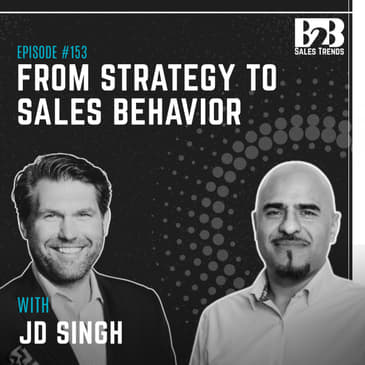
[00:00:00] Welcome my lovely people to another fabulous episode of the B2B Sales Trends Podcast. Now, customer first. Every company says it. Everybody wants to do it. The real challenge isn't writing those words into a mission statement. It's getting hundreds of people from often different businesses, different cultures and sort of different ways of working to consistently put the customer at the center of how they sell.
[00:00:28] On the B2B Sales Trends Podcast, we give you a sneak peek into the strategies of the world's best CROs and go-to-market leaders, the systems, the playbooks they are using so you don't have to figure it out the hard way. So if you're looking into increase win rates, to shorten sales cycles and to learn from the best in B2B selling, you are in the right place. My guest today is JD Singh.
[00:00:53] JD is the Senior Vice President and Global Head of Sales for Enterprise Solutions at S&P Global. I'm super pleased to have JD on the call today. Welcome to the show. Thank you, Harry. I appreciate that welcome.
[00:01:08] Your organization has grown by bringing together multiple businesses over the years, each with its own history, with its own sort of perks and cultures and way of working, right? From a sales leadership perspective, what's the biggest challenge in getting all of those teams aligned around a common approach to serving customers? What's your secret in that?
[00:01:34] Yeah, you know, it's a tough question, really, right? Because when you think of it from a sales leadership perspective, when you bring together multiple businesses, the single biggest challenge is how do you overcome this cultural inertia and establishing a unified commercial identity?
[00:01:48] It's not just about getting everyone to use the same systems, right? It's about replacing deep rooted, you know, tribal ways of working. So with a single common approach to the market, the acquired teams have their own heroes, success stories, muscle memory for how we win, and getting them to let go of that identity in favor of a new and shared one is a central challenge.
[00:02:13] So the core challenge really breaks down, I think, into three critical backgrounds. Some people call it, you know, reconciling religion. It's the way of selling. Each acquired company has its own sales philosophy or religion, as we call it.
[00:02:26] One might be built on aggressive, high volume transaction selling. Another might be built on concentrated relationship based cycles. A third may be a product led growth motion. So when these teams are forced together, their instincts clash. They have different definitions of what a good lead, different stages of the sales cycle process and different ideas of how to negotiate.
[00:02:48] So the leader has to define and install a single non-negotiable way of selling. This isn't about picking a winner. It's about defining a new unified methodology that becomes the law of the land. This includes a common language, a unified sales process, and clear rules of engagement. So aligning incentives, what people get paid for. Compensation plans are the most powerful expression of a company's culture. And if you don't align them, you will never align behavior.
[00:03:18] So again, there's different ways of looking at that. One team might reward pure revenue, encouraging heavy discounting. Another may reward you on profitability or multi-year contracts. A third may have bonuses tied to specific strategic products. These conflicting incentives will cause teams to work at cross purposes. The team paid on revenue will undercut the team paid on margin, leading to internal friction and customer confusion.
[00:03:41] So you have to create a single unified compensation plan directly rewarding the behaviors of the new common approach. And if the goal is to sell integrated solutions, then the plan must incentivize cross-selling and teamwork, not siloed performance. And then there's the merging the us versus them mentality. In any merger acquisition, there's an inherent us versus them dynamic.
[00:04:04] Their acquired teams often feel like their culture, processes and expertise are being dismissed. This leads to passive resistance. So where they publicly agree to the new approach, but privately continue to do things that they've always done it. So again, the sales leader has to become the chief, you know, visionary. And again, over communicating the why. Constantly explaining the strategic rationale for the new and unified approach.
[00:04:32] Celebrating unified wins and creating a best of culture. That's really in summary. The technical challenges of integrating systems is solvable. The biggest challenge is human. Deconstructing old identities and building a new and shared culture of success around a common commercial purpose. Do you run into a lot of resistance with that approach? Yes, I mean, you do. And that's why leaders have to lead.
[00:05:00] You know, it has to start from the, you know, from the managers, the frontline managers. You know, before just getting down to the rep level, you really have to, you know, ensure you empower your leaders to be aligned. And they have to get aligned very quickly to deliver those messages. I would imagine with letting go of the old ways as you have positioned it is not always an easy thing for these people to do, for these functions to do and so forth.
[00:05:29] So that resistance may be existing. But you're right. I mean, that's where strong leadership comes in, right? That's what helps them to change. Yeah. And there's lots of ways of looking at this. Sometimes people say you either get with the program or you don't. And people have to make decisions. You know, do you want to be on this new journey? And is that the right journey for you? So those are the kind of questions we have to do. At the end of the day, we're dealing with humans, the people.
[00:05:56] So you have to make sure that it's not, you know, one size fits all. But it is about, you know, what's best for the business and how do we align that to the people's skills? Now, that was sort of the internal how do we align everything? Now, let's talk a little bit about how we go out. You mentioned already a common way of selling, called it a religion, which is interesting. Everybody has their own, right?
[00:06:22] And so a lot of organizations talk about putting the customer first. This customer centricity terminology keeps flying around. In your experience, what does that actually look like in day-to-day selling? I mean, I think, you know, you have to prevent sales teams from eroding profits, right? By competing on price or making unnecessary concessions. A leader has to shift the team's focus from concession-driven selling to a model of mutual value creation.
[00:06:52] So, you know, again, if you think about the primary way to avoid, you know, price pressure is to anchor conversations in the value of the outcome, not the cost of the input. This is done by quantifying the customer's cost of inaction. You know, the money they are losing at risk. A lot of our, you know, a lot of solutions that, you know, customers are taking, without taking them, they will incur a big loss. So, when a, you know, cost of inaction is large, the price of the solution becomes a small factor.
[00:07:21] So, again, it's establishing the, you know, negotiation, you know, give-to-get model. You know, it should not always, negotiation should not always be a one-way street. Sales teams must not be trained to, you know, just give concessions like discounts without getting something in equal or greater business value in return. You know, you want a special concession, you do a multi-year deal or you do a longer-term commitment.
[00:07:46] And the most important thing, I think, is you have to build a co-created business case. So, instead of presenting a polished ROI, you know, we love this return on investment model to the customer. The most effective approach, you know, we find is to build it with them. Having the customer's own stakeholders supply the data that helps construct the financial justification and that takes the psychological ownership of the value, right? So, that makes them far less likely to argue against price because they will be arguing against
[00:08:16] their own maths. You know, it's knowing what actually is the real value to them. And then, finally, I think, you know, you have to know what your walk-away point is. A team cannot negotiate from a position of strength if they're afraid of losing the deal. This requires, you know, rigorous qualification to ensure the sales pipeline is healthy. And it's not desperate, right? It means teaching the team to recognize and walk away from a bad profit deal. You know, you want to put the customer first, but you also need to know when low margin,
[00:08:44] the high service costs drain resources that are better spent elsewhere. So, you have to put all of that together. It's interesting that you keep referring to the conversation cycle as a negotiation. Now, typically, I come originally from many years ago from the negotiation space. And people, a very common misconception in people's mind is that first I sell, sell, sell to you.
[00:09:10] And then once you're convinced to buy my solution, then we negotiate about price. Of course, that's the wrong mindset. And what intrigued me was the way you use the word negotiation. It sounds like you ask your people to really make sure there is a negotiation activity throughout the whole sales process. Is that your thinking? Yeah, I think, yeah, you have to think of it that way. Because if you think about, you know, it's a journey. Yeah.
[00:09:40] And everything is a negotiation, right? We all know whether it's our personal lives or professional lives. You're negotiating all the time. You know, we negotiate what time are we going to do this call? You know, when do we fit it into our schedules? You know, you're busy, I'm busy. And so, everything in life typically becomes some type, some form of a negotiation. Now, negotiation may not be the perfect word for it, but, you know, it's a discussion. You know, I think when you talk to customers, they will inherently always tell you, you know,
[00:10:09] it's like the old cliche, you know, what keeps you up at night? You know, and then you think from there, I can trigger something to make it the value prop. So, you start the discussion, but the negotiation always is, you know, you shouldn't be thinking of it as purely, I'm trying to sell you something. I don't, when I speak to customers or when I have my sales leaders and my sales teams speak to customers, it's never like we're there to just sell something. We're there to, you know, and again, it's a cliche of partnering, but you want to understand.
[00:10:35] And you should always look at things as, there may be a deal here and there may not be. I never walk into a meeting thinking, you know, I'm just here to sell something. I'm there to learn something about that customer. If I don't know something today, I may know, I may have preconceived notions, but my job is to understand what's going on. And sometimes you, at the end of the meeting or meetings, there may not be a common thread right now, but you know that there will be in the future based on that conversation, that dialogue. But that's kind of part of that negotiation. You start off early.
[00:11:05] The first negotiation you're doing is you're establishing yourself. You walk into the meeting, you walk into the room, you know, you set the stage of who you are, who you represent, and then you go and actually have a conversation and understand all the facets of what's going on. So that's why I think of it more of the negotiation. You know, it's putting your best foot forward on day one. Love it. Absolutely love it. I love talking about negotiation. It's such a, it's something that people continue to be intrigued about.
[00:11:35] But I agree with you. I agree with you very heavily. You know, if there is a natural fit between what you're looking for and what I can offer, great. Let's have a conversation around it. And of course, I'm going to showcase and let's build that ROI case together. And then if, again, if it's a natural fit, we have a conversation. We have a negotiation, right? But negotiation activity is interesting, is, you know, as early as from the right from
[00:12:03] the beginning in the funnel, you know, maybe agreeing on negotiating access to all the stakeholders that may be deciding on this deal. I may be negotiating the fact that is there a necessity for you to change my dear customer? Right. Or are you happy with the status quo? Or can we, you know, what's the cost of inaction? Let's decide and agree on that. It's all little agreements along the way. And the more you built up, the easier the end agreement will be.
[00:12:33] Right. Absolutely. Interesting topic. And if I can, and if I can touch on that, even at the most senior, even at the most senior level. So at a junior level or at a rep level, the conversation may be getting the meeting. The negotiation is trying to get the meeting. Even when you're, when meeting is set up for you and you're, and you're going in to represent whichever brand you're, you know, ambassador you are for, you still have to negotiate because
[00:12:59] you're walking into a meeting, which may have been set up because of very senior relationships, but that still doesn't mean you establish your credibility. You have to actually establish the credibility. You may be going in because someone's giving you time on the calendar because of very senior relationships that, you know, that are already in place, but that doesn't mean they're going to buy something from you. So then you have to establish your credibility. You have to negotiate that credibility. And that's the foundation which you build on.
[00:13:25] If you have a initial meeting where you can start talking the customer's language, then suddenly you've negotiated to your point, access to more stakeholders, access to further meetings. Otherwise you're having one meeting, which can be a very nice meet and greet and you go no way from that. So it's, yeah, to your earlier point, it's all a negotiation. It's interesting that you, you use the term earning credibility and, and, and I agree with you, you know, you have to earn credibility.
[00:13:54] You have to earn in a way the right to, to take a seat at the table. And especially in your business, salespeople are often sitting down with senior level executives, right? To discuss some of those more complex transformation projects that you're helping your clients with. What does someone that need to bring in terms of that credibility to, to, to earn that seat
[00:14:22] on the table doing these super, uh, senior executives? What's, what's, what's one of the secrets that you can share with the audience? I mean, you know, you know, you have to shift, you know, very quickly in the first meeting from this, you know, uh, let's call it a vendor approach, uh, to acting as a trusted business advisor. You know, when you're discussing these kinds of complex transformation projects, executives do not want to hear about a product pitch. They want to talk about their business.
[00:14:49] And I think, you know, that really is, um, you know, the, the, the key driver, you know, you earn that credibility by, uh, you know, giving them information. Sometimes they may not know from their own teams, you know, industry benchmarks, uh, sharing information, how their peers are tackling similar transformation hurdles, um, you know, bringing a view on market trends, you know, disruptive forces or regulatory shifts that's going to impact them maybe in three to five year strategy. You have to do your homework, right?
[00:15:17] And I always, I always find, you know, um, in sales or revenue, sometimes it's the most easiest thing. Look, I'm a little bit older than most people, you know, nowadays getting access to information is so easy. So showing up with generic knowledge, uh, is, is very much a fast track to a very short meeting. So you must demonstrate that you understand their specifics, uh, uh, issues. You know, you can analyze public data. You can, you know, reference things like their latest annual reports, earnings calls, you know, their interviews.
[00:15:46] You can frame your talking point around the exact priorities that the CEO has committed to, to their board. You know, oh, I, I remember seeing in your Q2 call that you are prioritizing, you know, supply chain resilience. Something that maybe suddenly will connect with them. Um, come with a little world research hypothesis about where their current bottlenecks lie. You know, it's better to be 80% right with a thoughtful hypothesis, then ask a lazy, open
[00:16:12] ended question, which we've all done, you know, in our career at some point, which is what keeps you up at night? Yeah. You know, it's, it's interesting because I interviewed, uh, somebody a while ago and, uh, also on this podcast. And, uh, she was referring to the fact that, you know, discovery has changed big time. Discovery is not about turning up and asking 20 questions anymore and, and, and ask you what your pain point is.
[00:16:43] Discovery is very clearly coming with a point of view, having done your research and then not finding out stuff because that doesn't add value to you, uh, as the recipient of the question, right? What adds value to you is if they get you to think about things that you haven't thought of before them, you may have not appreciated before is a need that can impact your business
[00:17:06] or you haven't considered before, uh, uh, as, as a particular risk to your organization, let's say. So to come to a piece of discovery, not by asking a bunch of questions, but really coming with a point of view, making sure you're driving and generating these new needs in the mind of the buyer to really lead them down a path of helping them achieve their outcomes, but by
[00:17:34] things they may not have appreciated or considered before. Do you agree with that? Oh, a hundred percent. I mean, I tell you a little secret and very little people know about me. I used to love going into a meeting and, um, and, and, you know, asking a few questions and understanding, you know, lay of the land and very quickly connecting the dots. You know, that was kind of like my superpower. You know, I used to believe that I loved to be able to sit in a meeting and be able to
[00:17:59] pivot to, you know, any conversation and take that into, you know, the outcome that I won because I used to, you know, be prepped, but I used to also love to be able to be in, in, in, in my mind, be able to very quickly while the person is speaking, connect the dots, but not everyone thinks like that. And I think as you get, you know, more experience and older and you start managing teams and people expecting everyone to have, think like that or be able to do that is setting yourself up for failure.
[00:18:28] So to your point, you have to go in much more prepared than let's say maybe, you know, uh, in the past where maybe some information or access to information wasn't as readily available. I mean, now we have information all around us. It's, it's really, you know, doing your homework, shifting through that. And going in well-prepared. You're right. This is what you have described. That capability is very rare. Actually, actually I proud myself to have that too, but I agree with you. Not a lot of people have that.
[00:18:57] And, uh, but you can overcome that, right? By these sort of strategies of, uh, of, of doing things slightly different than others, uh, typically do. Yes. And I call it industrialization, right? It's, you can industrialize sales teams and processes by having more of a frame framework to go from rather than just expecting everyone to be able to, you know, think on their feet as we used to say. So absolutely.
[00:19:22] I think, you know, you have a, uh, you know, that's why, you know, we have sales leaders and leadership programs, but really that's why we create strategies. And that's part of a core strategy. How do you scale this? Um, so all of these wonderful things that we've discussed now, um, it's one thing to get your super sellers to do this, but you have a large organization that you need to unify,
[00:19:47] uh, of course, with the same approach, the same skillset, the same mindset, the same approach to the customers and prospects. How do you scale this and how do you ensure the change sticks? Yeah. I mean, that's, that is one of the big challenges, but I think the way, the way you have to move your team from simply understanding the vision to actively changing how they sell on the ground, you have to bridge the gap between high level strategy and daily habits.
[00:20:17] And it's probably one of the hardest parts of sales enablement, but it's also probably the most critical. So, you know, again, how do you transform vision into tactical plays? Well, sellers can't execute on abstract vision. They need to know what to do differently when they pick up the phone. Um, you know, so you have to give them, you know, exact phrases, questions, objection handling techniques, uh, that align with the new strategy. You have to update your playbooks. You know, I had this conversation not too long ago with a very senior leader, ensuring
[00:20:45] your sales methodology, your emails, your discovery questions reflect new vision. If the tools don't change, the behavior won't change either. And I think what I touched on earlier is making your frontline managers the champions. Change fails when frontline managers aren't brought in or equipped to coach to it. So, A, gain them to buy in, but also making sure that they are equipped to coach it. You know, train the managers first before rolling out the chain to, you know, to your, to your ground troops.
[00:21:14] Ensure managers understand how to coach the new behaviors. Uh, structured call reviews. Managers need to listen to, you know, uh, calls and look for new talk tracks. You know, it's, it's kind of, I, I, I, I sometimes joke with folks, it's the old school way of doing stuff, you know, got taking the sales manager with the sales person on those meetings, maybe making sure, you know, it's not there to micromanage them. It's there to make sure that they're able to, you know, align with, you know, the new process.
[00:21:41] Um, and people respect what you, you know, uh, what you pay them for, right? So again, don't just talk, uh, you know, about this stuff. You have to track leading indicators, right? So don't wait for lagging revenue indicators. Track how often new pitch decks are sent, how new discovery questions are logged into the system. You know, we, I used to work at a former employer where every single conversation had to get logged into the CRM. Um, and as you know, what it may sound at that point was one thing, but you have a whole
[00:22:11] history of start to finish about the journey that customers been on. So anyone new can fit into that and adapt very quickly. Um, so I think those are some of the things and continuous reinforcement, right? A single kickoff event. Sometimes we do these, right? We have these big events or training session. They're forgotten in a week. So we try and do more micro learnings, you know, drip our small weekly reminders, you know, uh, quizzes, short videos, reinforcing the new concept and then celebrate the wins publicly
[00:22:40] highlight the reps who are successively executing the new strategy. When sellers sell, uh, and they see their peers winning, they want to follow that. Hopefully that, that approach. So I think those are the kinds of things, you know, you have to make the new way of selling the path of least resistance and you have to give them the tools to align with their managers. You said something earlier that I want to come back with because it's really worth to, uh,
[00:23:05] solve this and learn a little bit more about your, your thinking and your thought leadership on this. Uh, is you mentioned that one of the key things is build the ROI case together with your customer. How do you do that? How do you build an ROI case together with the customer? What would be your top three tips on this, uh, to the audience listening?
[00:23:31] I think, you know, um, to me, so for our business, this is fundamental because, you know, large complex transformation projects, you know, you, you can find a stakeholder who is, is excited about what, what you, your value proposition is. But again, they have a lot of internal stakeholders. And I think the goal is really, you know, again, without kind of sounding cliche is, is partnering with that person to, to get the relevant information that you can then help show them and highlight that.
[00:24:00] Um, so again, first we talked about credibility earlier. The biggest thing in these transformation, uh, journeys, uh, or someone has liked to refer to them as hard surgeries is really about building the credibility and trust upfront. So again, we, we do a lot of workshops to highlight and showcase what we've done in other areas. So building that trust and credibility, then you, you have created the negotiation to be
[00:24:27] much more, uh, have much more access to internal stakeholders where some of the information is going to be critical. Yeah. Understanding the technology stack that someone's using and why they should go on this journey. You know, the, the, the current setup is going to maybe fit for purpose today, but with, you know, the, the evolution of technology and, you know, AI is all around us now is moving at such a rapid pace. You're able to then, uh, include things that they may be the customer has a thought about,
[00:24:53] you know, typically our biggest challenges are the, are the technology teams because they play a big part about, you know, what gets built. And typically technology teams want to build in-house. They don't want to go with, you know, third party providers or vendors. So building the trust, building the credibility, getting, getting access to the teams. And then you, that flow of data that you get, you like, you know, we go in and we see everything. It is literally like doing hard search.
[00:25:20] You'll see all the valves that are not working, you know, and where you need to put different stents in. So you, you, you, you then build that roadmap of these are all of the challenges you, you know, we see for you. So we will map everything out, have credibility and trust, build the relationship, negotiate access to the teams. And then when we show them actually, here's your world today, but here's what the world should look like tomorrow for you based on your trajectory of your business.
[00:25:49] You would be surprised the amount of customers that were then just say, you know what, we, we need to now put this in, in, in words where we can then send this up, up the chain. So when you get to that point, it's much easier. And then it's, it's not, it's not our 10, 20, 50 page decks. It literally is a business case that will drive home because when that gets sent up to the exact level, they'll, it'll be in their language. It'll be in the systems they use today. It'll be in the challenges they see today.
[00:26:17] It'll be in the risks ahead. And it will be also aligning with their trajectory where they want to take that business. You know, in order for you to enter these new markets, we can continue to do what we're doing internally and it will take us a lot longer to get there. Or we can partner with, you know, this brand to get us there. Those are the kinds of things that kind of, when you put them together is what helps build that business case. Appreciate that insight.
[00:26:43] Fabulous thought leadership here for our audience. You've dealt with a lot of salespeople, B2B sellers throughout your career. What are the top three things in your opinion that top sellers these days are executing in front of their customers? When you think about their top three skills and behaviors that they need to possess to
[00:27:10] be elite level in nowadays day and age, what, what would that be? First, second, and third in order of priority? A great question. And, uh, you know, I've seen some of your podcasts, so I shouldn't know the question is coming, but, um, I think it's, um, oh, in, in order that that's, that's thrown me a little bit in integrity, drive, discipline. As simple as fabulous. Fabulous.
[00:27:34] And they are self-explanatory and I fully agree integrity, drive, and discipline. JD, you've been an amazing guest. Thank you for your time. Um, and on behalf of the audience for your contribution to the collective pool of knowledge, uh, thank you for, for your contribution. No, thank you for having me, Harry. Appreciate it. Lovely people. Building a customer first sales culture isn't slogans or initiatives.
[00:27:59] It's about aligning people around a common way of thinking, a common way of doing, helping them to earn credibility with customers, creating value instead of competing on price and developing leaders who understand both the customer and the business. If you'd like to learn more about improving commercial performance and creating more effective customer conversations, you find in the link below our Revenue Accelerator. Uh, check it out.
[00:28:28] Let's provide you very good insights. If you like this episode, follow the show, share it with your team and subscribe to it on YouTube or wherever you get your podcasts from. Until the next time, take care of yourself, your loved ones, and of course, your B2B customers. Bye-bye.