
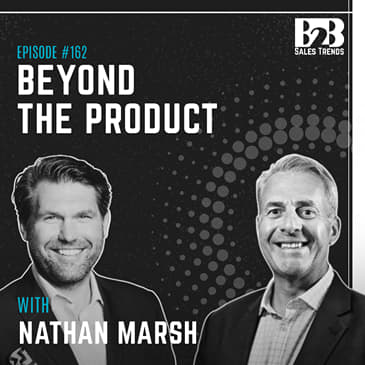
[00:00:00] Welcome, my lovely people, to another fabulous episode of the B2B Sales Trends Podcast. Today, we are exploring how enterprise sales organizations can move beyond selling features and functionality to build value-based partnerships that create measurable business outcomes for customers.
[00:00:21] At the B2B Sales Trends Podcast, we speak with senior commercial leaders from around the world to uncover the ideas, strategies, and leadership shaping the future of B2B sales. Today's guest is Nathan Marsh, and he is from Bentley Systems. Nathan is leading a culture shift in how his organization approaches enterprise selling by helping sales teams think like investors.
[00:00:47] Kind of a different take, which I really look forward to, and engage different stakeholders and focus on creating long-term value rather than simply selling products. Nathan, welcome to the podcast. Harry, thank you. It's a pleasure to be here, and I'm really excited to discuss what is a very hot topic for me, and I believe, our industries.
[00:01:10] Pleasure to have you here, and I forgot to say, Manjur, that you are responsible and an executive and senior vice president for the EMEA region at Bentley Systems. So, just for the record there, but let's dive into that, Nathan. So, for many years, technology companies have built their sales approach around product features, functionality, and technical expertise. They were really good at it, of course.
[00:01:37] But as buying behavior really has evolved, and we can talk about that a little bit in a second, how it has evolved, many organizations are finding that's no longer enough. No longer enough to differentiate themselves. What led Bentley's system, especially your approach, to begin shifting from feature and functionality-based selling to a more value-based approach? Thanks, Harry.
[00:02:04] I mean, that's a really hot topic for our industry as we get ever more pressure to build and renew national infrastructure globally, but also have a finite amount of economic resources to do that. Look, I've come from a background in corporate finance. I've been a management consultant in one of the big four. I've also been a buyer of software from Bentley and other organizations. So, I've been in a number of different seats, and I've been sold to on functionality, on pricing.
[00:02:33] I've also been sold to or partnered with on value, and I'll tell you which one is a lot more fun and productive. It's the latter one. So, that's really stayed with me, and that's something I'm very keen on, and we are bringing to Bentley Systems. So, for Bentley, the shift is really driven by the way our users' decisions have changed. Accounts we work in and the infrastructure leaders, they really are dealing with some of the most precious assets we have globally.
[00:02:59] Water networks, nuclear power stations, airports, etc. It is the fabric of a functioning society. So, cost is important. Functionality is important. But long-term value, and that value can be economic, it can be environmental value, and societal value. So, I'm really excited that peers of mine who remain in industry are really focused on value.
[00:03:22] They need to deliver capital projects with far greater certainty, meeting regulatory and sustainability commitments, and then operating the assets for 20, 30, 40, 50 years after the project. This is a long-term value conversation. It's got some pricing and some cost and some selling built into it, but the long-term play is around value.
[00:03:47] So, from my own experience, this means I believe the conversation shouldn't begin with what the software does and how it works. That's really important. But it's the impact that the software has, the value that it can create. Can it reduce risk on my project? Can it improve safety on my site? Can it make the asset that I'll hand over return greater value to the users and the investors? Can you help me understand the value of asset data and data itself as an asset, as an intangible asset?
[00:04:16] Well, if organizations come to me and say that, I'm listening. I'm really excited by that. So, features do matter. Functionality matters. But in the boardroom, and for investors, as we'll touch on later, it's value-led selling. So, our users no longer buy functionality in isolation. They're investing with us in better outcomes, lower risk, and greater confidence in how their precious assets are delivered and operated. That's really interesting.
[00:04:45] You shared at the beginning of your response here, you were a buyer before, right? And you were sold on functionality. You were sold on pricing. And sometimes, you were sold on value. And you mentioned the obvious one is obviously the one you preferred. Share with me how it made you feel as a buyer when somebody sold you on functionality or on price. I was, well, it was easy.
[00:05:16] I was trading. It was commoditized. It wasn't terribly exciting. And it was quick. So, that's all fine, by the way. But those organizations and those technologies and the services and components were bought, used, deployed, and intended to be updated at the next renewal. The value conversations were around a long-term growth partnership. We're co-investing. And co-investing can be time as well as economics.
[00:05:44] It can be creation of products or propositions or new ways of working. It's a totally different relationship. Right from the boardroom to the front desk, it's a true partnership. And I know which one's more enjoyable. When we had our pre-call to this, you mentioned something that really piqued my interest.
[00:06:02] And something that really gives a bit of a different spin on it, which I like, is this idea of creating value for customers requires sellers to see the customer's business through a very different lens than the typical one. One that simply the products or services that provide and beyond those.
[00:06:30] And one approach to value-based selling is encouraging sellers to think like, and this is your term here, think like investors. What does that mindset look like? And why is that so important for people to possess and execute? Firstly, I think it shows great empathy. Because at the end of the day, whilst it's not all about numbers, for many organizations and stakeholders, the numbers are important. Thinking like an investor isn't as complicated as it sounds.
[00:07:00] You don't need to be an investor. We don't need to go and do our ACA. We don't need to go and do our investor management qualifications. But we need to understand how investors think when it comes to responsible deployment of capital, a return on investment, and a value creation plan. Particularly private capital, but also government and institutional capital.
[00:07:20] So thinking like an investor really means looking beyond the immediate transaction and asking where value is created, protected or lost, and then captured in return. And as I said earlier, that value can be economic and non-economic. For infrastructure, that perspective is absolutely essential because the real economics extend far beyond design and construction.
[00:07:44] The cost, risk, and other opportunities often sit in the operational life of the asset. So it's worth spending a bit of time doing some basic research, I believe, and getting our salespeople who want to be elite salespeople and kind of growth generators just to pause and think. How would an investor, either public or private, think about this particular opportunity? And I assure you it will change the way you approach it.
[00:08:13] I also think a useful way to frame this is that infrastructure investors, because of the scale and duration of their projects, invest in confidence. They want confidence in a software product, in its functionality, in its reliability, in its security. But they really want long-term performance gives them confidence that the product or service or commodity will work, but it will work post-handover.
[00:08:40] So when the asset is up and running, when the airport is open, and that's a different conversation when it comes to comparing capabilities. It's really about helping executives make better investment decisions through the use of our capabilities and products. So your product and pricing last, value, return on investment, and impact first, in my opinion. Love it. Absolutely.
[00:09:05] And it's this idea of if we can affect our customers' business outcomes, that will impact the outcomes and the results they have, and therefore they will receive economic value. So outcomes, impact, and value, and in that flow. I always say that when you want sellers to behave in a certain way, they need to have the mindset and the skill set.
[00:09:35] And in a lot of the times, if you don't have the skill set, but the mindset, it's not going to work. If you have the skill set, but the mindset, it's also not going to work. So it really has to be both. And changing the way people sell often starts quite a bit before new tools or processes are introduced, and there are many out there these days, right?
[00:09:57] And it requires really people to think differently about the conversation, about how they're having those dialogues and the value they are creating. So how have you helped your sales organizations shift mindset and skill set from selling products to really creating business value for customers? How have you done that? Well, there's some kind of hard and soft and experiential methods.
[00:10:24] Some of the harder and more kind of defined methods might involve Franklin Covey, Miller Hyman, you know, really advanced and progressive techniques about how we can reframe and use tooling to reframe our seller's mindsets. Who are you selling to?
[00:11:09] Insight and information about accounts. You can drop an account's annual results or quarterly results into Copilot and really understand not just the performance, but what those accounts are looking for. In EMEA, our accounts operate across a range of different regulatory markets, environments, and infrastructure maturity levels.
[00:11:31] So on occasion, we do need to sell on cost and functionality, particularly to smaller firms at the lower end of the maturity scale. And that's fine. And then we work with them on the journey to talk about and help them understand the importance of value-based selling mindsets. Another thing we do is to spend more time with those investors I mentioned a while back.
[00:11:55] Learning from them, learning from advisors, learning from organizations that are right at the start, in fact, pre-phase zero of a major project. So before procurement starts on things like DCO and site selection. These are areas and phases in major projects that organizations like Bentley haven't typically got involved in.
[00:12:19] And I'm super excited that we're spending more time understanding and empathizing the seller's mindsets, a range of different sellers, thinking like an investor and spending time with investors to understand how they think. And, of course, starting early.
[00:13:01] We're going to have a lot of directors to understand what the impact of that is and how that can tee them up for a conversation about how we can help. Or maybe how we can get them connected because Bentley will be at the heart of that network. Whether quarterly or annual results or a profit warning or an acquisition occurs. I haven't mentioned sales or products yet, have I? But all these business dynamics are really important because they're important to our accounts and our clients. Supply chain uncertainty, workforce constraints.
[00:13:28] Some of the geopolitical issues in the Middle East, for example. Long-term maintenance obligations and changes in regulations and standards. All of these business dynamics, I believe, need to be front and center in an elite salesperson's mindset and planning. And therefore, I think the mindset shift is not here what our product can do. But here is how we can help you achieve what matters most to you. And getting that consistency is really key, right?
[00:13:57] You're looking after a large organization. How do you get everybody? How do you scale this, what you've just described? That's a real challenge. I think that's a big culture and commercial shift. I mean, we've got to be careful because there are some amazingly powerful tools and techniques in account mapping, market and industry benchmarking, sales mapping and opportunity mapping that we absolutely need.
[00:14:25] But I think it's the lens, the mindset that's important to adjust first. And these tools are as good as the user and are also quite ambidextrous. They can be flexed to change that mindset. But, you know, we're on a cultural journey and organizational change will help. So how we organize and how we structure can make these things, make these initiatives easier to do or harder to do.
[00:14:51] But ultimately, if you've got a band of committed salespeople and they're thinking the right way and they're thinking, even though I've used the word salespeople, but about growth, long-term growth and value creation in which the art of selling is mastered. Now, that is a powerful team. And they're there for the long run, not just the deal. And I like how you refer to them as growth generators earlier on in that conversation. That's a nice take on that. Yeah, definitely.
[00:15:20] Enterprise customers are increasingly looking, as we know, not just for vendors, but for strategic partners, right? And those strategic partners need to understand the customer's business, not simply suppliers who understand their product.
[00:15:35] So how does a value-based approach, what you've described, helps the sales team build this thing that is really key these days, I believe, that trust element with the customer and engage the senior decision makers more effectively? How does that work? How do you build that? I think building trust takes time. And it demands the most important part of any organization to be put front and center.
[00:16:05] And that's the person. And even though I work in a software business, our most important asset and our most important commodity is our people. Our most precious asset is our people. And they're the asset and the capability that helps build trust. So trust comes, and I can speak firsthand from this, comes from when users feel that you understand the pressures they face, not just the technology that they use.
[00:16:33] For senior decision makers in infrastructure, the pressures are significant. And I should know because I've been one. But I mentioned them a moment ago. Capital discipline, delivery certainty, safety, regulatory expectations, environmental commitments, public scrutiny, and long-term asset performance. These are grown-up, adult considerations. They're business considerations.
[00:16:56] So if you want me to buy from you, empathize with me, show me that you understand my concerns and the dynamics in my market. And then a value-based approach can really help sales teams engage at that level. It can change the relationship as well. You can move from supplier to partner when you show how expertise will help my business improve its performance.
[00:17:19] If you're selling software, if you're selling services, come and talk to me about my EBITDA, about my profit levels, about my acquisition plan. And then you will convince me that you understand me. You're taking the time and courtesy to empathize with me. And you're building trust in me. And so I think, you know, the amount of trust that's put in us to build multi-billion major infrastructure projects that quite simply can't go wrong,
[00:17:48] because it might be a water network or a rail terminal or a nuclear power station. We are absolutely enshrined by our clients with trust. So if you're going to come and sell to me, I want you to respect that and bring the same. So I guess in a nutshell, trust is really built when you can speak the industry or customer's language and really show that you understand business issues first.
[00:18:12] And that's what earns a place then to bring your products and your price list to, quite frankly, what will be a customer with open arms. Yeah. Sales leader listens to this. What advice would you give to him or her, especially somebody who wants to move their organization from selling features to creating lasting customer value, what you have described? What advice would you give these sales leaders?
[00:18:42] I'll give you advice from the heart and also advice from the journey. Bentley's all at the moment. This is absolutely cultural and structural change, not a sales initiative. It should, if you do it right, have a growth result off the back of it. But we've got to start to be clear on the business outcomes our users care most about. This is a lifestyle change, not a crash diet.
[00:19:07] So we have to instill training and education, get customers in to be honest with them, particularly those you want to partner with, and then keep it going. Keep the change going. Equip and reward our teams to understand the outcomes, quantify them where possible. And also think about how we reward our sales teams and our account directors. Different methods of reward, I think, might need to be considered as well. Consider new language.
[00:19:35] We all talk quite openly about the kind of sales terminology that we have. But like I mentioned earlier, thinking like investors. We end up in front of the person we sound like. So if we're wondering why we end up in front of the head of procurement or head of IT, two fantastically important stakeholders, it's because we sound like them. If we sound like a CFO or an investor or a head of change or a head of major projects or head of procurement, then we're probably going to end up in front of them.
[00:20:04] So really think about the language and the empathy that we use. And also I think a skill for salespeople, which I don't see much of, is storytelling. Bring to life the capabilities, the brilliant capabilities that your products and services have. But rather than taking you through the instruction manual or how they work, plenty of time for that. Tell me a story.
[00:20:28] So while we sit back and enjoy a coffee in one another's company, tell me a story about how your capabilities with others, because collaboration is really important, how you solved a really important and impactful problem. That concrete outcome that has, I think, a little bit of modesty built into it as well will really help me move you onto a value-based partnership to have clarity on leadership, build that commercial discipline and prove value over time.
[00:20:58] But ultimately, I think this is a cultural and organizational change, which will then impact sales, not the other way around. Right. Absolutely. Nathan, my last question, every single podcast, and we are almost at the end of our time together. It's always the same. And I know you've listened to some episodes before, so you know what the question is going to be.
[00:21:19] What are the top three skills and behaviors that you believe that B2B sellers need to have and execute to succeed nowadays? I think, and I have thought about this, I think we need to frame this with a realization of how complex. B2B trading is, particularly at the more sophisticated global account level.
[00:21:42] We hear from Gartner that 61% of B2B buyers prefer a rep-free buying experience. That's a rep in its current form, not in the form that you and I are talking about. 73% avoid suppliers that send irrelevant outreach. Well, that's okay, because we've just spent the last half an hour talking about how to be relevant. And nearly 70%, 69% report inconsistency between suppliers' web information and what they actually provide.
[00:22:11] Well, that's easy to get right. But if we get empathy and understanding right, we can resolve that. I guess I wanted to reinforce the fact, before I answer your question, that it's tough out there at the more sophisticated end. But that said, and that recognized, elite sales and growth teams, I think, master three things. Firstly, commercial curiosity. The ability to understand the end user's business, not just their technical requirements and environment.
[00:22:40] Secondly, they are really good at value articulation. The ability to connect the capability of their products to measurable outcomes, such as risk, certainty, return on investment, etc. And thirdly, executive credibility.
[00:22:59] Now, that doesn't mean instantly writing to the chief exec and demanding a meeting, but having the easy confidence and judgment to engage senior leaders in the language of strategy, business, investment, a long-term partnership. And to help those complex buying groups align around that shared definition of value. You get those right and see what happens to your sales. Well, lovely people. You heard it from Nathan.
[00:23:26] Nathan, commercial curiosity, value articulation, and executive credibility and engagement. Nathan, you've been a wonderful guest on our episode here. Thank you for your contribution to the collective pool of knowledge. We appreciate your time. It's a pleasure. I really enjoyed it, Harry. Thank you for having me. Bye-bye. Well, lovely people.
[00:23:51] Moving from feature-based selling to value-based partnerships isn't simply about changing a sales methodology. It's about changing the way an organization thinks, engages customers, and creates long-term value. As Nathan shared today, that journey begins with mindset.
[00:24:11] It develops through culture and ultimately enables sales teams to have more meaningful conversations with the people who shape investment and business outcomes. If, my lovely people, you enjoyed this episode, I hope you did. Follow the show, share it with your team, and subscribe to it on YouTube or wherever you get your podcasts from. Download our latest white paper and learn about our revenue accelerator tool.
[00:24:40] Both are linked in the show notes. Until the next time, take care of yourself, your loved ones, and, of course, your B2D customers. Bye-bye.