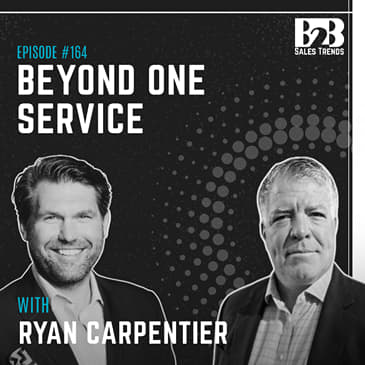
[00:00:00] My lovely people, welcome to the B2B Sales Trends Podcast. Another fabulous episode, of course. Today we're talking about rethinking the MedTech sales model and how commercial leaders can move beyond selling individual services to unlock more strategic long-term growth within their accounts. The MedTech market is changing. It's tough out there right now.
[00:00:25] The way large manufacturers invest in innovation is evolving, creating new challenges and opportunities for the companies that serve them. But the underlying question is one commercial leaders across industries are facing, which is when your market and your customers change, how does your go-to-market model need to change with them?
[00:00:49] On the B2B Sales Trends Podcast, my lovely people, we give you a sneak peek into the strategies of the world's best CROs and go-to-market leaders, the systems, the playbooks they are using so you don't have to figure it out the hard way. So if you want to increase win rates, shorten sales cycles and learn from the best in B2B selling, this podcast is for you. My guest today, super, super pleased to have him on an episode today, is Nathan Marsh.
[00:01:17] He's the Chief Commercial Officer at NAMSA, where he leads sales, marketing, client success and partnerships. Ryan is leading a commercial transformation designed to support NAMSA's next phase of growth and rethink how the organization goes to market. Ryan, welcome to the podcast. Thank you, Harry. Good morning. Let's start with what's happening in the market.
[00:01:43] How is the MedTech industry changing and what does that mean for the way companies like NAMSA's need to sell right now? Yeah, at a macro level over the last couple of years, at least with large OEMs, you know, what we've seen is them deploying their balance sheet, their R&D spend a little bit differently. So, you know, you've seen more focus on investing in smaller or micro companies from an acquisition standpoint.
[00:02:14] So, they're looking more to buy innovation in a lot of instances than they are looking to innovate themselves. So, that's one of the big changes we've seen. And, you know, how that affects the go-to-market, it's understanding, you know, the people that you're selling services to changes. It may not be the internal stakeholders at a large OEM.
[00:02:38] It could be the investment arm helping de-risk some of those potential investments. It's also rethinking how we sell to small and micro accounts and not just selling but how operationally we serve them more efficiently and just help them optimize their long-term development cycles. Because they may only have one assets or two assets.
[00:03:06] So, it's really thinking about, for those folks, putting together a solution that's based on value creation, that's based on helping them move from concept or if they have concept, but through the lab into clinical and then ultimately some type of an exit, whether it's a sale of the asset or commercialization.
[00:03:28] And when the market changes like you have described, leaders, commercial leaders especially, have to determine whether the organization that they have right now today is equipped to capture the opportunities that lie ahead of us. Now, as you look at the next phase of growth for NAMSA, considering all the changes in the space, how are you rethinking the way the commercial organizations go to market?
[00:03:57] Well, the traditional model, at least for NAMSA, was really focused on geography, territories, key accounts. And organized in a way not necessarily focused on how companies buy. Right. And so, you know, a large OEM, a strategic OEM is going to have different buying needs than an emerging company, a small company or a micro company.
[00:04:23] And so, you know, thinking about creating pods that go after how companies buy, not necessarily where they're located is, you know, one of the conversations that we're having. Just understanding that dynamic, how that's changed and how we organize and go to market that way. And what have you learned from this in terms of how they buy differently?
[00:04:48] Well, for a large OEM, there's a mix of their own internal teams. Maybe what we're being asked to do is more backfilling overflow work. There's also a greater propensity for them to buy multiple services and across different business units.
[00:05:10] So consulting, lab, clinical at the same time, whereas a smaller company is looking more discreetly at, hey, right now I need consulting that I have to get through a cycle. Now I need some lab, get through a cycle and then potentially, you know, go through the regulatory process and do a first in human or pivotal.
[00:05:36] And so, you know, the conversations for the large strategics are about, you know, how do we help augment staff? How do we, you know, their internal staff, internal services versus, you know, that smaller micro. It's really about how do we help them create value? How do we help them bring one asset through the development cycle? And it's new, it's innovative.
[00:06:04] So there are greater needs, questions around how to get that approved as opposed to, you know, maybe a company, it's a neurotech division of a large OEM and they're just looking at changing out an electrode or something along those lines. That complexity isn't the same as it is for some of these smaller innovative companies.
[00:06:22] Interesting. And, you know, we had a pre-call to this, preparation call to this recording and you shared some really interesting pieces around how to unlock growth within existing accounts that I want to tap into here a little bit more. Because for a lot of companies out there, growth immediately becomes a conversation around how do we win, you know, new business, new customers, right?
[00:06:50] But there can be significant untapped opportunities within the customers you already have or they already have. So how do you identify where that untapped growth exists within an account and then actually, you know, equip people to go after it? It's actually interesting data, at least from our standpoint.
[00:07:13] If you look across our customers, you know, upwards of 60% or maybe only buying one service at a given time. And so as you start to account plan and you think about, hey, where do we have an existing footprint versus where we don't? And so green, a green box would indicate, hey, we've got a footprint, we're doing businesses. And then you start to highlight the areas where we're not, right?
[00:07:39] And it could be maybe the company's not ready at that particular time, or it could be we've just become so focused on a particular service. We haven't thought about doing a crosscut by other services, whether it's lab services or, more importantly, whether it's clinical, right? And really driving people to have more holistic conversations across an entire account and not just a particular service. Right, right.
[00:08:05] And, of course, that's one thing to strategically plan this out, right? And it's another thing to ensure we are taking advantage of those opportunities. And a lot of the times in technical industry, salespeople often build, you know, their reputation and their career, shall I say, or deem product or subject matter expertise.
[00:08:29] That expertise matters, of course, but the conversations required to grow a strategic account are typically very different, right? What needs to change, in your opinion, in the way sellers engage with customers if they want to create opportunities beyond the immediate product or service need? What's your take of that?
[00:08:50] So one of the things I'm focused on evolving, at least our commercial organization, is a greater integration internally with operations and specifically with our SMEs, our subject matter experts. And so as you think about the business, the sales executive, right, they don't necessarily need to be the smartest person in the room, but they want to be able to bring the right people together at the right time and then manage the sales process.
[00:09:16] So I think about the sales folks as orchestra conductors or quarterbacks, right, you know, that are just helping run the process by bringing the right people together at the right time. And so if I've got working with a client and they're using one service, two services, right, I'm going to be motivated to ask who's responsible for that third or fourth service.
[00:09:42] I'm going to get a meeting and then I'm going to make sure that I have my subject matter expert or my KOL with me. So I've got people that are facing off and having a conversation from our side who have been on the other side of the table and understand what the challenges and needs are to develop devices and have been there and done that. And so what that does is help establish instant credibility and helps drive down, I believe, cycle time, sales cycle time.
[00:10:11] Right, right. And specific behaviors, of course, required for people to execute. And, you know, it's interesting. It's changing what you want sellers to do is one thing or making a decision of this is what you need to do from now on or this is the new model and so forth. Building an organization, though, that enables them to do it is another.
[00:10:34] How are you thinking about the roles, capabilities and expertise you really need around the sales team to support this new approach? So there's a couple of things and I'll get to the profile of the sellers. One thing that you mentioned that, you know, as part of this transformational process, it's also understanding what are the KPIs that matter, right?
[00:10:58] What are the KPIs that you want to measure, right, that help you give the visibility into the health or lack thereof of the business, right? And really focus in on those things that help drive the business and value.
[00:11:11] And so when I think about the profile of sellers, they don't necessarily have to come from another lab or testing business or another, you know, maybe they're from, they need to understand how to manage and sell strategically across an entire account. They need to understand how to have conversations at a more senior level.
[00:11:36] I think these are probably a lot of challenges that most companies have is you're always striving to get high enough in an organization to get to the economic buyer, to get to the decision maker and have that value benefit conversation. Not just, hey, I'm going to do one chemistry characterization test, but tying those tests into the overall objectives of what the business is trying to achieve.
[00:12:02] And not just thinking about it as an individual test, but as a part of the process that's going to help ultimately patients save lives, improve lives, but is going to help that device move through the process and tying what we do to their business objectives. So somebody has to be able to have that conversation. They also need to be creative when it comes to deal making, right? And I'm not talking about discounting. I'm talking about bundling services.
[00:12:29] I'm talking about, you know, putting multi-year contracts together, right? Where there's, you know, dedicated teams on our side. There's, you know, a way, because when you start creating longer term contracts with folks and then you marry your operational teams with that and you're providing a service at an exceptional level,
[00:12:51] that business development executive, there's less of a grind or less of a churn for them to go out and, you know, just thinking about getting and replacing revenue every year because you're locking it up in multi-year contracts with folks. And so that's what I mean about getting creative, right? It's providing visibility financially, operationally on both sides. Love it. Love it.
[00:13:17] And as you have touched on already, a go-to-market transformation typically reaches well beyond sales, right? The wider organization is really key to support that growth. And it can either reinforce the change or even work against it. I mean, I'm seeing a couple of different scenarios here.
[00:13:38] What else has to be aligned across the commercial organization to make a transformation really work the way you need to? For us, the way that we're currently aligned or organized, we have a lot of commercial contacts. So we've got a technical sales advisor team. We have a business development associate team, business development executive, so on and so forth.
[00:14:06] And so we've got a lot of people touching the client and trying to think about how we synthesize that so we reduce the amount of complexity in our conversations, right? We're not creating confusion on the client side or internally about who owns the account, right? Who do I go to to get an update? Who do I go to if there's a problem? So that's one of the things that I'm working on is trying to figure out or figuring out just making it less complex for the client to work with us, make it easy to work with us.
[00:14:36] And then beyond that, it's also operationally, right? And so streamlining, you know, for us, we have study directors, we have project managers, we have client success managers. So you might have six, seven people walk into a single account and it's just figuring out where those touch points happen, what the handoffs are, and really who's managing, who's the single voice, who's the sole source of truth for the client, but also internally. Sort of. Right. Interesting.
[00:15:07] Ryan, we, I know you've listened to a number of episodes of the podcast and you know that my last question in every single podcast is always the same. I'm really curious to hear what your take and what your response to that is. When you think about, and you have dealt with a lot of different sellers, more skilled, less skilled, more elite, lesser league,
[00:15:29] what are the top three skills every B2B seller needs to have and execute really well to be successful today? What would those top three be? And put them into order of priority for me, number one, number two, number three. I've found that the folks that are most organized, right?
[00:15:50] And think about, you know, planning as an integral part of what they do, not just going out and thinking about things as come as they may, right? But actually having an organized plan that they can execute against. Understanding that sales is a, you know, 90% of selling is a process. Yeah. Right. And so, you know, 10% is that the art where, you know, people buy because they believe that you're going to deliver on what you're saying.
[00:16:18] But from an individual seller standpoint, it's understanding, I go back to KPIs. If I have a, if I have a number and I do, I have a number to hit, you know, what do I need from demand generation to leads in my pipeline to feel confident that I'm going to get to the number I need to get to? What are those ratios, right?
[00:16:39] Really understanding my business, you know, what's the sales pipeline velocity and using that to look at my business and understand, hey, I'm behind, I'm ahead. Right. And so using data to help inform decisions basically is what it comes down to. And three, it's an intangible. You know, you've got to be aggressive. You've got to ask for the sale. Right. You've got to be professional about it.
[00:17:09] But at the same time, right, you've got to ask for the sale. Right. You can't just sit back and wait for it to come to you. Brian, you've been an amazing guest. We appreciate your contribution to the collective pool of knowledge of the B2B selling community. You've been a superstar. Thank you very much for your time. We appreciate it. Thank you, Harry. Have a great day. Well, lovely people, markets change, customers change, and eventually the way you sell has to change with them.
[00:17:37] And as Ryan shared with us today, for NAMSA, that means rethinking how the commercial organization goes to market, finds more opportunities to create this. And essentially, shall I say, value across existing accounts, evaluating customer conversations beyond individual services and aligning the wider organization around the growth they want to create.
[00:18:02] And while Ryan's transformation is happening in the medtech space, the challenge is, in the same time, much broader. If your customers are buying differently, your commercial model has to evolve with that. If you enjoyed the episode, follow the show, share it with your team, and subscribe on YouTube or wherever you get your podcasts from. Download our latest paper. It's a different take on discovery. Super interesting. It's in the show notes.
[00:18:31] And learn more about our Revenue Accelerator. Both are linked down below. Until the next time, my lovely people, take care of yourself, of course, your loved ones, and your B2B customers. Bye-bye.