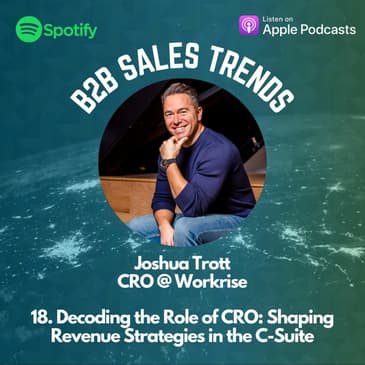
[00:00:00] To be the B sales trends, the podcast dedicated to sales leaders in the B2B space, where we share conversations about innovative and successful sales transformations to keep you up-to-date on the latest trends. This podcast is brought to you by Global Performance Group.
[00:00:22] Welcome to you another fabulous episode of the B2B sales trends podcast. The podcast that brings you hacks, tips, thought leadership for sales marketing and customers' access.
[00:00:36] It's brought to you my Global Performance Group a revenue improvement would take that implements behavior change for sales people to gain the competence of the skills. The confidence to execute these well and therefore encourage to engage more effectively with their clients and prospects.
[00:00:56] My name is Harry Kenlubacher, and I'm pleased to have today with me George Dwart from the product. Excuse me, I'll have a look at your name on George Dwart from WorkRides. Welcome to the podcast Josh. Thank you so much for having me excited to be here.
[00:01:14] I'm starting to be into your Josh. Tell us a little bit about yourself, how you path led to becoming the CEO of WorkRides.
[00:01:23] Yeah, happy to chat through it. I'll be very honest up front. It's a bit of a winding road, probably not the traditional path from a sales perspective that might be expected to discuss on your podcast, but my background is actually far more rooted in strategy and operations than it ever was in sales.
[00:01:41] Really, it started doing cancer research. So really far left field. There was something about the scientific method and really working with a hypothesis driven approach that just resonated with me very early on in my career.
[00:01:54] And quite frankly, is that got more ingrained and how I worked. I just saw the whole world through that lens. And so ultimately things just started to become an experiment. Things that you could like test, you could get data and ultimately use data to make really informed decisions.
[00:02:08] And so I found that this early stage of my career transit very well to both like the energy natural resources arena as well as consulting. And actually kind of pivoted and spent the next days in my career in the consulting landscape.
[00:02:22] This was where I actually got my first kind of exposure to the impact of being able to influence senior stakeholders in like that the power of being able to tell a story. And like every day when you're consultant, you're pitching your ideas.
[00:02:35] You're navigating really complex stakeholder groups and ultimately like you have to deliver a compelling story that showcases your deliverables right and generate and demonstrate the value that you're creating. So it really was sales without it being quote unquote sales.
[00:02:49] And it was really at this stage that I think as many consultants go through you want to actually realize some of the value of the work that you were doing instead of kind of like handing off deliverables.
[00:02:58] And so I looked for a way to kind of pivot into into a world in which I could spend my time doing the things that I started to realize that really enjoyed about the consulting world, which was one being a storyteller.
[00:03:08] Two, I love being customer facing and being in front of these customers. And then three being on the figure out how I could translate strategy into execution into like real tangible value for the clients that that we were serving.
[00:03:20] And so because of this like general manager, GM type roles really started like naturally makes sense is like a next step.
[00:03:26] And so I spent the next days in my career chasing jobs that enabled me to to play that role, which was really kind of like owning both the sales and like the customer facing relationship but also being able to translate that into the execution.
[00:03:39] And I found that combination of things to be just an incredibly powerful concept because like if you're getting feedback directly from clients every single day.
[00:03:47] You're responsible for generating the growth for your company, but you can also control the value and the quality of what you're then delivering your ability to stand behind that value proposition and to be able to articulate that clearly and to be able to make sure that your teams can articulate that it just felt like such a natural and powerful combination that made me I think effective more effective on both sides of the coin.
[00:04:09] And so around June of 2021, I actually joined the work rise versus the vice president of sales, where I was overseeing solar and industrial defense and oil and gas and I can get into kind of what work rise does.
[00:04:22] And then my role just quickly evolved from there so we restructured into business units, I became a head of oil and gas. So then I was owning the full PNL.
[00:04:31] An oil and gas for those in our know where is that our largest business unit by a large margin at the company and then as time progressed we actually went to consolidate all of the revenue functions across the whole company under me.
[00:04:44] As a serial, I manage sales, operations revenue operations marketing and customer success with the company as we kind of start our next space. So it's been quite a path but an exciting one nonetheless.
[00:04:56] Fabulous, thank you for the introduction. Share a little bit more work rise does if you could fall listeners.
[00:05:03] Of course, so at the end of the day we are a marketplace and network that enables our clients in the energy space to get access to the critical vendors and services that they require to execute energy projects on a daily basis.
[00:05:19] So it's a very powerful, powerful platform and ultimately without getting into too much detail the industry is very complicated and a lot of like how you actually access these vendors is quite data.
[00:05:33] And so a lot of paper, a lot of like old relationships and so what we're trying to do is really bring data and put that data in the power and the hand of our clients to be able to make better decisions on how they leverage their vendors.
[00:05:44] And what are the sort of the trends, the latest trends in the energy industry at that stage and how does work rise you know is leveraging these trends to accelerate growth and innovation in your sector.
[00:06:03] Yes, so there's I could spend an entire podcast a very long period of time talking about this and we won't and we won't do that.
[00:06:10] But I think two critical buckets one which probably won't be a surprise if you read the newspapers every single day the energy transition is this massive thematic pressure and opportunity that is really impacting every aspect of the energy landscape everything from a new old story on gas and everything in between.
[00:06:31] And really when you think about the energy transition it really is thinking about like how we reduce right ever alliance on fossil fuels and start to figure out how we enable a more sustainable long term energy future.
[00:06:43] There's our belief that mainly the traditional oil and gas and like large energy companies and players will be the ones who actually are best position to enable that transition.
[00:06:53] And we because they're critical capabilities are my very much a lot to what is required to build all of these large infrastructure projects and manage the capital deployment to go to do so.
[00:07:03] The key is that they're going to continue to require new innovative vendors and solution providers that they have not historically worked with.
[00:07:11] To be able to go in and execute against that and so this is where being able to create a marketplace and having a platform where they can easily like identify engage and transact with those types of providers.
[00:07:23] Is going to massively accelerate the pace and the speed in which they can go to market to be able to deliver that and so. That is not going away the energy transition is like here to stay the critical thing I think our clients deeply care about that.
[00:07:35] And we believe that we're uniquely positioned to be able to help grease the wheels and like speeding up they believe in a defined and deployed these like innovative vendors were able to forefront of all of this new technology.
[00:07:46] Technological advancement that we're seeing on a daily basis and then so that's one supply chain is the other big one and this is not specific to the oil and gas or energy industry at the green sea Madagross and any sectors.
[00:07:58] But there continues to be massive supply chain challenges re weren't making the world supply chain and like the patterns in which we've kind of built the entire industry and ecosystem around.
[00:08:08] And so we want to figure out and continue to help to evolve this supply chain as the world of all and I think again with our platform that is something we directly address and so.
[00:08:19] By being able to ease the burden of like rising supply chain complexity you're seeing pricing creases because of lack of pricing transparent transparency, a last lack of visibility inequality and we can help.
[00:08:32] I think alleviate a lot of the burden there which by default will help I think accelerate that energy transition again so I think those are the two really big themes that you see playing across the energy landscape today. Right.
[00:08:44] I've been on the receiving end of this last year I've put on my roof all the panels to produce electricity and here and all that it's actually a lot of it is subsidized by the governments, which is of course.
[00:08:58] Great for the end for the consumer but the supply chain was a real issue of all of it I think in May and they're only going to live it in December and the storage is still on here and so.
[00:09:09] So the the sector really has some challenges you know you and is constantly moving right it's constantly changing in a lot of different aspects now let's bring it back a little bit to the theme of support cast which is.
[00:09:25] B2B sales trends now share with me a little bit on on some of the points that you have discussed the wonder if we can elaborate a little bit of that you mentioned here some pricing creases you mentioned that.
[00:09:42] You'll people need to engage with senior stakeholders they navigate around stakeholders they have to focus on how to execute at the point of cast the main to face and so forth share with me your thoughts a little bit on. How you people need to tackle these challenges.
[00:10:07] I think really at the end of the day this is where we were kind of chatting before this idea of like the the consultative mind sales mindset and the role of like the sales person I believe is evolving greatly.
[00:10:22] And I think this the prerequisite skill sets and I think are increasing to and the demands and the job are increasing as as the complexity of these conversations continue to to increase and so.
[00:10:34] I think where we see a lot of like opportunity is to make sure that like ourselves folks are like very closely aligned to those those clients and customers because we see their needs evolving and there's many right and so.
[00:10:46] It's not enough to just be on chart ticked like well these are all like the pain points that like our customer space.
[00:10:51] If our sales folks are unable to actually articulate like the prioritization of those pain points to be able to understand really like what is like the willingness to pay or like what is that the size of the pain of those pain points and then direct conversations accordingly.
[00:11:06] I think one like what you end up with is like this list that is just far too broad to be able to like solve right and so like if you're going to try to be everything to everyone.
[00:11:14] I think you end up not delivering really any depth of value and and that's where I think we see.
[00:11:19] Where we win is what we understand deeply where like most critical pain points are and then I think the other piece of it is like as you look internally is the role of the the customer and the voice of the customer and how it helps to shape.
[00:11:34] That internal team strategy right and and the idea that like our product where product like company how that product is able to keep pace with that change.
[00:11:43] It's it's got to be driven through like the client requirements and more importantly, where like the features and like the values that are really driving that that that that willingness to pay in a stickiness.
[00:11:54] And so that's asking a lot on like on these sales people it's like you need to be able to have that complicated conversation you have to be able to prioritize and structure.
[00:12:01] Then information and then you need to be able to translate it back to it to the company so that we can continue to see our strategy of all we're making.
[00:12:09] Our decisions and adding the most value that we can and so I think it's what we've seen as it's much less now about just take your targets and you're doing a good job the expectation is far.
[00:12:19] For broader and I think far larger and I think that makes the job more interesting, but it also makes it more challenging. Right.
[00:12:26] And the complexity that multiple stakeholders involved in the whole thing right and then that's your tendency that sales people have to sort of gravitate to the conversation that that comes to go with.
[00:12:38] They usually shy away if I may say that for like people rose such as yourself right because that's the cease weed that is difficult you know.
[00:12:47] And let's just have a conversation with the technical people with the product people that's where I'm coming to work but in our experience they really have to broaden that that horizon and said no, you know.
[00:12:59] I have multiple stakeholders in my my sales process and I need to engage with every single one of them and maybe comfortable not it's still in necessity to do that. Is that is that something that you see to.
[00:13:14] No, I think that's absolutely right, especially like in the and the B to be landscape right it's these are complex sales you don't you can't just win with one person it's going to be different departments different senior leaders all with varying.
[00:13:28] And I think that we need to get to the point where we can. So, I think that is the way that we can be degrees of desires of what they want to see and where they think the value is.
[00:13:35] And I think that our best sales people with the people that we see do this I think the most effectively. Understand how they are able to shape the message in such a way that it resonates right and I think that again it goes back to.
[00:13:47] And then you're training people to like how do you recognize like the thematic common ground right like where where there where their places where everyone seems to be gravitating towards and then how do we make sure that.
[00:14:00] The sales motions the demo are able to actually reinforce reinforced that information and and demonstrate that value I think that makes that makes the job easier and if you can if you can do that well, but I also would argue it's probably one of the most complex aspects of it as you articulated.
[00:14:14] So it's good to I think it I think again that why you do this job right that's the fun part is trying to engage with people and understand what what makes them tick.
[00:14:24] Right, and one of the things this we see a lot is also you know obviously you're hitting all the right points right you get a shape the message it's better linking to the needs of the customer or the prospect.
[00:14:36] You got a demonstration value throughout your conversation cycle all these wonderful things. How do you in your organization ensure consistency within your sales force to execute to that but if I may say that for like if I level that you have.
[00:14:51] All that you people to do how do you ensure consistency that is actually executed. Yeah, I think this is where strengthen leadership. Become so critical and I'm not actually talking about myself we're and I'm very lucky. Oh you are.
[00:15:10] Yeah, we're very lucky and then we have very strong go to market leaders in my organization and so the process in which we identify identify those folks put them in the right positions.
[00:15:27] I think that just as it acts as like an amplification right and so if you have the right standard setters at the top they're able to. To I've the right culture drive the right awareness and expectations on performance they reinforce consistent messaging.
[00:15:42] I mean, it's kind of like it's the easy answer but like when you have great leaders it just it's contagious and like you you see the right behaviors reinforced in a daily basis.
[00:15:52] I think that's that's one to I think it's about like having the right incentives in place and making sure that like you're very thoughtful about like how.
[00:16:00] Incentives and your incentive structure drives behavior and so we try to find the right balance between like short term incentives especially on like the sales front.
[00:16:09] Well, also making sure people have a view on the long game and it's not about just like getting people to sign up but it's like they're signing up for the right reasons you don't want to see.
[00:16:18] I'm sure being like through the route frightened so I think there's again there's a there's an incentive aspect of that there's also cultural ethos is like we want to be long term strategic partners.
[00:16:28] And then that can be a tricky balance I think that again goes back to like the approach to hiring what type of profiles type of people.
[00:16:35] You're going after right and like we we've tried to strike a balance of like you want that aggression where people are like very target hungry and hyper focused on like delivering.
[00:16:43] But can see like the long game and like how we think about like the incentives to enable that behavior is it's important. So what I heard you saying for our listeners right in order to get consistency in sales execution. I noticed down point one.
[00:17:00] A contagious leadership point to incentive structures that drive behaviors and you didn't say that but a soup that from what you say and the right hiring and onboarding. That's right. Yes, yes. Right. Yeah. Very cool.
[00:17:17] What I what I have in called out I think is the the training and enablement aspect which I think is obviously that's that I would argue is just table sticks right you need to be making sure that.
[00:17:26] Like that's all reinforcing but ultimately I think it's the how you set the tone from the top.
[00:17:31] How you then re like reward those behaviors and then making sure that we're putting people in that line to that culture and are going to buy into that ethos and I think collectively that gives you high performing teams.
[00:17:48] Very interesting now we chat a little bit about that before before I get to my closing question here.
[00:17:55] How is AI going to influence all of this there's so much discussion going on about AI is going to replace humans and it's going to take so many jobs away and it's going to do this if that the reality is nobody really knows but.
[00:18:11] You know what what is your take I mean you just described a lot of. Human behaviors that are necessary to execute all these things that you mentioned how is AI going to change that other next five years or is it not. Was it. How do you open it?
[00:18:28] It's a great question highly speculative answer but I do. Right.
[00:18:32] I think ultimately AI offers like I think a huge opportunity in that it'll enable real it I think it'll enable like the best sales people to do more of what they love and I think if you are not a strong sales person.
[00:18:45] I think that will just like anything else like it will set sets out low performers I think if you rely on like road paths so you you're strategy like a repetitive and predictable process and playbook.
[00:18:58] That's something that AI will do better than you I think ultimately there is a human element especially in B to B sales. That is very hard to display with technology because at the end of the day we're talking about very large complex transactions.
[00:19:14] There's an element of trust and an element of relationship that I think will still always be part of the equation and so while I think there's a path to maybe having less large sales organizations I think what you will have it's people that are very, very good at understanding how to like navigate those complex stakeholders.
[00:19:34] They'll leverage AI to get an edge on how they can do that more efficiently how they can do the research that they can understand the best path and be armed with the best data. That idea of being a compelling storyteller building relationships.
[00:19:48] Enabling trust and knowing that like I'm the person on the other side of this deal and that's like I'm here for you and like we're here as partners in the long term I think it's very, very difficult to display.
[00:19:59] And I think as people think about like what should I be focused on by moving forward it's continuing to build those very human skills because I think that is ultimate where I see I've experienced success and where I think my best sales folks and like go to market people have successes like they're very capable relationship builders who then leverage other tools to just give themselves an exponential edge.
[00:20:22] And I think that really is the future and probably no different from a lot of other roles but in sales specifically so much of a team and so much of a relationship based in the database. And that's going to be very hard to display some chat TV.
[00:20:35] I completely agree what a lot of people sort of pick you know when they predict what's going to happen in sales and with AI and so forth.
[00:20:46] I guess we also need to look at how is buying going to change how is the other side going to change how is AI going to use my camera just local.
[00:20:56] How is the the buying side going to changes result of that because the sales site really has to then also go into similar direction. It's going to be a very interesting.
[00:21:11] I think the thing that is where I will see this above quickly I would imagine is if you're trying to if you're trying to blow smoke or you're and you don't really know your stuff you will get found out very quickly because they can sit there on a call and ask a prompt and know that like you're talking nonsense.
[00:21:33] And so that's what I say like it will I think it will assess out people that have gotten by by leaning on kind of like lower skill tactics and over promising under delivering and it will require sales people to just be like on their game.
[00:21:47] No, they're competitive set no really understand what their value proposition is understand like who their client is because like information all types of information will just be so readily available that that will make conversations more difficult like you will have to be more compelling.
[00:22:02] I think I'm going to teach you. I loved that phone I haven't thought about that yet but I completely agree with you they really have to raise their game if they want to survive in quotes.
[00:22:14] Yeah, technology is going to hit us and that's good for our business because then they have to upskill them so that's great. There you go. Thanks for the kindness. You're a grown plan now you're good to go. Right right. Last question for you.
[00:22:33] What if you could give three tips are three things that have to have a long explanation but three points that you would recommend to any salesperson.
[00:22:45] To do and to execute to be able to get to that elite level that we have just discussed what would those top three things will be in order number one most important two and three top three things that people need to do to be excellent sales.
[00:23:03] I think more and more the first thing is going to be this this idea of being able to communicate in like linked together like strategy with execution.
[00:23:12] Why I say that is that I think again more and more sales is becoming a conduit between like client and the incredibly fast rate of change which we see client needs evolving. Where it's like your product might add value today and all the seven tomorrow that does not.
[00:23:28] And like your ability to be able to digest that information ask the right questions and then be able to relay that internally and understand that like you actually serve a critical role internally to your teams to be able to like bring that.
[00:23:41] To the to the teams to make sure that your product is keeping pace with that I think that's like emergent and and I think that is new I think it is not just about like I hit my quotas anymore because what you sold today.
[00:23:52] Might not have it might be obsolete very quickly because of how like the world is just changing in a different rate and so.
[00:23:59] That ability to like codify that information can be able to articulate it internally not just externally like being the voice the keeper of the the the the customer voice.
[00:24:10] I think has never been more critical and that like relationship in the asing with like product and engineering and the rest of the good market functions.
[00:24:17] It just I think has never been more important and I think people that do that well will succeed and we'll be able to like come out the other side.
[00:24:24] For off so I think that's definitely the top one that I can't like reinforce enough as I think beyond that. I think like the continuing up leveling in my skills around like the language of like what product and engineering speak continues to be important.
[00:24:40] Again, because of the requirements to translate like these needs and the technical requirements and being able to understand that like this it starts to blur the lines I think was like product management.
[00:24:51] And like that role I think starts to look a lot more ubiquitous because because because they're this inherently what you are selling.
[00:24:57] So I think like the upscaling around that language will will continue to be wildly critical and is something that our organization that we're kind of working on on a daily basis is how do we continue to improve and strengthen that bonds between those two organizations and making sure that we speak a common common language.
[00:25:14] So I think that would be number two and then on number three. I always recommend this but it's for me it's making sure you have a strong mentor. I know that might sound like a weird recommendation.
[00:25:27] But I think especially an external mentor that's not within your own organization of company. I think that challenges you to continue to think differently about like again that rate of change and like where does driving success elsewhere.
[00:25:41] I think it's kind of like maybe a get out of jail free time because I'm saying well the answer is to make sure you're getting the answer of what you need to be focused on.
[00:25:47] But like if I think about some of the most powerful things that I've done.
[00:25:51] It has been driven through like really strong mentor and mentee relationships and like how that's helped me if they focused on like this is something I really need to actually invest in or is like oh this is a.
[00:26:00] This is a fat that's not going to make a long term difference and so taking the time to like use your networking skills and that that make you good at sales and use that for your own personal gain.
[00:26:09] I think it can be highly valuable and it's something I actually don't see people do nearly enough and they don't invest in it early enough in their career and I think that sets you behind because I think it can be a force multiplier being successful in the role.
[00:26:22] Absolutely couldn't agree more with you with all of those three points. Thank you so much Josh for your fabulous insights. I know all listeners really appreciate your input and your expertise. So thank you for your time. Thanks for everybody for tuning in again until next episode.
[00:26:43] Happy selling. Look after yourself and bye bye.