[00:00:00] My lovely people, most companies think culture is a very soft topic. Sometimes you talk about that topic at offsides or at kickoffs. Not something that really drives revenue. But here is the issue with that. If your sales team, your engineers or your partners underlined, you don't have a culture problem, you really have a performance problem.
[00:00:24] On the B2B Sales Trends podcast, we give you a sneak peek into the strategies of the world's best CROs and go-to-market leaders, the systems, the playbooks they're using, so you don't have to figure it out yourself. If you're interested in increasing win rates, reducing sales cycle and learning from the best in B2B selling, this podcast is for you.
[00:00:47] Today, we're talking about how culture actually drives performance and how to turn something a little bit abstract into a system you can execute and measure.
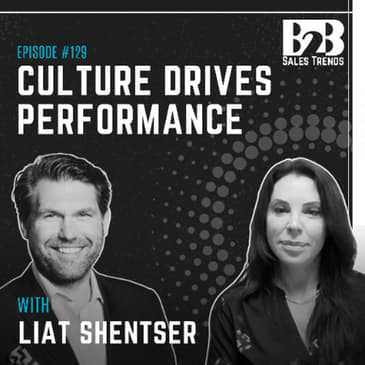
[00:01:00] I'm super, super pleased for my guest today. To join us is Liat Shentster. She is the VP of Solution Engineering at SentinelOne with over 20 years of experience across cybersecurity, cloud and enterprise technologies, leading high performance teams across sales and engineering. Liat, welcome to the B2B Sales Trends podcast. Thank you. Glad to be here.
[00:01:29] Let's start with the reality most organizations face. You got sales, you got solution engineers and partners all interacting with the same customer, but often pulling in a slightly different direction. What breaks down when that alignment isn't there anymore? And what does it actually cost the business?
[00:01:54] Absolutely. So, it's not unique to one company. It happens a lot because you have different sets of KPIs and different strategy to drive different levers. But what you really see at the end of the day, net-net, is the customer confidence, customer trust. And as a result, your POs, your bookings, sales cycles become longer all of a sudden because you lose the basic trust that you have between a company and a vendor and a customer, right?
[00:02:18] So, this is the first thing that we see and we see it with the numbers from a company standpoint. You mentioned customer trust here a couple of times in your first response. I'm curious about that. Can you put some context and some more meat on this, please? That would be great. I know we are in the world of AI and agentic AI, but we're not quite there yet. We're still people selling to people.
[00:02:43] And in my world, we're not really selling shoes, but we're not selling technology. We're selling business outcomes. So, the trust that you get from the customer is with the human and humility relationship that you have with the customer. And when the customer experience multiple touches from different points in the organization, but doesn't feel heard and doesn't have one point of contact, it breaks the trust.
[00:03:12] It happens outside of the professional workplace. It happens in real life. And that's the first thing that we need to look at when we have multiple organizations. The reality is that organizations have multiple organizations to drive a laser sharp approach in what we need to achieve for the customer.
[00:03:30] But we need to be really aware and have one front to the customer and not to show and expose the entire background operation or backside operation to the customer. So, it's something that is on my mind all the time because it's the basic vehicle of communication and interaction between us and the customer. And it's, it's, I agree with you.
[00:03:56] It's more important than ever to get that piece right, that communication element of things. Before we get into solutions, give us a bit of a sense of the environment you operate in. You know, what role do solution engineers play today in complex enterprise sales and why they have become so critical these days? Yeah, yeah.
[00:04:22] I mentioned that we, in the IT world, we don't sell shoes. It's a pretty much a technical sales-led engagement. And so, the solution engineers or sales engineers are really, really important to convey the commercial application of the technology, right? We, the crucial part of the role of the SC in my environment is, you know, they're trilinguals.
[00:04:48] They speak technical from the BU, from the product environment to the customer, translating it to business and customer language, and then take the customer needs and wants and translating it back to features and functions to enhance and continue to grow the offering to be more relevant to the customer at the end of the day. Also, in cyber, it's not really a choice. In the digital world, you need to have the cyber.
[00:05:18] So, to ensure that we are out there and explaining to the customers what is it that they get from us, the sales engineer has a crucial role in this environment. The role of the sales engineer, you can hear that there is a sales there as well. It's not just a techie behind the scene. This role requires a high amount, fairly high amount of emotional intelligence as well because sell is trust.
[00:05:43] And becoming a trusted advisor is something that has nothing to do with the technology, though our technology and our knowledge from a technical perspective is our currency. So, you see that you have sales, you have channel, you have legal, you have everything else. But in a technical world, the sales engineer really drives the chart here. Right, right.
[00:06:04] It's interesting when we had our pre-call a few days ago to this, you mentioned you were really strong on the culture element of things. And when you think about sort of building a high-performing organization, you mentioned that you don't start with the tools or the structure. You start with the culture, which I thought was a really interesting take.
[00:06:30] Share with the audience, where do you begin with this? What are sort of the first few principles you anchor on when shaping that culture? I want to start with kind of my three first principles, but I'll take it a step back because it's really important. I start by hiring nice people. I can teach the business. I can teach the technology. I can communicate and over-commute the strategy. But I cannot make you nice if you're not a nice person.
[00:07:00] And people like to be in the environment of nice people because, again, people sell to people. But I'm really a firm believer of intent, clarity, and purpose with everything that I do, driving outcomes and results. So if everything that I do is not intentional, it's not clear, and there is no purpose, I wonder and I ask if I should do it in the first place. So these are the principles that I start with.
[00:07:27] And when you take it to the culture side, it's really to create a vulnerability-based trust. I started now in SentinelOne, and I'm dying to, you know, we're three weeks to finishing the quarter, and I'm dying to look at the pipeline and closing everything. But I really hold myself back to get to know my people. And my people, not only the people reporting to me, people, customers, partners, people reporting to me, people in other organizations,
[00:07:54] to get to know the people, to understand the dynamics and what makes them tick. Once I understand that and understand how I work, we establish common grounds. Then you can start threading in the strategy and the pipeline and close rate, etc. But to get to know each other, I think you need to, the culture starts where you take and extract yourself outside of the work environment. Because this is what we do at home. This is what we do when we go and meet with friends.
[00:08:21] Take it back to work because that's the essence of humanity. I love that. And the intent, clarity, and purpose element, I think, is simple. But it's really what it takes. I really like that. That's a great, great point. Do you have an example that you can share with the audience how or where you have applied that intent, clarity, and purpose? Absolutely.
[00:08:50] In everything we do. So when you look at the vision, okay? So I like to look at it and I explain always when I talk about strategy, vision, mission. These are terms that, you know, maybe they're military terms. Maybe they're professional terms. I like to make it really, really clear and talk to the heart and mind of people. So for me, it's really you have a vehicle, you have a car. Where do you go? You need to have a destination, right? Right.
[00:09:17] So to me, it's always making very clear where the destination is and making really the journey very purposeful. So where are we going? Are we charging the car or putting petrol in the car? It needs to be really meaningful. And it needs to be intentional. Do you really want to drive to Amsterdam or do you want to drive to another city? So you really start by clarifying the entire thing. Don't assume people know where you go.
[00:09:47] Don't think that because people in the organization for many years or they're just newbies, that they don't know that we should all be on the same page. And it's so easy because we share common language. We're all humans. We can talk. So I really take the clarity, intent and purpose, starting with communicating and not assuming, asking and seeking to understand. I love it. Share with us the framework that you shared with me before.
[00:10:16] I think that's really interesting and highlights a clear structure around that. It's something that I developed in many companies ago and tuned it and refined it as the technology changed. As you see, as you saw, I noticed that engineers cannot just be in the background doing technical stuff. They need to actually speak and sell.
[00:10:42] And as we also realize that there's the pace of cyber is so fast. So, for example, when you talk about a concept like zero trust or you talk about a concept of AI sim, it's really important to not assume that customers and people understand what we mean by that. So the communication is really important. And I realize also that as you want to stay close to the customer, you need to gain the customer trust.
[00:11:11] But also, as an SE, sales engineers, you need to sell. So the value creation. So I developed a model which is called the three pillar approach, SE makers. SEs like to make things. And it starts with technology evangelist, trusted advisor and value creator. And under each, you have a set of capabilities and skills that are required to get into this level.
[00:11:35] And I call this whole thing the unicorn because if you have an SE that displays these three pillars, they can sell, they can code, they can bring the PO in, they can reduce the sell cycles, they can increase the win rates, they can increase the profitability in the company. And it's a fun environment to work with. So I hired against that. I develop against that.
[00:12:01] And I try to make sure that in the organization, we have these skill sets in a way that we represent the organization. And most importantly, our customer base. What was the third one? I got technology value creation. We have the technology evangelist. Yes. We have the trusted advisor and the value creator. And I'm happy to give you one liner on each of them because it's very important. I think that will be very valuable for our listeners.
[00:12:31] Amazing. Amazing. So look, usually SEs, they can have a really good presentation one-on-one or one to seven people at a customer and make a point of something. I think the additional skill set that I'm looking for and I'm developing right now is to capture and masmerize a big audience.
[00:12:52] Because if you look at your pipeline and you think that it's made up of customers, but not prospects and partners and ecosystem and the entire community, we are wrong, right? Because the pool there is a lot wider if you see that like that. And so to be able to stand on a stage and masmerize a big audience and introduce a concept, not only bring you customers, returning customers prospects,
[00:13:20] but also create a brand awareness from a marketing perspective to the company. And I don't think that we should sell. We should be advisors. Hence the trusted advisor. And here, it's on a total different level. It's again, emotional intelligence here. It's I get close to the customer not to sell, to develop relationships which are beyond the platform of SentinelOne, beyond that. And then it's intent, clarity and purpose in the relationship and what I'm trying to drive.
[00:13:49] And last but not least, the value creator. I do not want to drop the mic when we have a technical win because we had a really successful POV, proof of value. I want to make sure that the customer understands all the way to procurement, the value that they get from the technology and the repeating value that they get from the technology. Otherwise, there is no renewal. So the SE plays a key role there as well.
[00:14:13] So you see, we're touching the entire infinite sales stages and sales structure. It's interesting. The SE role has been sort of not always in the limelight of things in the past few years. And they've become super, super, super important. I think it comes from the nature of the SE, right? The SEs are more the majority.
[00:14:43] I don't want to generalize, but the majority introvert, maybe neurodiversity there. And the account manager, the flamboyant account manager, the flamboyant sales leader, they will be in the front. That's their job. They are the positive, the energetic. They see the opportunity even when there is no opportunity. So I think perhaps that's why the techies are a little bit in the background.
[00:15:08] But I don't know an account manager or account executive who will say, I'm going to sell without my SE. It does not exist, right? But as we go through the changes and the emotional intelligence that we are supplying the SE community with, you will see them more and more out there. Again, I don't want them to be flamboyant. I don't want them to be the salesperson. I want them to be the currency, the technology, knowledge, the trust.
[00:15:36] And I want them to connect the technology to business outcomes. That's super important. And that's really the key. How do the SEs shift from just being technical experts to having a conversation on business outcomes? And that's a challenging shift for them. But, you know, I agree with you.
[00:16:04] It doesn't have to be the flamboyant salesperson. You need to facilitate a very good, thought-provoking, outcome-driven conversation. And with a little bit of upskill and capability transformation, that's possible. That's possible. And then combine it with your wonderful knowledge of all the technical aspects that you know. Fantastic. That's a great combination.
[00:16:33] Absolutely. Right. I think part of the enablement on top of the technical enablement is storytelling and a lot of analogies. And the analogies are really, really good because customers really relate to that. Yeah. You know, especially in a competitive world where you have a car that drives from point A to point B.
[00:16:54] But the topology and the architecture with an electric car is very different for kind of the normal traditional engine car, right? So understanding what's under the hood is really important and simulating the environment into kind of world real situations.
[00:17:14] Because most CIOs, some of them are very technical, but they really want to take costs out to enable innovation and productivity and not to be breached, right? Right. So how do you tell them the story? And that level, that C-level, what are they buying? They're not buying tech. They're buying outcomes. They're buying two things. One of two, in my opinion. I'd be curious to hear yours.
[00:17:41] They either buy the outcomes of what you can help me provide, right? Or they buy the fact that you can help me avoid a risk. Absolutely. Or both. And one of the two, then I'm ready to go on as a C-suite leader. Anything else? Any tech-related stuff? Yeah. I'm making the decision based on the outcomes that you can help me provide or the risk you can help me to avoid, right? I would say both. Yeah. Yeah.
[00:18:11] Avoiding the risk. And, you know, in cybersecurity terms, it's understanding your posture to understand your risk. Yeah. And it's the ability to detect the risk and the response and mitigate and mediate. This is really important as fast as possible. So that's kind of number one. That's a necessity. But you must enable organizations versus blocking organizations because cyber could be really simple. You just block the connection, right? But that's not what we do.
[00:18:41] You want to enable it in a way that makes sense for the organization to continue to grow, innovate, and be productive and make money because we're not an NGO. Right. Exactly. Let's talk a little bit about the collaboration aspect of things. Because as you've alluded to, it's a team effort. You know, selling is a team sport these days. You're bringing together very different profiles.
[00:19:10] The flamboyant salesperson, as you have mentioned, the highly technical engineer and, you know, different partners throughout it. How do you get them aligned around one way of working instead of operating in silos? Absolutely. I try to remove friction and chatter by always starting from the customer and working backwards.
[00:19:35] Because then it doesn't matter your character, your opinions, your experience. We look at the customer as the focal point of everything that we do, our go-to-market, our processes, our procedures, our financing. Everything starts and ends with the customer. But in a clear way, purposeful and meaningful way.
[00:19:57] You know, if you're there just to sell for the quarter, customers understand that you need to really genuinely be a people's person to have a meaningful relationship with a customer. You can sell, you can advise, you can listen. But it starts with the relationship that you develop with the customer, a meaningful relationship. And again, I think it's also, I come back to the communication.
[00:20:22] It's really important that we put on the table and we're very transparent and very clear on we have the ADHD salesperson and we have the neurodiverse or on the spectrum, the introvert SC. That's okay. And then the channel to help us. So you kind of work with the middleman as well, because this is the fastest way route to market. It's we have to have a really, I call it the, it's not a monogamist marriage, right?
[00:20:50] It's the other way around because you kind of have, you have three people in a marriage and very committed for the customer. Right. I like your take on that. You have to start with the customer because a lot of the times these different roles, they just have their own agendas. They're measured, you know, differently. They have their own compensation. And, and obviously everybody's behavior drives towards those elements, right?
[00:21:17] But when you start with the customer in the middle office, in the center of everything, those and how we all need to be affecting and creating outcomes, impact and value for those customers. You know, that's when you get alignment, right? Absolutely. Absolutely. And take it to the next level, our community. When you look at cyber, you look at the physical world and you look at the digital world.
[00:21:44] And most of us communicate and live digitally much more average on, you know, in any given day. So I think that the concept of cyber, especially with agentic AI, are really important to speak regardless of selling or not, because it's the giving back to communities as well. It's really important. Sentinel One is really strong, for example, on teaching children on cyber. And it's really important because that's your next generation.
[00:22:12] We're not selling anything, but it's the education and it's giving back to a society and environment that you're part of. Love it. Absolutely. That's great. Obviously, that great culture, those elements that create that culture that you have just shared with the audience has to, at some point, show up in performance, right? In the outcomes, in the sales results. As you said, you went on an NGO. Okay.
[00:22:41] How do you measure whether this is actually working or not? It's a very good question. I look at the numbers. I look at the ACV and the TCV. I look at the forecast versus plan. What's the gap there? I look at everything because if the number does not align and we're not unlocking the true potential that we have in the market and the market is red hot, then I know something is missing there. It's hardly a broken process or reporting structure.
[00:23:11] It's usually the culture, at least from my experience. And I've been around for 20 plus odd years. Usually, it's the culture. So when I try to change something, I always measure it against the outcome of what I'm trying to achieve. I try to sell. So I look at my numbers from a sales perspective and everything that we talked about so far, sales cycles, POV duration. I look at my profitability. Do I sell discount or do I sell value?
[00:23:41] What do I do there? And I look at my customer retention and I look at the attrition of the team. It's really difficult when you have high attrition in the sales organization to keep continuity with customer relationships, right? So I'm looking at all these elements and I really work backwards from the customer. I have I'm a pretty data person. So I'm attached to Clary. I'm attached to Salesforce.
[00:24:05] I'm attached to different platforms that give me this mirror and this, I would say, very sober look at my organization. And I don't do things in vacuum because the sales engineer is no good without their husband or wife, the account manager, without the channel, without legal, without the right go to market process, without quoting. And I can go on and on and on.
[00:24:30] So you run culture is a responsibility of everyone in the organization, not the top leader, not the individual contributors. Everyone. I always say PG, customer success and culture is the responsibility of everyone in the organization. Love it.
[00:24:50] Now, it clearly creates performance and it's a performance driver that the culture element that you have described. What mindset shift has to happen now for leaders to stop treating culture as a, you know, sort of a soft, nice to have topic and really starting it as what you have described it as, as a performance driver?
[00:25:18] I ask them about their family because they cannot run the family, you know, and their friendships. I'm sure some can, but I am fortunate to have met people who, you know, are really intentional also in their personal life and they don't have split personality. So they bring the true self to work. But it really starts with what kind of a person you are.
[00:25:40] And I think that the education and enablement, because I, you know, you always have to debate, are you a born leader or you can make everyone a leader? I believe in education. You can teach people to be really effective leaders, but you need to teach and you need to continue and show the benefit of having diversity, diversity of thoughts. You know that there is a gender diversity, which is a vehicle in age and experience and everything that we have in terms of diversity.
[00:26:08] But you want to have the diversity of thoughts and you want to represent your customer base. It starts with culture. Love it. I'm going to ask you three quick questions under the term of our lightning audit here. What is one thing that a leader should start doing if he or she wants to implement that culture you were talking about? What's the one thing they should start doing?
[00:26:36] Listen and put themselves out there to create the vulnerability based trust leading by example. So you can lean on people as well. That's OK to ask for help. That's OK to say that I block my calendar to have training and it's not a technical training because I care about my health. That's absolutely OK. Leaders should lead by example. And everyone, even aspiring leader, should think I want to be the change I want to see in my environment.
[00:27:05] So it starts with listen, assume positive intent, give the benefit of the doubt, vulnerability based trust led by the leader. And what's one thing they should stop doing? Think that culture is a soft thing. It's a powerful element of every human interaction. It's not something that the HR is telling me to do that. So I need to do that. This is your key to success.
[00:27:34] Yeah, it really is. It really is. The last question on every podcast that we ask is what, in your opinion, are the top three skills or traits that define truly elite performers? In the SE world or in the sales world, in your opinion, what are the top three skills or behaviors that top elite sellers or SEs need to possess these days?
[00:28:03] Iron willpower. OK, that's number one. Focus. Human. Love it. Can you put a little bit more context on that for me? Iron willpower, focus and human. Say a couple of sentences on this before we close. You can. I interviewed and interacted with top notch smart people, but they don't have the discipline and they don't have the passion and the willingness.
[00:28:33] So they're smart. They're super capable, but you get nothing out of it. Right. So this willpower, iron willpower and determination for me, it's really this is what sets you out of everyone else. In my opinion, the rest I can teach. And how about the focus? The focus. The focus. The focus. We have a focus issue. We talked about strategy. We talked about culture.
[00:29:02] You know, it's so easy to let your calendar take over the strategy. But do you work with intent, clarity and purpose? Right. Then you decide. So you need to focus. You need to understand every day. What do I want to achieve today? And go get it. Of course, you will have distractions and you will have the things that your manager asks you to do. But what are you trying to achieve? Does that serve your purpose? And if not, you deprioritize it. So stay focused. Absolutely.
[00:29:31] And how about the last one? Human. Human. It's interesting. One of my biggest customers in the Netherlands, it's a global company. 40% of their workforce are bots. Agentic AI agents. Right. What does culture mean for them? Right. And how do they work in this construct? So human is to make sure that you understand your people around you.
[00:30:01] And again, people could be agents if they're a really good replica of the human intelligence and emotional intelligence. But most importantly, really people. So it's your people, your customers, your partners. That's really important because if you understand them, you can relate to them. If you can relate to them, you can communicate. If you can communicate, you can relay a message and achieve something really big together. It's really tough to teach these things.
[00:30:30] Sometimes it requires for you to adopt it as a second nature. But it's absolutely what great, uber great leaders need in the world of AI where I don't know that AI will achieve this. I want to say yes. Especially the recent books that I'm reading. So it looks like it's going to be really interesting human versus machine, machine, human together. Right.
[00:30:54] But I think that this is really what sets people apart as really great leaders and leaders that leave legacy, not for them, for their people. Yeah. Liat, you've been an amazing, amazing guest. I know our audience will super appreciate your insights and your thought leadership on this very important topic. So thank you for taking the time. Thank you for paying into the collective pool of knowledge and wisdom of B2B selling here. Thank you.
[00:31:24] My absolute pleasure, Harry. Thank you so much. My lovely people, culture isn't soft. That's the main thing I'm taking from this. It shows up in how teams actually collaborate. It shows up in how customers experience you and your individuals on the team. And eventually it shows up in your revenue. If your teams aren't aligned, no tool, no process, no framework is going to fix that.
[00:31:50] The leader who will win are the ones who turn culture into something operational, something visible, something coachable, something measurable. That's the real difference. If you want to hear more of these conversations when you can learn the systems behind high-performing teams, subscribe to the podcast on YouTube or wherever you get your podcasts. Until the next time, my lovely people, take care of yourself, your loved ones, and, of course, your B2B customers. Bye-bye.