
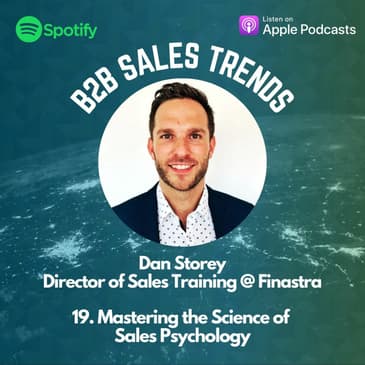
[00:00:00] To be the B sales trends, the podcast dedicated to sales leaders in the B2B space where we share conversations about innovative and successful sales transformations to keep you up-to-date on the latest trends. This podcast is brought to you by Global Performance Group.
[00:00:22] Welcome yet another fabulous episode of the B2B sales trends podcast. The podcast that brings you hacks to extorts leadership for sales, marketing, customer success and all other wonderful things. It's brought to you by us, Global Performance Group. A revenue improvement will
[00:00:41] take that implements behavior change to provide sales people the competence and the confidence and the courage to sell and negotiate based on customer outcomes. My name is Harry Kenderbach Today I have with me then, starring from Finaas Stutt at the director of sales training there,
[00:01:04] welcome to the B2B sales trends podcast. Thanks, Harry. Exciting to be here and look forward to this conversation. Absolutely. As a form of introduction then tell us a little bit about your background and expertise in psychology and we're going to talk a little bit about it.
[00:01:20] It gives a little bit of background and how it relates to the world of sales for our listeners. Perfect, yes. I started studying psychology almost by accident back, maybe I'm not going to say how many years ago but it's got a two in it I think.
[00:01:39] A friend of mine gave me a CD. This is a updating some things now. I said listen to this CD. I think it's going to be really interesting for you because at the time I was working with athletes,
[00:01:48] I was working with people who were looking to improve their fitness. He gave me this CD by mindset. He said look what have you applied this to our thesis? This is great. So, starts doing that and
[00:01:57] I wanted to study this thing and the CD he gave me was about neural and linguistic programming or an LP. And so I thought I'm going to dive into this and learn as much like possibly cancer started studying it.
[00:02:09] And the school I was studying with said hey you know what we're trying to teach this in business. Do you want to come on board and help us? I can start teaching this as a concept.
[00:02:19] Sounds great. What's the first job? The first job was going to teach these sales people and straight in to, you know what sales people are like, straight into teaching psychological concepts to hungry sales people who frankly didn't want to learn about psychological concepts.
[00:02:38] They wanted to learn how we're going to make money, how money to sell people stuff. And there was this dichotomy at the right of beginning of my career. I'm like,
[00:02:46] well, this is such a useful tool but you don't want to hear it in a way I'm going to try and deliver it. How do I bring the two together? And so I guess over the years that was what I tried to figure out.
[00:02:57] It's how do I apply the conception of neurodegroistic programming into language and snares that sales people understand? And I guess like I've been doing that for a few years now. And so there's these undercover techniques and models and frameworks. If you understand them and
[00:03:13] I have to apply them in a communication situation, an influence situation, I think you can make you pretty powerful. That's very cool. Tell us a little bit about your role of finastra as an intro.
[00:03:26] For Nastra, my job is to ensure that our sales team, we have a large sales team, 100s and 100s people globally are prepared and ready for their role. So whether that is our SDR organization
[00:03:38] who come on board maybe into their first ever sales role, giving them the tools to skills they need to be able to be effective and immediately on the phone all the way up to our strategic sales
[00:03:47] people who maybe need, you know, probably not the basics but really scenarios and how do we handle our toughest objections or how do we negotiate really powerfully? We're trying to cover the entire spectrum of training and also give them the tools and resources they need.
[00:04:03] That's like you have a lot on your plate to make sure that these sales people have what they need to do their job very nicely. Let's focus a little bit on this psychology and the NLP part that
[00:04:17] you have already nicely introduced. So if I'm a sales person, how can I leverage this that psychology and NLP to enhance my communication skills and to become in a way a more
[00:04:34] persuasive influencer? Let's do two. I'm going to give you two. The first one is awareness of self. This is probably the biggest one. Self people love to talk, we're tend to be pretty get at it,
[00:04:49] but we have tendencies, we have patterns in New England, we call them meta programs. The way our brain is wired leads to a particular way in different situations. There's lots of personality
[00:05:05] test site there that you maybe aware of things like disk, my brigs, insights, those kind of things. And it all based around this idea that although we say the same things what we hear and what
[00:05:17] we tuned in for is slightly different. So let's give you two examples and hopefully make sense. If I ask you how is your day? It's nice question, nice and easy. There's two ways of answering.
[00:05:31] You can give me a big picture answer or you can give me a small detail chunk answer. And some people say it's great, love and my day, really busy but I haven't fun. Like big picture.
[00:05:41] Yes that's a one person. The other person says, well you know what I work up at 828 this morning. It was late because my lamplock didn't go off. I'm pretty sure I set it up. This could just
[00:05:50] get to take them that long to explain their day, right? Some people we just have these tendencies. It's okay. There's nothing wrong with these tendencies but it's being aware of your preferences
[00:06:00] because if I'm talking to you, I really knew like big picture. But I go too much into the detail or I could see what was happening when I was going into something like in a sun on this is going to take
[00:06:10] is going on. It's just going to keep going on about it day. I need to go over and wipe it. And you'll bring those some rocks, right? You'll bring those some rocks. So imagine if you're the
[00:06:18] salesperson in your prospects that brings those some rocks. So the first one for salespeople is to think about what are my communication tendencies and my communicating in the same way that my prospect wants to hear. And our job of salespeople is to be almost like comedians, right?
[00:06:35] We need to have different ways of communicating. Now we work in banking, in software space, pretty technical and probably going to need to go into detail at times and if I'm a big picture
[00:06:48] person, which I am, I'll have a tendency to gloss over a lot of things which is going to frustrate the heck out of my detail people. So just being aware of that. When do I need to go into detail?
[00:06:58] When do I need to come up a little? So interesting question. So I was just reflecting why you were explaining this, how I typically use this. And I definitely don't use it in a way or state. But especially in our world nowadays, right? There's many, many virtual calls.
[00:07:19] I'm not the lead by that the way you communicate sort of sets an expectation and example to get the others to sort of follow you. So for example when there is this awkward
[00:07:31] silence at the beginning of the call and you want to break the ice a little bit. Instead of saying how are you? I usually start and say something around, well my day is going
[00:07:42] really well. The weather is fantastic here in Salzburg. It's about 30 degrees and I've had a number of good calls and how are you? So in a way that sets an example for them to respond in a similar way.
[00:07:56] Now does that fall into that any sort of category that you have just explained or not? I think so. I actually use that technique in challenging situations. Sometimes you ask a question and if we
[00:08:06] go back at all, my background is American football. If we look at my sporty background, played American football for a very long time, I was a quarterback which is the guy that's throwable. And at the beginning of the game, you've got nerves, right? You've got a tension.
[00:08:19] I don't want to do a good job. And so we wanted to create easy wins or CBs confidence builders. And this was one of those things. The first few plays would be ones that you could do
[00:08:29] English sleep, but get ice closed. And that's an example of that, right? So, Harry, if I ask you're a really tough question. Yeah, let's say, what are the biggest goals that you and
[00:08:41] your organization are working on? To answer that is really difficult. It's a difficult question to answer. If we ask that at the beginning of the conversation, it's going to be pretty tricky.
[00:08:51] So I can use something like that to give some examples and lead and kind of do that. So, what are you working on? What we're finding is companies in your sector are working on these
[00:09:01] three things. How closely does that relate? So you give them some kind of ballpark to work in with the answer. So it's an example of in an LP terms would be pacing and then leading, right? So you're
[00:09:14] leading a conversation by building that report early on. Loads of different techniques and Harry, I can see how you're using them already. So there's a, oh, but there's one thing,
[00:09:24] people are saying, are you doing an LP to me? That was one of the things. It's like, you know, you don't do this to people. It's just an awareness in the language that you can flex and turn on,
[00:09:33] but after what it just becomes a bit more second nature. It is interesting. I used that technique that you have described. And intent, you know, not being aware of what you've just described again by saying, you know, what, you know, typically what we hear, the biggest goals currently
[00:09:51] I in your industry, you know, XYZ. And then you set up an example and the conversation set up and they sort of lead that hotel you in a way, and this sounds horrible. But tell you in a way
[00:10:04] what you want to hear. You have to sort of hold their hand and lead them down the pathway you want to lead them. And that's sort of an initial set up for that. Very interesting. I just
[00:10:16] reflected a couple of things that I did myself. Thank you, you know, that was good. So fascinating. Are they sort of, you know, any other specific psychological techniques or an LP strategies that you would recommend now? We talked about a couple of things, but there's something that
[00:10:38] you recommend to be on strong or connections with potential clients or where do you see that also in this sales process, a lot of questions on on on on the topic. So let's let's talk about a model
[00:10:50] that I talk about quite a lot, which is the neurological levels model. Okay, and you can use this in many applications are talk about very briefly from a report perspective, but then we'll also talk
[00:11:00] about it from a questioning perspective. So me and my brother, right? Do you have siblings, you have brothers sisters? I see what you're doing. Yes, too. No brothers. Do you have your brothers? And of course, as kids you always get on smoothly, they're an ever-any argument
[00:11:17] so any fights or anything along those lines right? Right, exactly the same with my brother. So we'd have one of these very smooth days where nothing would happen and you're at your age of this next
[00:11:28] time, your age of those ropes. And the next day at breakfast, what happened? You probably just actually like nothing happened. We just like, not in carrying on right? That's that's report. That's the ability to kind of go through tension and come out the other side with a relationship.
[00:11:45] Can you imagine having a similar argument with a client or a prospect and just go waking up? If you wake up for breakfast with you, prospects anyway, there's something to be aware of there. But you know what I mean? Many times sales people are scared to do confrontation.
[00:12:01] They're scared to argue or disagree because of the all-know-the relationship is at risk. And the retombia because we're not a deep enough level of rapport. And rapport has layers, right? If you think about the most basic way that we teach rapport is matching and mirroring.
[00:12:15] If somebody crosses around to cross your arms and be user-world, you use a word of expression, nose, discretion, nose, and so it's just a bit weird. Right, mimicking. It works in very superficial situations, but the neurological level
[00:12:28] model says, let's go a little bit deeper. How can we look at rapport at deeper level? And so the model goes like this is environment or results behavior. So if we do behavior level movement type
[00:12:39] rapport, that's superficial. If you think about training as well behavior, the way we change behavior, we give people capabilities or skills, we give them the ability to do something different, hopefully they behave the changes. They change those things. Above that, imaginary relying is
[00:12:54] we're moving into psychology. And we have this idea of values and beliefs. Okay, and values and beliefs says, what is the motivation behind those behaviors? Why do people do the thing? So ask your question Harry. You kind of gave me an idea about the Iron Man last time.
[00:13:12] We spoke. Why do you do what was it that called you and compelled you to do Iron Man? What did you get out of those challenges? I got one thing out of it and as was a life lesson for me that
[00:13:26] there is no limit to anything. Why is that important to you? Because it's something I used to believe that there is a limit to people's what people do, especially myself. And through doing these extreme distances in triathlons when bike run,
[00:13:54] I started to believe that there is really no limit. It depends how you set up your mindset. In sports the other day, I heard a good analogy saying a good resource only has to jump us.
[00:14:10] Johnson's highest at has to. Now make sure you set the bar high enough so you jump higher. I think that's my main lesson and that was my main motivation for that. And the reality is
[00:14:24] anything is possible. Beautiful. Okay, so what we've gotten now is an understanding of your motivation. Your drive your challenges to remove that limitation of belief. To remove in yourself and others, that belief that we're inhibited. But actually if we go beyond, then we're capable of
[00:14:43] almost anything. Something along those lines. I do remember back in the day when you early sales career, you were told, find something you're having common with your prospect. Right. We're all taught that, find something and I, what did you do on a weekend? I played piano.
[00:14:58] Yeah, I grew a tree. I don't know. I need to make out all sorts of things. I still have a really big problem. I don't, yeah, I need to say, yeah, I play piano. It's no a different thing. So
[00:15:09] but if I ask you that question, I understand your motivation. I'm a, I've tried I'm and I'm not even going to try and kind of correlate with you on that. But I can connect with
[00:15:19] you on that, that mindset piece of removing limitation. And I can talk about the way I coach people or I can talk about my own personal journey in bodybuilding which I've started recently. Right?
[00:15:29] Because that for me is the same. I want to show that I'm capable of more on now if we have that conversation, that's going to jealous together in a way that, you know,
[00:15:40] I cross my arms and scratch my nose is never going to do that. So we can develop a relationship on that and that will actually keep us really tight. So what you find with families, there's another
[00:15:51] level above that is we call it identity. It's like, what is the shirt that you wear or how do you see yourself? What is the symbol that you're associated? And for family, it's back family. But if I
[00:16:03] ask you that question as well, when you're in that moment, when you're, when you're seeing yourself as an Iron Man, how would you describe that person as Harry? How would you describe that
[00:16:13] in a word or a phrase or a symbol? Well, in a less perfect. Right? And so also, by the way, for salespeople listening to this, watch Harry. Why is this a bit of video or the story of
[00:16:29] notice there's two things that happen. Number one is there's a break of eye contact and you look around because he's thinking, and there's silence. Okay. When you ask these questions, go to shut up for a minute because there's an important silence as you Harry are processing
[00:16:42] that and really accessing it. So the deep level questions like I said, neurological levels model were into that values and beliefs thing and the one above that is as I mentioned, identity. But if we can create rapport at values and values and beliefs, not easier than
[00:16:59] finding something specific in common or just doing matching a theory. What you've shared also with the motivations and so forth versus what you do versus the reasons why you're doing it, a lot of is it connected in, obviously, all the sales content, negotiation content, once versus
[00:17:18] needs, once is what you want to do. The need is the motivation is why you're doing it. And so selling to the need and having a conversation based on the motivations, based on the personal outcomes
[00:17:33] and so forth means critical and makes a huge change in the level of conversation you have. What I've just noticed when you have described things or the way I've reacted, your very observant. Now is that something that you recommend sales people to do and to what
[00:17:55] level and what tips could you give people on that topic? So I do love this topic. Do you watch things like, there's a great show, light to me. Tim Roth is about the human
[00:18:10] light attack to go or these are my improvements. People used to say, I'm for it, if you're only listening across my arms, what does that mean? What does crossing arms mean? People are defensive, aggressive, sometimes it could be cold, it could mean I'm comfortable in a situation.
[00:18:29] I've got shoulder injury and I'm just personally I don't find much association to specific poses. But change of posture or change of behavior is important. So if you're a sales person, don't look for the specifics. What does that mean? Instead look for the changes.
[00:18:50] So if you're leaning back in a conversation and you say something and suddenly you lean forward and you've got to kind of turn look on your face. The question you would have to answer, okay so
[00:19:01] why is this important? There's a change you're leaning into a conversation or if you notice that somebody has changed eye contact and they're looking away. They say, okay is there's not relevant
[00:19:11] like something along those lines and just notice the changes and notice what you did at that time that potentially could have created those changes. So I don't think that specific postures if you're thinking about sales are always like a buying sign, a leaning on the table
[00:19:27] they're really doing it. It's not always the case but changes in posture can tell you a human. It is interesting. I can resume very well what you say. I'm actually you don't see this
[00:19:41] over the video. I'm 6.7 tall and whenever I'm faced a face with somebody, usually the chairs are too small and I usually sit comfortably by crossing my legs and some people have interpreted that
[00:19:58] as being closed off and being distant to people and so forth. For me it's not at all. I'm just being comfortable here so yeah it's interesting how that plays out.
[00:20:10] Yeah we assume too many things and you know just know that everybody else has a whole bunch of stuff going on that you just don't need to know that. You just never know right? So let's continue a little bit
[00:20:24] about the influence and persuasion sort of path. Share an example with me you've already given a number of them. Share an example with me of how salespeople successfully have utilized some of those psychological principles or LLP to influence a buying decision making process because
[00:20:49] that's really the key nowadays is how do we influence the buying decision? How do we influence stakeholders that are involved in my sales process? Can you share some examples of how this has or how some salespeople have successfully leveraged some of those principles that you share?
[00:21:12] Yeah so I'd say the first one let's go back to neurological levels is understanding values and if we can understand values a lot more, we'll come back to your needs once situation. Should you sell something that somebody wants versus needs and I work with a guy J11 said
[00:21:28] you wrote all the curriculum marketing books years ago for nominal phenomenon man just in general and he talked about buying exterior and how he wants went to his back in the day so it's our
[00:21:39] story. I went and said like I want this stereo this speaker there's back in the living of the build everything like modular and the salesperson said to him that's great what do you need
[00:21:48] it for? Why do you want this stereo? And J said I want it for my house or if this instinct. So okay great so that's what you want but what you need is this and
[00:22:02] this you're right this you need to upgrade this you need to dandry and actually what he did he came away with a better package even for less money but it was closer more aligned to the the
[00:22:12] needs than the original ones. So the only way you can understand that is by asking that question why is this important? Why is this important? If you if it's a wall for wall straight yeah
[00:22:25] sell me this pen. Why do you want to pen? People always go to the pen so why would you want to pen? And some people say well I might want to write my name but somebody might say well I'm opening
[00:22:38] a stationary shop and I need to buy a whole bunch of stationary equipment so I guess I thought you only did pens but now you've opened the capacity to sell a whole lot more right
[00:22:49] so by asking this why is this important? This is really the first question why is you open the doors and you open the doors to flexibility and what that allows you to do say
[00:22:59] okay well you thought you wanted this but based on what you've told me is important this is the way that you should do and we should be able to educate a sales people but it's based on
[00:23:10] that if somebody says I want this stereo not a good stereo spirit person so I'm got that one but I've got this one that's a difficult sale right that's a difficult sale against switch someone
[00:23:22] to a separate product unless you say what is it want an entire future's benefits etc to that specific want so sales people who understand values really important the other thing that values does is again mean you have this same value of unleashing potential and driving challenge
[00:23:43] and making it a limit as thing possible but the way we do it is different so the higher you go the easier is to get consensus the lower you go in terms of specifics the easier is to get
[00:23:58] different so now if you think about buying committees think about how many people are involved in a buying decision not lots they probably all got different views of how to do it on the specifics
[00:24:13] but if you can unite people around a vision, identity, a value and a way of doing things then you can get a little bit more flexibility. This is a mediation tactic this is an negotiation
[00:24:28] tactic they use this in all of the most heated tense conversations this stop this backup why is this important why are we trying to achieve right now and then go back into the detail
[00:24:40] and so it's this ability to flex between general and specific abstract and detailed that if you're a really good sales person and you get resistance it's that ability to come back so I say that's
[00:24:52] number one that's probably one of the biggest things is understanding values if you can do that really well you'll be able to communicate a multiple different levels. I love what you shared around
[00:25:08] that one piece that you said is uniting stakeholders around the vision. I think I think if people can do that that thing well that part that's a huge shift you know how do we you know what's the
[00:25:26] research there's different researchers nine to twelve stakeholders within an AP to be sales process right now yeah everybody has different needs and we're selling them something so how do we unite all these stakeholders around the same vision to again lead them down the path a lot that part
[00:25:46] very cool we an anecdote out of my past many many years ago must be in over 20 years ago I used to work for bank and we used to assess sort of sales people
[00:25:58] and how what their initial skill level is of selling and we basically gave them the toothbrush say sell me that a toothbrush and they all went into looking how long the brush is and look
[00:26:11] but the amazing color you can go as far as you can go back into your mouth and just back corner in this corner so basically selling on features right and if they would have asked one question
[00:26:24] what do you need it for well I'm actually a guitar player and I need the the toothbrush to go back into strings and clean my strings completely different things so only one question this was
[00:26:36] very quickly to assess people asking the obvious and sometimes what may appear as the dumb question which seriously is no and it was the phenomenal results came out of it. it's just one question right before the beginning it's not in the shop people good or not
[00:26:51] pick with that one question at the beginning why were we here why were amnesty's coming safe right what what are we doing and that's things done but it's just reset and coming out of
[00:27:02] specific moving back one stage and you can surveying I've had a podcast the other day with somebody who said listen this is simple you know what's the problem why is that a problem and how can I help you solve it it's in yeah anyway um
[00:27:25] through our research on you we did a little bit of research on you you talk a lot about behavioral decision science in the biodecision making process frankly you're into a little bit the concept of behavioral decision making you know or behavioral
[00:27:41] decision science should I say and it's relevance to understanding how bios make decisions okay so study persuasion and influence which is one side of the equation for a long time right trying
[00:27:54] to figure out how could we be more articulate how could we be more better communicators all of those the other side of the equation is what's going on in the other person's head while you're saying
[00:28:05] all these things and that's decision science right that's that's looking at the psychology of how do we make decisions how do we choose behaviors for two reasons I studied this number one
[00:28:16] because I want to be a better communicator it's salesperson I want to be able to influence people better but also secondly looking at my own decisions and trying to figure out why I'm not to
[00:28:26] there's always a selfish element right to try and figure out how we're all white and what it comes out to and there's loads of research on this amazing research books like thinking fast and slow, nudge, predictably irrational or these kind of things is that we make decisions
[00:28:43] generally pretty badly and and when I say badly is where why do things in particular ways that don't always service the biggest way that we're wired is towards status quo we're wired
[00:28:58] to try and keep things that's saying no matter how bad they are we prefer that way you know better the devil you know better the devil you know and actually change and risk associated with
[00:29:10] change creates in assurance at all we'll get right into it like to be able to procrastinate and compute things up and so sales people have to be aware of this tendency of status quo
[00:29:22] we used to think that we're competing against other products right we're not like we are artists in extent but the you know there's the biggest deal on the reach of the deal a lot so
[00:29:33] kind of win loss that's sorry close loss is no decision because always no decision no decision we're going to carry on with the incumbent way of doing things is the status quo so how do you
[00:29:44] so we need to sell and value okay and people say okay well now I've had one parent and value one dollar of value to a company then it's worth it but no you're wrong like fundamentally
[00:29:54] you're wrong because yes it may be better than a product okay a product that maybe better than product B but what the change involves the thing about what else it involves it means
[00:30:07] an admission that the previous decision was bad I mean you need me to say that I was wrong I could start like that's got a cost there's a cost of implementation like changing everything
[00:30:18] oh that's so much effort do you have spare energy and things now here I know you got kids and they got family if you got a little bit of energy then you're just not using it the moment
[00:30:26] that you could probably put into something no nobody has that pocket there is probably a cost there's so many of these things so sell people said oh if I could make you one parent is like no
[00:30:37] fundamentally no you're wrong you need to account for all of those and you need to overindex on the additional value of this print so that's where sales people need to go knowing that there
[00:30:47] is a massive tendency to pump the brakes and to do nothing um so how do we overcome that and we do that by number one is the overindexing on the value that's going to come but also then
[00:31:00] if you think about prospect theory it is the pain we want to hit people a little stick is painting is cost of an action if you don't do anything if you don't change that isn't status quo that's actually deterioration as that's getting worse and you're going
[00:31:15] to lose whatever it is you're trying to gain like market share, profitability and all those things so salesperson has to be able to elegantly articulate both of those aspects to get people
[00:31:25] or I could offer the fence if I go into a sales conversation and I leave and somebody's still maybe something's gone wrong I want them as a yes or no I don't mind I don't mind whether they're
[00:31:39] yes or no but I can't physically leave them as a maybe because it means that I haven't educated them as to the importance of this decision whether they decide to go with me or anybody else
[00:31:51] I need to just knock them off that fence I need to challenge and disrupt that status quo to a point where they may not be comfortable but they know they're going to do something about it and fundamentally how that's why salespeople are disliked good salespeople are disliked
[00:32:06] is because before I called you or before we had the conversation you were happy they was going good you know like say it's sunny you've had a couple of hours been nice cook coffee
[00:32:16] after the salesperson you know having you problem to solve right you have the same amount of energy in attention that you had previously but now you have any problem and the only thing that was different was that salesperson came into your life so you know salespeople will always
[00:32:32] create problems excellent salespeople will show how to solve those problems and a nice defective way love it, love it, fabulous we're going to do a follow-up to this podcast and we're going to get you commitment right now because we're almost a 30 minutes already so really good let's touch
[00:32:54] one last aspect of this a little bit on a lot of people talk about biases these days are there any specific sort of biases that frequently come up during sales process that you have seen
[00:33:10] and how can salespeople use this knowledge that you share to their vantage to sort of get people off the maybe and get them to make a decision I guess so no just make a decision right yep so
[00:33:26] the one that is an obscure one but I like it a lot is some can cost pharmacy which you like the heck is that wasn't signed so strange some can cost pharmacy means that you've made a decision
[00:33:39] and you've committed to that decision and whether contradictory information comes along later or not or a better solution you like I've committed to this decision and I'm going to give you a very specific
[00:33:49] example and I'll keep the names of the innocent ad the equation and the guilty they're also so yeah and at some point in the not too distant past I became responsible for a team that had
[00:34:04] a learning platform in place okay and was in contract okay um status quo right that's the status quo this is exactly what I've got we've we're in contract we're committed great but it didn't do
[00:34:18] what I needed it to do the hurry what would you do in that situation right most people would say well I'm in contract I'm just going to wait to the end of the contract and then I'll do something
[00:34:28] different at the end of the contract because we're committed right but I knew that I need to do something differently I knew that actually that gap for me was significant and I needed to solve it
[00:34:41] before the end of the contract okay and so once market did the research I had done some of the research for and I knew there was the capacity to overindex still got the additional value
[00:34:51] and either cost of an action and all those things so what I was able to do is to buy at this time was negotiate a new contract over the existing terms that allowed me to both
[00:35:04] maintain the status quo from a financial perspective and realize the shift I needed to make because I was able to do that as a buyer now as a salesperson what do we do when we come up against
[00:35:19] others in existing contract there's another year left on it okay what we start conversation in six months nine months or something like that no sorry stop it if you're a solution
[00:35:32] think about you know I think about it if your solution can add additional value that over that year you can realize more benefit more profit more whatever it is then buy the solution now even though
[00:35:46] you're still in contract madness right if you're making widgets right and you bought a machine it makes 10 widgets a minute like I'm not good at widgets or minutes so go with my maths here
[00:35:57] and you've bought that and you've got it for a year and another machine comes along two minutes later and says let you just bought that I know but here's what it makes 25 widgets and
[00:36:06] actually within three months you'll have made you money back but would you buy it although I'm sorry I would just bought this widget machine and you know I only mixed 10 but we're stuck with it
[00:36:15] no the said sport decision is to upgrade even though you've made that purchase you've sunk that cost that this is why it's cost that's done you've spent a market move on make a new decision
[00:36:31] in this moment for what is better so salespeople when you're up against contracts that's what you got to think if your product is significantly better you can realize more value more revenue
[00:36:43] impact even over an existing contract find a way to convince people to buy be aware of this some concoce fantasy wind away to explode that blow it out of the water it is done all of the time and then just get really creative on the negotiation strategies.
[00:37:02] Well I think people really like that in so last question for you Dan obviously you've seen a lot of salespeople you've seen a lot of good ones you've seen a lot of bad ones
[00:37:17] give me your top three things in a one word answer that top salespeople have to do and do well in today's environment. So top three things and always be learning our class number one number two number three number one always be learning okay
[00:37:39] the industry changes products change become an expert find a way to maintain that expert status salespeople should know the problems that are being facing had a problem my position itself is an expert and that takes constant learning not just for your market and industry but also
[00:37:56] think about what we've covered today how you can become better persuasion expert give you a better communicator can you understand decisions how you can you understand that the psychology that goes into two years after professional go learn dedicated time on a regular basis number two
[00:38:13] become better listening and you mentioned it there Harry is what should we be aware of everything everything you know look at people's posture how does that change look at their facial
[00:38:25] gestures I know we're going to need tiny little boxes now but you can still see a huge amount just in terms of where people tilt their head or raise their eyebrows something on those lines so
[00:38:33] just tune yourself into that tune but just observe the changes and notice what happens during those conversations so learn the last one or I'm going to go a bit fluffy okay I'm going to go a bit
[00:38:48] fluffy I'm going to say asset on coaching pass it on the best salespeople we need really good salespeople to influence next generation okay a lot of salespeople get from a salesman just working there good salespeople bad salespeople good managers bad managers and bad things tend to
[00:39:10] progress through the industry okay bad tendencies bad habits bad all those things if you're a good salesperson please go and teach become part of the sales training sales needment organization within your business go and offer your time to coach buddy on board do all of those things
[00:39:28] take people or like take people on your sales meetings have them join you on sales meetings they can observe and what witness you in action and then ask them for their feedback be able to be coached
[00:39:40] even from junior people or people with observations as well so I say those things always be learning find a way to listen and be interested in observe a little bit more and then help us out there's
[00:39:51] everyone's in sales training everyone's in sales enable and it's a mindset it's not team so yeah let's bring through the next generation of sales learn listen and pass it on love it
[00:40:01] it've been one of my favorite guests and thank you so much really appreciate your your super insights and oh our listeners will appreciate your income too thanks everybody for tuning into the B2B sales trends podcast again until the next episode have you selling look after
[00:40:21] your sales all the best