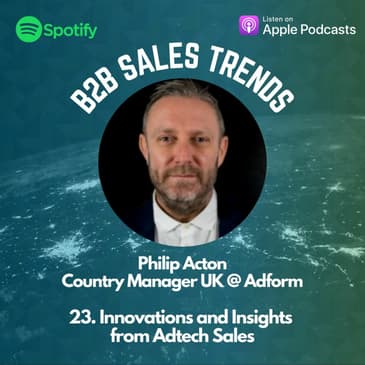
[00:00:00] To be the B sales trends, the podcast dedicated to sales leaders in the B2B space
[00:00:11] where we share conversations about innovative and successful sales transformations
[00:00:16] to keep you up-to-date on the latest trends. This podcast is brought to you by Global
[00:00:21] Performance Group.
[00:00:22] Welcome yet to another fabulous episode of the B2B Sales Trends
[00:00:27] podcast, my dear people. This show that brings you hacks tips, thought leadership
[00:00:32] for sales and customer success. It's brought to you by Global Performance Group
[00:00:38] and who are we, where our revenue improvement will take. That influence behavior
[00:00:43] change to provide sales people and customer success, the competence of the skills,
[00:00:48] the confidence to execute those effectively and the courage to sell and retain
[00:00:55] and negotiate based on client outcomes. My name is Harry Kendelbach
[00:01:00] and today I have with me, Philip, called Phil Schultley,
[00:01:05] act in the country manager of the UK for a company called AdFall.
[00:01:10] Welcome to the B2B Sales Trends podcast field.
[00:01:14] Thanks, Harry. Hello everyone and delighted to be here.
[00:01:18] Thank you for making time for a list I've wrote into it.
[00:01:21] You know, AdFall was recognized recently by Gardner as a leader in the magic
[00:01:27] quadring for AdTech. Can you tell us more about AdFall and its unique value
[00:01:34] prop and how it differentiates itself from the competitive marketplace that you
[00:01:39] will be great?
[00:01:40] Sure, yeah, delighted too. So for those that don't know what AdTech is,
[00:01:44] it's stands for advertising technology.
[00:01:47] So we're essentially a technology partner to brands and agencies that really
[00:01:52] want to plan and measure and optimize advertising campaigns online.
[00:01:58] And that takes a very degree of different formats,
[00:02:02] but things like Anna adds video ads even now with connected TV,
[00:02:06] even some of the TV ads that you see.
[00:02:09] We have been consistently recognised as a leader by Gardner in the past four years or
[00:02:14] so. And I think there's actually there's a number of things that stand out for me.
[00:02:19] Number one, I would say most of the other companies that are in the lead
[00:02:23] of Quadra 10 to be US centric tech companies.
[00:02:26] And now as a European first company we have 21 years experience.
[00:02:31] We have HQ in Copenhagen.
[00:02:33] We have 17 or 18 offices in Europe alone with more outside of Europe.
[00:02:40] So we really know what works, what works in the US might not necessarily work over here.
[00:02:46] And so we focus on local market knowledge and support.
[00:02:49] I think that's the number one element.
[00:02:51] And then I think there's a few more.
[00:02:53] So if we look at for instance the death of the cookie, which is very big in our industry,
[00:02:58] this is that Google Chrome is also going to go away from using cookies in line with other
[00:03:03] browsers like like Firefox or Safari.
[00:03:07] There's much more stringent policies around what people can do here.
[00:03:11] It's much more fragmented and there's much more partners that you have to partner with.
[00:03:16] So our solution which is called ID fusion really tries to make sense of that.
[00:03:21] And you know, the awards that we've won over the past few years of show,
[00:03:25] that to be the case.
[00:03:27] Then I think there's perhaps three more key benefits.
[00:03:30] One is that we are as an ad tech vendor.
[00:03:33] And so our end to end stack we have certain products that all work together to combine one solution.
[00:03:38] And that works both across the by and sell side.
[00:03:41] And that allows for better transparency between an advertiser spend and how much of that
[00:03:46] spend goes to actually two publishers website.
[00:03:49] It allows for better performance and it allows for I think better collaboration between the teams.
[00:03:55] Because many of the brands we work with will use what we use just users as one platform
[00:04:00] as opposed to having to use multiple vendors.
[00:04:03] So I think they're the kind of key challenges and then I think the other thing really,
[00:04:07] and I suppose it does relate into sales is service.
[00:04:10] So again, when we compare to big US tech and when gotmer has called us out consistently,
[00:04:16] it's that we've been called out for great service.
[00:04:18] So just because we are a team and doesn't mean we just provide tech,
[00:04:21] it means we provide service and support and try to sit now strategically with our clients
[00:04:26] and see where we can add valuable.
[00:04:28] I think they're the USP to me.
[00:04:31] The service element is really key thing in your industry and a lot of companies are lacking that.
[00:04:37] So that's really good that you focus on that.
[00:04:41] That's great.
[00:04:43] You have a pretty impressive 20 plus-ish years of experience in the tech space and in the sales industry
[00:04:53] with a large portion of that time in the advertising and marketing space.
[00:04:59] Could you share some of your key insights or trends that you've seen that you've observed
[00:05:05] in the B2B sales landscape all over the years?
[00:05:10] Yeah, thanks for reminding me.
[00:05:13] I worked out this morning and it was, I started out in sales when I was 22 years old,
[00:05:20] I was in 1996, so it's actually 28 years ago, I think next year.
[00:05:25] Quite a frightening thought and then I moved into online in 2003,
[00:05:29] so 20 years in online this year.
[00:05:31] I think I'm actually going to start with my offline story first because
[00:05:36] because I did eight years at a large American company but it wasn't a big American tech company.
[00:05:42] It was a big American chemical company and this was my first sales job.
[00:05:45] I covered sales in account management.
[00:05:48] I had very little training, I had a very good mentor, a chuck called Peter Healey,
[00:05:52] I still talk about it this day.
[00:05:54] He was the best salesman in the company and he took me under his wing
[00:05:58] and really showed me how to be a very, very good salesman without any sort of formal training.
[00:06:05] And I think one of the things that Peter did really well was again going back to the service.
[00:06:11] He spent a lot of time with his clients, he would be there whenever they needed him,
[00:06:16] whenever they called him he would, he would, you know, drop what he was doing and go in.
[00:06:20] And so he built up a level of trust.
[00:06:22] He knew their business, knew them personally and what was important to them.
[00:06:26] And so when he had these existing accounts and he grew these existing accounts,
[00:06:30] I guess using up sell techniques, it was always based on an level of trust.
[00:06:35] But he always made sure that he and therefore the company won.
[00:06:40] So I think when I think of some of the habits that I've once throughout the years,
[00:06:43] it's that you know, think when win.
[00:06:46] You can provide a solution to a customer's needs but you can still do it with something that adds value to you and to your business as well.
[00:06:53] And I think that that has always kind of stuck with me.
[00:06:57] I think we did eventually get around to some sales training in about four years of my eight years.
[00:07:03] And then I remember it very old fashion sales training techniques.
[00:07:07] But there were some things that I think still resonate.
[00:07:10] And that was again, the timer we talked about needs and wants and the fact that once I'm out for the need,
[00:07:18] which I know is something with resonated you Harry.
[00:07:20] So that was from 20 years ago.
[00:07:22] And yeah, and also we talked about different personas.
[00:07:25] Understanding that the way that you would perhaps approach a sell to this person would be very different to this person.
[00:07:31] Whether it was a different job title or something within the company or whether it was just a different personality.
[00:07:36] I think was really important.
[00:07:38] So as we've moved through my online career, so I've worked for small startups.
[00:07:44] I've worked for agencies and I've worked for big US tech and most recently Adobe.
[00:07:49] And I think the big difference there Adobe provided lots of sales training and it showed.
[00:07:56] I mean, it showed in the deal size it showed that the deals you know that there were much larger than the start of deals.
[00:08:03] We did more complex multi solution based deals.
[00:08:07] Whereas I think with the start of them, it was kind of almost boiler plate you know three or four questions.
[00:08:13] Stock presentation asked for the order move on to the next deal.
[00:08:17] So you know, but I think when I started out in online in 2003, I think also the audience just wasn't as informed as they are now.
[00:08:24] So we worked, you know, to sell online marketing essentially we're selling ROI we're saying we'll take your lot of things with you and we could well optimize it to use.
[00:08:32] To go further, which was great because the people that we were talking to do then didn't necessarily know how to do this.
[00:08:40] And I think now the clients are much more informed.
[00:08:43] So you have to work much harder and you have to work much smarter and you have to do your homework to uncover the challenges that they have.
[00:08:50] But thankfully we're still focused on selling ROI which is a which is a great situation to be in.
[00:08:56] Yeah, that's really interesting. There's a lot of stats out there from different sources and different researchers that.
[00:09:03] Buyers are better informed than ever and you know a large percentage and I'm called me on this.
[00:09:09] What is it? 60, 70% a couple different research bodies have started stated that the buying decision has been already made before they even engage a sales person.
[00:09:20] So if sales people and you couple that with customers or prospects being better informed than ever, if a sales person crops up and asks the same or rubbish questions everybody else is asking, you know, you're not providing any value to that.
[00:09:35] And you come and really differentiate yourself so I really believe it's it's not a case of finding out needs anymore.
[00:09:44] And it's about how do we really generate new needs in the mind of the prospects and each that research before needs that they have an appreciated that makes a difference to their business.
[00:09:58] I think that's where the fine line of average sales people to great sales people are and I think yeah really high level that nicely.
[00:10:07] Just to add to that I think more on element that you you know you said to kind of that if the buyers have, you know, already made their decision before a sales person walks through the door then you need to ensure that the company that you work for is in the.
[00:10:22] Is is front and center in the mind of someone with a well thinking about that. I think that's a big difference that has changed since.
[00:10:30] I thought it's actually 2003 you know, what can you do to add value in terms of is it a white paper that you can release is a case that is.
[00:10:40] Is it events that either you hold that may tap into that person's challenges or or as you say on cover challenges they didn't know existed or is it events that you can just attend where you know those people are going to.
[00:10:53] To be there I think building that brand so that when they're in that situation of starting to look at vendors because we have so many so much competition in the marketplace mean our largest competitors Google who have their own text act so that talk about David versus Goliath.
[00:11:08] And we have to be the noisy dog in the room so that we're in that conversation as early as possible.
[00:11:14] Right. Very interesting stuff.
[00:11:18] When you think about your role as as the country manager for for for ad form, you know obviously you need to build sales strategy deliver revenue objectives and so forth to the company can you can you share some of your.
[00:11:33] I've been trying to get a lot of strategies thoughts on achieving these objectives because it's a tough market out there how.
[00:11:40] Yeah, yeah, I'll talk about the strategy I mean you know I think before the strategy there's there's certain principles and so on in which you need to do together.
[00:11:50] I think that the buy in from the team and perhaps we can talk about later stage but in terms of the actual strategies you know we around about this time over year we were sitting down as a business and we're looking at next year and planning so every year you know I will sit down with my.
[00:12:06] I will have an outline from the board on what they expect the UK to deliver and now though then sit down with my kind of the leaders in my team so my heads of customers success.
[00:12:16] My sales directors and he global account teams that are run from here and I'll try to distill the company strategy in what role the UK has to play within that we are one of about 28 markets I think there will be a office presence.
[00:12:30] So I think this in turn gives them the buy in that I trust them and I value their feedback and I think that's really important when you're looking to set a strategy.
[00:12:40] So we try and then break down the overall company strategy into into I guess bite size chunks so.
[00:12:47] You know we have a revenue target for next year so what part of that is going to come from existing business what part is going to come from new business.
[00:12:55] Then we can sit down with the new business leader and say who are we focused on looking at next year is it brands as agencies is it publishers because we sell into all of those.
[00:13:06] How do approach different verticals you know do we have clients in those verticals that we can get references from or case studies or you know kind of information that we can drop into the.
[00:13:17] The conversations the nuggets of values of you as you call them do we intend events that are that we can speak at that are vertical specific a retail specific and so on and does our sales outreach then tap into all of those various points so.
[00:13:32] We use sales outreach to try and help you know open some doors and then the the enterprise sales team would go in and run that sale cycle.
[00:13:40] But to do so we need to have some cadence around how often we try and approach someone what kind of story we try and tell to them and it isn't just about sending blanket cold emails out but it's also trying to say.
[00:13:54] Meet these people at events and so on and that's the kind of new business approach then the existing client approach.
[00:14:00] So it's slightly different because of course we know our customers but then we'll look at our top clients will see is their potential for them to grow still all their.
[00:14:10] And so we have a lot of things that we have that looks small on paper but actually we know they haven't a huge opportunity to grow with us.
[00:14:16] So if we spend more time working with them how can we do that and that then ties into our account plan strategies which each of the account directors gives us to say this is my.
[00:14:27] And here are the.
[00:14:28] And so I'm going to focus on next year and this is the stories that I'm going to try and tell to uncover certain challenges and then we know that we have some solutions that we can sell in based on that.
[00:14:39] So there's a there's a degree of planning there's a degree of bringing the team along with you on on that journey.
[00:14:47] And ensuring that we plan properly and then and then interesting them to go out and perform and yes of course have regular checkings but don't don't I never want to micro manager.
[00:14:56] I want them to know that we're here to support them but that we trust them to go out there and and do the best that they come.
[00:15:04] You know there's a number of stats out on the on the idea of that 80% of your business or revenue should be coming from existing companies existing client relationships.
[00:15:15] And 20% of new companies because it's obviously quite a kind of position cost and and it's easier to to sell into existing relationships and upsell and cross sell.
[00:15:28] And I know cultivating and developing you know existing client relationships and building these relationships with different brands and media and creative agency is is one of your focuses can you share a few specific ways that.
[00:15:46] You used to sort of nurture these relationships and how these strategies could be relevant to to our audience who's listening sales and sales leadership.
[00:15:56] Yeah, so I think you know I might may maybe I mentioned this before but we're looking at and I've had for that.
[00:16:04] That if we if we like we can sell products we have four key ones within an hour overall stack or we can tell a better story which is that we have an integrated advertising platform and therefore.
[00:16:17] It's more of a solution and there's benefits that this brings because we're then not going in and competing against point products that are just selling features.
[00:16:26] So we're going in and we're selling an end to end solution that can meet meet your needs and quite often the clients that we have.
[00:16:33] If we say we have four key parts of it I would say on average probably the average is probably about two and a half that we have so products adoption.
[00:16:41] So they are brought into if we have this bit together that one plus one equals three there's a benefit.
[00:16:49] So that's a great place to start because then we're not talking about products we're talking about you know solutions and covering those those challenges and I think that.
[00:16:59] There are some real challenges in our industry their effects customers.
[00:17:04] There's things like the death of the cookie which is going to make it hard for advertising to perform there's a lack of transparency in our industry possibly by having multiple vendors between the advertiser and the website the advertisers wants to.
[00:17:18] And we're going to be on where we see lots of kind of hidden fees and so on so that's a challenge there's there's more and more channels if you think about how you interact with the internet there's more channels that you use now there's more screens there's no all these digital out of home screen you see when you're walking around.
[00:17:35] I and clients are essentially a client that we use your client that we speak to is someone that has a sales target so they're quite commercial themselves.
[00:17:45] And I always say you know they're probably sat there right now thinking what am I going to do next year when the cookies go away or how do I how do I reduce my vendors so that I have you know much more transparency or you know how do I get into digital out of home or digital audio.
[00:18:01] And they're they're looking for someone to help make sense of that for them and so I think from that point of view if we're out there and we're speaking to the right people within the within the brands or the agencies that we talk to.
[00:18:16] Then you know when you say sort of trying to find out uncover needs there's a lot in there that they maybe didn't realize that they need it that we could help show them by saying for instance if you were to look at your supply path.
[00:18:29] You realize that we can improve performance by 20% just by removing multiple vendors and providing one vendor and there's the kind of thing that they maybe didn't think about it first but it's something that we can we can sit down with and help them uncover.
[00:18:44] You've mentioned to turn out a couple of times explain to our audience what they're after cookies.
[00:18:50] Yeah, of course. Of course we're in an industry that likes to use acronyms and and and similar is also a metaphor so so a cookie is is is is basically a tag that sits on websites it sits on a.
[00:19:05] Playout sits on in city emails and it's used to create a trail so the trail was called a cookie trail. Yeah, I did was it's like going into the forest and leaving cookie crumbs behind so you know your way out.
[00:19:17] But advertisers would use these cookies to be able to determine that you know how we decided that he wants it to go on holiday he'd been to a travel website then.
[00:19:27] You know then a bit later sort of email you open it click on it and then when bought and you can see that purchase journey by using cookies.
[00:19:35] Now these cookies are no restored party cookies because they don't belong to the website there are a piece of tape that someone else has put on and most of the large browsers so you know Safari if you use apple you'll be familiar with Safari Firefox is another browser and now Google Chrome are saying that these are essentially not great for.
[00:19:56] I guess customer experience then maybe not data compliant and so on so there's a big focus on whether you know GDPR now in Europe.
[00:20:04] And so they're removing the ability for us to use them in advertising purposes from from the start of next year.
[00:20:11] So as an industry we're looking to try and find solutions.
[00:20:15] There are a number of different vendors out there which have come out with different types of solutions and I think what we add from a decided to do is rather bring another.
[00:20:25] I think that's a big idea or type of solutions to the market we just rebuild our platform to be agnostic to whichever is the biggest in the market that you're in or whichever it is that the customer the agency works with so.
[00:20:37] It's about trying to find a solution next year to how we still run advertising in an effective way without being too invasive on a consumer's privacy.
[00:20:46] Thank you for clarifying that that's helpful especially the death of it.
[00:20:51] I must admit I haven't heard before so that's that's very interesting.
[00:20:57] Let's get back to the selling aspect of things and we've collaborated in the past with some of your teams and super impressive about the commitment of your people the willingness to engage and to change things.
[00:21:15] So I think congratulations on that culture within our form.
[00:21:22] When we talk about selling we always talk about accounts versus products.
[00:21:28] What in your view does it take for salespeople to sell based on outcomes?
[00:21:34] Specifically the skills and behaviors needed to drive those better client outcomes.
[00:21:41] What's your opinion on that?
[00:21:44] Yeah I think that there's a number of personal habits that the salesperson can learn that or maybe there's some that are just within them.
[00:21:57] I mean if I had to choose specific ones that were the salespeople that I've always worked with the best I would say.
[00:22:06] I think the number one thing is an attitude approach is proactive approach rather than a reactive approach.
[00:22:14] So the industry that we work in like a lot of industries is an unidentified job and what you put in this job you get out.
[00:22:23] And I think that what's the old Gary player saying the hard I work the lucky or I get.
[00:22:30] I think that's by having a hard working attitude and a willingness to learn.
[00:22:38] That is going to make somebody going to be much more susceptible to new techniques and new ideas and listening to feedback and so on and so forth because it's not always the case with someone who's been in the industry a long time.
[00:22:51] I've had sales training. I can't be told right but the fact of the matter is that that's not true and you should always be learning and always be looking to hone your craft.
[00:23:01] So I think hard work is really important and attitude is crucial.
[00:23:06] I think being organized is really important.
[00:23:09] Breaking down your your your your I guess your tasks your day in your week into.
[00:23:17] You know how much time how many meetings do I have this week how much time are going to spend prepping for meetings. I think this is one of the number one things that.
[00:23:24] People miss they don't they don't think about prepping for them.
[00:23:28] How much outreach to I perhaps need to do how much information do I need to read about what's happening in the industry and use this to share clients and so on.
[00:23:38] And how much time do I spend you know almost like sharpening the source so on put on your own personal development on practicing and improving to make sure that your.
[00:23:48] You know that you're getting better in this every day so I think it's hard it's an attitude and it's being you know hard work and organizing but the two elements from training that I think people can focus on is and it's perhaps two of the.
[00:24:04] Two of the hardest ones that a salesperson can learn is number one is listening because most salespeople tend to be.
[00:24:12] Quackery, brigarious and want to you know want to talk a lot more than their clients it's it's it's a real challenge to learn but listening.
[00:24:21] Don't think of the question.
[00:24:24] What are the next brilliant question that pops into your mind while you're listening someone just actually letting them finish and then pause and then think of the question and that comes back to this next the bit after listening is having the right questions getting into some detail.
[00:24:39] Being willing to get into a bit of an uncomfortable situation perhaps but to try and get the most out of a situation but not you know not be afraid to kind of skirt around what you perhaps see as as an issue or a challenge for that client and help them on cover it.
[00:24:54] Don't just ask for all five questions I think that I've taken a box on that I know about this this client so yeah there was a lot but I think it's it's I think it's a number one it's an attitude approach because with the right attitude you can achieve anything.
[00:25:06] And number two it's about organizing your time and being willing to learn.
[00:25:11] So my last question was going to be if you can hire the perfect salesperson and add an interlude level and you can give him or her three skills to say these are the top three skills I want you to.
[00:25:27] And skills of behaviors that I want you to execute and and know to perfection.
[00:25:34] I guess you sort of answer that a little bit before summarized those for me as a final thought sure I'll I'll add say organized.
[00:25:45] Yeah.
[00:25:47] Personality.
[00:25:49] Yep and hardworking.
[00:25:53] Fabulous 11 and it's interesting you know in our industry people always sort of trying to come up with the latest and the newest thing and how much is that going to change and how much is this going to change and and in the end of the day comes down to a few fundamental things.
[00:26:15] Always very passionate about the fact that you know if you give sales people 20 things to do they will do one if you give them five things to do they will do for so focus on a few really good ones that that the people are willing to execute to perfection and it doesn't.
[00:26:38] And it doesn't take to reinvent the wheel here so I'm feel you've been a fabulous guest thank you so much for these brilliant insights for our audience we really appreciate your time.
[00:26:53] I know our listeners have taken a few really cool things away from this so thank you.
[00:26:59] Thanks everyone for tuning in to this episode we're looking forward to hearing you again until the next episode I leave you with the final thought engage with your clients in the way that Phil has outlined here and happy selling to everybody look after yourselves until the next episode. Thank you.