[00:00:00] Welcome to B2B Sales Trends, the podcast dedicated to sales leaders in the B2B space, where we
[00:00:11] share conversations about innovative and successful sales transformations to keep you up to date
[00:00:17] on the latest trends.
[00:00:18] This podcast is brought to you by Global Performance Group.
[00:00:23] Welcome yet to another fabulous episode of the B2B Sales Trends podcast my people.
[00:00:28] Be sure that brings you hacks, tips, thought leadership for sales, marketing, customer success
[00:00:35] and today sales engineering.
[00:00:38] It's brought to you by us who is us.
[00:00:40] We are Global Performance Group.
[00:00:41] We are a revenue improvement boutique that implements behavior change to facilitate
[00:00:48] a process that provides salespeople, customer success, sales engineers with the competence,
[00:00:54] confidence and courage to sell and negotiate based on customer outcomes.
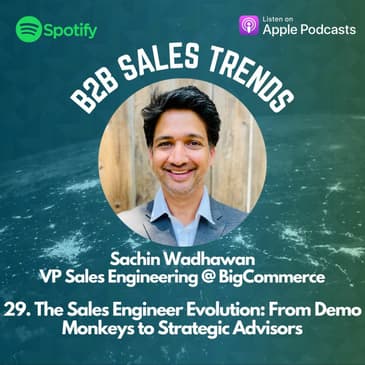
[00:01:01] My name is Harry Kendall Bach and today I have with me Sashin Wadhawin.
[00:01:07] I hope I pronounced that right and Sashin is the, let me get your title right, the VP
[00:01:13] of Sales Engineering at BigCommerce.
[00:01:18] Welcome to the B2B Sales Trends podcast Sashin.
[00:01:21] Thank you for having me, Harry.
[00:01:22] Great to be here.
[00:01:23] Great, fabulous.
[00:01:24] Can you start by sharing a bit about your background and the journey that led you through your
[00:01:30] current role as the VP of Sales Engineering at BigCommerce?
[00:01:36] Yeah, absolutely.
[00:01:37] Excited to start on that.
[00:01:41] I also want to acknowledge that as I looked through some of your other podcasts, previous
[00:01:46] recordings it is a great honor to be talking about sales engineering.
[00:01:51] Obviously you'll hear that I'm very passionate about this profession, but I think it's going
[00:01:56] to be, it's a really important and valuable aspect of B2B sales that doesn't have all
[00:02:02] the awareness that I think we have today.
[00:02:06] To answer your question, I fell into sales engineering just like every other sales engineer
[00:02:14] falls into it.
[00:02:17] None of us have gone through an undergrad or a master's in sales engineering because it
[00:02:21] doesn't exist.
[00:02:22] I know that can scare some of the sales reps listening because you realize that your sales
[00:02:27] engineers have, none of us have a certification because there is no university that exists
[00:02:35] for that.
[00:02:37] I started my career as a software developer.
[00:02:39] I have an undergrad in computer science and a master's in software engineering.
[00:02:44] I was on the path to write code and build technology.
[00:02:50] Interestingly, the startup that I was at didn't have sales engineers.
[00:02:54] One of the biggest challenges that our sales team ran into was how our technology integrated
[00:03:01] to their existing back office system.
[00:03:04] At that point, I was on the implementation team.
[00:03:10] On one very big opportunity, they brought me in as an external person to talk about integration.
[00:03:16] Apparently I did so well that they were like, hey, we need this guy on every sales call when
[00:03:21] we're talking about integrations and I became a sales engineer.
[00:03:25] I was the first sales engineer in that company.
[00:03:28] Harry, since then, I fell into the role.
[00:03:32] I fell in love with this role.
[00:03:34] I've done that over six times in my career where I've gone into different companies and
[00:03:40] especially companies that don't have a formalized sales engineering function.
[00:03:43] I've gone in and built that sales engineering function from the ground up and made sales
[00:03:50] engineering the silver bullet for why sales wins deals.
[00:03:55] That's exactly what I did at BigCommerce about eight years ago.
[00:03:59] We didn't have a formalized SC function.
[00:04:02] I came in, hired some of our first sales engineers, built the program out and like I said now,
[00:04:11] one of the reasons we win deals is because of sales engineering at BigCommerce.
[00:04:15] Fabulous, fabulous.
[00:04:16] And your passion for sales engineers has also influenced your wardrobe.
[00:04:21] Get up and show us a t-shirt.
[00:04:24] Yeah, this is, you know, I work for an E-card.
[00:04:25] Trust you, SC, I love it.
[00:04:27] Interestingly, every employee at BigCommerce gets a free e-commerce store.
[00:04:33] This is, hey, use your own technology.
[00:04:35] And when I joined, I was wondering, it's like, okay, I don't have any other side business.
[00:04:40] Like what am I going to build my store on?
[00:04:43] And because I'm passionate about sales engineering, I was like, hey, let's sell some sales
[00:04:47] engineering swag.
[00:04:49] And this one, sales reps love it.
[00:04:53] Most of these t-shirts are actually purchased by sales reps because they want to give this
[00:04:58] as a gift to their sales engineers.
[00:05:00] But yes, to everyone listening, trust your SC is my mantra.
[00:05:04] Fabulous, love it.
[00:05:08] You get a lot of experience.
[00:05:09] In fact, if I remember correctly, you have 20 years in South Centre Price platform
[00:05:14] experience and you've witnessed clearly a lot of different trends and different
[00:05:20] directions in B2B sales.
[00:05:22] So how have you seen the B2B sales landscape involved, particularly in the context of enterprise
[00:05:33] sales?
[00:05:34] Yeah, it's been an amazing journey.
[00:05:37] And I know you're talking about SAS and I remember 20 years ago, right?
[00:05:42] SAS was still evolving, still growing.
[00:05:46] And even today, we compete with on-prem even in today's DNA.
[00:05:52] So I can speak from a sales engineering perspective as I've seen those technical sales and sales
[00:05:59] processes become more and more complex.
[00:06:04] It used to be where sales process was really about, sell me what's in the box.
[00:06:11] So demonstrate the features that are in the box from a sales reps standpoint, talk about
[00:06:17] the value of the solution.
[00:06:20] And I feel over the years, sales just has gotten more complex, has gotten more technical.
[00:06:28] And as a result of that, our profession, sales engineers have gotten to have a more prominent
[00:06:37] role in the sales cycle.
[00:06:40] So I've seen from an evolution for 20 years ago, most people didn't know what sales
[00:06:46] engineers were if they needed them.
[00:06:50] And it was really more of a demo monkey.
[00:06:51] It's like, we needed somebody who can show and tell the product.
[00:06:55] And now because the sales process is getting more complex, the technology is getting more
[00:07:00] complex.
[00:07:01] The sales engineering role has evolved from not just being a demo monkey to be more
[00:07:06] of a technical consultant in the sales process.
[00:07:10] Right.
[00:07:11] Interesting.
[00:07:12] And I would say some of that, and I know we'll talk more on these topics, but some of that
[00:07:18] trend I believe is especially in SaaS, is really being driven by the need for integration.
[00:07:26] So anytime a buyer is looking at the technology that the sales rep is selling, they are not
[00:07:32] just thinking about how they're going to use that technology.
[00:07:35] They're thinking about how that technology is going to integrate with other, the full
[00:07:40] tech stack that they already have.
[00:07:42] Right.
[00:07:43] And it's also been driven by customization, right?
[00:07:46] I think the early on, SaaS was really about, hey, let the buyers use the way we have
[00:07:52] built the technology.
[00:07:53] Right.
[00:07:54] So it's the ease of use, it's point and click.
[00:07:56] And I think over the 20 years, businesses have started to love SaaS.
[00:08:02] They see the value of SaaS, but they don't want SaaS to restrict everything they
[00:08:07] can do in the technology.
[00:08:08] They want to customize SaaS to meet their requirement.
[00:08:12] So I think both the integrations and the customization of SaaS creates this higher level of technical
[00:08:18] complexity in sales cycles that we've seen over the last 20 years.
[00:08:23] Interesting.
[00:08:24] I've had, on a future podcast guest who I had a pre-meeting with yesterday, he's
[00:08:32] the Chief Revenue Officer for a SaaS organization.
[00:08:40] And he said that the challenge really is to get the entire organization to move from what's
[00:08:49] in the box, from a product focus to an outcome-based focus.
[00:08:55] And that includes all the different layers of client facing people.
[00:09:00] It includes sales engineers, it includes everybody who touches the customer at some point in the
[00:09:06] sales process.
[00:09:07] They need to have an outcome-based focus and a skill set.
[00:09:12] Actually, he said mindset and skill set.
[00:09:15] Does that resonate with you?
[00:09:17] Absolutely.
[00:09:18] Absolutely.
[00:09:19] This is something, in a lot of sales engineering, forging and training, it's all about
[00:09:26] talking about value and outcomes, then talking about futures.
[00:09:30] Because the buyers don't really care that much about the bells and whistles and what the
[00:09:34] technology can do unless it results in the outcome that they're trying to achieve.
[00:09:40] So I think it's absolutely critical for both sales engineers and sales reps to be aligned
[00:09:47] before you go into a meeting to what are the outcomes that our buyer needs and wants.
[00:09:56] You have to be prescriptive.
[00:09:57] This is again the level of complexity is driving a higher need to be you got to tell the buyer,
[00:10:05] not just answer all their questions that's a given but also guide them towards what's
[00:10:11] the best path to achieve those outcomes that they're looking for.
[00:10:17] And really guide them also to a point where they suddenly discover needs that they haven't
[00:10:29] considered before, needs that they haven't appreciated before, needs that they didn't
[00:10:35] know they can have an impact on their business.
[00:10:39] That's when you have that outcome-focused conversation then.
[00:10:43] Yeah, absolutely.
[00:10:44] It used to be that the expectation was you are the expert in what your technology can
[00:10:52] do.
[00:10:53] And again, when you go back to the box and out of the box and one black box that you
[00:10:57] get mindset, right?
[00:11:01] The ability that I know everything about this product is what the buyer needs because
[00:11:04] they're only going to use that box.
[00:11:07] And they want to know in the sales cycle what the box can do so they can get the
[00:11:11] right outcome from that box.
[00:11:13] Right now that we move into more of an integrated tech stack, right?
[00:11:18] The buyers need that extra, hey, you have other customers that are similar to me that
[00:11:24] use your technology and they use these other technologies around it.
[00:11:28] What are some pros and cons or what are some benefits that and challenges that they
[00:11:34] are experiencing to your point that you should tell me?
[00:11:37] Like educate me on, am I not asking you the questions that others have asked along
[00:11:43] the way?
[00:11:44] And I think that changes the way we sell and we present the right solutions to
[00:11:52] our buyers.
[00:11:53] Absolutely.
[00:11:54] I've heard you talk about in the past the fact that buyers are more
[00:12:01] concerned about their slack of technologies rather than seeking one seller with all solutions.
[00:12:11] Could you elaborate a little bit on that topic and how this shift in buying behavior has
[00:12:17] impacted the sales approach, especially in enterprise space?
[00:12:22] Yeah, one buzzword that's very prominent in our industry at BitCommerce.
[00:12:27] So we're an e-commerce enterprise e-commerce platform.
[00:12:32] The buzzword is composability, right?
[00:12:34] And I'm pretty sure it's pretty prominent in other industries as well.
[00:12:37] But the concept, the definition of composability simply put is the ability
[00:12:43] for a business to build their tech stack in a composable way, right?
[00:12:49] Where it's the pieces of the puzzle can be very easily swapped in and out based
[00:12:57] on what the business's requirements are.
[00:12:58] Again, it's an anti-monolith mindset where I don't want to be stuck
[00:13:04] with one technology that does A, B and C really well, but the E and F part are kind of OK.
[00:13:12] I would rather replace the D and F part with another technology that does that part
[00:13:17] really well.
[00:13:18] So it's this mindset of businesses need a faster pace to be able to leverage
[00:13:25] their technology to what they need.
[00:13:26] They sometimes may not have tolerance for the one platform that they're choosing
[00:13:31] to wait for their roadmap to deliver those features.
[00:13:35] And if the platform is not delivering it, they want to be able to replace
[00:13:38] some component of it with something else, right?
[00:13:41] So what that creates a challenge for the sales cycles is the prospect
[00:13:53] has composability in mind.
[00:13:55] So when they're talking to you and their mind, they're also thinking about
[00:14:00] how much of your tech they're going to use and how much of your tech
[00:14:04] they're going to replace with something else.
[00:14:06] And when they're thinking about that, they're also thinking about
[00:14:10] how will my technology integrate with those other solutions that they have in mind, right?
[00:14:15] So that creates a higher level of complexity for the sellers
[00:14:20] to be able to understand what their full tech stack is.
[00:14:24] So in sales engineering, right?
[00:14:26] At least in our company, you know, we're starting to shift our mindset to look,
[00:14:30] I'm not a sales engineer for my platform.
[00:14:33] I need to be a sales engineer for the tech stack that this buyer will
[00:14:37] eventually end up using.
[00:14:38] And as you can imagine in the tech stack, it's not just my technology.
[00:14:41] It's my partner's technology that makes up the tech stack as well.
[00:14:45] Right.
[00:14:46] Right.
[00:14:47] You mentioned that buyers want to reevaluate every one to two years
[00:14:51] during these technological, you know, rapid technological
[00:14:56] advantage, advances, shall I say?
[00:14:59] Yeah. What does this impact this the way sales professionals
[00:15:04] approach these partnerships, these long term partnerships
[00:15:07] and how do you really navigate that landscape?
[00:15:11] And maybe you can share an example out of big commerce here.
[00:15:15] Yeah. Yeah, I think, you know, I've always believed that sales
[00:15:19] is a long term relationship, right?
[00:15:21] Any buyer, even though in many cases our action kind of concludes
[00:15:28] one wants to contract a sign, but it's the trust that a buyer
[00:15:32] is putting in, you know, with the frontline people, right?
[00:15:35] How much how passionate they are about their product,
[00:15:37] how knowledgeable they are about their product.
[00:15:39] So it is a long term play there.
[00:15:43] I think it's this movement to composability and this movement to,
[00:15:49] you know, being able to replace tech stack and swap,
[00:15:53] you know, technologies out as needed.
[00:15:56] It's a win-win-win for prospects because buyers get to deliver
[00:16:02] their value at a faster pace because they're not
[00:16:06] they're not hindered by the technology, the monolith,
[00:16:09] the box that they are they are married to for the long term.
[00:16:13] Right. So they're not they don't have to make a high risk,
[00:16:16] 10-year term decision right now.
[00:16:19] They can actually make a lower risk one two year decision and say,
[00:16:23] look, if we'll use this technology for one two years
[00:16:25] and if it's not working, we'll swap it out.
[00:16:26] Right. I think it's a win-win for sales, right?
[00:16:30] Because to me that translates to more sales cycles, right?
[00:16:33] Because when we reach out to prospects, the worst thing we want to hear is,
[00:16:38] oh, you know what? I'm in a contract for next five years.
[00:16:40] So come back and talk to me in five years is like bummer, right?
[00:16:45] But if they're in a contract for a year
[00:16:46] and you know, we've got an opportunity to show them
[00:16:49] how using our technology, they can actually get to their outcomes faster.
[00:16:54] They're all all open ears, right?
[00:16:56] So so I think this it's a win-win for both prospects,
[00:17:00] vendors and and sales reps.
[00:17:03] And, you know, we just have to change our approach
[00:17:09] and we have to solution around that.
[00:17:11] Right. So I think the way we sell both from a sales and sales engineering standpoint,
[00:17:18] we have to build that trust with with that in mind,
[00:17:21] set that what they are looking at, right?
[00:17:24] The risk profile that they are, the buyers are putting on the table
[00:17:28] is not for this is something I'm going to be married to for the long term.
[00:17:32] Right. That comes into how we price it.
[00:17:35] That comes into kind of how we talk about like,
[00:17:39] hey, you know, using this technology in five years from now,
[00:17:41] you're going to see these results.
[00:17:43] You know, the buyer is kind of going,
[00:17:44] I don't know if you're going to be my vendor for five years from now.
[00:17:47] Right. So talk to me about what this technology can do for me
[00:17:51] in the next three months, in the next six months, the next year.
[00:17:55] Right. Let's focus on the benefits that I get from that.
[00:18:00] Right. In e-commerce, to give you an example, right?
[00:18:03] We, you know, we e-commerce,
[00:18:06] re-platform is very extensive.
[00:18:09] Right. It's very disruptive to a business when you have a,
[00:18:13] you know, full functioning store,
[00:18:14] you have millions of orders coming in and, you know,
[00:18:17] just the thought of replacing that component out can be daunting
[00:18:22] because you're like, hey, while we're doing the application,
[00:18:24] what happens to my user that go to my URL?
[00:18:27] Are they going to not see a page not found?
[00:18:30] Right. That can be disastrous.
[00:18:33] You know, so there's solutions around how somebody can,
[00:18:38] you know, either continue to run two e-commerce platforms in parallel
[00:18:42] and then shift over.
[00:18:44] We can also be a very modular approach
[00:18:47] where we can start to take over certain brands of that business
[00:18:52] and then eventually kind of grow into that account
[00:18:55] and take over the entire e-commerce presence.
[00:18:57] So it's just a mind shift.
[00:18:59] And I think as long as you understand
[00:19:01] that your buyers are not thinking five to ten years,
[00:19:06] you know, at timeframe,
[00:19:07] you just have to change your approach on what value you're bringing into that.
[00:19:11] Right. And that's also industry specific.
[00:19:13] I'm sure there's, you know, products and platforms
[00:19:15] that truly are five to ten year timeframe.
[00:19:18] But in my experience, that time is shrinking overall.
[00:19:22] Yeah. And I think it's also a risk factor, right?
[00:19:24] Long time, long ten years, long contracts mean big risk, right?
[00:19:30] So big risk, longer risk.
[00:19:34] Share for the benefit of the audience,
[00:19:38] if you would, sort of the differences
[00:19:40] between salespeople and sales engineers
[00:19:42] and specifically in the context of technical expertise
[00:19:46] to each one of the roles throughout the sales cycle.
[00:19:50] Yeah. That will be great.
[00:19:52] Yeah. This is a passion of mine.
[00:19:55] And I think I've always...
[00:19:57] I can't look at that.
[00:19:58] And since, yeah, since I fell into this role, right, Harry,
[00:20:01] I've always observed that, you know, there's a drawback
[00:20:09] to not have all the SES that sales reps work with,
[00:20:14] you know, go through a certification, right?
[00:20:17] Like when somebody graduates from engineering school,
[00:20:20] somebody graduates from medical school or law school, right?
[00:20:23] You expect a certain level of, right?
[00:20:25] Everybody's kind of gone through that.
[00:20:27] But all of us kind of learn the sales engineering, right?
[00:20:31] On the fly, right?
[00:20:32] So I would highly encourage every sales rep listening in
[00:20:36] to ask their SES, how did you and why did you become an SC?
[00:20:40] And I can tell you there's probably a very juicy story
[00:20:43] behind that because it's a coincidence.
[00:20:46] But I believe the most important relationship
[00:20:51] that exists in today's enterprise sales
[00:20:54] is the AE and SC relationship.
[00:20:57] Right?
[00:20:58] It's the dance that we have to perform in synergy.
[00:21:03] Imagine every prospect meeting when you have an AE and an SC,
[00:21:08] right, we're playing two different roles,
[00:21:11] but they have to be very unified, right?
[00:21:13] To answer your question, the sales rep is playing the business role, right?
[00:21:19] What's the value?
[00:21:20] Are you a viable company?
[00:21:22] How do you differentiate from a business standpoint
[00:21:25] when you're working across competitors, etc., etc.
[00:21:28] and later on around pricing and ROI and things like that?
[00:21:32] Whereas the SC, the sales engineers
[00:21:35] is accountable for getting the technical win, right?
[00:21:37] Are we checking all the boxes for what the prospect needs?
[00:21:41] And again, it's not just about can your platform do all of these
[00:21:45] but what else the buyer should be thinking about from a technology?
[00:21:49] What else is possible, right?
[00:21:50] What else can be customized, right?
[00:21:52] So in most sales cycles, the A and the SE together usually have 30 minutes, 45 minutes, maybe an hour in front of a prospect.
[00:22:03] And we have to dance to the prospects team, right?
[00:22:07] Every prospect is different.
[00:22:08] Every opportunity you go in, there's different personalities there.
[00:22:12] So I think that SE and A relationship, I call it the Batman and Robin.
[00:22:16] And I'll tell you, there's sales engineers that believe that they can do sales reps jobs better.
[00:22:23] You know, and, and, and I can tell you that every each one of those sales engineers, if they ever fall, find themselves in a sales reps role, they will have a higher empathy for how much complexity there is in the sales reps role.
[00:22:37] Right? So, so I don't want to be Batman as an SE.
[00:22:41] I'm very happy to be an amazing Robin.
[00:22:44] And, and, but I think that relationship is really important.
[00:22:47] It's not a master-servant relationship.
[00:22:50] Right? That's the bad way to look at it.
[00:22:52] It's a very consultative relationship.
[00:22:54] Right throughout the sales cycle, the sales rep has to continue to ensure that we are winning their trust from a business standpoint.
[00:23:03] And the SE has to complement and build that trust and credibility from a technical platform, consultative value standpoint.
[00:23:14] Right? So it's a, you know, it's for reps.
[00:23:19] I can tell you Harry, for reps that have really strong relationship with their SEs, they will swear to know that they win deals because of their relationships.
[00:23:32] And the reps that struggle with that, they will tell you that they avoid at all cost to bring their SE into the conversation.
[00:23:40] Right? So when it works, it works really well.
[00:23:44] So I assume there has to be a big aspect of planning and being aligned and preparing for conversation, you know, who takes what role and that aspect of it.
[00:23:57] Does that happen in your opinion enough in these situations?
[00:24:03] It should happen. I'm sure we agree it should happen.
[00:24:06] Does it happen enough in those these planning meetings, these spending enough time together to prepare for these conversations?
[00:24:16] Yeah, I would like it to be, it happens all the time because you know, we usually get one chance, right, for a prospect to get them to say,
[00:24:26] yes, I want to keep evaluating this vendor or no, I'm kind of done.
[00:24:30] I've seen enough, right? Let's move on to the next one.
[00:24:32] Right? I hope it happened more.
[00:24:35] I think some of what I've learned is it really needs to happen from top down.
[00:24:40] Right. So as I've taken over SE leadership at different companies, I really have to be the sales leader has really has to be bought in into the value of sales engineer.
[00:24:52] Right.
[00:24:52] And I can tell you have been at companies where I wasn't aligned, right?
[00:24:56] And I was literally begging and, you know, working really hard to have that sales leader understand why an SE should be involved in every opportunity.
[00:25:08] And they saw sales engineering as an added cost, right?
[00:25:12] Because if I'm a sales rep, I can just schedule that meeting with the prospect.
[00:25:15] But now I have to schedule a meeting, look at my calendar of my SE if he or she is available.
[00:25:21] You know, it can create friction, right?
[00:25:23] But the benefits outweigh the double teaming on these opportunities.
[00:25:30] So, you know, I certainly see that it has to come from top down.
[00:25:36] And but once there is awareness across both the SE and the AE, it really has to be both have to invest.
[00:25:46] It's just like every other relationship, right?
[00:25:48] Both have to invest in each other.
[00:25:50] Right. Both have to understand every SE is unique, just like every sales rep is unique.
[00:25:54] They have different styles, different personalities, different strengths and weaknesses.
[00:25:59] Being able to understand and acknowledge each other's strength and weakness goes a long way because sales engineering,
[00:26:06] just like sales rep is also a very lone profession, right?
[00:26:09] Well, oftentimes SEs and reps are tied up and they're in their territory winning deals.
[00:26:15] You know, they may not interact with other sales reps or other SEs, right?
[00:26:19] So I think it really is the importance of it is at a one on one level, but it has to come down from the leadership to say,
[00:26:27] hey, SEs and the AE's, we need...
[00:26:30] I want you guys aligned. Let's get on with it, right?
[00:26:32] We're really going to win deals and beat competition.
[00:26:35] You guys have to be tight.
[00:26:37] Right, right.
[00:26:39] There's a significant difference in numbers between sales reps and sales engineers with something like,
[00:26:47] where do I have that?
[00:26:47] With something like 6 million reps, sales reps compared to 40,000 sales engineers.
[00:26:55] Yeah.
[00:26:56] So how does this ratio impact the industry and what challenges or advantages does that bring?
[00:27:02] I mean, it's pretty significant.
[00:27:04] Yeah.
[00:27:05] Yeah, it's interesting when you talk to sales leaders who get their SEs,
[00:27:08] they are usually saying we don't have enough SEs because having more SEs
[00:27:15] directly translates to winning more deals or having more strong SEs, I should say, great SEs.
[00:27:20] Right?
[00:27:22] But some of that number is skewed because not all of those sales reps are doing enterprise,
[00:27:28] technical enterprise sales and the prominence of sales engineering really becomes higher
[00:27:36] based on the complexity of the sale, complexity of the product.
[00:27:40] The more technically advanced the solution is the more value sales engineering traditionally adds.
[00:27:49] But that only tells me, Harry, that there is such an amazing opportunity
[00:27:54] for the sales engineering profession to continue to grow.
[00:27:57] Right?
[00:27:58] I've been in this profession 20 years, fell into this profession like everybody else.
[00:28:03] And I've gone from having to really explain to everybody what sales engineering is to less
[00:28:09] explain now because there's more awareness.
[00:28:12] I'll tell you last year, I actually went to one of the technology platforms
[00:28:17] that's purpose built for sales engineering.
[00:28:19] I went to their user conference and in my professional career, this is the first time, Harry,
[00:28:26] I went to an event where all I saw was sales engineers and sales engineering leaders.
[00:28:34] Now, you may not think that, hey, what's the big deal in that?
[00:28:36] Right? But I went to a lot of sales events and they were sales kickoffs, conferences.
[00:28:43] These were events for sales people and sales engineers were just like one subset of it.
[00:28:50] Right? So I think where the industry is heading is sales engineering is becoming more mainstream.
[00:28:55] There's about 15 to 20 technologies that are out there now, startups, innovations happening
[00:29:03] that is purpose built for sales engineering.
[00:29:05] Some of these companies are VC funded.
[00:29:07] And I think industry overall is identifying that sales engineering is not just a black magic
[00:29:13] or just something somebody does, but because it has tangible impact to the outcome of sales,
[00:29:21] the profession is maturing and I think we'll see that ratio increase.
[00:29:26] The industry says, and again, this may not apply to everyone,
[00:29:29] but one to three is a very healthy ratio between one SC supporting three sales reps.
[00:29:37] Now, in big enterprise, it may be one to one in lower enterprise or more mid-market
[00:29:44] and maybe one to five, one to six, but what I've heard is one to three is a very healthy way
[00:29:49] to look at three reps to one SC.
[00:29:53] Interesting.
[00:29:55] OK. We're almost at the end of our time together here.
[00:29:59] A final question I have for you is, looking into the future, nobody has a crystal ball,
[00:30:05] obviously, but looking ahead, what trends do you foresee shaping the role of
[00:30:10] SCs in the future and B2B sales?
[00:30:12] What would you predict here?
[00:30:15] I want a lot more SCs in the industry.
[00:30:20] I want the profession to be more recognized, more formalized.
[00:30:25] I would love to have more certifications, more awareness, more like an MBA type program.
[00:30:32] That's where I want to see the industry evolve.
[00:30:34] But from a B2B sales standpoint and especially from a sales engineering perspective,
[00:30:40] I think AI that's on top of mind for everyone is absolutely going to play a role in sales and SCs.
[00:30:47] You know, one thing I feel good about hearing about AI is a lot of AI applications are nonhuman
[00:30:55] and sales is very, very human.
[00:30:58] Right? People buy from people that may change.
[00:31:01] Technologies may buy from technologies, but as long as we have people that are making these decisions,
[00:31:07] they need that human connection.
[00:31:08] And I think both the sales reps and the SCs provide that trust, that credibility.
[00:31:16] And that can't be automated.
[00:31:18] Right? It has to be from the tone, the body language.
[00:31:23] There are so many aspects to that relationship on why people make a decision when there are equally comparable solutions out there.
[00:31:34] I don't think that will change, but I feel that technology innovation over time,
[00:31:38] there are very mundane part of both sales and SCs that can easily be automated.
[00:31:44] Right? You think about RFP responses.
[00:31:46] You think about prospect, just want to ask some high level questions about your solution and about your product.
[00:31:53] They don't need to talk to sales rep just yet because they are just vetting things out.
[00:31:58] They can very easily talk to a chatbot and get some high level questions and answers before they talk to a sales rep.
[00:32:08] Right?
[00:32:09] So I think the profession will continue to grow.
[00:32:11] I feel very safe for both sales and sales engineering from AI personally,
[00:32:16] because I really believe that we're the human element of a sales cycle that is here to stay.
[00:32:23] Fabulous.
[00:32:25] Sajin, you've been a fabulous guest for us.
[00:32:27] I know our listeners really appreciate your highly professional views and tips and tricks that you have shared with the audience.
[00:32:38] Thank you for that.
[00:32:39] You're welcome.
[00:32:40] Thank you for having me and sales engineering as a topic in your podcast.
[00:32:44] For anybody listening, please go talk to your SCs, ask them about their journey, recognize for their efforts.
[00:32:52] You know, oftentimes we are the unsung heroes in the sales cycle, but I can tell you once you've got that relationship with your SC,
[00:33:01] that SC will fight day and night to help you win your deals.
[00:33:06] So go make them.
[00:33:07] You make me want to have a seat for myself.
[00:33:11] Thank you.
[00:33:11] There you go.
[00:33:14] Once you have it, I love you back.
[00:33:18] Thank you so much.
[00:33:19] I'll get my dear people.
[00:33:20] Appreciate your time tuning in again.
[00:33:22] A couple of calls to action.
[00:33:24] Go to our website, globalperformancegroup.com.
[00:33:27] Consume all the other podcasts or go to Spotify and follow us there.
[00:33:32] Our channel, happy selling.
[00:33:34] And as to the T-shirt of our good friend, Sajidir Trust, your S-E.
[00:33:40] All the best to you.
[00:33:41] Happy selling.
[00:33:42] Look after yourselves.
[00:33:43] Thanks everyone.
[00:33:44] Take care.
[00:33:45] Bye bye.