
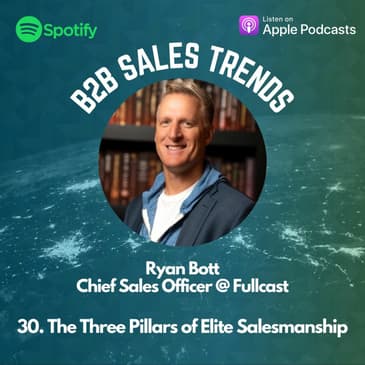
[00:00:00] Welcome to B2B Sales Trends, the podcast dedicated to sales leaders in the B2B space,
[00:00:11] where we share conversations about innovative and successful sales transformations to keep
[00:00:16] you up to date on the latest trends.
[00:00:18] This podcast is brought to you by Global Performance Group.
[00:00:22] Welcome yet to another fabulous episode of the B2B Sales Trends podcast.
[00:00:28] My dear listeners, the show that brings you hacks, tips, thoughts, leadership for sales,
[00:00:35] marketing customer success.
[00:00:37] It's brought to you by us who is our Global Performance Group, a revenue improvement boutique
[00:00:43] that implements behavior change to provide salespeople with first of all the competence
[00:00:49] to engage differently, the confidence to having done that a number of times and therefore
[00:00:54] the courage to talk with stakeholders effectively and sell and negotiate based on outcomes.
[00:01:03] My name is Harry Kendall Bach, I'm the CEO of the company and today I have the pleasure
[00:01:07] to have with me Ryan Bodd.
[00:01:10] Ryan is the Chief Sales Officer of Focused.
[00:01:15] Welcome to the B2B Sales Trends podcast, Ryan.
[00:01:19] Thank you, Harry.
[00:01:20] Thank you very much.
[00:01:21] It's a pleasure to be here.
[00:01:23] Fabulous.
[00:01:24] Ryan, to kick this off, give us a quick introduction about you and your role and a little bit of
[00:01:31] history about you.
[00:01:32] Oh, sure.
[00:01:33] Yeah, thank you.
[00:01:35] You and I have known each other.
[00:01:36] We bumped into each other.
[00:01:37] Gosh, it was a cliche.
[00:01:40] It's going to sound cliche.
[00:01:41] I think we met at a bar somewhere around there years ago and you had been doing
[00:01:48] work at Sodexo.
[00:01:49] I was at Sodexo.
[00:01:51] I originally started my last seven years, six and a half years was at Sodexo and started
[00:01:57] in North America and helped build up one of our software divisions if you will in America
[00:02:05] in the US and then was promoted into a global role where I was helping oversee all things
[00:02:11] revenue and helping build GoToMarket.
[00:02:15] We knew each other from then and we were trying to solve many of the same problems
[00:02:18] just from different angles.
[00:02:21] Before that, it's been multiple startups.
[00:02:24] It's been some really big companies, some very small companies with always the focus of GoToMarket.
[00:02:30] I don't know where that came from other than when I was younger, I realized how much I
[00:02:35] liked it.
[00:02:36] I went and got my MBA from a university here in the States called Arizona State
[00:02:41] University.
[00:02:42] I still remember this question where one of my professors asked me, what do you
[00:02:48] want to be when you grow up?
[00:02:50] I said, I want to be in sales leadership.
[00:02:54] The class turned to me and said, where's CEO and where was finance because a lot of people
[00:03:02] are going into finance.
[00:03:03] You want to go into big banking that you want to work on Wall Street with your
[00:03:05] MBAs?
[00:03:06] I want to work in sales leadership.
[00:03:08] Revenue is the fun side of the house.
[00:03:11] Right.
[00:03:12] Exactly.
[00:03:13] Thank you for that introduction, Ryan.
[00:03:16] The title of the podcast potentially is Unpacking.
[00:03:20] I'm going to read this for my marketing view.
[00:03:23] Unpacking, GoToMarket pitfalls as strategic analysis.
[00:03:28] Let's kick off with that if we would.
[00:03:32] You have led a number of sales and revenue operations teams in the past.
[00:03:39] You likely encountered a variety of challenges in that GoToMarket arena.
[00:03:47] Can you share some specific incidences and issues where let's say low win rates provided
[00:03:55] or post challenges?
[00:03:57] How did you strategically address those to overcome these obstacles?
[00:04:02] Yeah.
[00:04:03] Well, first off, low win rates kill morale.
[00:04:07] You want to build a sales team and you want them to produce low win rates kill their morale.
[00:04:13] Nobody's happy.
[00:04:14] It's not fun.
[00:04:15] There's an edge about all of the meetings.
[00:04:18] As a person, as an individual, I go into a sales call.
[00:04:22] I get no and I'm not happy.
[00:04:26] I go home that impacts my family, my loved ones.
[00:04:30] I come back to work the next day and try it again.
[00:04:34] It turns out that low win rates have a much bigger impact on the culture of a company
[00:04:39] than people realize.
[00:04:43] If I look and say, okay, anyone can Google this.
[00:04:46] What does Gartner say?
[00:04:47] What does Forester say?
[00:04:48] What does McKinsey say about low win rates?
[00:04:50] What are the top reasons?
[00:04:52] You'll see a lot of different answers.
[00:04:57] I think one of the, and meaning what I don't find is as much consistency.
[00:05:04] I had a breakthrough.
[00:05:06] Can I tell you just one quick story about this, Harry?
[00:05:11] I had a breakthrough and it was about 10 years ago.
[00:05:16] I was in my 75th QBR, quarterly business review, meaning we get at the end of the
[00:05:21] quarter, we get all of ourselves people together.
[00:05:24] We have marketing in the room.
[00:05:25] I would encourage by the way marketing in the room, even the executives are in the room.
[00:05:30] You go to the front lines and you have each sales rep, account executive, whatever you
[00:05:36] title them, stand up and present three things.
[00:05:39] What did I accomplish last quarter?
[00:05:42] What will I accomplish this quarter, which is my forecast?
[00:05:46] What do I need to do that?
[00:05:48] In essence, what are my obstacles?
[00:05:50] I like to say what do you need because that's a moment, by the way, every rep who's
[00:05:55] listening, you need to be a business owner.
[00:05:58] We've hired Pete.
[00:05:59] We've hired you to be the business owner.
[00:06:01] Do not give a laundry list.
[00:06:04] Here's everything I need and it's not well thought through.
[00:06:08] Think about impact.
[00:06:09] Think about what's reasonable.
[00:06:11] Come prepared.
[00:06:12] A quick example of this by the way, a tangent, but I had a rep.
[00:06:17] We had a rep stand up one time was working Asia.
[00:06:22] We had, this was at Fusion I.O.
[00:06:24] We were going from 12 million to 400 million annual revenue and we were going there about
[00:06:29] 22 months.
[00:06:30] It went extremely fast.
[00:06:32] Wow.
[00:06:33] And US dollars.
[00:06:36] And we were probably at the 180 million mark when he said, he stands up at the QBR and
[00:06:43] instead of giving the laundry list that other people, some others had said, I need better
[00:06:51] snacks.
[00:06:52] And if we only had something to send the customers after and we need to be at this trade show
[00:06:57] and quite frankly, our competitors are giving away, I don't know, free airline flights.
[00:07:05] People have bizarre things when they say, he stood up and said, I have now asked three
[00:07:10] times for a website in Chinese.
[00:07:13] He showed the impact.
[00:07:14] He said, I have $200 million worth of business that's at stake if we don't have a website
[00:07:20] in Chinese.
[00:07:22] How quick do you think that problem got solved?
[00:07:25] It's extremely fast.
[00:07:27] They said, why isn't the website in Chinese?
[00:07:30] Everyone's talking and he literally, this was his ask.
[00:07:32] So there's an example of be a business owner.
[00:07:34] He owned it by the way.
[00:07:35] He did close that.
[00:07:36] It's what got us.
[00:07:38] So as I was sitting there in my seven about my 75th QBR and I'm listening, I realized
[00:07:42] I had all of these notes from all of the past years of listening.
[00:07:48] This is 15 plus years of listening to QBRs.
[00:07:52] And I started to group the notes together and I asked myself this question, what are the real
[00:07:56] reasons why people don't win?
[00:08:00] And I started grouping them.
[00:08:04] And you hear everything why we didn't win, right?
[00:08:06] You name it, Harry.
[00:08:07] You've heard them.
[00:08:08] We don't win because of competition.
[00:08:10] We don't win because of market conditions.
[00:08:12] We were too high of a price.
[00:08:14] We didn't price it properly.
[00:08:15] We were late to the game.
[00:08:17] We weren't in with the decision maker.
[00:08:20] Rarely do you hear them say, I didn't do a good job.
[00:08:23] Right?
[00:08:24] Rarely do they say that I messed up.
[00:08:27] My pitch was bad.
[00:08:28] My presentation wasn't good.
[00:08:29] I didn't run a good cycle.
[00:08:33] But you had to read.
[00:08:34] You had as someone who is observing this, I had to ask, well, is it them?
[00:08:38] And so I ruled out some things were easy, you know, I ruled out some things, some
[00:08:44] things like price, I can rule out.
[00:08:46] And why do I say that?
[00:08:48] Well, price is a function of perception, perceived value.
[00:08:54] I perceive that I'll pay $1,000 US for an iPhone, right?
[00:09:00] However, what if Harry, this iPhone never turned on?
[00:09:03] What would you pay for it then?
[00:09:05] Right.
[00:09:06] Ten quid?
[00:09:07] I mean, it's like, well, perception.
[00:09:11] I perceive that I can do things with it.
[00:09:13] So I thought, well, is that controllable?
[00:09:15] Yes.
[00:09:16] Because I can proceed, I can control the perception of value and I can control it in three ways.
[00:09:22] By the way, I can control it through the perception of the company.
[00:09:27] So this is what the perception of value comes from three places.
[00:09:31] Perception of the company.
[00:09:32] Is it a good company to work with?
[00:09:34] The perception of the outcome of the product will allow me to do email, will allow
[00:09:38] me to calendar and pick up my kids on time.
[00:09:41] Or the perception and the perception of you, right?
[00:09:44] As the salesperson.
[00:09:45] So I can control that.
[00:09:47] But what I realized was there were three main things why we didn't win.
[00:09:52] There were three main reasons.
[00:09:53] And I'm going to start with this and then we can take it from wherever.
[00:09:57] But I grouped this into three buckets.
[00:10:01] I took all of them and I said, okay, and there were three apparent buckets.
[00:10:03] And here they are.
[00:10:05] Number one was the product.
[00:10:08] Number one was the product.
[00:10:10] If the product actually had the right features, functions, if it was doing what it needed
[00:10:14] to do, if it provided outcomes, it would win.
[00:10:20] And so there is a product led strategy that has to work.
[00:10:23] We have to understand what are we offering and what are the products and do they meet
[00:10:27] the pain of the customer?
[00:10:29] Not just a want.
[00:10:31] And that was a very real thing.
[00:10:32] There were times where reps would stand up and say, I missed my number.
[00:10:36] We had four deals that we didn't win because of these missing features or these missing
[00:10:43] functions or this missing offer.
[00:10:45] So that was one.
[00:10:47] The second thing I realized was productivity of a rep.
[00:10:50] And what I mean by that is, were they good?
[00:10:56] Did I trust that they had a good product?
[00:11:00] They had good opportunities.
[00:11:03] They didn't know how to close.
[00:11:04] They didn't know how to sell.
[00:11:05] They didn't know how to present.
[00:11:07] And that gets to your world of enablement.
[00:11:10] How do we ensure that reps are actually good?
[00:11:13] So that was the second.
[00:11:15] And the third thing that I realized was it was pipeline.
[00:11:20] If I had good product and I had a good sales rep and they didn't have pipeline, it didn't
[00:11:26] matter.
[00:11:28] When I figured that out, my whole world changed.
[00:11:31] This is going to sound easy, but it's a formula I give your listeners when you're a leader
[00:11:38] or even as a rep.
[00:11:39] But let's just take either for a minute.
[00:11:41] But as a leader, look at your business and ask, is this a function of pipeline, a product
[00:11:48] or the productivity of my people?
[00:11:51] Meaning how good they are.
[00:11:53] Which is it?
[00:11:54] And I would submit that if you do that, start with one and inflate it.
[00:11:59] So the three have to work in equilibrium.
[00:12:02] But you can force function the other two to rise up.
[00:12:06] For example, if I got really good reps and I made sure they were really good, it would
[00:12:10] put pressure on the product team and the pipeline teams is to get more.
[00:12:14] If I inflate pipeline and I get a bunch of new leads, it's going to force my reps
[00:12:20] to get really good in a hurry.
[00:12:22] And it's going to force the product to be up to speed.
[00:12:24] So you can see that I can play with any three of these, but what happens is I put pressure
[00:12:28] on one, it's going to send a signal to the others, you need to also step up.
[00:12:35] When I realized that it changed my game as a manager, as a rep and I taught it to
[00:12:40] reps that it also changed their game because they started realizing, okay, it is me.
[00:12:45] This is a good product, this is a good pipeline or I need to give feedback to the product
[00:12:49] teams or I need to make sure I have more pipeline.
[00:12:53] And it was so simple and yet so profound.
[00:12:56] And I think if you look at the pitfalls that we get into or the low win rates, we can
[00:13:03] bucket into those three and own the story.
[00:13:08] And you're going to be 90% accurate by thinking in those three.
[00:13:13] That was a breakthrough for me.
[00:13:17] I've talked a lot.
[00:13:18] I'm going to stop talking for a minute.
[00:13:20] No, I love that insight and I couldn't agree more with you that this is a really good
[00:13:27] formula for business leaders and for business owners on this.
[00:13:32] And regardless of how big or how small the business is, it really comes down to these
[00:13:37] three simple things.
[00:13:39] And yeah, there are probably subsections for each one of those buckets.
[00:13:44] But in essence, I'm always a big fan of let's not make this too complicated.
[00:13:52] Let's keep this really simple.
[00:13:54] And that's why I really like that three bucket piece 100%.
[00:14:00] Are you applying this now at full cast too?
[00:14:04] Yeah, absolutely.
[00:14:05] The thing is I apply it and I don't tell people.
[00:14:08] Sneaky, but good.
[00:14:11] Because it works for me and what I realize is it works for them, but I don't preach
[00:14:16] it.
[00:14:17] I'm giving it to your listeners as a secret, but I truly don't talk about it that much.
[00:14:22] My good boss, Bruno Van Hels, at Sodexo and he's since retired, but we spent the last
[00:14:28] what five years rebuilding the revenue structure at Sodexo as you know.
[00:14:34] And now there's some great people leading it, Mark Kumar and Frank.
[00:14:38] If you look at what we did to get the ball started, there had been a rut.
[00:14:44] Bruno asked me what should we do?
[00:14:45] And I didn't tell him the three P's.
[00:14:47] I just said start with pipeline.
[00:14:51] And we built demand gen centers.
[00:14:53] We built what we call them the MSDCs.
[00:14:54] We built centers around the globe that Durham Lane, for example, I think you had
[00:15:02] Durham Lane on your podcast, if I remember it right.
[00:15:06] Richard, but anyway, companies like that helped us in the UK and Europe.
[00:15:11] But we said can we start with pipeline?
[00:15:15] And so we built up this demand.
[00:15:18] We recreated marketing.
[00:15:22] We retooled the sales engine in a way that would create pipeline.
[00:15:26] We brought in inside sales and SDRs that hadn't happened before.
[00:15:31] We spent more money on the top of the funnel.
[00:15:33] And sure enough, exactly as we predicted when pipeline got exposed,
[00:15:38] then we could say, well, you have deals.
[00:15:41] Why aren't you closing them?
[00:15:43] And then it put pressure on the offers team to say, well,
[00:15:45] let's make sure these offers work.
[00:15:46] So yes, and I'm doing it at full cast right now,
[00:15:50] but I'm not going to tell you which PM starting with.
[00:15:54] So how do you...
[00:15:58] Let's take a step back.
[00:15:59] So a lot of the times what I hear from leaders is they are
[00:16:01] implementing all of these, but how do we real time track
[00:16:07] the effectiveness of these issues and points that we are
[00:16:11] implementing is always a key and depends a little bit on the KPIs,
[00:16:14] of course.
[00:16:15] But I know that forecast has an AI driven platform there
[00:16:20] that changed, can switch up a lot of really good things
[00:16:25] about this.
[00:16:26] How does what you offer helps to create benefits for the C-suite
[00:16:35] in decision making?
[00:16:36] When I first heard about it, it's good.
[00:16:37] So I want the listeners to hear about that.
[00:16:40] How can you help them do that better?
[00:16:43] No, thank you.
[00:16:44] And I in no way intend to make this a picture presentation
[00:16:48] about forecast, but I appreciate you asking.
[00:16:51] Maybe a more interesting question at first is why did I join?
[00:16:56] I had lived...
[00:16:58] Okay, let me take some of my past for a minute and apply it.
[00:17:03] I was always tasked with go to market plans.
[00:17:06] Right?
[00:17:07] A lot of companies build, they build it annually.
[00:17:10] Some build it annually, but it's a three year forecast.
[00:17:13] So it's always that every year we bring it back out.
[00:17:16] We bring it out of the grave.
[00:17:18] We dust it off, we bring it out of the shelf.
[00:17:21] That motion right there is disingenuous.
[00:17:25] Right?
[00:17:25] So listen to what I said.
[00:17:27] They dust it off, they bring it back out.
[00:17:30] Most organizations are taking a look at their true go to market
[00:17:33] plan that took months to build.
[00:17:37] They're pulling it out once a year.
[00:17:41] Why?
[00:17:41] Because it was painful.
[00:17:42] It was painful to build.
[00:17:44] I had to get finance.
[00:17:46] So I have three sort of three tenants, right?
[00:17:48] And this is how it works.
[00:17:50] I have finance who's being given a number from a CFO
[00:17:53] to attain and FB and A financial planning and analysis.
[00:18:01] So those analysts, they're building a model top down driven
[00:18:05] from a CFO from a financial perspective.
[00:18:08] Then I have sales leaders.
[00:18:10] And sales leaders are typically building two models, right?
[00:18:13] A pipeline model and a capacity model.
[00:18:15] How many people do I need?
[00:18:16] How many leads do I need?
[00:18:19] And therefore I'm going to back into a quota
[00:18:22] and that's how we're going to hit my number.
[00:18:24] So they try a bottoms up approach.
[00:18:26] We get a top down and bottoms up.
[00:18:27] And then you have revenue operations in the middle.
[00:18:30] And this whole new world of RevOps is trying to balance it.
[00:18:33] And yet they're not given a lot of power to do so.
[00:18:36] So often they get minimized.
[00:18:39] And they're trying to balance these three.
[00:18:40] And it becomes a quite painful process
[00:18:42] because one, there's no collaboration or very little.
[00:18:47] Two, it gets set for what?
[00:18:49] A presentation to the board, to the executive staff.
[00:18:51] You name it that says we need this amount of budget
[00:18:54] and we'll hit this number.
[00:18:57] They tell you the plan and then guess what happens?
[00:18:59] They go back and they throw away the plan
[00:19:01] and say I got my five million in budget
[00:19:06] and now I'll do whatever I want with it.
[00:19:07] I mean, I might roughly keep to the plan.
[00:19:10] So the plan never gets measured beyond it.
[00:19:12] And CRM is not a good place to measure against that plan.
[00:19:16] I can track KPIs part of the plan,
[00:19:18] but I actually can't track the plan.
[00:19:21] And so this whole world of AI has been building up
[00:19:26] to the point where you say could AI actually,
[00:19:28] could I put parameters in AI
[00:19:30] and it could tell me what a basic plan looks like?
[00:19:33] And even more basic, could it get to maybe 80, 70,
[00:19:36] 80% accuracy?
[00:19:39] We're not there yet, we're at 50.
[00:19:41] But so we built AI into an engine.
[00:19:46] That said, okay, could you give me,
[00:19:49] I'll put my parameters in
[00:19:50] and could you get me 50% of the way there?
[00:19:53] And then could I manipulate,
[00:19:55] could I manually add my rules engine
[00:19:58] for the rest of the 50% and get it extremely accurate?
[00:20:02] And so three things kind of came out of it.
[00:20:04] One is it was AI driven.
[00:20:09] Two is we found it was a place
[00:20:11] that actually people collaborated.
[00:20:12] So as soon as the finance team said,
[00:20:14] oh wait, there's a plan already built.
[00:20:17] Yeah, we built it, we did state version one
[00:20:19] is version one on AI come take a look at it.
[00:20:21] The sales are so wait, there's a plan already built.
[00:20:25] And both of those people realized,
[00:20:27] well I've got really cool spreadsheets.
[00:20:30] Maybe it is easier to look at what AI would have built.
[00:20:33] The Rebov's person saying yes, I got them where I wanted.
[00:20:36] Now they're in their collaborating and they say,
[00:20:38] well actually I think we'll have more SDRs,
[00:20:40] we'll have more reps,
[00:20:42] we won't lead with this product
[00:20:44] till halfway through the year.
[00:20:45] Great, now I'm thinking of breaking in the model
[00:20:48] into six territories instead of three.
[00:20:51] And then the Rebov's person is saying,
[00:20:53] you know what, we're not gonna go
[00:20:54] into these following countries this year.
[00:20:56] We are gonna delineate with this product.
[00:20:58] I need a product group,
[00:20:59] I'll use product as a territory.
[00:21:01] So I want a team selling that.
[00:21:03] And all of a sudden in there
[00:21:05] they could build the rules engines.
[00:21:06] If this, then that, these are the territories we need.
[00:21:09] And then you can model that out.
[00:21:11] And it says, well what does that look like?
[00:21:14] And you can have multiple plans inside the system
[00:21:16] and then you click publish on the one.
[00:21:19] Well the beauty is now it's tracked
[00:21:21] because full cast is syncing with the CRM.
[00:21:25] Right.
[00:21:25] Only in the data and it's saying,
[00:21:27] are we actually meeting the plan we agreed to
[00:21:30] versus a spreadsheet that got put in a box?
[00:21:33] Right.
[00:21:35] And whether like we're doing it right or not,
[00:21:37] it's some version of that that will be the future.
[00:21:41] Right.
[00:21:41] Makes sense.
[00:21:42] Interesting and it definitely will help
[00:21:45] in the whole process.
[00:21:47] Now, tell me talking about the future
[00:21:49] and AI and everything that's been talking about now
[00:21:53] and a lot of salespeople are actually afraid
[00:21:57] a part of their roles will be replaced
[00:22:00] and I had a lot of people talking about it.
[00:22:04] What's your opinion on the future?
[00:22:06] How AI will impact sales roles going forward?
[00:22:10] Yeah.
[00:22:12] Yeah, right now we're in this world.
[00:22:15] There's two things.
[00:22:16] Let's predict what happens in 18 months, 24 months
[00:22:19] because I think you're gonna see
[00:22:20] massive breakthroughs between now and then.
[00:22:23] But here's where we are for your next 18 months
[00:22:26] and so sales reps don't get too worried.
[00:22:30] AI won't replace your job.
[00:22:32] Someone running AI will replace your job.
[00:22:37] And so you're finding a whole following online right now.
[00:22:40] It's on LinkedIn and others where people are figuring out AI prompts.
[00:22:45] AI is being built into the intent engines.
[00:22:48] Right.
[00:22:50] And people who know how to run those will get ahead.
[00:22:54] Let me give you an example.
[00:22:58] If I go back 20 years ago,
[00:23:00] I was very early in on what's called
[00:23:02] the sales development SDR,
[00:23:05] a sales development rep.
[00:23:06] Some people call them BDRs.
[00:23:08] But it was SDR,
[00:23:10] what it was was Aaron Ross and Jason Lemkin
[00:23:13] who I think are the sort of the godfathers
[00:23:15] of this movement, Aaron's at Salesforce
[00:23:17] and he realized he'd convinced his Mark Benioff
[00:23:19] if he can split off the qualification,
[00:23:22] the finding, the hunting role.
[00:23:25] The salespeople would get better at closing
[00:23:28] and he tries it and it totally works.
[00:23:29] Jason Lemkin did the same thing
[00:23:31] at a place called Echo, I forget,
[00:23:36] but he sold to Adobe.
[00:23:37] Yep.
[00:23:38] And they both create this
[00:23:40] and then they publish their findings
[00:23:42] and it took off and it created the SDR.
[00:23:44] I was right there with Aaron,
[00:23:45] I was figuring it out.
[00:23:46] A couple of times we'd chat,
[00:23:48] I'm like, hey, how does this work?
[00:23:52] So I've got history with the SDRs.
[00:23:53] SDRs will go away in this new AI world
[00:23:57] but it will be something different.
[00:23:59] I'm claiming it's gonna be called an SDO,
[00:24:02] Sales Development Operator.
[00:24:04] And what I mean by that is it is someone
[00:24:06] who has figured out all of the AI signals,
[00:24:08] the intent, the prompts,
[00:24:10] instead of running on a one to three ratio
[00:24:12] where they find leads for three AEs,
[00:24:15] they could go one to five
[00:24:17] and they can get as much business
[00:24:21] as if they were phoning
[00:24:23] because they figured out how to use AI
[00:24:26] to get to the right people at the right time
[00:24:28] with the right message.
[00:24:30] So I do believe the SDR movement changes to an SDO
[00:24:33] and I would encourage anyone listening to say,
[00:24:35] get really good at this because it's happening
[00:24:37] and to put it in perspective,
[00:24:39] I just posted the role
[00:24:41] and I've just hired someone yesterday
[00:24:43] who fits this exactly.
[00:24:46] And he is, his name's Joseph, he's so good.
[00:24:50] I can't wait to see what happens
[00:24:51] and so I might post about online,
[00:24:53] I keep you in form.
[00:24:55] The magic is I think sales reps,
[00:24:59] marketing's presence gets bigger
[00:25:01] because of the intent signals
[00:25:03] and the AI driven signals.
[00:25:05] And to see AI, what it's doing
[00:25:08] is it's making sense of the signals
[00:25:10] better than anything ever before.
[00:25:11] And so I used to have to pay for,
[00:25:15] Zoom info scoops or an inside view
[00:25:19] or I used to, all these sort of signals.
[00:25:24] Those are gonna be interesting, right?
[00:25:25] Those vendors are gonna go up against someone
[00:25:28] being able to write a prompt,
[00:25:31] an AI engine and not have to pay for that.
[00:25:34] And so you're gonna see that condensed
[00:25:37] but what you'll find is whether you use a tool
[00:25:41] or you're doing on your own reps have to be using it.
[00:25:45] And so marketing's presence kind of gets bigger
[00:25:47] and I think reps are left with
[00:25:49] two really fundamental skill sets
[00:25:51] and that is I've gotta build trust
[00:25:54] because see the world right now is saying,
[00:25:56] do I trust AI?
[00:25:58] Yeah, right.
[00:26:00] And I need to be a real person.
[00:26:04] And so the idea of I can make it real
[00:26:08] and Nick and I can build trust
[00:26:11] will absolutely keep the sales reps in the game.
[00:26:15] Right, and I call that authentic based selling.
[00:26:18] So ABS or you have account based management
[00:26:21] account based market and ABM.
[00:26:23] So this is authentic based marketing.
[00:26:26] Being really authentic about it can,
[00:26:30] we call everything based on outcomes.
[00:26:32] So how do you create a thought provoking conversations
[00:26:35] based on outcomes?
[00:26:36] But I like the point where you gotta be authentic
[00:26:39] in the process of doing that.
[00:26:42] I completely agree with the SDR assessment
[00:26:45] that you've mentioned.
[00:26:47] I do think that the sales rep arena,
[00:26:52] they have to have to have to get to an elite level
[00:26:56] if they wanna survive.
[00:26:57] Cause competition will be bigger.
[00:26:59] I predict that these SDRs that are right now SDRs,
[00:27:02] you know, what are they gonna do?
[00:27:03] They're gonna look for another job
[00:27:05] which is the natural progression
[00:27:07] is to become an AE or another form of sales level.
[00:27:12] So that pool will get bigger
[00:27:14] and with that sort of movement,
[00:27:16] the best will survive.
[00:27:17] So get yourself in fantastic shape
[00:27:20] in your skill level and do that effectively.
[00:27:23] Fabulous.
[00:27:25] You full of insights man,
[00:27:26] I could do five episodes with you here.
[00:27:30] Well, you make a good point.
[00:27:31] I don't know if you'd be willing to state this
[00:27:32] but do you think,
[00:27:34] cause this is what everybody's wondering
[00:27:35] what is the reduction in force in the sales world?
[00:27:38] Right?
[00:27:39] Does it, does it decrease?
[00:27:41] And made a point there where one could argue it does.
[00:27:45] Is that 10%, is it 15% more than that?
[00:27:48] But it probably does reduce, right?
[00:27:51] Right.
[00:27:53] Well, it depends.
[00:27:55] It depends how effective the pipeline fueling is.
[00:28:00] You know, that replacement of SDRs,
[00:28:04] SDO actually kind of like that.
[00:28:07] I'm gonna nick that term off of you.
[00:28:10] Just give me credit.
[00:28:11] Would do.
[00:28:12] I will mate, I will.
[00:28:14] It really depends.
[00:28:15] I mean, that's like, you know,
[00:28:18] how long is a piece of string?
[00:28:19] I just don't know, right?
[00:28:21] It depends.
[00:28:22] Great question.
[00:28:23] Right?
[00:28:24] Yeah.
[00:28:25] Talking of which,
[00:28:26] we are almost at the end of our time together.
[00:28:28] Very much enjoyed.
[00:28:30] I always finish up with a final question
[00:28:35] that is you as an expert,
[00:28:37] you have seen so many salespeople executing
[00:28:40] go-to-market strategies.
[00:28:42] You've seen the good, the bad
[00:28:44] and the ugly I may claim that for you.
[00:28:48] Give us, you know, when we talk about elite level salespeople,
[00:28:52] the ones that are going to make the difference in the future,
[00:28:57] give me the top three skills and behaviors
[00:29:00] that these people need to do and execute
[00:29:03] at a level of perfection every time when they engage
[00:29:07] with their clients and prospects.
[00:29:09] What would be those top three skills and behaviors will be?
[00:29:13] And maybe if you can even rank them,
[00:29:16] number one, number two and number three for us,
[00:29:19] that will be very interesting.
[00:29:22] Okay.
[00:29:23] Wow.
[00:29:26] All right, there's a little team,
[00:29:28] a little football club that I like to watch on television.
[00:29:32] It's called AFC Richmond.
[00:29:34] Okay.
[00:29:37] And this is from Ted Laszlo.
[00:29:39] I don't know how big Ted Laszlo really got in the UK,
[00:29:41] but in the States it got pretty.
[00:29:44] But everyone knows this line of when he's playing darts
[00:29:49] in the pub and he basically gets,
[00:29:53] he goes on this winning streak
[00:29:54] and no one knows that he knew how to play darts
[00:29:56] and he wins a bet.
[00:29:59] And that's when this line comes up, be curious.
[00:30:03] I have found that when I am a sumptive
[00:30:07] in any environment as a manager, leader,
[00:30:10] or as a sales rep, it does not work well for me.
[00:30:14] And it's been tough because I think I'm kind of smart, right?
[00:30:17] We all do.
[00:30:18] We think, oh, we've been around for a while.
[00:30:20] We're smart, just be curious.
[00:30:22] And that would be my number one.
[00:30:24] Ask if you're managing or leading a team,
[00:30:26] don't make an assumption when you walk into a one-on-one
[00:30:29] with a team member, be curious.
[00:30:32] Ask, ask what might have gotten to that point.
[00:30:35] When you're in a cell, be curious.
[00:30:38] Truly, not fake curious, not disingenuous curiosity,
[00:30:44] but curiosity where you feel and ask from your heart.
[00:30:50] I truly want to know why you do things this way.
[00:30:53] What's been the outcome?
[00:30:54] If you change this, what might happen?
[00:30:57] If you don't do anything, what might happen?
[00:31:01] You're not trying to lead down a path
[00:31:02] of sand or sales methodology.
[00:31:04] You're trying to be curious
[00:31:06] because you actually do want to know.
[00:31:09] So that to me is my number one and thank Ted Lasso.
[00:31:16] Gosh, number two, here's what I found in the sales world.
[00:31:20] And it applies to a lot of environments,
[00:31:23] but it applies specifically to sales.
[00:31:26] And that is that individuals succeed, but teams win.
[00:31:31] Individuals succeed, but teams win.
[00:31:32] I would say that's number two is
[00:31:34] individuals can have a lot of success,
[00:31:37] but as you know, and I love football
[00:31:38] and I say this truly football meaning,
[00:31:40] the European version of football, which is soccer here.
[00:31:45] We're big fans.
[00:31:46] And anyway, you know, the team is as good
[00:31:51] as its weakest link.
[00:31:53] It's the team that wins based on individuals succeeding,
[00:31:59] but the individuals don't win.
[00:32:00] The team wins.
[00:32:01] They don't put when they show the score after,
[00:32:05] they don't show the names of who won.
[00:32:07] They show the team that's who won.
[00:32:11] And so you just think about that for a minute
[00:32:14] and I think it would serve everyone well.
[00:32:18] In a cell, your customer is your team.
[00:32:20] You want a win-win.
[00:32:23] Let them win with you.
[00:32:25] You don't have to win as the sales person, right?
[00:32:28] You don't go to the pub after and high five
[00:32:30] and yes, we took advantage of them.
[00:32:31] Boom.
[00:32:32] No, they need to be going to the pub saying
[00:32:34] that was a great deal with you after.
[00:32:39] I guess number three, an elite sales person
[00:32:42] owns their forecast.
[00:32:46] You're really good at knowing your business.
[00:32:48] You're really good at being able to break the forecast
[00:32:50] because you realize that your forecast
[00:32:53] is your greatest ally.
[00:32:55] If you get it right or you're within say five,
[00:32:58] even 10 points, accuracy, higher or lower,
[00:33:02] they keep you.
[00:33:05] It's that wild forecast that gets you in trouble.
[00:33:07] Yeah, I'm gonna hit 2 million this quarter
[00:33:09] and you come in at one.
[00:33:12] It doesn't work, right?
[00:33:13] It would be much better if you understood your forecast.
[00:33:15] So as a leader, same thing.
[00:33:17] I get fired because my forecast is wildly off.
[00:33:21] I can't predict my business.
[00:33:22] That's when a sales leader gets fired.
[00:33:25] Or that goes. Love it.
[00:33:26] I would say the best of things, yeah.
[00:33:29] There is so many takeaways for our audience there.
[00:33:34] Started off with low win rates, kills morale
[00:33:38] and that culture, I love that input.
[00:33:41] For any sales leader there's your call to action,
[00:33:44] my dear people, those three buckets,
[00:33:47] product, productivity and pipeline.
[00:33:50] Really key to think about all three of them.
[00:33:54] And if one of them is lacking, you have an issue.
[00:33:57] I'm gonna steal the SDO,
[00:33:59] the sales development operator term from you
[00:34:02] and the top three things that you as a salesperson
[00:34:06] need to be spot on is be curious,
[00:34:09] be, you know, work within the team environment
[00:34:14] and lead those customer and client teams
[00:34:17] and own your forecast.
[00:34:20] Thank you so much, Ryan, for your fabulous, fabulous insights.
[00:34:24] I know our listeners really appreciate your input.
[00:34:29] Thank you for being a guest today.
[00:34:31] Thank you. It was a real pleasure, Harry,
[00:34:33] and good luck this year.
[00:34:34] It's going to be a great year.
[00:34:36] It will be a great year for our listeners.
[00:34:38] Call to action, go to www.globalperformancegroup.com
[00:34:43] join our global sales portal
[00:34:45] where you can consume and see all the podcasts
[00:34:49] and webinars all on the topic of selling based on outcome,
[00:34:53] negotiating based on outcome.
[00:34:54] How do you deal with the different stakeholders
[00:34:58] and thanks for everyone to tune in again
[00:35:03] until the next episode.
[00:35:05] Happy selling, be brave and be courageous.
[00:35:08] Look after yourselves.
[00:35:09] Thank you so much.