
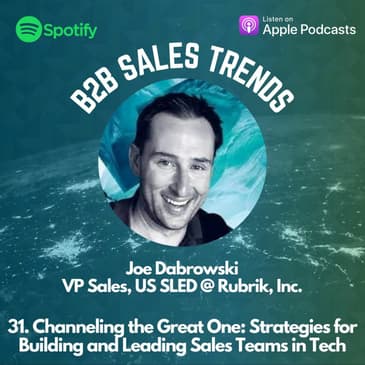
[00:00:00] Welcome to B2B Sales Trends, the podcast dedicated to sales leaders in the B2B space, where we
[00:00:11] share conversations about innovative and successful sales transformations to keep you up-to-date
[00:00:17] on the latest trends.
[00:00:18] This podcast is brought to you by Global Performance Group.
[00:00:22] Welcome yet another fabulous episode of the B2B Sales Trends podcast.
[00:00:28] We show that brings you hacks, tips and thought leadership for sales, marketing and customer
[00:00:34] success.
[00:00:35] It's brought to you by Global Performance Group.
[00:00:38] We are a revenue improvement boutique that implements behavior change within sales organizations
[00:00:43] for salespeople to get the competence, the confidence and the courage to sell and negotiate
[00:00:49] based on outcomes.
[00:00:51] If you're interested we solve three problems for our customers.
[00:00:54] We increase win rates, we reduce sales cycle times and we protect margin leakage in the process.
[00:01:02] Today I have with me Joe Dabrowski.
[00:01:06] Joe is the AVP of Sales for Americas for Public Sector at Rubrik.
[00:01:15] Welcome to the B2B Sales Trends podcast, Joe.
[00:01:18] Harry, how are you doing today?
[00:01:21] I'm very well.
[00:01:22] Thank you.
[00:01:23] It's a pleasure to have you on our show.
[00:01:25] Thank you for making time.
[00:01:26] Yeah, thanks for having me.
[00:01:27] I'm very excited.
[00:01:29] That's such a great program.
[00:01:31] Joe, as a form of introduction, give us a little bit of background about you and share with
[00:01:38] us especially your 20-year experience in the tech sales industry.
[00:01:44] Yeah, yeah, absolutely.
[00:01:45] So I was born and raised in upstate New York.
[00:01:50] Really growing up like many American kids.
[00:01:53] When I was in high school, I got my first kind of sales job.
[00:01:57] I was selling patio furniture and full equipment, learning about the products and understanding
[00:02:03] customer needs and all that.
[00:02:04] It really gave me a lot of energy.
[00:02:08] Going to a decent college in Rhode Island and right out of school, I got my first
[00:02:13] big break.
[00:02:15] It was a career job.
[00:02:17] It was a company called EMC.
[00:02:18] They're a big data storage company sales training program.
[00:02:22] Get up here to learn about the industry, learn about sales, 500-600 cold calls a week,
[00:02:28] get 15 appointments.
[00:02:29] If you do that well, we'll put you in the field.
[00:02:31] So the classic launch into professional sales if you will.
[00:02:39] From there, they put me out in the field and moved around a little bit.
[00:02:44] I made my way to a company called NetApp, which is renowned for its corporate culture.
[00:02:48] I had about eight or nine years there and a variety of roles.
[00:02:52] Had a chance to get into leadership pretty young.
[00:02:55] From there, I went on to do some very large account selling at a company called Splunk,
[00:02:59] which many people are familiar with, acquired by Cisco.
[00:03:02] And then for the last six years, I've kind of grown at rubric starting as a sales
[00:03:08] person, moving up to first line manager, second and third line leadership.
[00:03:12] So it's been quite a ride.
[00:03:14] I've had plenty of great mentors along the way.
[00:03:19] I think that's one thing we'll talk about.
[00:03:21] But I look at this as a lifelong sport of learning, Eric.
[00:03:25] It's something I have to learn every single day.
[00:03:28] Right, right.
[00:03:29] And at rubric, you're leading a team with significant sort of, you know,
[00:03:34] a significant sales component, shall I say.
[00:03:37] Can you share a little bit of your philosophy on building a, you know,
[00:03:41] a successful sales team and how you've applied it there at rubric?
[00:03:46] Yeah, that's a great question.
[00:03:48] I think first of all, it all starts with the people, right?
[00:03:50] So people are the greatest asset, you know.
[00:03:53] Our job is to honestly recruit, retain and then build revenue around the greatest people.
[00:04:00] Right, so you got to have a great recruiting profile.
[00:04:02] You have to have a great recruiting process.
[00:04:05] And you have to be a great place to work, right?
[00:04:08] You have to be a place where people want to come, give them an opportunity to obviously
[00:04:12] make money, to grow their careers, to do new things, try new things, gain new skills.
[00:04:19] So that's really, you know, kind of how we approach the front side of it.
[00:04:24] From there, you know, my job is all about, I guess, building a culture and a support system
[00:04:31] that allows people to be the best versions of themselves.
[00:04:36] So that starts with like, what are your goals right over the next year, two, three, five,
[00:04:40] ten years?
[00:04:42] Figure out their why, right?
[00:04:43] Why are they doing this?
[00:04:44] Why are they working so hard?
[00:04:46] Why do they sign up for such a combat sport, right?
[00:04:50] Like sales.
[00:04:51] Right.
[00:04:52] And, you know, kind of meeting them where they are and helping them get to where
[00:04:55] they want to go, right?
[00:04:56] So taking the blinders off, sometimes people need to, you know, be inspired
[00:05:02] to think bigger, right?
[00:05:04] I've seen time and time again, you know, hey, I want to make X or get here.
[00:05:09] I'm like, you could easily do three times that amount.
[00:05:12] You have the potential, right?
[00:05:14] So inspiring people along the way.
[00:05:17] And then the last piece of it all is really around kind of running a tight
[00:05:22] sales process being very focused on customer outcomes, right?
[00:05:27] Less focused on what we do features and things like that, but really
[00:05:31] focused on solving the biggest problem.
[00:05:34] Big problems require big dollars to solve, right?
[00:05:37] So that's really what we want to attach ourselves to is the biggest
[00:05:40] problem in the room.
[00:05:42] Then how do we do that?
[00:05:43] How do we celebrate customer success along the way?
[00:05:46] How do we help build great champions of our technology, of our software?
[00:05:53] There's a lot that goes into that component.
[00:05:56] I love a few things in what you said.
[00:05:58] You know, the best version of myself, of yourself, of your people.
[00:06:04] What can they be?
[00:06:05] It's been sort of a life mantra of myself now, a couple of years now.
[00:06:11] You know, what do you eat?
[00:06:12] How do you perform?
[00:06:13] How do you train?
[00:06:14] How do you...
[00:06:15] It all sort of contributes to it, to come out as the best version
[00:06:20] of yourself and combine that with a good process around it.
[00:06:25] You know, that's really good.
[00:06:28] You mentioned outcomes and sort of that outcome culture, you know,
[00:06:32] everything we do at our organization is all outcome focused.
[00:06:36] Share your thinking a little bit more why that is so important in your view.
[00:06:42] Yeah, I mean, because at the end of the day, I think anyone that's
[00:06:45] selling something, there should be a business impact to it, right?
[00:06:49] And kind of think back to the old John F. Kennedy NASA story, right?
[00:06:54] John F. Kennedy down visiting NASA and think he saw somebody who was
[00:06:59] kind of cleaning up the trash and kind of cleaning up.
[00:07:01] And he says, Hey, what do you do here, NASA?
[00:07:04] And that person said, I help get people on the moon.
[00:07:09] They weren't taking out the trash.
[00:07:10] They were helping get people on the moon.
[00:07:11] So like, that's how I look at everything.
[00:07:13] So what is that like, you know, unwinding that, what does that really mean?
[00:07:16] Well, first of all, you need to help your customers,
[00:07:19] your prospective customers understand where they are, right?
[00:07:22] What is their current state?
[00:07:24] What is maybe not working for them and what is the impact of that,
[00:07:28] right at a higher level than just, Oh, it takes Billy seven hours to do
[00:07:33] a task, it should take him one, that type of thing.
[00:07:35] It's more is there a big operational impact here?
[00:07:38] Is there a business risk impact?
[00:07:40] Is it preventing us from making more widgets?
[00:07:43] Is it costing us more money to make more widgets?
[00:07:45] Is it limiting our ability to sell widgets?
[00:07:47] What is it?
[00:07:49] Right? So meeting them where they are helping define their current state
[00:07:53] and kind of the negatives associated with that current state.
[00:07:57] Right. And then paint a picture of what's possible.
[00:08:00] Hey, here's what best organizations do.
[00:08:03] Here's how they've solved the problem.
[00:08:04] So a lot of reference selling obviously.
[00:08:06] Right. But then you get this big gap, right?
[00:08:09] We're here, we want to go there.
[00:08:11] What do I need to get there?
[00:08:13] Right. If you can align to that.
[00:08:17] That's when you can build the strongest champion.
[00:08:19] That's where you have the best business case.
[00:08:20] That's where you're aligned to the biggest problem in the room.
[00:08:22] And you can quite honestly go ask for a lot of money to go fix it, hopefully.
[00:08:27] Yeah. Right. Right.
[00:08:29] And I agree with everything you said.
[00:08:32] I couldn't have said it nicer.
[00:08:34] I heard you say when we prepare for this podcast a few days ago,
[00:08:39] you mentioned this concept of building champions and cultural conversion.
[00:08:47] Could you elaborate a little bit and share that with our listeners?
[00:08:51] And how does this play out in the overall sale strategy at Rubrik?
[00:08:58] Yeah, great question.
[00:08:59] I've got a very famous friend, mentor, boss of mine, Brian McCarthy.
[00:09:04] He always says, we don't sell software,
[00:09:07] we build champions who sell software for us.
[00:09:10] I think that's a very important way to look at the world.
[00:09:15] What we do at Rubrik right now is we originally found it 10 years ago
[00:09:21] to modernize, make a cloud ready,
[00:09:23] the backup and recovery aspect of IT.
[00:09:27] Meanwhile, the problem statement has shifted considerably.
[00:09:31] So 10 years ago, it was fire, floods, user errors.
[00:09:34] Those are the reasons you'd have to recover.
[00:09:36] Now you've got the bad guys.
[00:09:38] You've got ransomware attacks, destructive data attacks,
[00:09:42] which used to be really the purview of information security,
[00:09:45] whereas the core backup was a general IT thing.
[00:09:49] Right.
[00:09:49] Those teams weren't on the same bowling teams.
[00:09:52] They didn't go out for beers a lot.
[00:09:54] They'd often not necessarily see the same eye to eye.
[00:09:56] So to fix the biggest problem in the room,
[00:09:59] i.e., the big cyber risk for organizations,
[00:10:03] we need to get security and IT talking together to solve the problem.
[00:10:08] Right?
[00:10:08] So you have to repeat that whole process of like, you're here,
[00:10:11] you've got pain, you want to go here,
[00:10:13] but then do it across multiple silos within an organization.
[00:10:16] And then you get other people involved.
[00:10:18] Financial people, right?
[00:10:19] CFOs care about this because of the loss in the risk,
[00:10:23] governance, risk and compliance folks.
[00:10:24] So there's a lot of kind of people involved
[00:10:27] in this type of really big problem.
[00:10:30] Right?
[00:10:31] So it's about building multiple champions,
[00:10:33] building multiple people who understand the problem
[00:10:36] and define the problem well,
[00:10:38] agree on where they want to go in a time frame
[00:10:41] on how to get there
[00:10:42] and therefore have solved a significant risk
[00:10:44] for the organization.
[00:10:46] Five years ago, that was kind of unheard of, right?
[00:10:48] In this type of thing.
[00:10:49] Now it's absolutely needed to keep pace with the bad guys
[00:10:52] who were coming after you, your data,
[00:10:55] your resident data, your student data.
[00:10:57] Right.
[00:10:57] This.
[00:10:59] Right.
[00:11:01] It's even a little bit,
[00:11:03] I heard this term the other day too,
[00:11:05] it's how do we unite,
[00:11:10] how do we unite all the champions
[00:11:12] within our customer organization for one vision?
[00:11:19] Does that resonate?
[00:11:21] I think it does, right?
[00:11:22] I mean, I think being very prescriptive
[00:11:27] about what great looks like.
[00:11:29] Right.
[00:11:30] And sharing in successive organizations
[00:11:33] that have pulled that off because,
[00:11:35] Yes.
[00:11:35] You know, you're probably well aware
[00:11:38] and you can apply this across,
[00:11:39] it's not just for like security or something like that,
[00:11:41] but there's always more problems
[00:11:44] than ability to fix them, right?
[00:11:46] You can't go from like, hey,
[00:11:48] we got a huge problem to like,
[00:11:49] wow, we marked ourselves safe from this problem.
[00:11:51] You know, go today tomorrow.
[00:11:53] So you got to kind of implement some sort of like,
[00:11:55] I always say crawl, walk, run type of scenario
[00:11:59] where you're consistent, improving,
[00:12:01] you're getting better, you've got a plan.
[00:12:03] It's the same thing.
[00:12:04] Honestly, Harry, you probably see it as like
[00:12:06] how we grow salespeople, right?
[00:12:08] How we do.
[00:12:09] Exactly.
[00:12:10] Right.
[00:12:11] We're going to get them from like,
[00:12:12] hey, I barely understand
[00:12:14] how this new style of selling works
[00:12:16] to like being an expert at it today.
[00:12:19] But over a course of four or six, eight months,
[00:12:21] 10 months a year with very consistent effort
[00:12:26] and feedback and coaching
[00:12:27] and some failure along the way,
[00:12:31] it can be done, right?
[00:12:32] Yeah.
[00:12:34] And I think you,
[00:12:35] the word consistency is key in it.
[00:12:38] And you know, our industry specifically
[00:12:40] over the years has suffered from
[00:12:44] some cowboys out there who, you know,
[00:12:48] oh, let's do a workshop and that will change the world.
[00:12:50] Well, it just doesn't,
[00:12:51] that consistency part is missing
[00:12:54] and you really got to implement that culture.
[00:12:57] You know, and there's a number of things involved
[00:12:59] and I couldn't agree more with you.
[00:13:02] You talked a little bit about
[00:13:06] also about the idea of winning at each stage,
[00:13:11] you know, of sort of a structured sales process
[00:13:14] and making sure you're winning each stage of it.
[00:13:16] And the reason why I asked that question,
[00:13:19] you know, one of the key things
[00:13:22] in the last few months that we continuously hear is
[00:13:26] we need to increase our win rates
[00:13:28] and we need to reduce sales cycle time.
[00:13:30] Now those two elements for me go clearly hand in hand
[00:13:36] by not executing your sales process at each stage.
[00:13:40] Handsome asking the question
[00:13:42] if you can share some experience on that.
[00:13:44] What does that look like at Rubrik
[00:13:48] or in your approach anyway?
[00:13:51] Yeah, so I think you nailed it, right?
[00:13:53] So consistency is the key here, right?
[00:13:57] So being predictable, repeatable, right?
[00:14:00] And, you know, everyone kind of talking about
[00:14:03] opportunities or potential opportunities
[00:14:05] using the same sheet of music, I think is really, really important.
[00:14:08] So start at the beginning, like what is one of the most
[00:14:11] important things you do as a salesperson?
[00:14:13] It's build a qualified pipeline.
[00:14:17] How do you do that?
[00:14:18] Well, you do that by getting out and going and talking to people
[00:14:21] and telling stories and asking questions, right?
[00:14:25] Starts there.
[00:14:26] So the question becomes is when do we identify
[00:14:30] and when do we kind of call out, hey, we've won
[00:14:34] the pipeline generation stage.
[00:14:35] So this is an actual opportunity, right?
[00:14:39] So the way I do it, it's like, OK, if we identified
[00:14:42] a problem we're solving, is the juice squeeze?
[00:14:46] Is there pain there that we can both see, right?
[00:14:49] You're the customer, perspective, customer, the person.
[00:14:52] We agree that, yes, that like that's tough.
[00:14:55] That's stopping you from doing something
[00:14:56] that's adding additional risk, right?
[00:14:59] You've got somebody who's willing to talk to you about this,
[00:15:02] right, a potential champion, right?
[00:15:03] They might not be a champion, but at least they're saying,
[00:15:06] hey, there might be a problem.
[00:15:07] I might need to talk to somebody about it.
[00:15:09] Right. And then we have next step.
[00:15:12] Or was this just a nice like high five vest?
[00:15:16] Right, right.
[00:15:17] If you do that, I would say you have an opportunity.
[00:15:20] Yeah, right.
[00:15:23] Right. And then it's OK, cool.
[00:15:25] How do we win the next stage?
[00:15:27] So an hour in stage one, how do we win stage one?
[00:15:30] What are the things we need to do over the course
[00:15:32] of the next meeting to meetings, three meetings?
[00:15:35] Right. Right. To build momentum
[00:15:37] and ensure that we are starting to define the project, right?
[00:15:42] We're basically just in the project.
[00:15:43] So it's like, who needs to be involved in this?
[00:15:46] What are they thinking about?
[00:15:48] They need to solve it, right?
[00:15:49] What is their criteria?
[00:15:51] What does the pain mean?
[00:15:54] Yeah, right. Hey, we can't do this.
[00:15:56] OK, who cares about that?
[00:15:59] Well, someone so cares about it
[00:16:00] because it stops us from making more widgets.
[00:16:03] Ah, right.
[00:16:05] You've now now to a business, right?
[00:16:06] And then again, as you go down this path,
[00:16:09] your champion, if you will, your potential champion or coach
[00:16:12] should be giving you more information.
[00:16:14] They should be getting more excited
[00:16:16] because they better understand the problem.
[00:16:18] They better understand that there's a solution
[00:16:20] that could fix this great.
[00:16:21] And then if I bring this solution to my CFO, CEO,
[00:16:26] CIO, whoever, it's going to make me look pretty cool.
[00:16:30] That could help my career.
[00:16:31] I got a personal win in it, right?
[00:16:32] So I think if you can focus on just that piece right there,
[00:16:37] that's where I spend a lot of coaching, right?
[00:16:40] That's where I want my first line leaders to coach
[00:16:43] is on that early stage stuff because it's hard.
[00:16:47] It's unknown. It's not defined, right?
[00:16:50] If you're a sales leader and you're spending all of your time
[00:16:53] like, OK, we can get the P.O.
[00:16:54] Wednesday or Thursday, like, listen, I get any orders important.
[00:16:58] But you're not just coaching anything.
[00:17:00] You're not helping your team
[00:17:01] by just ganging on them about which day of P.O. is coming in.
[00:17:04] You're helping them when you're helping them get into the boat,
[00:17:08] finding pain, testing a potential champion,
[00:17:13] you know, all of that kind of hard stuff.
[00:17:15] That's that's where the need.
[00:17:17] Right.
[00:17:19] And so for me, my mind, finding out the pain is one thing,
[00:17:24] right? And I think you've clearly highlighted that that's important.
[00:17:29] We talk a lot of the time of
[00:17:34] pointing people to pain and needs that they didn't know they have,
[00:17:40] or they didn't know or appreciated.
[00:17:45] It will impact their business.
[00:17:47] We call them underappreciated needs
[00:17:50] because I find that all the time when I talk to salespeople
[00:17:53] and obviously talk a lot to salespeople,
[00:17:55] when they come and ask the same old rubbish and boring questions
[00:17:59] that everybody else is asking, it's like, man,
[00:18:04] you're asking me a question and basically you want me to confirm to you
[00:18:09] what quite honestly you should know
[00:18:11] and what are your assumptions at this stage?
[00:18:13] Right. You're not adding any value to me.
[00:18:15] Now, if you ask me questions that are,
[00:18:19] you know, the tough questions, the thought-provoking questions,
[00:18:22] you know, in our methodology, we call them strike-up questions
[00:18:25] because they strike to the heart of the matter.
[00:18:26] But, you know, when you get me to think
[00:18:31] from your types of questioning and point me to needs
[00:18:34] that I haven't thought of before,
[00:18:37] now that adds value to me.
[00:18:39] Does that resonate with you?
[00:18:41] 100 percent. We do it every single day.
[00:18:43] Right. Again, I talked about the market dynamic shifting.
[00:18:46] Right. Right. So, you know, in our world, 10 years ago,
[00:18:50] the backup team didn't care about how protected and hard
[00:18:54] in this environment was, but now it's on everyone's top of mind.
[00:18:57] Right. And there are certain industry buzzwords that they hear
[00:19:01] that like, hey, you know, if I did that one or two things,
[00:19:04] I'd feel safe.
[00:19:05] Well, the reality is we've got to get into the details.
[00:19:07] Right. It's much more nuanced than that.
[00:19:09] And the bad guys are evolving and all that other stuff.
[00:19:12] So a lot of what we do, you know, in our sales process is
[00:19:17] ask the open-ended questions.
[00:19:19] Right. So, you know, to your striker style questions,
[00:19:21] they need to be open-ended.
[00:19:23] It can't be like, hey, do you like gray or red?
[00:19:26] Right. You're not going to get anything there.
[00:19:29] Walk me through how you determine what color you like better.
[00:19:32] Right. That's an open-ended question.
[00:19:33] You can talk more.
[00:19:35] Right. And you can do that to a certain point,
[00:19:37] but people do end up shutting down after a while
[00:19:39] because you feel like a little bit of, wow, this guy's like,
[00:19:43] all over me, I don't have great answers.
[00:19:45] Right. Right.
[00:19:46] The way you, the way I do that is I'll just start telling stories.
[00:19:50] So it's a question to kind of pull more out and pull
[00:19:53] conversation back to center, tell a story to add context
[00:19:57] and why it's important. Right.
[00:19:59] Everybody loves hearing stories, right?
[00:20:01] It diffuses the room, so to speak.
[00:20:03] So that's how I use that to kind of keep that
[00:20:06] conversation moving in a positive direction.
[00:20:09] But at the end of the day, what you're doing is educating customers.
[00:20:12] Right. And if you're educating customers on the problem,
[00:20:16] more than the feature that you might represent,
[00:20:18] you'll be useful to them. Exactly.
[00:20:21] But if you focus on the features,
[00:20:24] I mean, they can go to YouTube and get that, no offense.
[00:20:27] Exactly. And I mean, it's so interesting when I listen to you talk,
[00:20:32] you talk like it's the most normal thing ever.
[00:20:35] But I'll tell you, you're talking here from an extremely high level
[00:20:41] because a lot of salespeople
[00:20:46] are rubbish at what you have just described, they should be doing.
[00:20:51] And so great learning.
[00:20:54] Share with me your thinking on, so we've identified the pain now.
[00:20:58] We made sure we've identified different needs
[00:21:01] that they haven't thought of before and so forth.
[00:21:06] The idea of increasing win rates
[00:21:09] and reducing sale cycle time has a lot to do also
[00:21:13] with how we create urgency.
[00:21:17] Now, in my mind, that's also something you can very much incorporate
[00:21:22] in your articulation of how you articulate the value
[00:21:26] you can bring and the outcomes that you can bring.
[00:21:29] Share with me your thinking of the idea of create urgency to close.
[00:21:35] Yeah. I mean, it's a great, great point.
[00:21:37] Right. And it's, I think one of the,
[00:21:40] when you get past some of the first stuff
[00:21:42] we talked about, the reps that can do this well and build,
[00:21:46] I call it build momentum and create that urgency
[00:21:50] and like the why now.
[00:21:52] Right? If you had to think of it, why do we have to do anything?
[00:21:54] Why do we have to do it now?
[00:21:56] That becomes really, really critical.
[00:21:58] Right? So I think there's a few components to it.
[00:22:01] Right? One is when you're doing prospecting,
[00:22:06] there might be multiple, like I described what we do,
[00:22:09] there's multiple stakeholders associated with many of these problems.
[00:22:12] Right? And they all have a very different point of view.
[00:22:14] Right? So you doing your research and getting ready to have a conversation
[00:22:18] with these, you should have a point of view for that persona.
[00:22:22] Right? Right? So you could get to, you know, in my world,
[00:22:26] it could be the IT group and then it could be security ops.
[00:22:28] And they could all be like, yeah, this is important, but not urgent.
[00:22:32] Right?
[00:22:34] Wouldn't you know, you get to the risk compliance folks
[00:22:37] and they're like, oh, we just got our cyber insurance rate
[00:22:40] and if we don't do something, we have to pay a bunch of money.
[00:22:43] Right? Urgency back in, but I wouldn't have got there
[00:22:47] had I not been prospecting.
[00:22:48] Still, I'm in the game.
[00:22:50] I still need to keep prospecting.
[00:22:52] Yeah, right. Right?
[00:22:53] Because I need more points of view.
[00:22:54] Right? Right?
[00:22:56] And these campaigns, like the ones we run,
[00:22:58] I call them W-style campaigns
[00:23:01] because we do insert ourselves towards the top of the stack.
[00:23:04] Oftentimes we get pushed down to go get more data,
[00:23:07] but you got to come back with an important updated point of view.
[00:23:10] Hey, I learned this, right?
[00:23:12] Because then you're valuable to the executive.
[00:23:14] It's not just that you're actually like helping them.
[00:23:18] Right? So I think that helps build urgency
[00:23:20] because you're mapping to an executive's understanding
[00:23:23] of the problem and why they need to do it now.
[00:23:25] Right? Right?
[00:23:27] And then what is the risk?
[00:23:29] I think that's the last piece is like
[00:23:32] there could be a financial reason to do this.
[00:23:34] In other words, you know,
[00:23:35] our stuff is cheaper than your old stuff.
[00:23:37] Okay? Right. Right. Right.
[00:23:39] But solving a risk problem
[00:23:42] or solving a revenue protection problem
[00:23:43] or helping a customer get a product to market quicker,
[00:23:47] we'll naturally catch more urgency then,
[00:23:50] hey, we're going to save 10% on our car insurance.
[00:23:52] Right? Yeah, exactly.
[00:23:54] Exactly. People make decisions out of two reasons.
[00:23:57] Out of one or two reasons,
[00:23:58] shall I say either to avoid a risk or to gain an outcome.
[00:24:01] And if you can't speak to either of those,
[00:24:03] then I'm going to make a decision.
[00:24:05] Simple as that.
[00:24:06] Yeah.
[00:24:07] It's like an operational or technical need
[00:24:09] versus a business critical need.
[00:24:11] Right?
[00:24:12] Again, tie yourself to the biggest problem.
[00:24:13] You'll get the biggest dollars.
[00:24:16] Outcome, the biggest dollars. Right?
[00:24:20] You shared with me and you mentioned
[00:24:21] the three things sellers need to improve.
[00:24:23] My final question on every single podcast that we do,
[00:24:28] the three things sellers need to do exceptionally well
[00:24:31] to be at an elite level.
[00:24:33] And you shared with me a cool story
[00:24:35] that I would love you to repeat again for our listeners.
[00:24:39] That's the Wayne Gretzky story,
[00:24:42] I believe you're a hockey fan.
[00:24:45] And so share that with our audience.
[00:24:47] I thought that was very fitting.
[00:24:49] Yeah. I mean, so, you know, Wayne Gretzky
[00:24:51] from the time he was a very little boy
[00:24:55] was a student of the game of hockey.
[00:24:57] His father used to make him sit there and watch TV
[00:25:00] and have a piece of paper in front of him
[00:25:01] and literally just without looking,
[00:25:04] follow the puck with a pencil or pen around the rink,
[00:25:07] which was a piece of paper.
[00:25:09] So we got a sixth sense, if you will, for the game.
[00:25:13] And I think the best salespeople do that.
[00:25:15] So you look at Wayne Gretzky, he wasn't the biggest dude.
[00:25:17] Sure, he was a little bit fast
[00:25:18] and could shoot well, a great backhand.
[00:25:20] All of those things, he had good skills,
[00:25:22] which many salespeople do.
[00:25:24] But he had this sixth sense about the game where
[00:25:27] as he was carrying the puck into the attacking zone
[00:25:29] he would curl off is a way to let the kind of play develop
[00:25:34] and give him that extra second or two to make that better play.
[00:25:38] Like the best possible play.
[00:25:40] And that's very much how I look at sales, right?
[00:25:43] The people that are in full control
[00:25:44] of all of their skills and all of their creativity
[00:25:47] and all of that in the moment
[00:25:50] because they understand it so well
[00:25:51] they'll have extra time to make the best play possible.
[00:25:54] When you're brand new at it, man, those players are big.
[00:25:58] They're fast, they're coming at me quick.
[00:26:00] I don't have a lot of time.
[00:26:01] I gotta move quicker, right?
[00:26:03] When you become a pro and an expert
[00:26:05] and really focus on the consistency of practicing hard
[00:26:10] you'll have that extra time to make that better play.
[00:26:12] Better plays result more goals,
[00:26:14] more goals or more money in your pocket.
[00:26:15] Better customer outcomes, everyone's.
[00:26:19] Being in control and take control, love it.
[00:26:23] Love it, absolutely love it.
[00:26:25] Joe, you've been a fabulous guest
[00:26:28] and a super addition to our podcast series.
[00:26:31] Thank you so much.
[00:26:32] I know our listeners very, very much appreciate your insights
[00:26:35] and thought leadership.
[00:26:36] Thank you for taking the time.
[00:26:38] Aaron, this has been awesome.
[00:26:39] I really appreciate what you do.
[00:26:40] Thanks for having me on
[00:26:41] and thanks for sharing all your wonderful content.
[00:26:44] We really appreciate it.
[00:26:46] Absolutely.
[00:26:47] For our community of listeners and my dear people
[00:26:49] two calls to action here.
[00:26:51] Share this podcast if you think someone would benefit
[00:26:54] from the learnings, from the great input
[00:26:56] that Joe has passed on here.
[00:26:59] The second go to globalperformancegroup.com
[00:27:02] sign up for free to the Global Sales Hotel.
[00:27:05] We share a lot of cool content, templates, webinars,
[00:27:09] podcasts, all these wonderful things over free.
[00:27:11] So sign up and get this content.
[00:27:14] Look after yourselves until the next time.
[00:27:17] Happy selling and speak to you soon.
[00:27:19] Bye-bye.