
[00:00:05] Welcome to B2B Sales Trends, the podcast dedicated to sales leaders in the B2B space, where we share conversations about innovative and successful sales transformations to keep you up to date on the latest trends. This podcast is brought to you by Global Performance Group.
[00:00:22] Welcome yet to another fabulous episode, my dear people, of the B2B Sales Trends podcast, the show that brings you hacks, tips, thought leadership for sales, marketing, and customer success.
[00:00:35] It's brought to you by Global Performance Group. We are a revenue improvement boutique that implements behavior change to provide salespeople the confidence, confidence, and courage to sell and negotiate based on customer outcomes.
[00:00:50] We solve three problems for our customers, which is we increase their win rates, we reduce their sales cycle time, and protect their margins.
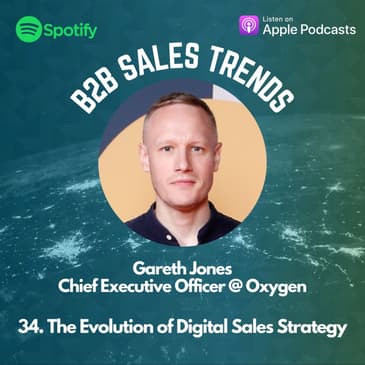
[00:01:00] My name is Harry Kendelbacher, and today I have with me Gareth Jones. Gareth is the CEO of Oxygen. Welcome to the B2B Sales Trends podcast, Gareth.
[00:01:13] Thank you, Harry. That's an excellent introduction you've got there. You really hit your USPs all the way through.
[00:01:20] Absolutely. Absolutely. Not my first time. Thank you. Gareth, as a form of introduction, give us a little bit of an intro about yourself, your organization that you've built over many years.
[00:01:34] We've known each other for quite a few years at this stage. So give us a little bit of background for our listeners about you and your company.
[00:01:42] Sure. I think I'll start with the company first and work backwards, if that's okay.
[00:01:48] So I'm the CEO of HubSpot Solutions partner Oxygen. We've been HubSpot Solutions partners since 2013, made an unusual decision to become a solutions partner in mainland China.
[00:02:02] And I'll get to why that's unusual and what the challenges were in a little bit.
[00:02:07] So in terms of Oxygen, what we do is create digital leaders on HubSpot through unifying marketing, sales, and customer service.
[00:02:18] So in terms of how I ended up running Oxygen, how I ended up in China, probably from my voice and from the video, people realize I'm not Chinese.
[00:02:29] Name's a little bit of a giveaway as well.
[00:02:32] So essentially, when I was 24, I was outsourcing software to China.
[00:02:40] So I had a lot of Chinese friends for my master's degree program in the UK, studied computer science, and my professors were Chinese.
[00:02:48] That was back in 2007, 2008.
[00:02:52] So at that time, China, I think, was the number three economy globally.
[00:02:57] And I just knew it was the next big thing.
[00:02:59] I was constantly reminded.
[00:03:01] I had a contract in London for three months, and there was a big sign on the tube saying, you know, China's going to be the next big thing.
[00:03:10] And I was just surrounded by Chinese people.
[00:03:11] And I thought, right, I need to get a piece of this.
[00:03:15] Started outsourcing, and, you know, I hit a few bumps.
[00:03:19] I was communicating directly with the software developer, undercutting his manager sometimes.
[00:03:25] I made him lose face.
[00:03:26] So there's a few kind of funny, interesting things that happened initially.
[00:03:29] And I thought, I'm only really going to get a handle on this if I go out there.
[00:03:34] So I asked my university professor, hey, can you set me up with a teaching gig in China that will enable me to live in China, have a visa while I go about setting up my company?
[00:03:47] So I managed to do that.
[00:03:50] That was a little bit of a, you know, winding road to get there.
[00:03:54] Originally, I was due to go to Beijing, the capital.
[00:03:57] Later on, it was Zhengzhou, which is a tier two city.
[00:04:00] And then closer to the time, the agent was like, it's near Zhengzhou.
[00:04:05] And being 24, I was like, okay, fine, you know, whatever.
[00:04:09] I'll just run with this.
[00:04:11] I actually ended up in a tier three city called Zhumadian.
[00:04:15] There's, I think, five other foreigners in a city of around a million people.
[00:04:19] So I ended up right in the middle of China.
[00:04:25] You couldn't buy things like cheese and deodorant just to give you like an idea of how non-Westernized this place was.
[00:04:32] No one spoke English.
[00:04:33] So it was challenging, but it was a fantastic place for me to learn Chinese language.
[00:04:39] And I think, crucially, Chinese culture.
[00:04:41] Most people in China are from these tier three cities where there's around a million people that you've never heard of that you wouldn't necessarily see on the news.
[00:04:49] So I spent eight months there, finished up my contract at the university, and then moved down to Shenzhen.
[00:04:55] Shenzhen, basically the tech capital of China.
[00:04:59] One of my mates from my master's degree program already had a software company in Shenzhen.
[00:05:06] So he employed me in that company.
[00:05:08] I gave him shares in the UK company.
[00:05:11] And for five years, we did a bunch of software projects in mainland China.
[00:05:17] So around energy management, energy monitoring, and things like that.
[00:05:21] And that gave me a really good experience and feel for selling in China, working with Chinese staff and things like that.
[00:05:31] What I did realize through that experience, though, was I wasn't particularly good at sales and marketing.
[00:05:36] I was an entrepreneur, but very much engineering mindset.
[00:05:42] And I sort of realized, yeah, if I really want to grow my business, I need to think more like a sales guy, more like a marketer.
[00:05:52] I think it was then 2013.
[00:05:55] A friend of mine, Dan, he founded a company called Oxygen.
[00:05:59] So this is not my baby.
[00:06:01] This is my adopted baby.
[00:06:03] Dan, at the time, was global communications manager for TP-Link.
[00:06:08] So they're a massive global writer, manufacturer, provide networking solutions.
[00:06:14] He realized that we could potentially assist in creating more companies like TP-Link.
[00:06:22] He saw TP-Link go from a small one-floor office in Shenzhen to what it is today.
[00:06:31] And he was like, hey, we can do this for other companies.
[00:06:34] So we started out marketing for manufacturers in China, and that's what led us to HubSpot.
[00:06:42] We realized that these manufacturers, they usually have some sort of ERP system, but they didn't have a CRM.
[00:06:49] They didn't have any marketing.
[00:06:50] They were just listing their products on Alibaba or relying on external distributors.
[00:06:56] So that's kind of how we started, targeting generally second, third-tier manufacturers.
[00:07:03] We couldn't go in for tier one at the beginning and helping them sell their products overseas.
[00:07:13] Interesting.
[00:07:15] You've, you know, since you've become the CEO of Oxygen in 2017, I think it was, right?
[00:07:26] You're very modest about your description, by the way, because I've known quite a bit about the company.
[00:07:32] You really have grown Oxygen into a fantastic world-class digital agency.
[00:07:39] Apparently, according to my researcher, with an MPS score of 82 and an extremely high customer retention rate.
[00:07:49] So fantastic.
[00:07:49] Can you talk a little bit about the initiatives that played a role in achieving that level of retention and growth and what you've done as a company owner and leader to achieve that success?
[00:08:05] Yeah.
[00:08:05] So I think one of the foundations is the core values.
[00:08:09] So up until 2017, I was the CTO.
[00:08:13] My business partner, Dan, at the time was the CEO.
[00:08:16] He later moved to Ogilvy and went in a different direction.
[00:08:22] When I became CEO, I realized that we really need to build a culture and a culture that's tied to values and values that are tied to behaviors.
[00:08:32] So we went about thinking, okay, what do we really care about?
[00:08:37] So we went through the Barrett values assessments, where essentially you just pick out your core values.
[00:08:44] Other members of leadership and the team did the same thing.
[00:08:47] And we arrived at some core themes.
[00:08:50] Humility being one of them.
[00:08:53] Excellence being another.
[00:08:56] Also at the time, integrity, curiosity.
[00:09:00] So we really had those things in mind from the beginning.
[00:09:05] And then we tied those to certain behaviors.
[00:09:08] So humility, we would tie that to, okay, if the client gives you bad feedback, what do you do?
[00:09:16] You know, are you going to fast and attack the client?
[00:09:19] Or are you going to calmly, you know, take that feedback on board and try to work out, okay, is there actually something in that?
[00:09:25] Is there a valid thing that we need to sort out?
[00:09:27] So building those values in from the start, I think, was really important.
[00:09:32] And they've evolved a little bit over time.
[00:09:35] So we added efficiency because we realized as an agency, it's crucial for our profitability.
[00:09:42] And initially, I think we were, sometimes I think we cared more about our client's business than our own business.
[00:09:49] Like, I really felt sort of emotionally involved in other people's businesses because at the time, we were mainly working with medium-sized companies where we had a lot of autonomy, a lot of control.
[00:10:01] And we were given almost free reign as consultants to change the business processes.
[00:10:07] And you'd really get involved in other people's business, their P&L and other things.
[00:10:11] I mean, it was almost like we'd speed run our way to be consultants without doing the requisite, you know, Bain-McKinsey qualifications.
[00:10:20] We just sort of ended up doing that based on our experience with the manufacturers.
[00:10:26] So a combination, I think, of really caring whether we do a good job.
[00:10:30] As a person, I've always really cared about that.
[00:10:33] Even at school, you know, I'd want to do well.
[00:10:35] I'd want to get good grades for me.
[00:10:37] My business partner is very competitive as well.
[00:10:40] So I think that bled down into the organization and also focusing on the employees.
[00:10:46] So a lot of marketing agencies, they would typically make people do OT, work on weekends, very reactive.
[00:10:54] Probably most people's perception of a marketing agency is that someone on the phone, very busy, you know, just multitasking.
[00:11:01] We decided that we wouldn't do that.
[00:11:04] We decided that you will work your 9 to 5.
[00:11:07] You'll work your 40 hours.
[00:11:08] If you do more than that, you'll get paid overtime.
[00:11:11] We offered holidays beyond what you would normally get in Hong Kong.
[00:11:16] Probably for you in Austria, you would not think this is great.
[00:11:20] But we offered four-week holidays in Hong Kong.
[00:11:23] And we also did that in mainland China.
[00:11:25] Mainland China is typically, you know, five to seven days.
[00:11:29] It's really not a lot.
[00:11:30] So I think by focusing and really caring about the clients, caring about their business,
[00:11:35] actually caring about the team, you're going to get better work and you're going to get clients that stick as opposed to just doing a very, you know, sales first motion where you just churn through a load of clients.
[00:11:50] You get a bunch of sales people and you keep getting new clients.
[00:11:52] We thought, okay, we're getting clients from inbound marketing.
[00:11:56] We don't have to really push the sales initially.
[00:11:59] And if we keep them, it's a lot easier for us to upsell.
[00:12:03] And it's a lot nicer working with these clients that we care about and we have these good relationships with.
[00:12:10] Do you agree with the ratio of 80-20 saying that 80% of your business should come from your existing clients and 20% from new clients?
[00:12:20] If you will get to that level of an organization such as where you are right now, do you agree with that ratio?
[00:12:28] 80-20.
[00:12:31] I guess it depends, right?
[00:12:32] So it depends on market conditions, right?
[00:12:36] I mean, most of you would notice you also work with MNCs.
[00:12:41] A lot of your clients would have noticed this.
[00:12:43] It's harder to clothe business and it's harder to upsell now.
[00:12:45] It's harder to kind of do everything.
[00:12:47] But if you were able to grow those accounts that you've already got, it is so much easier.
[00:12:52] So, yeah, if you were growing that 80% of the accounts and you're growing them 30-40% and you're just adding 20%, well, fine.
[00:13:03] That's great.
[00:13:04] Right.
[00:13:05] Under the assumption that you can grow those accounts.
[00:13:08] And what we notice in marketing in general, so up until about 2021, even into 22, we had 85% retainer revenue.
[00:13:20] So guaranteed monthly revenue.
[00:13:22] I know it was amazing.
[00:13:25] We don't quite have that now.
[00:13:28] We dropped down to about 60%.
[00:13:30] Now we're up to about 75%.
[00:13:32] But that enabled us to do a lot of things and allow the employees to spend time on training and things like that.
[00:13:37] So, yeah, I think broadly that 80-20 rule for a lot of things is pretty good.
[00:13:43] And, yeah, especially in this case, upselling is a lot easier than closing new business.
[00:13:48] So you talked about marketing conditions and you obviously serve the Chinese market.
[00:13:54] What are sort of the challenges and opportunities that exist in that market as well as how do you have to tailor your services to the digital landscape within China?
[00:14:12] I'm curious about that.
[00:14:14] Good question.
[00:14:16] And it's changed a lot since we started.
[00:14:18] So I think the key thing is the technology piece.
[00:14:21] Google, Facebook, even HubSpot to a certain extent.
[00:14:26] Many other software as a service platforms simply do not work in China.
[00:14:31] So you are operating on a completely different technology ecosystem.
[00:14:38] You're operating on WeChat.
[00:14:41] You're operating on Little Red Book.
[00:14:42] You're operating on other platforms.
[00:14:44] I think the second part is the way people work.
[00:14:49] In the West, people are a lot more proactive.
[00:14:51] Or in an ideal situation, people are more proactive.
[00:14:56] China is very, very reactive.
[00:14:59] So one thing we observe, say, with a company that's adopted HubSpot for sales globally and they want to use us for HubSpot for sales in China,
[00:15:09] it's very difficult to get the team out of using WeChat as their CRM.
[00:15:17] So WeChat for context, you could think of it like WhatsApp, plus plus, many other things.
[00:15:23] You can do a lot of things in WeChat.
[00:15:24] So they're essentially using a personal messenger service for all their sales interactions.
[00:15:29] And if you don't have a CRM, how are you prioritizing?
[00:15:32] How are you specifying which of these leads is high priority and we need to pursue?
[00:15:38] You're essentially just reacting to who's sending the messages.
[00:15:41] So I think changing that behavior or at least adjusting to that behavior a little bit is definitely one of the biggest challenges we face internally
[00:15:51] and faced with assisting our clients with the sales piece.
[00:15:56] On the sales side, it's changed dramatically.
[00:16:01] So previously, it was very informal.
[00:16:04] So from 2013, 14, 15, even at the MNC level or Chinese MNCs, there would be relationship building, drinking,
[00:16:14] a lot of those sort of prerequisites that you kind of had to do.
[00:16:18] We saw a big change just before COVID and even more so in COVID to China's manufacturers having really tight procurement processes.
[00:16:29] So they went from nothing, and this is quite common with things in China.
[00:16:33] It'll go from absolutely nothing to, oh, wow, this is a really, really thorough procurement process,
[00:16:40] more so than we're experiencing in the West.
[00:16:43] And also there's technology and political considerations.
[00:16:46] We sell HubSpot.
[00:16:49] HubSpot is a U.S.-hosted service.
[00:16:51] Sometimes we don't win projects simply because it's U.S.-hosted.
[00:16:56] And we never had those challenges before.
[00:16:59] So it's interesting how it's evolved and how Chinese companies have become more sophisticated
[00:17:05] and how we weren't dealing with procurement before.
[00:17:08] Now we're dealing with procurement plus a very strict laundry list of technical requirements that we didn't have to go through before.
[00:17:19] Okay.
[00:17:20] So quite a very diverse and very, very different marketplace that you need to go into with an American-hosted solution,
[00:17:30] which is interesting, and I can very much relate to that, to those challenges.
[00:17:37] You know, you mentioned, you know, marketing, a little bit of inbound marketing.
[00:17:45] You know, converting more leads, winning more business, shorten sales cycle, you know, build a stronger online presence for your clients.
[00:17:59] With a focus on inbound marketing, what are the key strategies that you help your client or implement yourself to achieve those goals?
[00:18:08] What are sort of the things that you implement?
[00:18:11] What are sort of the thinking and the strategies on those topics?
[00:18:16] Yeah, good question.
[00:18:18] The key thing is niching.
[00:18:19] So whether it's us, whether it's for our clients, it's finding what your niche is and working it.
[00:18:27] So for you guys, you do sales training broadly, but it's a much bigger topic than that.
[00:18:34] You know, you've got certain market segments that you work with.
[00:18:38] You work very specifically around improving and changing the behavior of salespeople.
[00:18:44] So you have specific niches within, you know, the sales market.
[00:18:49] For us, okay, we do HubSpot.
[00:18:52] Thousands of agencies do HubSpot now.
[00:18:54] So what we did from the beginning was always HubSpot and China, HubSpot and WeChat.
[00:19:00] So whatever we were talking about was specific to this market.
[00:19:04] Or if we're talking about total cost of ownership, we wouldn't make it general.
[00:19:09] We would make it very specific to, okay, you're a business in Hong Kong.
[00:19:15] You were using Salesforce plus whatever other software, plus maybe you need to integrate with China.
[00:19:21] How would that compare with moving to a HubSpot tech stack?
[00:19:26] So our approach has always been to niche, either by what your value proposition is or by your industry,
[00:19:33] and then get very specific on the types of advice you're offering.
[00:19:37] You're probably not going to get as many visitors or views, but those aren't always the best metrics.
[00:19:43] We find some of our best performing blogs and content, maybe they get like 20, 30 views a month,
[00:19:50] but we might get four or five people converting on that content because it's decision stage,
[00:19:56] it's niche, and it's relevant to one of our buy personas, which could be, you know,
[00:20:02] private medical in Hong Kong.
[00:20:03] It could be a Chinese manufacturer going over at Seas.
[00:20:07] Whatever it is, it's very specific to that thing.
[00:20:09] So if there was one piece of advice I would give, it would be just get specific and niche with your content,
[00:20:17] especially with the changes to the landscape with AI.
[00:20:22] AI is an amazing tool, but we're going to get a deluge of mediocre chat GPT content.
[00:20:28] You can already see it now.
[00:20:31] There are many research papers published with very clear, like, you know, chat GPT, introductions.
[00:20:39] That's only going to continue.
[00:20:41] So I think it becomes even more important to niche and be specific about the advice that you're providing
[00:20:47] to your buyer personas.
[00:20:49] Talking of which, how do you see AI impacting the future?
[00:20:56] It's a big, big topic, but how do you see AI impacting that future of marketing and sales?
[00:21:03] And what are you doing with an oxygen to leverage AI in your services?
[00:21:12] All right.
[00:21:14] It is a big question.
[00:21:15] It's a good one.
[00:21:16] It's one that everyone's been talking about some time with good reason.
[00:21:19] So if I think of our AI journey, so it probably started now about a year and a half ago.
[00:21:27] We realized that, you know, GPT, generative AI, large language models, they're going to have
[00:21:34] a massive impact in the world.
[00:21:36] And it weighs three to five years.
[00:21:39] We can't even get our heads around.
[00:21:41] But we've got to focus on the year and hour and what we can do.
[00:21:44] So the first thing that we did as an organization was, what are we doing now that's going to get
[00:21:51] subsumed by AI soon?
[00:21:53] What is going to be commoditized or easier to do because of AI?
[00:21:58] So, for example, blogs, content.
[00:22:01] We realized that being more of a creative agency on that side wasn't in our interest.
[00:22:08] And in terms of the hires from that point, we focused more on solutions architect type roles
[00:22:16] because AI is not great at second and third order thinking.
[00:22:22] What I mean by that is, I don't know, take electric cars.
[00:22:27] So there are many arguments for and against electric cars.
[00:22:31] And you could ask the AI, what do you think of buying an EV?
[00:22:35] And it would give you a list of, you know, pros and cons to it.
[00:22:38] It wouldn't necessarily jump to the implications of electric vehicles.
[00:22:44] For example, what would happen to gas stations?
[00:22:48] Would, because people buy cigarettes at gas stations, would the amount of people smoking
[00:22:54] cigarettes decrease as a consequence of these things?
[00:22:57] I know it's not an important thing to think about, but it can't quite make those mental
[00:23:02] leaps yet.
[00:23:03] So, you know, it's pretty good at the moment, but it can't quite make those mental leaps.
[00:23:08] And we thought, okay, those kind of mental leaps and that kind of strategic solutions
[00:23:14] thinking is something that's going to be one of the last things to go.
[00:23:19] So in terms of our offering, we used to do more commoditized content like blogs, social
[00:23:24] media posts, those kind of things.
[00:23:26] We still do them a little bit, but not to the same quantity we used to.
[00:23:29] We focused our service offering, our communications, our marketing messages on HubSpot training,
[00:23:36] solutions architecture, HubSpot migration.
[00:23:40] And yeah, as a result, we are doing more profitable business and we're doing more resilient
[00:23:45] business that is not necessarily going to be taken by AI.
[00:23:51] So that was one of the first things we did.
[00:23:53] Then we were like, okay, how can we use AI in our agency?
[00:23:58] So one of the most obvious ones is creating content.
[00:24:02] So creating a GPT or co-pilot, you don't necessarily have to tune it, but at least pre-prompting it.
[00:24:12] That means giving it a preset of instructions to do things in a certain way that you want to make sure that it understands a certain topic or understands your tone of voice or whatever you want to get out of it.
[00:24:23] So we're using it a lot for writing.
[00:24:26] We were using it for sorting and categorization.
[00:24:29] So one thing that you can do is add it to a sheet and it can summarize data and cells of the sheet.
[00:24:37] Or for example, if you're using ABM tools like Apollo, which they're great tools, they help you enrich the data and know more about companies.
[00:24:47] You could ask it, for example, pull all the data out of Apollo for your target companies and ask it, okay, does this company manufacture in China?
[00:24:57] Or something like that, that would take extra digging.
[00:25:01] GPT would be able to take information about the company and know, okay, yes, this one manufactures products or no, this one doesn't.
[00:25:08] This one's likely a buyer.
[00:25:10] Even if it doesn't get it perfect, it will give you extra insights that you wouldn't necessarily have.
[00:25:17] And you can automate that very quickly.
[00:25:18] So that's one thing we don't see a lot of companies doing until we tell them to do it.
[00:25:25] But it's very, very useful to use it for that kind of sorting, filtering, data enrichment side of things.
[00:25:34] So really the research part of that, who are going to be my target customers, who are going to be my ICPs in my sales process, that all becomes a lot more easier and more efficient to do.
[00:25:49] Do I understand that right?
[00:25:51] Yeah, exactly.
[00:25:52] Because if you think of your target accounts, it's basically an algorithm anyway.
[00:25:57] It's instructions, size of company, location, what type of product.
[00:26:01] So anything that is some kind of algorithm, you can usually add that GPT layer on top, run whatever data you have, and you'll just do it a lot faster.
[00:26:11] Instead of getting your sales intern to be churning these things out and trying to do it, boom, you can press the button and you can have thousands of companies, tens of thousands of contacts tiered as you want into your target segments.
[00:26:26] Do you think AI will replace salespeople at some point?
[00:26:30] So there are different sales roles, right?
[00:26:35] You've got technical sales, you've got SDRs, you've got different roles.
[00:26:41] I think it will change the dynamics for salespeople and it will raise the bar.
[00:26:48] So probably what's going to happen, and I'm already seeing it, you've probably seen it in your inbox.
[00:26:52] You get more of these GPT type emails that are probably not that targeted to you and your company.
[00:26:59] But, you know, you're getting drowned in this kind of first touch communication.
[00:27:05] That's going to continue.
[00:27:07] People are going to want to have conversations like this.
[00:27:09] They're going to want to speak to real people.
[00:27:12] And a lot of that filtering, sorting, and other things can be done with AI tools.
[00:27:19] So if you're a sales manager or a sales director, strategically thinking, you'd be like, okay, I probably just need one or two very good salespeople with excellent networks that have access to these tools,
[00:27:35] as opposed to an army of, you know, mediocre salespeople that can execute, that can follow a plan, but don't have the necessary, you know, empathy, ego, drive, charisma, all the kind of attributes that you would want in a salesperson.
[00:27:52] So I think it might reduce the size of sales teams and increase the value of those, you know, high quality sales reps, if that makes sense.
[00:28:03] Right.
[00:28:04] Right.
[00:28:05] Which I completely agree with your assessment here.
[00:28:09] I think the skills portion of salespeople just needs to elevate to an elite level.
[00:28:17] If you want, if sales is your profession of choice, you really need to up your game in terms of the skills and behaviors that you need to execute, giving this all AI, which will be sort of placed around.
[00:28:35] The sales process and plugged into the sales process everywhere.
[00:28:38] But there's still that human aspect.
[00:28:41] I love the term that you use, that mental leap.
[00:28:47] And I agree with you.
[00:28:49] It can't be replacing salespeople just now.
[00:28:53] So that's good.
[00:28:55] We talked a little bit how sales will evolve just now.
[00:29:02] This digital transformation.
[00:29:05] What do you think that sales leaders need to be aware of considering the whole digital transformation landscape?
[00:29:14] I guess as a sales leader, there's a few things, right?
[00:29:17] Right.
[00:29:18] One of the key things is the products or services you're selling.
[00:29:21] You may not have complete control over that, but you're the person with your ear to the ground, knowing what your customers are saying, right?
[00:29:29] So working with product to work out is what we're really selling worthwhile.
[00:29:35] And feeding back quickly, I think, is incredibly important.
[00:29:38] You know, maybe sales leaders don't feel that that's their main responsibility.
[00:29:41] But I think that is probably one of the first things.
[00:29:45] The other big thing is the total cost of ownership of tools.
[00:29:50] So software platforms and ecosystems are getting more complex.
[00:29:55] Things are getting more expensive.
[00:29:58] So getting on an ecosystem or a platform that your team can use, that everyone is trained on,
[00:30:06] that is actually giving you a return on investment is probably more important than ever.
[00:30:11] I mean, if you look back at the peak mid sort of COVID, where a lot of companies were hiring like crazy and the SaaS companies were doing incredibly well,
[00:30:22] we've seen that, you know, really downturn now into probably what is a more realistic market.
[00:30:27] And I think sales leaders are going to have to look at their tech stack and look at it from not just an IT point of view.
[00:30:34] So something we see a lot of in Hong Kong is the IT director has a lot of control over the tech stack and over the tools that salespeople are using.
[00:30:44] Whereas really, the sales director, the sales leader really needs to take control of that and sure, use the expertise of IT, but work out, am I getting value for this?
[00:30:56] Are salespeople actually putting things in the right pipelines?
[00:31:00] Are they using meeting links effectively?
[00:31:03] Am I getting all the data points that I want?
[00:31:05] I paid a lot of money for Apollo to enrich data, you know, with my CRM, whether it's Salesforce, Salesforce, whatever.
[00:31:12] Am I using it?
[00:31:13] Are the salespeople using it?
[00:31:15] So performing an audit on a tech side on what's working.
[00:31:20] So that's kind of more our space and what we take care of.
[00:31:24] But I think probably the most important thing aside from that is making sure the salespeople have robust networks because AI is going to depersonalize a lot of stuff.
[00:31:36] We're going to get sick of AI generated videos, which are indistinguishable from video.
[00:31:44] I don't know if you've seen the updates on Sora.
[00:31:48] I feel like they're almost holding it back maybe, you know, with a push from government to say, hey, we're not ready for this.
[00:31:54] We don't have the laws and infrastructure.
[00:31:57] But imagine a world within a year or so where you and I can create a one or two minute video about anything we want, basically by giving it a storyline and a prompt.
[00:32:07] We can already create images that are indistinguishable from reality.
[00:32:12] So people are going to increasingly want to deal with other people.
[00:32:16] So I think the whole near-bound concept, I'm not sure if you're familiar with that term.
[00:32:22] Yeah.
[00:32:23] So I think near-bound is going to be good.
[00:32:25] But the planning part of you is that will be good.
[00:32:27] I'm not sure if everybody is.
[00:32:29] Yeah.
[00:32:30] So a good example would be our two companies.
[00:32:34] So we both service multinationals.
[00:32:37] So we've got a crossover in potential customers we can sell to.
[00:32:40] You use HubSpot.
[00:32:42] I use HubSpot.
[00:32:44] What we can do is I could, for example, say for all my customers and former customers, I'm going to service those to Harry at GPG.
[00:32:55] Harry is going to do the same for me.
[00:32:57] We would obviously sign, you know, a non-disclosure agreement and a partnership agreement and other things.
[00:33:02] But the fact that you know those customers, you've already serviced them well, will definitely give me a massive leg up in any negotiations I have.
[00:33:10] That would work reciprocally with you.
[00:33:13] And I guess beyond the database sharing, there's doing stuff like this podcast.
[00:33:17] You know, like co-branding things, maybe doing benchmarking reports.
[00:33:23] There's a lot of different things that people can do.
[00:33:26] But partnering up and utilizing other resources is going to be so important when we're drowning in AI-generated content, images, videos.
[00:33:36] You're going to want those real relationships with real people.
[00:33:39] And that will, I think, matter more than ever.
[00:33:44] Right.
[00:33:45] Fascinating stuff.
[00:33:47] Thank you, Gareth.
[00:33:49] I know our listeners will greatly appreciate your insights and thought leadership on this.
[00:33:54] Thank you for taking the time to be our guest today.
[00:33:58] We appreciate it.
[00:33:59] No, no worries, Harry.
[00:34:01] It's been a pleasure catching up and sharing insights.
[00:34:04] For our community of listeners, two calls to action.
[00:34:08] Share this podcast if you think somebody would benefit from the content and from the great insights that Gareth has shared with us today.
[00:34:17] Number two, go to globalperformancegroup.com to get access to our global sales platform,
[00:34:23] which is going to give you all additional podcasts, webinars, and additional content that you will find beneficial from the world of sales marketing.
[00:34:33] And customer success.
[00:34:35] Until the next time, my dear people, look up to yourself and happy selling.
[00:34:38] Bye-bye.