

[00:00:05] Welcome to B2B Sales Trends, the podcast dedicated to sales leaders in the B2B space, where we share conversations about innovative and successful sales transformations to keep you up to date on the latest trends. This podcast is brought to you by Global Performance Group.
[00:00:22] Welcome here to another fabulous episode of the B2B Sales Trends podcast, my dear people, the show that brings you facts, tips, thought leadership for sales, marketing and customer success.
[00:00:35] This podcast is brought to you by Global Performance Group. We are a revenue improvement boutique that implements behavior change to provide salespeople with the competence, the confidence and the courage to sell based on customer outcomes.
[00:00:50] We solve three problems for our customers, which is we're increasing their win rates, we're reducing their sales cycle, and we're going to protect margins throughout the sales process.
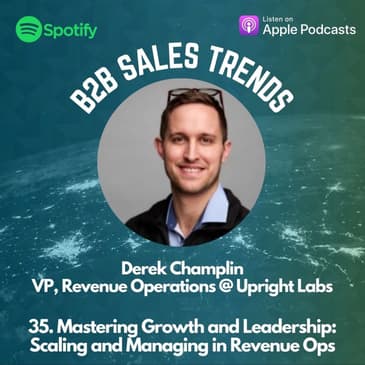
[00:01:01] My name is Harry Kendall-Bach and today I have with me Derek Champlin, who is the VP of Revenue Ops at Upright Labs. Welcome to the B2B Sales Trends podcast, Derek.
[00:01:14] Yes, Harry, thank you so much. Happy to be here.
[00:01:17] Fabulous. We appreciate your time. Share a little bit of an intro of yourself and give us a bit of a sneak preview into your journey from an ops role into sales and how that transition has changed.
[00:01:31] How that transition has shaped your approach to rev ops at Upright Labs, if you would.
[00:01:36] Sure. So my background really has been very traditional in warehousing and supply chain.
[00:01:43] Kind of came from that logistics background, you know, heavy industry, automotive and healthcare, and then took a bet in joining a startup.
[00:01:52] So I joined Upright Labs and eventually evolved from doing more operations and support into sales.
[00:02:01] I'll say that I've always been keen to take on new challenges in my career.
[00:02:06] And so after building out a lot of the Salvation Army's e-commerce across the U.S., it really allowed me to have some confidence in navigating into sales.
[00:02:19] So I'd like to think I'd bring a little bit more, maybe realistic targets and KPIs to my sales approach.
[00:02:28] And that's been appreciated by the folks on the other side of the negotiation table.
[00:02:35] Love it. Love it. Quite a journey you have there.
[00:02:38] Your organization, Upright Labs, you've had massive growth since 2020.
[00:02:45] And you've been expanding to, you know, to a number of new clients in the second hand and e-commerce year over year.
[00:02:54] So that growth has been consistent since 2020.
[00:02:58] Can you share a little bit on the key factors that contributed to that superb and impressive growth that you have achieved?
[00:03:07] Sure. Honestly, I have to thank our product team for that.
[00:03:11] It starts with a clear product market fit.
[00:03:15] In the second hand space, especially in e-commerce, there's a lot of complexity that's involved.
[00:03:22] You know, unique items, everything from, you know, massive speakers down to, you know, jewelry pendants.
[00:03:29] So being able to build a product that can process any kind of skew and listed online very quickly was a tough challenge that they took on.
[00:03:40] So it's enabled us to sell really relatively easily.
[00:03:45] And in addition to that, we've got such a rich culture.
[00:03:50] There's just a diversity of experience on our team.
[00:03:55] And that kind of helps us be both, you know, competitive, but also, you know, in a healthy way.
[00:04:01] It's not like overbearing.
[00:04:03] Right.
[00:04:04] Right.
[00:04:06] And you, as I understand it, you're sort of wearing two hats, right?
[00:04:11] You're a player coach and then, you know, you're managing SDRs, you're managing partnerships.
[00:04:17] And on top of that, the overall business strategy too.
[00:04:21] You know, what are the challenges that you are facing in sort of balancing closing your own deals and progressing your own deals while overseeing the team and all the other tasks that you have to execute?
[00:04:36] What are some of the challenges that you'd face with that?
[00:04:39] I mean, there's no shortage of hats in a startup environment.
[00:04:42] Right.
[00:04:42] So for me, I think it comes down to being able to delegate and communicate effectively on a daily basis.
[00:04:52] So not letting deals linger, focusing on what's going to have the highest kind of return on your time.
[00:04:59] And if you've got a simple task, just knock it out.
[00:05:03] Otherwise it's going to, you know, take more time than it needs to.
[00:05:06] So I think there's a mix of speed and clarity that I'm trying to, you know, incorporate every day.
[00:05:14] What advice would you give somebody who's thriving or looking to move into and thrive into sort of a player coach role, especially in terms of time management and enabling others within the team?
[00:05:30] Any advice from your end?
[00:05:33] Yeah, I sort of say this in jest, but figure out your exit plan.
[00:05:39] Being a player coach should not be a long term solution.
[00:05:44] I think inevitably you're going to burn out if you're doing that for, you know, years on end.
[00:05:48] But for me, a couple of things that work really well is just, you know, having blocks on my calendar and then doing something called the Pomodoro technique.
[00:05:57] So essentially that just means focusing on one task for a period of time, taking breaks throughout the day so that when you are working, you can be really hyperproductive.
[00:06:08] Pomodoro technique.
[00:06:09] Share that from our audience what that is and describe that a little bit for us.
[00:06:13] Sure. Yeah, I guess simply put, it just means I work for 25 minutes on one task and then take a five minute break before I start something new.
[00:06:22] Something one of my colleagues had advised was, you know, start your day with a list of your recurring tasks and a list of tasks that you've been assigned.
[00:06:33] Figure out, you know, what's going to have the best return on your time for that day.
[00:06:37] Right, right.
[00:06:39] A couple of questions ago, you mentioned the highest return of your time.
[00:06:44] I really can resonate with that because that's all we bring to the table these days, isn't it?
[00:06:51] Our time and how do we slice and dice that between all the tasks that we have to achieve?
[00:06:56] Yeah.
[00:06:57] And what gives us as you have framed the highest return of your time?
[00:07:02] That's my learning right here from that podcast.
[00:07:04] So thank you for that.
[00:07:06] Yeah, I appreciate that.
[00:07:07] It's the most precious commodity, right?
[00:07:11] So we got to take care of it.
[00:07:13] It is.
[00:07:14] It is.
[00:07:14] And it's, we have to just be very cautious with how we divvy up our day and our time.
[00:07:24] I couldn't agree more.
[00:07:27] You know, obviously through such a, you know, quick growth or sustained growth in the last few years, you had to acquire and retain the right talent.
[00:07:43] Share with us a little bit what challenges have you faced in getting the right people in, retaining the right talent.
[00:07:51] How do you ensure a smooth transition for new team members and so forth?
[00:07:56] Share a little bit your thoughts on those topics.
[00:07:59] I mean, there's a lot to unpack there.
[00:08:01] Um, as a startup, you know, inevitably like being high growth, being fast paced, it's not the most comfortable environment.
[00:08:10] Um, so something I've really instilled with my team is making sure that they're a hundred percent bought in to what they're doing.
[00:08:19] So actually I had a couple of team members who've moved on to do other things and I don't have any reservations with that, right?
[00:08:29] Like if, if they're going to be better served and more passionate about something else, I'd rather know that early on.
[00:08:35] Um, and then make sure that through the hiring process, we're really screening for those who have a vested interest in, in the mission of what we do, which is, you know, serving the secondhand industry.
[00:08:48] If that doesn't exist, inevitably the quality is not going to be as good and the investment's not going to be as strong from those team members.
[00:08:57] Right.
[00:08:58] It is interesting.
[00:09:00] There's, there's a saying in, uh, in Austrian, uh, for those listeners who've been now on a number of podcasts and based in Salzburg in Austria, where the sound of music lives, by the way.
[00:09:11] Um, you know, there is a saying, never, never try to stop somebody who wants to travel.
[00:09:17] Right.
[00:09:18] So if somebody is not bought in, if somebody, uh, sees more fulfillment somewhere else, then, then there is no point, right?
[00:09:29] There's no point.
[00:09:30] Nothing will make him overnight, uh, happy again, and, uh, therefore contributing to the level that we need to.
[00:09:37] Uh, it's an interesting, interesting point here.
[00:09:41] And especially with a startup, uh, I mean, that kind of commitment is key, isn't it?
[00:09:46] That you need.
[00:09:47] Yeah.
[00:09:48] Um, thankfully we had, you know, our two founders were, you know, living and breathing what we do seven days a week at times.
[00:09:56] So, um, that really sets a tone, not to say that we were required to work that much, but more so, you know, gives you something to strive for in terms of like how invested you are.
[00:10:09] Right.
[00:10:10] Right.
[00:10:10] Right.
[00:10:11] Um, Upright Labs recently has acquired its main competitor, which I thought was interesting and now really has to adapt to new culture, new products and so forth.
[00:10:21] Um, in this sort of phase of, uh, you know, in this sort of, uh, discovery phase, uh, how are you navigating that process of figuring out the most effective workflows and understanding the underappreciated needs of your audience and so forth?
[00:10:40] I mean, that must come with a lot of challenges.
[00:10:43] Yeah.
[00:10:44] Um, early on it really boiled down to understanding how each team, each department operates.
[00:10:53] Yeah.
[00:10:54] And I guess approaching it with a bit of humility help to knowing that one is not necessarily better than the other.
[00:11:02] There may be things that, uh, our competitor did better that we may be able to adopt and vice versa.
[00:11:09] Um, and then in addition to that, uh, you know, over time, really making sure that we're tuning into our customers needs.
[00:11:19] So the thing that we've adopted there is a more public facing roadmap and more of the voice of our customer in the way that our product develops.
[00:11:27] Right.
[00:11:28] And I think that that has allowed us to make sure that we are aware of our customers needs, whether that is a, an acquired customer or, you know, one of the original upright customers.
[00:11:42] Right.
[00:11:43] Right.
[00:11:45] Now I know you travel quite a bit, uh, and you have a tough travel schedule and obviously family commitments and so forth.
[00:11:54] How do you balance personal and professional sort of responsibilities and your professional and personal life?
[00:12:01] And, and what sort of advice would you have for others in similar situations?
[00:12:06] Yeah.
[00:12:07] Um, a lot of this comes down to, uh, setting boundaries for yourself.
[00:12:12] So what's going to be sustainable?
[00:12:15] What does balance look like for you?
[00:12:18] Um, I do two young kids.
[00:12:20] I've also got an incredibly supportive wife.
[00:12:22] So that definitely helps.
[00:12:25] Um, but a couple of those kind of simple habits for me is, you know, making sure I decompress before I come out of the home office.
[00:12:33] Um, trying to travel less than seven days at a time and then.
[00:12:38] Baking in some time when I come back from a trip to, you know, level set with the family before I dive back in.
[00:12:45] So for me, that's starting a couple hours late after a late flight and having breakfast with the family.
[00:12:52] That allows me to kind of reset before I go back into the office.
[00:12:58] Right.
[00:12:59] So.
[00:12:59] It's those little routines that one needs to set just to keep in touch with real life too.
[00:13:06] Right.
[00:13:06] As that's important.
[00:13:08] Exactly.
[00:13:09] That's important.
[00:13:09] I have one final question that I always ask at every, at the end of every podcast.
[00:13:14] That is, uh, obviously you've given your experience in, uh, RevGen sales and salespeople, obviously a lot of salespeople, sales leaders, uh, uh, listen to this.
[00:13:28] In your experience, what are the top three things that salespeople have to do and have to execute really well so that they are elite salespeople?
[00:13:42] So what, uh, what have you seen the top salespeople do the top three things that they do that makes them excellent salespeople?
[00:13:50] What would you say to that?
[00:13:52] Yeah.
[00:13:52] Um, very good question.
[00:13:55] So I think here, uh, a couple of key things that I really instill within my team.
[00:14:01] Um, one is making sure that they communicate well and communicate authentically.
[00:14:10] Um, so I don't want them committing us to things we can't do or overselling or just trying to have a very transactional sales process.
[00:14:20] So for us, it is a consultative sale.
[00:14:23] It's getting in depth and understanding what the prospect needs on the other side of the table.
[00:14:28] Um, secondly, it is knowing what tools they have at their disposal.
[00:14:34] Uh, there is so much that is available to us today.
[00:14:38] That is not only, uh, free, but maybe, uh, a cheap investment and you can get a massive return.
[00:14:45] Um, so there are certain tools they're using on a regular basis to find new leads, uh, to book meetings, to have more automation in their daily habits.
[00:14:57] Um, and a lot of them are free tools.
[00:15:00] So knowing how to use those tools and, and incorporate them on a daily basis.
[00:15:04] And then finally making sure that they have balance.
[00:15:07] Uh, I think sales can have a ton of volatility, which can impact your mental and physical health at times.
[00:15:15] So as, as crucial as those like quotas are, or those targets are for the month.
[00:15:21] Um, I also want to make sure that they are setting themselves up to be with us for a long period of time.
[00:15:27] And so if they've got a personal thing that comes up or they need a day off at some point, I don't want to be too rigid in that way because it's not going to pay off in the long term.
[00:15:40] I completely agree with you.
[00:15:42] And it's, it's great that, that you, you note, this is one of the top three things because finding that balance is really key.
[00:15:50] You don't want somebody who is on the top, but one day and then very low on the next day.
[00:15:56] And so for predictability, um, of what comes in.
[00:16:00] So, and you need that balance.
[00:16:03] Um, uh, great.
[00:16:05] So basically communicate well in an authentic way.
[00:16:10] Um, find out what the clients and prospects need, um, and, uh, ensuring that we match those needs with what we can offer.
[00:16:19] Know the tools and use them and be creative around them as well as have balance in the way you approach, uh, uh, your sales process.
[00:16:29] Fabulous.
[00:16:30] Um, Derek, thank you.
[00:16:32] Uh, you've been a fabulous guest, uh, on our podcast.
[00:16:36] I know our listeners very much appreciate your insights, your thought leadership.
[00:16:40] So thank you for taking the time.
[00:16:42] You're welcome.
[00:16:43] Thank you, Harry.
[00:16:44] Well, community out there of listeners, two calls to actions, share this podcast.
[00:16:48] Uh, with people who you think would benefit from its content.
[00:16:54] They would thank you forever.
[00:16:56] We thank you forever to, uh, go to global performance group, uh, dot com as well.
[00:17:02] Uh, sign up to the global sales portal, which includes webinars, podcasts, additional high value content and tools, uh, all for free for your own benefit and consumption.
[00:17:15] Until the next time, my dear people look after yourself and happy selling.
[00:17:19] Bye-bye.
[00:17:20] Thanks for listening.
[00:17:20] Bye.
[00:17:20] Bye.