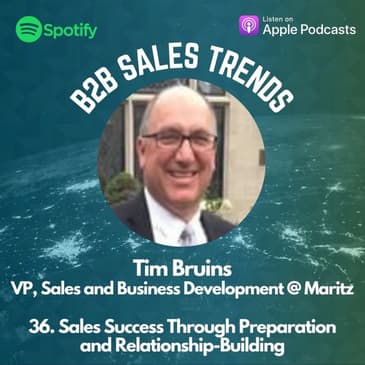
[00:00:05] Welcome to B2B Sales Trends, the podcast dedicated to sales leaders in the B2B space, where we share conversations about innovative and successful sales transformations to keep you up to date on the latest trends. This podcast is brought to you by Global Performance Group.
[00:00:22] Welcome yet to another fabulous episode of the B2B Sales Trends podcast, my dear people, the show that brings you hacks, tips, thought leadership for sales, marketing, and customer success.
[00:00:34] It's brought to you by Global Performance Group.
[00:00:37] Who are we? We are a revenue improvement boutique that implements behavior change to provide salespeople with the competence, the confidence, and the courage to sell and negotiate based on customer outcomes.
[00:00:53] We solve three problems for our customers, which is we increase their win rates, we reduce their sales cycle time, and we protect margins throughout the sales process.
[00:01:03] My name is Harry Kendallbacher, and today I have with me Tim Bruins, who is the VP of sales for a company called Maritz.
[00:01:14] Welcome to the B2B Sales Trends podcast, Tim.
[00:01:17] Hang on, that would be Maritz.
[00:01:18] Maritz, thank you for putting this right, Tim. Welcome to the podcast.
[00:01:23] Hey, nice to be here. Thank you very much for having me.
[00:01:26] Fabulous.
[00:01:27] Tim, can you share a little bit of your experience and journey within your organization and how it's shaped the perspective on relationship between salespeople, procurement professionals, and what you've brought to the table there?
[00:01:43] That would be fabulous.
[00:01:44] Sure.
[00:01:46] Starting this business, I'm in the travel business.
[00:01:48] We provide travel logistics for companies, anybody who does anything from a small board of directors meeting to incentive trips up to product launches and some of the biggest association business around the world.
[00:02:06] I started as a travel director, so I was accompanying groups around the world, which was one of the best jobs ever.
[00:02:12] Got to see the world on somebody else's dime.
[00:02:17] Went into a sales support role after that, followed by got into sales in 1993.
[00:02:25] Did that for about 20 years and then got into sales management about 10 years ago.
[00:02:30] Had various run-ins with procurement along the way.
[00:02:35] You know, it used to be procurement was something to be avoided, something that you just didn't want to, if there's any way to avoid dealing with procurement department, we tried to.
[00:02:45] I've changed my view on that a little bit.
[00:02:48] They can be some of our biggest advocates.
[00:02:50] They have been our proponents for us.
[00:02:54] And, you know, the biggest thing I brought to the table, I think, is kind of changing the attitude.
[00:03:01] We, within our own sales organization, worked with our procurement department to put together a sales training that said, okay, tell us what you guys are looking for.
[00:03:12] What annoys you?
[00:03:13] What annoys you?
[00:03:15] What kind of things do salespeople do that annoy you?
[00:03:17] Or what are you looking for when you have a salesperson and really get their take on things, which has been helpful?
[00:03:26] Interesting.
[00:03:27] Our research says that 30% to 70% of deal improvement can be achieved if salespeople engage procurement professionals early on in the sales process.
[00:03:40] The problem is that salespeople think, eh, procurement is, you know, they're only there to squeeze me on price.
[00:03:46] I'm uncomfortable engaging them early.
[00:03:48] Why would I inflict that pain on me so their natural tendency is to keep them as long as possible away in the sales process?
[00:03:57] Is that your experience, too, with the typical salespeople behavior when it comes to dealing with procurement?
[00:04:05] Yeah, that's it exactly.
[00:04:06] And I think there's a misunderstanding is that at the end of the day, the procurement person is trying to save money, but they're also trying to mitigate risk.
[00:04:16] You know, they want to make sure that their company is using a supplier that is safe, that's going to provide value.
[00:04:23] And I think that's where a good salesperson is going to understand how is procurement measured and how can we go about it?
[00:04:31] You know, we are in the relationship business.
[00:04:34] We want to do business with people we'd like to have lunch with.
[00:04:38] And so it's important to establish relationships, not only with the vice president of sales and marketing in our world, but also with procurement.
[00:04:48] They can make your life a lot easier.
[00:04:51] They understand what the rules are for engagement with their company and how to do that.
[00:04:58] And our successful salespeople have negotiated with procurement in a way that, you know, we've become an advocate for them and they've become an advocate for us.
[00:05:10] And that's the way to go.
[00:05:12] How do you create this?
[00:05:14] I mean, I'm going to come back to that question.
[00:05:19] So when we decided to bring out a solution that helps salespeople to deal with procurement, right?
[00:05:29] We basically packaged in all the pieces of information that salespeople need to know about procurement.
[00:05:36] So how are they measured?
[00:05:37] What are their KPIs?
[00:05:39] How do they create a buying strategy?
[00:05:41] How do they assess the market?
[00:05:43] How do they assess their demand internally for the solution that they need and so forth?
[00:05:49] So all to really give salespeople a sneak peek on the other side of the table.
[00:05:58] Is that, in your opinion, what salespeople need in order to deal with procurement effectively?
[00:06:06] Yeah, I think what they need to do is they need to understand.
[00:06:09] They need to understand procurement.
[00:06:11] They also, as any good salesperson, they need to ask good questions and they need to listen well.
[00:06:19] And in the negotiations that I've had, there's, you know, we've got a few stories that, you know, I've got one negotiation that this was beautiful with a cohort of mine.
[00:06:30] We were meeting with the procurement department and they came in and they came in and said, you cannot increase any of your fees.
[00:06:39] You can't increase anything, you know, and it's like we're renegotiating a three-year deal.
[00:06:43] And obviously things are going to increase over the course of three years.
[00:06:47] So as we start the conversation, we said, well, we're providing different services and whatever than what we did three years ago.
[00:06:55] And the procurement person said, well, if you have a different service, you can add a fee.
[00:07:01] You just can't increase the fees that you have.
[00:07:05] Okay.
[00:07:07] So instead of, okay, they can't have anything go up on the stuff that's in there, but if we've got 10 different fees that we're charging, well, maybe there's another three or four that maybe we get a chance to charge because we're offering a service that we didn't provide before.
[00:07:20] And we're able to recoup some of our costs and, you know, keep our margins healthy and, you know, go about doing it that way.
[00:07:28] So it's, again, listening to what procurement is saying and how they're playing the game.
[00:07:34] And at the end of the day, procurement wants us to be in business too.
[00:07:38] They're not in the market to drive us out of business by, you know, lowering the cost so much that we can't afford to make a profit.
[00:07:47] My experience with procurement is that obviously a lot of them are leading with price.
[00:07:54] And it's interesting because many of the listeners know we train, obviously, salespeople and how they articulate value, how to negotiate and so forth, all these wonderful things.
[00:08:04] But we also train procurement people, how they negotiate with their suppliers.
[00:08:08] So we have the sneak peek view of that side.
[00:08:13] And my experience really is that you would get a lot of procurement people are leading with price, but it's not their top KPI, what they're looking for.
[00:08:27] It's risk mitigation.
[00:08:29] It's ensuring you can provide a certain quality of service and so forth.
[00:08:33] Is that what you're seeing too?
[00:08:35] Oh, that's exactly it.
[00:08:37] That's why I said, even if it seems like it's priced, you need to understand your own product and service and to be able to articulate the value to procurement as to why you want to deal with us versus our competitor.
[00:08:52] I look at Merit's has been around for 130 years this year.
[00:08:58] We're asking companies to spend a lot of money when they do a big product launch or sales kickoff or whatever it is.
[00:09:06] It can be millions of dollars.
[00:09:08] So if you're going to spend millions of dollars, you want to make sure you're with a company that's going to be around if something bad happens in the marketplace.
[00:09:17] Being around for 130 years, we've kind of proven ourselves.
[00:09:19] We've been through quite a bit.
[00:09:22] The other thing is, before COVID, it was a little over 4 million room nights a year.
[00:09:29] Right now, we're over 3.9, almost 4 million room nights a year.
[00:09:34] That gives us a lot of buying power within our industry with hotels and destination management companies.
[00:09:43] That equates to dollars saved for you, Mr. Client.
[00:09:49] And we look at it and say, if you're looking at 100% of your program costs, 90% of them are third-party costs.
[00:09:57] Why wouldn't you want us to save you as much money on the third-party costs?
[00:10:01] And so we might be a little bit higher as far as our markup, but the overall markup, we're saving you a lot of money.
[00:10:07] Exactly.
[00:10:07] So being able to articulate that with a procurement person and understand that at the end of the day, you want to make sure we're around to do it.
[00:10:16] We're providing services for companies that are like yours.
[00:10:21] So you want to go with the best, you should be with us.
[00:10:24] Right.
[00:10:26] It sounds like you have tremendous experience in sort of the negotiation environment there.
[00:10:33] Can you share with our listeners sort of, you know, what emerging trends do you see when you implement negotiation tactics or use negotiation tactics,
[00:10:43] especially in the context of interactions between salespeople and the C-suite, let's say, or salespeople and procurement professionals?
[00:10:53] What sort of common negotiation tactics that salespeople come up against?
[00:10:59] Right now, it's been interesting in the last couple of years.
[00:11:04] Obviously, procurement is getting a lot more involved as prices around the world have gone up.
[00:11:10] They're looking at a way to drive the price down or, like I said, get more value, more bang for their buck.
[00:11:18] You're having more committees.
[00:11:20] It's not just one person.
[00:11:22] You're getting the stakeholder within the organization to meet with their procurement people.
[00:11:29] A lot more RFPs being sent out and bids to say, all right, let's make sure we're getting the best deal from everyone.
[00:11:37] So even long-term customers are doing that every once in a while to say, let's just see what the marketplace looks like.
[00:11:45] And again, it's not one person, which is, again, why I think it's important.
[00:11:50] We used to have something that we talked about being five high and five wide, you know, having relationships deep and wide within the organization so that you've got advocates at multiple levels that can talk about that.
[00:12:06] And if they're on the committee or on, you know, if they're one of the decision makers, they're advocating for you.
[00:12:11] You mentioned RFPs.
[00:12:16] It's an interesting topic for our audience, for salespeople and sales leaders.
[00:12:22] We always hear that sort of objection to say, well, it's an RFP.
[00:12:27] There's nothing I can do.
[00:12:29] Why would I deal with procurement?
[00:12:30] It's all written out and we're basically there to respond.
[00:12:35] How would you react to something like that?
[00:12:38] I think one of the things that our procurement class that our company came up with I thought was beautiful is, again, you're building relationships with folks.
[00:12:50] If the RFP is well-written, compliment the procurement guy.
[00:12:55] They obviously did their homework.
[00:12:56] They did their job.
[00:12:57] They did a good job, which if the RFP is written well, it saves us time.
[00:13:04] It saves us, you know, time and effort.
[00:13:07] I've seen RFPs that have been copied and pasted, you know, 10 different times.
[00:13:12] And, you know, you're looking at this stuff going, half the stuff we know that you don't want.
[00:13:17] So now you've got to go back and say, do I really need to respond to this?
[00:13:19] Well, no, that wasn't supposed to be in there.
[00:13:21] You know, did you respond to it?
[00:13:22] No, that wasn't there.
[00:13:23] You know, if you've got an RFP that's well-written, it's going to save you time.
[00:13:28] And, again, affirming the procurement person for doing their job is going to help you build a relationship with them.
[00:13:36] Right.
[00:13:38] And the last few questions that we've sort of, you know, chatted through, it always comes out to the relationship aspect of things.
[00:13:47] You know, and you've mentioned a number of, you know, behaviors and skills such as asking good questions and good listening and, you know, engagement skills and so forth.
[00:14:00] They all lead up to that piece that you need, that relationship.
[00:14:05] Right.
[00:14:07] Yep.
[00:14:08] I mean, that's key.
[00:14:10] You know, one of my mentors had said people want to do business with somebody they want to have lunch with.
[00:14:16] Yeah, right.
[00:14:17] Exactly.
[00:14:17] You know, if I don't like you, I'm not necessarily going to try to make sure we're doing business together, especially in our world because we're traveling quite a bit and going to different places that we're spending a lot of time with our customers.
[00:14:31] Right.
[00:14:31] So the relationship is key.
[00:14:33] And it can be difficult to build a relationship with procurement.
[00:14:40] But it's not, it can be done.
[00:14:43] Because once again, you're trying to help them, you know, again, as a salesperson, you're trying to help them in their career.
[00:14:50] Right.
[00:14:50] You know, we look at part of our job is to get our clients promoted.
[00:14:54] You know, get them promoted within the organization, make them look good, and we all win.
[00:14:58] Right.
[00:15:00] So, yeah, I've had a number of different clients that we're trying to get into that we haven't had business with.
[00:15:06] And I'll meet with procurement and say, all right, what do we need to do?
[00:15:09] Right.
[00:15:09] How do we go about doing this?
[00:15:12] What's missing from our portfolio?
[00:15:14] Or what are we missing that we haven't been able to get on the bid list or we haven't been able to obtain your business up to this point?
[00:15:21] And most of them are pretty candid.
[00:15:24] Yeah.
[00:15:25] And it's pretty interesting.
[00:15:28] One of the things when we did a large deployment to a procurement team, I think it's their Fortune 500 company, actually, and their procurement team.
[00:15:38] And one of the things that one of their strategic points was to say, hey, procurement, we as procurement, we need to be the innovation engine of our organization.
[00:15:51] Now, what did that mean to them?
[00:15:54] That meant that we as procurement, we shouldn't just be a buying function for our internal stakeholders.
[00:16:02] What we should be doing is we need to dock on onto the insights, the value, the knowledge that we can get from the outside from our suppliers and then share them internally.
[00:16:16] So we, in a way, as procurement, sit in the middle.
[00:16:20] We are that innovation engine and we provide innovation to our internal stakeholders.
[00:16:26] Does that resonate with you?
[00:16:27] Oh, absolutely it does.
[00:16:29] That's one of the things that I think we do well.
[00:16:31] We've got something we've published.
[00:16:34] It's, I don't want to call it a newsletter, but it's something called The Source that is kind of looking at industry trends, you know, across our travel business, whether it's hotels or destinations or types of meetings that we send out once a month and try to get that in front of, you know, we send it to procurement people regularly.
[00:16:58] Again, to just educate them on what's going on in our world.
[00:17:01] Because some of them, again, if they're in procurement with a large organization, they're not necessarily all always buying travel.
[00:17:08] They could be buying other things as well.
[00:17:10] So we want to make sure you're up to snuff on, hey, guess what?
[00:17:14] Food and beverage has increased by 30% over the last two years.
[00:17:18] We only went up by 8%.
[00:17:20] So, I mean, we've been doing the job of trying to keep things, you know, so educating them, I think, is part of our job.
[00:17:30] Absolutely.
[00:17:30] And when you have that kind of mindset as a salesperson, that just creates a completely different level of conversation with procurement, right?
[00:17:43] Right.
[00:17:44] It's interesting.
[00:17:49] We obviously mentioned it's a very negotiation-rich sort of environment.
[00:17:56] And negotiation, our experience is always around power and who is more powerful at what part in the negotiation.
[00:18:07] And it's interesting.
[00:18:10] Don't quote me exactly on the percentages because I don't exactly recall what they are.
[00:18:16] But there was a research a couple of years back, I think it was, where they've interviewed procurement people and salespeople.
[00:18:26] And they asked either side the same question, which was, who do you think has more power in the negotiation?
[00:18:34] Now, salespeople said something like, I don't know, 80%, 85%, something like that, of the power is with procurement people.
[00:18:43] And almost the same percentage, procurement people said that the power is with salespeople.
[00:18:49] And I found that really interesting because, and it highlighted to me again, power is perception, right?
[00:18:57] Right.
[00:18:59] And you need them as much as they need you.
[00:19:03] And I thought that was a fascinating reading at the time when I consumed that.
[00:19:09] Oh, without a doubt.
[00:19:11] I mean, each side thinks that, you know, the other side is going to win.
[00:19:14] And I want to make sure that you don't win.
[00:19:16] That was one of the things that was, there's a couple of different things.
[00:19:19] One of the things was, I would say in your negotiations, if you can, I mean, if it's a long-term deal, it's just not the salesperson talking.
[00:19:26] Get your finance people involved or get somebody else involved that, you know, might be able to assist to have different views, different ways of looking at things.
[00:19:38] Also, make sure you do your homework and you understand what the negotiation is about, if you can.
[00:19:44] One of the greatest stories I have from a guy that I work with, we had a labor-based billing, labor-based pricing model with a very large company.
[00:19:56] And the procurement guy looked at this and said, $74 an hour.
[00:20:01] Where did you guys come up with that?
[00:20:04] And our guy was perfect.
[00:20:05] He said, I don't know.
[00:20:08] He said, what do you mean you don't know?
[00:20:09] You're charging us $74 an hour and you don't know where it came from?
[00:20:12] He's like, well, our cost is $125 an hour.
[00:20:16] You guys only allow us to charge $74.
[00:20:19] So tell me where you came up with that.
[00:20:22] He said, we got to make our money someplace else because you're only allowing us to charge something that's significantly less than what it's costing us.
[00:20:30] And the guy's like, yeah, let's just move on to another.
[00:20:32] Yeah, right.
[00:20:34] But he understood what our costs were.
[00:20:37] He understands what we're charging.
[00:20:40] It's like, hey, there has to be give and take.
[00:20:43] But at the end of the day, hey, we all need to win here.
[00:20:48] Love it.
[00:20:49] Thank you for sharing that story.
[00:20:53] It highlights, again, that with the right articulating, through right communication skills throughout these dialogues with those professional buyers, most of the tactics that they're using can be dissolved relatively easy.
[00:21:13] Right.
[00:21:14] Right.
[00:21:14] I mean, we just came out of one that, you know, after three years, you know, everyone knows how inflation and how labor costs have risen over the last three years.
[00:21:24] Right.
[00:21:25] And we had one guy from procurement that came in and he started with, yeah, we want to negotiate a three-year deal.
[00:21:32] We think our labor rate should be lower than what you had last year and it should go down for the next three years.
[00:21:38] It's like, this isn't a good way to start.
[00:21:41] Yeah.
[00:21:42] Right.
[00:21:43] Right.
[00:21:44] Right.
[00:21:44] Yeah.
[00:21:45] Let's reset here.
[00:21:48] We're not doing that.
[00:21:50] Exactly.
[00:21:51] Yeah.
[00:21:51] So you do come across some people that are unreasonable that, you know, and I think part of the negotiation, and I mean, this is hard for all salespeople to do, but at some point you got to be willing to walk away.
[00:22:02] I mean, if it's hard for you.
[00:22:33] I mean, if it really is bad for your company.
[00:22:34] And we're not going to be willing to discuss that, you know, if it's hard for us to do, you know, after the deal with, you know, I have a strong opinion of that.
[00:22:46] And no deal is better than a bad deal.
[00:22:48] We here in Austria say, it's a good party when everybody has fun, right?
[00:22:54] But if you're at that party and you're the only one that doesn't have fun, it's not a good party, right?
[00:23:00] So no deal is better than a bad deal.
[00:23:03] Fabulous.
[00:23:04] Tim, let me ask you the final question of today, which is, you know, you've been and done that.
[00:23:12] You have tremendous amount of experience.
[00:23:14] You've seen good salespeople.
[00:23:16] You've seen not so good salespeople, if I can put that politely.
[00:23:23] And give us your top three.
[00:23:26] What do you think are the top three things that salespeople do have to do extremely well to be elite salespeople?
[00:23:36] So what are the top three skills of behaviors that salespeople need to have to be excellent salespeople?
[00:23:42] What would they be in your opinion?
[00:23:44] Number one, do your homework.
[00:23:47] You know, don't come in and ask the client for or prospect for things that you could have found someplace else.
[00:23:55] You know, start asking questions that are very basic.
[00:23:57] I mean, that just shows that you haven't done your homework.
[00:24:00] You haven't spent the time to do it.
[00:24:01] Why should I spend my time educating you on that?
[00:24:04] Right.
[00:24:04] So if I would say do your homework, number one, you know, show that you're interested, understand their business, you know, at a certain level.
[00:24:13] You may not know it completely, but at least know what you're dealing with and what they do for a living and how they're working.
[00:24:21] And I've said it over and over again.
[00:24:24] Salespeople have to be great listeners.
[00:24:26] They have to be able to listen and discern what customers are talking about in any way, shape or form.
[00:24:35] Listen, whether it's personally, you know, what their families are doing business wise, whatever will help you become elite because you'll find some nuances.
[00:24:46] You'll find some little things.
[00:24:47] You know, the attention to detail is critical, but it's listening, asking the right questions and listening and being interested.
[00:24:55] Third, and I keep saying this, be someone you want to have lunch with.
[00:25:01] You know, stay abreast of current events.
[00:25:05] Be somebody that's interesting to talk to.
[00:25:09] You know, do a little homework on the person that you're seeing and what college are they interested in?
[00:25:15] What sports are they interested in?
[00:25:18] Whatever.
[00:25:19] You know, what's going on in their world and be able to be willing to talk through some of that stuff.
[00:25:25] So I would say, yeah, you know, do your homework, listen and be someone you want to have lunch with.
[00:25:33] How's that?
[00:25:35] I love it.
[00:25:36] That really sums it up nicely.
[00:25:38] And I couldn't agree more if I can have my humble opinion to that.
[00:25:47] Thank you, Tim.
[00:25:49] Yeah.
[00:25:49] I know our listeners will super appreciate your insights, thought leadership, and they will get great benefit from what you have shared.
[00:25:58] Thank you for taking the time.
[00:26:00] Thank you for the time.
[00:26:00] Thank you for the opportunity of doing this.
[00:26:02] Thank you.
[00:26:04] If everyone wants to do a travel program, give me a call.
[00:26:07] Absolutely.
[00:26:08] For our community of listeners, my dear people, two calls to action for you.
[00:26:12] Share this podcast with anybody who you think might benefit from the great insights that Tim shared in the last 20, 25 minutes.
[00:26:21] Second one, go to globalperformancegroup.com.
[00:26:24] There is a section, our global sales portal that gives you podcasts, webinars, additional free content, all for free.
[00:26:32] Sign up and consume it and use it as much as you can.
[00:26:36] Until the next time, stay safe, stay well, look after yourselves and happy selling.
[00:26:41] Bye-bye.
[00:26:41] Bye-bye.