
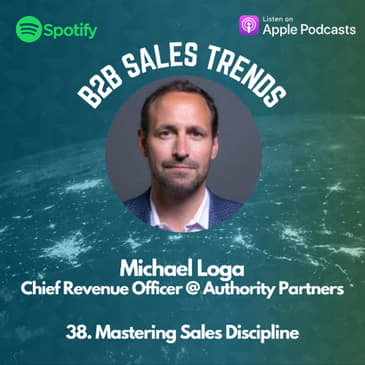

[00:00:05] Welcome to B2B Sales Trends, the podcast dedicated to sales leaders in the B2B space, where we share conversations about innovative and successful sales transformations to keep you up to date on the latest trends. This podcast is brought to you by Global Performance Group.
[00:00:22] Welcome here to another fabulous episode of the B2B Sales Trends podcast, the show that brings you hacks, tips, thought leadership for sales, marketing, and customer success.
[00:00:33] It's brought to you by Global Performance Group. We are a revenue improvement boutique that implements behavior change to provide salespeople and their managers with the competence, confidence, and courage to sell and negotiate based on customer outcomes.
[00:00:51] We solve three problems for our customers, which is we increase their win rates, we reduce their sales cycles, and we protect their margins.
[00:01:01] My name is Harry Kendall-Bacher. I'm the CEO of the company. Today, I have with me Michael Loger. Michael is the CRO for Authority Partners. Welcome to the B2B Sales Trends podcast, Michael.
[00:01:15] Thank you, Harry. Thank you for having me.
[00:01:18] A pleasure. Thank you for making time. Michael, give us a little bit of an introduction to start us off with, if we could. Tell us about yourself a little bit and Authority Partners.
[00:01:30] Sure thing. Thank you. I started in finance and on Wall Street for a number of years and moved into sales really hardcore over the last 20 years.
[00:01:40] And it's a discipline that I've carried a bag. I've been in leadership roles and that it's something that I think you have to, like all disciplines, continually study about it.
[00:01:49] Originally, I'm from Western Canada, a big hockey fan, big Edmonton Oilers fan.
[00:01:54] And I joined Authority Partners a little over a year ago as their CRO.
[00:01:59] Authority Partners is a technology and strategy software development firm formed 26 years ago.
[00:02:06] We have core development centers in Sarajevo, in Istanbul, and in Santo Domingo.
[00:02:14] And our value prop is that we really show a strong ability to deliver for our customers and really meet them where they're at.
[00:02:22] And we work with large orgs of over 200 billion to small startups.
[00:02:26] And that's about us in a nutshell.
[00:02:28] Michael, thank you for that kind introduction.
[00:02:30] We had a bit of a preparation call a couple of weeks ago, and we decided to come up with a topic about salespeople and their behaviors.
[00:02:43] And we've identified the fact that you've come across many different sales professionals in your career and that you've also come across, along with that,
[00:02:55] some of the salespeople that are really not good salespeople, to put that politely.
[00:03:01] And I want to talk about that today.
[00:03:03] I think for our listeners, managers, sales leaders, salespeople, I think it will be very valuable for you to share your insights,
[00:03:11] what your perception is, why there are bad salespeople out there, in quotes, of course, and what they could be doing better.
[00:03:22] So let's get this started with, in your opinion, what are some of the most common traits or behaviors that make somebody a bad salesperson, if I can say that that way?
[00:03:36] Thanks, Harry.
[00:03:38] I guess what I've seen, especially since COVID and the advent of a lot of AI-driven technology and the ability to use sequencing when people are doing outreach for prospecting,
[00:03:54] there's a lot less.
[00:03:56] One of the traits is just doing the work and putting it in and not allowing just to sit there and use technology.
[00:04:02] So every day, I talk to CIOs and CTOs, and they tell me about the number of different cold calls, LinkedIn messaging, or emails that they get in a day that basically has no common sense to it.
[00:04:19] That they're not looking at the person's persona of what the company may be having struggles with or what they may be looking to.
[00:04:26] And instead, they're just saying, here's my product or here's my services.
[00:04:30] Can we do business?
[00:04:31] And it's really lazy type of efforts versus taking the ability to think about the person's business that they're reaching out to, to understand what their challenges are.
[00:04:42] Reading their 10Ks, reading their 10Qs, understanding their strategic presentations, and seeing if you have an off-rate that may help them solve some of their problems.
[00:04:51] But for the most part, the common trait is just being lazy and just allowing things to not look at what they need to do.
[00:04:59] And why do you think that is?
[00:05:01] Why do you think salespeople tend to now rely on technology like that?
[00:05:09] Why do you think they're lazy?
[00:05:11] I mean, surely that's one thing as a salesperson that you need to bring to the table, that you're not lazy.
[00:05:17] Well, I think it's because many times it's what they're being measured at from a sales leadership perspective.
[00:05:25] And I learned a really valuable lesson from one of my former bosses that by no means do I want to be a CRM jockey.
[00:05:33] What really should be measured are really two ledgers.
[00:05:37] And that is, you know, what's sold in a quarter or a year?
[00:05:41] Who's leading the scoreboard on selling?
[00:05:44] And then really, I think the next most important is meeting activity.
[00:05:48] Are you having conversations with people?
[00:05:50] Are you meeting with people and are you learning from them?
[00:05:52] And those two things, but many CRMs or many CROs or sales leadership are measuring things like how many emails did you send in a week or how many cold calls did you do?
[00:06:04] And things like that that are just busyness in nature.
[00:06:07] And so for people to get their numbers up, they use these types of technologies.
[00:06:11] And it's the wrong thing to be measured.
[00:06:14] So it really should be how do we, you know, what's your meeting activities, right?
[00:06:21] To the old formula, the amount of meetings you have or the amount of conversations you have drives the amount of opportunities and the amount of opportunities, a certain percentage ratio will drive closures.
[00:06:34] Is it as simple as that?
[00:06:36] That's the simplest equation in sales as it is.
[00:06:38] You know, you do have the research and planning of your patch or wherever you're looking to reach out to ahead of time.
[00:06:44] And then you're going to look at how you can leverage your internal network and your own team's network to try and get those meetings because the best thing is a warm referral from somebody, obviously, to get that first meeting.
[00:06:57] But then you're absolutely correct.
[00:06:59] It goes to opportunities.
[00:07:00] Opportunities lead to solutioning, hopefully, and then it will hopefully lead to close one.
[00:07:05] So, yes, absolutely.
[00:07:07] So with this whole big wave of AI, and obviously AI is part of our lives already and will be even more, how do you think AI will impact the sales process or shall I say the behavior of the salespeople?
[00:07:22] Because that's what we're talking about, really.
[00:07:25] Well, for one thing, I was not an early adopter of tools like ChatGPT.
[00:07:31] And now I can't imagine my life without it.
[00:07:34] Not because at first I really disliked it because I was like, that's not my voice.
[00:07:39] And I was okay with an occasional grammatical error.
[00:07:42] But the reality is that it makes my life much more efficient.
[00:07:46] So if I'm looking to, and I know it's not perfect and you have to sort of fact check it at times.
[00:07:50] But if I'm looking to do research or if I'm looking to try and identify pain points or even write an email a little bit better, it's very helpful in that.
[00:07:59] So it makes my life efficient.
[00:08:02] It's not going to, maybe it could replace, I think, some product sales.
[00:08:07] But at the end of the day, where I think AI is driving us is that we're really moving back into more of a relational sale where we're actually going to be more human to human.
[00:08:17] Do I trust you?
[00:08:18] Do I trust your firm?
[00:08:20] Can you provide the services or the products that are needed?
[00:08:23] And if many ways, it's actually swinging the pendulum back.
[00:08:27] I think about 10, 12 years ago, there was a big movement in challenger sales and you should be a challenger rep and everything else.
[00:08:33] I don't think that's as relevant anymore, especially in the world of IT technology and IT services.
[00:08:40] And I think it's really more, do you have a proven track record?
[00:08:43] Do you have the offerings that can help solve my company's needs?
[00:08:46] And then do I trust you and your firm?
[00:08:50] And AI cannot build trust.
[00:08:53] I would 100% agree with you.
[00:08:55] There's a stat out there and I don't know the exact percentage now, but it's a very high percentage of buyers.
[00:09:04] They have made already the buying decision or are very well informed of the options and to them that solve their problems before they engage a salesperson.
[00:09:15] So if you crop up with the same old and are not able to create that relationship, are not able to create that trust, everything that you can't get from a machine, basically, right?
[00:09:29] Then you're not really doing your job as a salesperson.
[00:09:33] Would you agree with that?
[00:09:34] I 100% agree.
[00:09:35] You're absolutely correct.
[00:09:36] I think it's really important in this day and age, and it was part of our go-to-market strategy for the first half of this year, where we did 22 events, whether it was conferences or roundtables, all in person within the first five months.
[00:09:51] Because I think it's important to be out there.
[00:09:52] If you're really looking to gain new client base or new prospect, you have to look somebody in the eye.
[00:09:57] You have to be able to have the ability to shake him or her hand, and you have to really be able to listen to them.
[00:10:03] So the old motto of people buy from people and relationship is key is going to be more important than ever.
[00:10:11] I absolutely think that that is for sure.
[00:10:15] And I think it's really important to leverage your network.
[00:10:17] And your network shouldn't just be like, oh, I have relations with a ton of CIOs or CTOs.
[00:10:24] When you're expanding your network, you should be working also from people that won't be buying from you.
[00:10:29] You should work with the recent college graduates that maybe your son or daughters are friends with, trying to help them network.
[00:10:37] It's got to be a full circle.
[00:10:39] It can't just be because you're looking to get, I do believe in karma, and I've helped out a number of people that I know will never buy from me because they're 30 years junior to me.
[00:10:48] So that's just the way it is.
[00:10:51] What are the key, apart from laziness, what are the key mistakes that inexperienced salespeople often make when they're trying to close a deal?
[00:11:03] This is a term I wish I could say.
[00:11:04] I came up with it, but I didn't.
[00:11:06] It was a former boss.
[00:11:08] But they have commission breath.
[00:11:10] And they're so hungry for the deal.
[00:11:13] They just can't let it go.
[00:11:14] They can't stop like, so what do you want to do?
[00:11:18] Or they're very like, they just keep pressing and pressing and pressing.
[00:11:22] And I'm not saying I'm perfect at this.
[00:11:24] I'm far from it, although I do keep it in the back of my mind.
[00:11:29] Really, you should be trying to adopt to the 80-20 rule where the client is speaking 80% of the time and you're speaking 20% of the time.
[00:11:36] It shows that you have active listening skills.
[00:11:39] It shows that you're trying to understand where they're coming from and that you're able to say, hey.
[00:11:45] And it's okay to say, I don't know.
[00:11:47] Like, I am in technology, but I've never coded.
[00:11:51] So there's certain questions that get asked of me.
[00:11:53] And I just say, I need to come back to you on that because I don't have the right answer.
[00:11:56] But I see way too many people that are too anxious, too eager to try and close because they may have somebody's thumb over them saying, we got to get these orders, numbers in and everything.
[00:12:07] Like, it's okay to be patient.
[00:12:09] It's okay.
[00:12:10] You know, the second best thing to a yes is a quick no, right?
[00:12:14] So it's okay for the person to say, no, you're not what we're looking for.
[00:12:18] And that helps you make your time more efficient.
[00:12:21] So let's say we have this bad, lazy sort of all the things that we've talked about, a salesperson in front of us.
[00:12:31] Can he or she be turned around into a great one?
[00:12:33] How does that, and if yes, how does that transformation process look like?
[00:12:40] Well, number one, I do think it's about having good, effective leaders and leadership that can help mentor.
[00:12:47] And I think one of the challenges that many people in leadership roles, not only sales, is that they have too many people reporting into them.
[00:12:55] So they can't effectively help mentor or help coach up.
[00:12:58] I think it was a Harvard business review study that said the most people you should have reporting into is seven.
[00:13:04] And there's been many times in my career where I've had much more than that.
[00:13:08] I'm fortunate right now.
[00:13:09] I'm kind of at that number currently, and I feel like I'm ability to have time.
[00:13:13] The second thing, and this has to come from them, is that they have to be willing to accept feedback and to understand that they need to do work on it.
[00:13:24] So one of the things I look at my role or my discipline of sales, just as if I was, and I know I'm not saving lives, but just as if I was a doctor or I was a software developer, I'm always trying to get better and better and better.
[00:13:42] Once you stop learning, obviously the cliche, you stop living as far as I'm concerned.
[00:13:46] So I've taken different sales trainings from Challenger sales to Sandler sales.
[00:13:51] I did a 10-week intensive Northwestern Kellogg high-impact sales, always trying to learn, continue to read, and trying to just evolve.
[00:14:02] You don't have to just stick to one discipline.
[00:14:04] You can make it sort of a hybrid of a bunch, but they have to be willing to invest in themselves and try and go and learn.
[00:14:10] Because I found all those teachings to be very valuable, and I continue to want to learn.
[00:14:15] I just finished reading the book Getting Naked, and it's kind of made me give a philosophical approach about how I approach an introductory meeting.
[00:14:24] Whereas, you know, I'm not sure if you've read the book or not, but I've always been like, be prepared, do your research, do your homework.
[00:14:31] And this other firm was like, they just show up and they just start consulting.
[00:14:35] They just start asking questions.
[00:14:37] And I found it interesting because I would find it to be unusual for me not to be prepared before a call.
[00:14:44] And, of course, you haven't taken the best sales training out there, which is, of course, my company, but that's just a side note.
[00:14:50] Well, you know what, Harry?
[00:14:52] This is the, you know, I haven't done the training in a while, and we're coming into 2025 as we talked about.
[00:14:58] So anything's possible.
[00:15:00] There you go, mate.
[00:15:01] There you go.
[00:15:01] Not the topic of the podcast.
[00:15:03] Anyway, Michael, my last question always is, and I feel like in this case you've sort of answered it.
[00:15:09] My last question always is, what are the top three things that elite salespeople do to be elite, basically?
[00:15:18] And from my notes, what you've said is, you know, they shouldn't be lazy.
[00:15:23] They should be listening, and they should be great relationship buildup.
[00:15:27] So what is it that you need to add from that, from people who say they are elite salespeople?
[00:15:34] What do they do?
[00:15:36] Well, number one, I just think that they wake up hungry every day.
[00:15:41] And I call that word the grind.
[00:15:43] And as a sales leader, I shouldn't have to motivate a sales rep.
[00:15:50] If I have to motivate somebody, then that means that I probably have the wrong person.
[00:15:54] So they wake up every day in the hunt for a deal.
[00:15:57] And a lot of times, you have to understand from your teammates' perspective what's important to them.
[00:16:03] Many people will obviously say, you know, especially in North America, well, it's about the comp package.
[00:16:09] And if I get paid on a deal and things like that, that's what motivates them.
[00:16:13] But for a lot of people that are really elite, they also get a lot of satisfaction out of building that trust relation
[00:16:20] and solving problems for their client and doing a good job with them.
[00:16:24] I just had a one-on-one with the CTO of a company that we've been working with for a year.
[00:16:29] And he gave such positive feedback about the team that was delivering that I made sure that I transferred that information.
[00:16:37] Except that makes me happy.
[00:16:40] When we're actually doing a good job for a client and solving their problems, that makes me just as happy as a paycheck any day of the week.
[00:16:48] You got to be hungry.
[00:16:50] You got to grind.
[00:16:51] You got to listen well.
[00:16:53] And you got to be consultative and build relationships.
[00:16:56] I love it.
[00:16:58] Thank you, Michael.
[00:16:59] I know our listeners will greatly appreciate your insights and your thought leadership.
[00:17:04] So thank you for taking the time to do this podcast with us.
[00:17:08] Harry, it's been a pleasure getting to know you over the last couple of months.
[00:17:12] And I applaud you for what you're doing.
[00:17:14] It's definitely a bit of a new approach to trying to get information out there.
[00:17:22] I know everybody's doing a podcast.
[00:17:24] But it's my first time ever being on one.
[00:17:27] So thank you for having me.
[00:17:29] Well, you're a natural, Michael.
[00:17:31] So thank you for our community of listeners.
[00:17:33] Two calls to actions.
[00:17:35] Share this podcast with people who you think this might be of value to or applicable.
[00:17:41] Give us a like.
[00:17:42] Share us.
[00:17:43] We're on Spotify, iTunes, and all those different channels.
[00:17:46] And go to globalperformancegroup.com.
[00:17:48] There is a section.
[00:17:50] It's called the Global Sales Portal.
[00:17:51] It has all the different webinars, podcasts, additional content, everything to do with the key skills and behaviors
[00:18:00] for people to sell and negotiate based on customer outcomes.
[00:18:05] And it's free, by the way.
[00:18:06] So until the next time, look after yourselves and happy selling.
[00:18:11] All the best.