[00:00:05] Welcome to B2B Sales Trends, the podcast dedicated to sales leaders in the B2B space, where we share conversations about innovative and successful sales transformations to keep you up to date on the latest trends. This podcast is brought to you by Global Performance Group. Welcome here to another fabulous episode of the B2B Sales Trends podcast, my dear listeners.
[00:00:29] The show that helps you with hacks, chips, thought leadership for sales, marketing and customer success. It's brought to you by Global Performance Group. We are a revenue improvement boutique that implements behavior change to provide salespeople and sales managers with the competence, the confidence and the courage to sell and negotiate. Based on customer outcomes. We solve three problems for our customers.
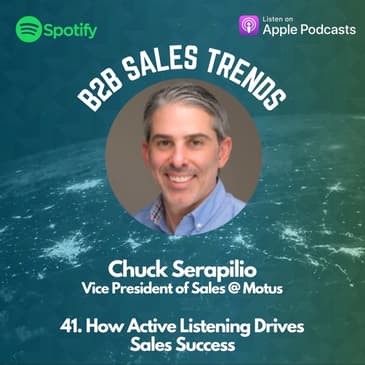
[00:00:57] We increase win rates, we reduce sales cycles and we protect margins. My name is Harry Kandelbacher and today I have with me Chuck Serapilio. I hope I pronounced that right. Welcome to the B2B Sales Trends podcast, Chuck. Thank you, Harry. I appreciate the opportunity to speak with you and your group here. Absolutely. Chuck is the VP of Sales, MMS for Motus.
[00:01:24] Chuck, let's start this off, if we could, by telling us a little bit about yourself and Motus to kick it off. Sure. So Motus is an organization that I run what we call MMS or managed mobility. So enterprises on a global scale. Everybody's got one of these in some shape or form.
[00:01:45] They have a device and so we're a company that another enterprise would hire us sort of like a payroll company to manage that environment. Motus as an organization also has a couple of different business units. That's the largest part of our company is the vehicle division where we help manage fleets. We help manage the reimbursements and things like that for motor vehicles and the mileage expenses associated to that. So in a roundabout way, we all kind of link together from a mobile perspective.
[00:02:15] As for myself, I've been in some form of sales capacity for about 24 years. My background also has I'm a recovering entrepreneur. So I've owned a couple of companies in that space as well. The one I own for a little bit over 10 years and we we sold that company in 2012.
[00:02:37] And then from there, I went back within the same industry of mobility and telecom and rail ransom sales organizations for a few different companies in that space. Lovely. Thank you for that introduction. And Chuck, we've had a call a few weeks ago in preparation to this podcast and you shared with me that you and your team and with your organization,
[00:03:03] there's typically, you know, relatively long sales cycles that your sales team is embarking on. Share with us a little bit, if you could, your experience and how you deal with those long sales cycles. Because there's a lot of, there's a bit of a ripple effect to it. You know, long sales cycle could mean win rates go up and down and so forth. So share with us your experience and how you deal with those long sales cycles effectively.
[00:03:32] And what do you do to make it shorter? Yeah. It's a great question. And again, I've been in this specific space for the better half of 24 years in the space of telecom. And now there's telecom product and there's telecom service. And so in the telecom service side where I've spent a majority of my time, our sales cycle generally lasts between six to eight months. And that really is a regardless of the size of the opportunity. It just seems that they all kind of revolve around the same time.
[00:04:00] And like I said, I've worked at different companies, own my own, and it all seems to be the same. We've all tried. And so to reduce that sales cycle, sometimes it happens. You know, you get the, there's the unicorn, as we say in sales, that just falls in your lap and they're ready to go. And that sales cycle is, you know, 45 days, but the majority of them are a longer sales cycle.
[00:04:25] And so I think what the most important part in a long sales cycle is engagement. How are you continually engaging with your prospect during that time? So they don't get fatigued about talking to you, right? And I think that's one of the biggest risks when you have these long sales cycles is one, not being pushy. And two, the fatigue that usually takes place with the customer, right? I mean, they also get fatigued.
[00:04:52] You know, they're in a position of, you know, this has gone on for six to eight months and they want, they have an objective. And so throughout that process, even though that it is a long process, the one way that we've encouraged salespeople to stay engaged is by offering the customer and having those open-ended discussions, not just about what you want as the salesperson, right? So I think sometimes salespeople come in with, I know what I need to get.
[00:05:20] Okay, let's figure out what the customer's outcome is and start directing conversations around that. That way you can stay engaged. Also discussing things in a broader context. Again, telecom spans a variety of avenues, right? So you have mobile, you have wireline, you have the transition from one to the other. You have cloud, you have security. There's a lot that goes into it.
[00:05:47] And sometimes if you get too singular focused, you're only going to ask questions that are pertinent to one thing and you're going to miss the bigger picture. And so we really like to ask questions on a more holistic basis that offer up conversation, that engage the customer on things that we may not do directly, but it gives the customer the idea that we just want to know what else is happening. That's where the whole idea of also offering customers like nuggets of information comes into play.
[00:06:16] Because now I can ask a broader conversation, have a broader discussion, and be able to offer customers intelligence, knowledge, networking, something that they may express a problem that, again, you may not be able to solve directly, but staying engaged with them is truly important. And when you're having those open conversations, you can pull some of that out of there.
[00:06:42] You can extract something that, again, may not be directly related to what you're selling, but it offers you an opportunity to stay engaged. And I think we always have to remember that people buy from people. Regardless of the product that you're selling, you may have the best widget in the world. People end up buying from people. And so during these long engagements, we have to remain people. And that's the most important part.
[00:07:09] Even though we have revenue targets, quota targets, all these fun things that salespeople do, it's important to remain human in this whole experience. Otherwise, I really think that's where you find where the longer the sales cycle usually tracks off is because you've become less human about it. Now it becomes almost demanding. We need to get this done. And we haven't figured out a perfect way to reduce the sales cycle, unfortunately.
[00:07:37] We keep trying, and you try different things. But in our industry, staying engaged is one of the most important aspects that we can do during that sales cycle. I have so many questions. You actually shared so many nuggets just now. I love that phrase you used, you know, suffer.
[00:08:05] You know, avoid this fatigue element that a long sales cycle draws with it. You mentioned customer outcomes. So how do we have that conversation that is really focused on customer outcomes? We always say that people make decisions one out of two ways, right? It's either to avoid a risk or to gain an outcome. So make sure you steer the conversation to one of those two elements.
[00:08:33] Anything else won't give you the outcome that you are looking for. But sticking with that customer outcome sort of piece, you know, in our preparation call, you also mentioned that you're going to, you know, one of your jobs at this organization, at previous organizations, was to scale good salespeople's behavior.
[00:08:59] So how do you now look at the right behavior that you need to scale that is directly related to customer outcomes? What are those, in your opinion? Well, the behaviors of a good salesperson, I think, are common amongst all sales folks, right? The ability, you know, you ever have a conversation with someone and you can tell that they're just waiting for their opportunity to talk? And so they hear everything, but they listen to nothing.
[00:09:30] And a good salesperson and a quality of a good salesperson and, you know, even to scale a good salesperson is they first have to have the ability to listen. Listen to your prospects. And again, in our sales cycle, it's very long. So there's a lot of listening that's going to take place. But each one of those conversations is going to be really important for those pieces of information that's going to help you advance your sale, right? Your ability to sell that customer.
[00:09:59] They're giving you everything that you need. They're giving you everything that you need to either sell or I'm a big proponent of, and this, you know, working with sales folks is getting to know as fast as you can. Right? Salespeople have a tendency of holding on to things because it looks good in Salesforce. It looks good on the pipeline. It looks good in the funnel. So I don't want to arbitrarily just remove it because then I got to fill it with something else. Get to know as fast as you can. That's listening.
[00:10:29] Listening to your customer. Understanding what is their outcome and are they willing to do the things that are necessary to get to that outcome? Having those open conversations about that I think is truly important. And, again, it differentiates sales folks, right? The folks that can get to know, move on to the next, are your successful salespeople because they're not going to be waiting and waiting six, eight months to basically be told no. Right? And you could have been told no six months ago.
[00:10:59] And you could have been working on something else. So I think it's really important as you scale salespeople is, one, train them on listening, right? Listening is important because you can hear everything, but you've got to really listen for the opportunities for when the prospect is going to tell you exactly what you need to know. And then draw them to that conclusion whether or not that this is really going to happen. What's the no? Is it a no?
[00:11:24] And if it's a no, then, again, it's a great opportunity to, you know, it's not you, it's me, right? And break up with that prospect because sometimes that's what you have to do, right? Not everyone works. So, right. So really the ability to listen, getting to know fast if you have to, obviously, and having an open conversation that is steered towards outcome.
[00:11:50] Are those the key salespeople's behavior that people should consider to become elite in this job? Yeah, I think that and just knowledge about their industry as a total, right? So if you're in an industry, having a good network, a good knowledge about the space that you're in is super important. Yeah. Yeah. Yeah. Good. Good.
[00:12:16] So how about, now this doesn't strike me to be extremely difficult, right? That's pretty straightforward. I'm curious, in your opinion, you know, okay, I got to listen. I got to hold the conversation. I got to get to know quickly. I got to work the process. That's not raw concise.
[00:12:39] Why do you think there is such a difference in really good people in this profession and or not? Good people. That's a great question. And I think it comes down to, in some cases, just, you hate to kind of generalize it, but just being a human, right?
[00:13:03] You know, we all know when we're in a sales situation, if we're being sold to or if that person really cares about that outcome. And there's a big difference between those two. And I think, again, that's a separation of a good salesperson versus an average salesperson. Can you bridge that gap where that customer truly feels you have their best outcome in mind? And I'll give you an example of that.
[00:13:33] So a few years ago, I worked with a financial organization, and they offered up an opportunity to respond to an RFP. And so we had a team that did that for us. We kind of got to the second stage. And so the first stage was really filling out information. You check all these, you know, you dot the I's, cross the T's, you move on.
[00:13:54] But then when we got to the second part of that, you know, in order for us to move forward, we got in this conversation about outcome. But first to get to the outcome, we had to understand where they are. And through that conversation, you know, and listening, we found out who their current provider was. We really dived into what was their current problem or challenge.
[00:14:19] And rather than trying to get us to the next stage, we took a step back and we said, well, in order to make that monumental shift, there's a lot of work that has to be done. And how about this? How about I call your current provider who I know? I know your account manager. How about I call them and I help them get you the outcome you need so you don't have to go through this big monumental change?
[00:14:43] And there was a very long pause, as you could imagine, as a prospect listening to a salesperson, basically selling themselves out of the opportunity. I'll never forget the gentleman said, either you are a horrible salesperson or you're the best salesperson I've ever talked to. And I can't tell which one you are. And I said, well, we'll worry about that after I help you get to where you need to go. So do you want me to call the company?
[00:15:12] No, we just want a contract with you. I said, great. And we broke down that barrier and really got to what we wanted was to sell them our solution. They got the outcome that they wanted. And they got a partner that, you know, humanized this whole experience that, again, we were willing to risk our ability to sell to make sure that we could help the customer solve the problem and deliver the outcome that they were.
[00:15:40] That they needed in their business. And again, I think it's a risk. You know, no doubt. But a good salesperson, a good, confident salesperson can do those things and still win. And still win because that prospect sees you now, sees this whole experience as a human experience, not just a transaction. Right.
[00:16:03] So it sounds like you built, although uniquely, I have to say, trust up front that they say, oh, this guy is not just going to try to flog me something or sell me something. Right. He truly has my desired outcome at heart and he's willing to help me even if he doesn't benefit.
[00:16:25] And therefore, they said, okay, if he's willing to do that, then, you know, I better start working with him because he really has our desired outcome and our needed out. And you certainly achieved what you were looking for. Very interesting. Very cool story.
[00:16:48] Besides the three key things that you have mentioned, the open conversation, the getting to know as soon as possible and listen intentionally to everything your prospect or your client has to say.
[00:17:07] To finish this off, what's additional things that you say you could give as a tip to our audience to say, you know, if you need to be elite at that level in that profession, here are the things that I recommend you to do. What would that be? Well, we talked about one of them. So networking is key. You know, I think, you know, again, we as salespeople get bogged down with things. And we forget about there's a whole environment out there.
[00:17:37] Being well-versed and educated in the space that you are. Again, everything has a dependency. It doesn't matter what you're selling. There's some sort of dependency in there. So understand the dependencies because you can then be more educated than the other salesperson that you could be competing against. I think those things are wildly important. And I'll just speak from my own personal experience. They've been successful with me and they've been successful with people that work with me is in those two things in particular.
[00:18:07] I think there's the other obvious things, right? The ability to ask questions, the ability to take notes. There's also the ability, you know, to. I don't know what the what the best way to say it is, Harry, but there's the ability for salespeople, good salespeople to know their limits and to know when it's important to bring somebody else in. As you're talking to a prospect.
[00:18:35] And again, our sales cycles are pretty long. You know, knowing when there's the important opportunity to say that supersedes my knowledge, I have to bring in somebody else. Too often, too many salespeople will try to be everything to everyone. And who you're talking to already knows you don't know what you're talking about in that particular avenue. So but there's a fear, right?
[00:19:01] There's a fear of salespeople that if I let anybody else in, it might not. No, you have to trust other people. You have to bring in other people and know your limits is extremely important in building that trust with your customer or your prospect. Right. My dear people, you heard it here first. You got to listen. You got to build trust. You got to network. You got to educate yourself in the space. Ask questions.
[00:19:30] Take notice. You know, notes well. Know your limits and trust the team around you to engage with customers effectively. Thank you, Chuck. I know our listeners super appreciate your insights and your thought leadership. Thank you for taking the time. Thank you, Harry. Have a great day. For our community of listeners, two calls to action.
[00:19:55] Share this podcast with somebody you think could benefit from the insights that Chuck has shared with us. Or in the second one, go to globalperformancegroup.com. Sign up for the Global Sales Portal where you get all webinars, podcasts, other sensational content all for free. So sign up for that. Until the next time, look after yourselves and happy selling. Bye-bye. Alright.