
[00:00:00] Confidence in everything you do in life is very important because if you're not confident yourself about what you're selling, then how are you going to be able to convince someone that what you have is bringing the value? Welcome, my lovely people, to another episode of the B2B Sales Trends Podcast.
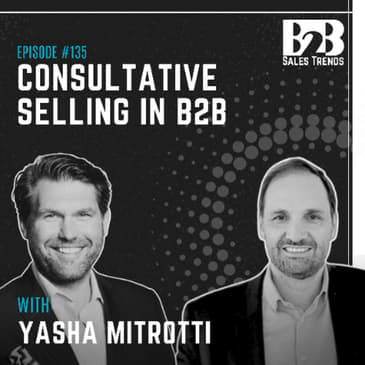
[00:00:17] My lovely people, there is a moment many sales leaders quietly recognize when the conversation that once worked no longer lands in the same way with the same quality. The questions change, the stakeholders change, and suddenly expertise alone isn't enough. My guest today is Yasha Mitrotti.
[00:00:40] Yasha is the Executive Vice President of Industrial Applications at Bayou Merieux. I hope I pronounced that correctly today.
[00:00:49] Over nearly three decades, Yasha has led commercial organizations across regions, cultures, and business models experiencing firsthand how selling has moved from highly technical exchanges in the lab, for example, to complex decisions shaped by economists, and economics, rather operations and executive priorities.
[00:01:17] In this episode, we'll talk about what that shift really demands, how value has to be reframed, how premium is defended under pressure, and what leaders must confront when the way they sell evolves faster than the people doing the selling. Can't wait for this episode. Welcome to the B2B Sales Trends Podcast, Yasha. Thank you, Harry. A pleasure to be here.
[00:01:45] Yasha, give us a bit of an update to kick us off with about your journey, how we got into this place, and give us a bit of an introduction about yourself. Sure. So, I've been in Bayou Merieux now working for almost, as you said, 30 years. It's a long time. I started back in my home country last century, by the way.
[00:02:08] And yes, I've had the privilege to lead sales organizations all across different countries, regions, continents. And today, I'm heading one of the divisions of Yomelieu out of the two we have, which is industrial applications, which deals with the food and pharma markets. And happy to be here and discuss about selling, which is what we love to do on a daily basis. So, eager to hit the discussion. Love it, Yasha. Thank you.
[00:02:38] Buying has changed. We discussed this a little bit in our pre-call leading up to this recording. And selling got quite a bit harder. You've watched buying behavior shift across different regions. There's different elements in the tenders, distributors, private buyers, new stakeholders. When did you first feel the real turning point in this? The moment sort of the technical sales stopped being enough?
[00:03:08] Well, very difficult for me to state a year exactly when that changed. But I said it's the change of the century where everything happened. And in Yomelieu, whether it's a clinical division or industrial division, we have always been selling to a lab. So, it's a technical sales about expertise. It's about how our product performs. And suddenly, I would say in the early 2000s, we started to see new stakeholders coming into the picture, which were never the case.
[00:03:37] So, at the beginning, we had some purchasing people. Then we had some CFOs, then CEOs, manufacturing managers. So, we've seen that transformation that today, in order to sell our products or solutions, you don't need to talk to the same stakeholder we're talking in the past. But it has really enlarged. And obviously, that had meant a lot of different changes around our organization to be able to tackle all those different stakeholders. So, it's been quite a while.
[00:04:05] And we're trying to drive and navigate through that over the last 15 to 20 years. Interesting. What are some of the mistakes? What are the most common mistakes? Let me reframe this. What are some of the common, most often used mistakes that those technical sellers make when the economic buyer gets involved or showed up? You know, procurement, CFO. Suddenly, the conversation changes.
[00:04:34] What are some of these mistakes that you have witnessed over the years? Well, the first mistake is obviously not applying the good sales techniques, which are always very useful to understand the pain points of the customer. So, if we take that aside, assuming that all the salespeople already know the well techniques, making the discovery, understanding the needs, we take that apart. The main common mistake that they would do is basically bring back to discussion, back to the technical level.
[00:05:04] Because when you're discussing with those kind of people, I mean, they don't care about the technique behind. They have people in their labs that obviously have validated that. And obviously, the most comfortable place to our people, which used to be biologists, people that know exactly what they're talking about, is to bring back the discussion to that technical level. And obviously, that's the biggest mistake they can do because those people don't want to talk about that because they realize that other people during the selling process already validated those points.
[00:05:33] So, they really want to understand what is your offer or your product or your solution addressing my pain points as CFO, as manufacturing manager, or as purchasing, where my whole deal is to decrease the total cost of ownership. Which is another thing that we need to discuss because sometimes we start discussing about the cost of the product or the solution and not the total cost of ownership, which is obviously what we try to bring.
[00:05:58] So, the most common mistake is to bring it back to the technical level and not wanting to address the pain points of the different stakeholders that are very different from the technical part. Now, I would imagine in our experience, that's very difficult because you have super smart people on your Salesforce, right? They have degrees, senior level degrees.
[00:06:22] They understand their world and the technical aspect of what you're selling to an exceptional level. So, the default, a lot of the times, their comfort zone, for lack of a better word, is the technical conversation. You said bring it back really to that total cost of ownership discussion, bring it back to outcomes, to business impact and so forth.
[00:06:48] Do you see people falling back into that comfort zone a lot? And what does it take for them to stay out of that? Sure. I mean, everything we do at Biomarieux and it's based on innovation is value-based selling. So, we are clearly selling the value of our solutions, which we believe not only we have great quality, but we can bring a lot of add-ons that the customer probably doesn't see at the first stake.
[00:07:15] So, yes, I got to tell you over the last 30 years of experience, we've seen how our sales reps that were very good at the time 30 years ago are exactly not the ones we need today. Right. Because everything has changed. And when you have a very highly technical sales guy, if he remains on the technical side, he will not be able to show the whole value of the solution that he's selling.
[00:07:40] So, yeah, that's a common mistake, as I was saying before, that they fall into that and they can get in a very difficult conversation. So, over the last 30 years, what we've done is obviously train a lot of people to basically get them out of that comfort zone and try to basically tell them how they should speak with different stakeholders. So, in selling, and I think you will agree with me, Harry, it's a never-ending story. It's a journey that you have to go on and this never stops.
[00:08:10] So, yeah, the company and all our people behind have put a lot of new things into place. We've put a lot of trainings into place. Just making sure that those people are well prepared to basically face those kind of discussions. And I got to be honest that during those 30 years, it is nice to see that a lot of them have been able to basically increase the capabilities. And today, they're really good sales reps as they were 20 years ago.
[00:08:37] But unfortunately, a lot of them actually were not able to cope with the challenge. So, obviously, it is difficult to say that not everyone succeeds. And it's a journey that you have to face. And obviously, you will have winners and you will have users. Hey, a quick pause here because if you're leading a sales team right now, you will want to hear this.
[00:09:01] We've just released our new report, the 26 sales trends for 2026. It's pulled from the conversations we've had with senior leaders on this very podcast. The themes, the shifts, and the realities shaping how customers buy and how teams need to sell in the new year. It's practical, it's concise, and it's built to help you make better decisions faster.
[00:09:30] You can download it for free at the link in this description box or at globalperformancegroup.com. Now, let's get back to the conversation. It's a really good one. Can you give us a concrete example? You mentioned value-based selling. Can you give us a concrete example of how that value story in a way has to adapt and is changing depending on which stakeholder is in the room?
[00:09:57] Is it a lab director versus a physician versus a manufacturing manager or versus a CAEO or a CFO? How does that story change in your value selling equation? Well, the thing is that many years ago, we were having, as I said, a technical sale and you were selling to the lab. And once you had convinced the lab that your product had the good specificity, sensitivity, and you had an accuracy and it was good,
[00:10:25] then the customer was happy and maybe he was willing to change compared to what he has. Once you start getting new stakeholders in the negotiation, they're not looking for the same. I mean, the quality guy is looking for a very trustable product, affordable, that he could basically manage. But when you're discussing with a CFO, he wants to see what's the total cost of ownership. Am I going to gain something on that? The purchasing, he only wants to see the value of the product, the cost of the product itself, and none more than that.
[00:10:53] And obviously, when you go to a manufacturing manager and a CEO, maybe he wants to look a bigger picture. So obviously, depending on who you're talking to, it's very different. So, I mean, there are lots of examples that I can get and I'm going to take an example right now of what I currently do. I mean, in industrial applications, we deal with the food industry. So we have a lot of those big names that everybody knows that sells products all around the world.
[00:11:20] And if you go to discuss with a lab manager, he wants to see, okay, what's this compared to what I have? Is this more sensitive? Is this getting more accuracy on the result? Well, when you go and discuss with a manufacturing manager of that same, for them, the lab goes into the cost. So they want to decrease cost at every stake. So we've got to discuss with him. It's not, yes, obviously, the accuracy is very important, but the turnaround time, how much you're going to gain,
[00:11:46] instead of having, you know, a lot of those have to put those stocks on hold during the quarantine until they get the result from the lab, which usually can take up to four or five days. Obviously, if you're able to get a result in one day, you're gaining four days of stock. So with the lab manager, that's important, but that's not going to mean a lot to him.
[00:12:07] But when you go and discuss with the manufacturing manager or to the CEO, he wants to understand what's, I mean, how is he turning around his inventory? So he's very obviously stressed about those things. So this is where you clearly see that the value that you're selling is different depending on the stakeholder that you have. And you need to be able to get into that, this conversation.
[00:12:30] And that's why even the sales reps that we have today, sometimes they are no longer biologists because they have to go away from that in order to convince the different stakeholders that our solution is the best and is addressing the pain points of the customer. It's interesting what you say, because I really believe that, you know, every, the value that you provide obviously has to be adjusted to the different stakeholders.
[00:12:54] Now that comes from, they all have different needs and the different outcomes that they need out of this relationship or partnership. Now, what this also means is that everybody's needs are different. So that means that the sales rep really needs to adjust that kind of conversation to them. And I believe that just finding out needs is not good enough anymore.
[00:13:20] You really have to generate unconsidered needs, needs that the customer or the stakeholder hasn't considered that you can help them with, or even underappreciated needs, needs that the customer or the stakeholder hasn't appreciated can have an impact on their business. That's that innovation conversation that needs to happen, in my opinion. I mean, what's your take on this?
[00:13:45] You know, I have a great example, which is not exactly under my current responsibility, but I managed that when I was managing the different subsidiaries or EMBA. But 10 years ago, we acquired a company in the US, which had a completely new product addressing what we call today the syndromic approach. And meaning that sometimes persons at the time, I'm talking 2015, you had a respiratory infection. You didn't know what it was.
[00:14:12] And if you're an elderly person or you're immunocompromised, you might have some issues. So you go to the doctor to see what's going on. And unfortunately, and this is, I mean, not me saying it, but there's a lot of media around that, studies, that in probably 30 or 20 or 30% of the cases, the doctor doesn't know exactly what's going on, what the person happens. And what the doctor does is he does a lot of different tests, try to understand what the patient has.
[00:14:40] And then obviously, based on that, he will adapt her therapy. And by the way, at the time, when we went to see the labs, they saw our solution and said, wow, that's interesting. We should have one. So we obviously made the deal. And at the end, we were not seeing any demand because obviously the doctors at the hospital didn't know it existed. So we had to take all our sales force, which was a tremendous thing, saying, you know what, guys, now you're going to, you know, you now need to go and discuss with doctors.
[00:15:10] Right. I mean, they were afraid because doctors are not an easy person to talk to. And obviously, if you go to a doctor and you start getting into the complexity of the test, the PCR, how is it being done? I mean, the doctor doesn't want to know that. It says, what am I going to do with the result? Right. And that was completely getting our people from their comfort zone. They had to go and see some other stakeholders that they didn't see in the past. So we created a need that didn't exist.
[00:15:37] And this is because of innovation for the company that created something that didn't exist. But actually, that changed completely landscape. And we could see that after. And I will tell you on the pandemic how it happened. But that was a completely different need that didn't exist. It was not mentioned by anyone. But we brought this innovation and we created the need and we created the demand. Now, the good thing or bad thing is how many of the pandemic was not a good thing that happened.
[00:16:01] But when the pandemic in 2020 arrived, there was no PCR test for COVID because nobody knew what COVID was. So during the first months of that pandemic, a lot of patients were going with clearly a respiratory disease, going to the customer. Those customers or hospitals that did have our solution didn't know what to do.
[00:16:25] So they did this kind of panel, which you were testing at the end 20 targets or 22 targets. And at the end, if you get a result, everything negative, meaning that it was not a flu A, flu B or whatever. So then the conclusion is, so you have COVID. And this is how at the beginning of the pandemic, a lot of the patients were actually diagnosed. Then obviously three or four months after it initiated, we started to have PCR kits and a lot of different things that we,
[00:16:54] by the way, we also made. And today our panel includes COVID in that test. So that was good. But this clearly shows that in this perfect example, we had to create the need. We had to create the demand. And obviously the journey was not easy because then our sales reps were actually facing a new stakeholder that they didn't face before. And it clearly showed that we were not ready for that challenge.
[00:17:22] And we had to do a lot of efforts in training, coaching, et cetera. And today we are clearly after five years saying that we have the capacity to discuss with doctors, with physicians, and tell them what the benefit of our products can bring to them under daily practice. Now, a great example. Thank you for sharing.
[00:17:44] This approach or these kind of conversations, they need a certain level of confidence from the sellers, right? To really engage in that new demand or create that new demand. That requires a different conversation. And that different conversation requires a level of confidence.
[00:18:05] How important is confidence in the way that your people are representing the organization and engaging with your clients? I mean, confidence in everything you do in life is very important. Because if you're not confident yourself about what you're selling, then how are you going to be able to convince someone that what you have is bringing the value? So I think it is that confidence which is obviously very important.
[00:18:33] And in that example that I mentioned before, obviously, which is completely normal, these guys were used to speak to labs. Then they were used to speak to purchasing managers, CFOs, even manufacturing managers, CEOs. But the medical community is something that they were not aware of because they didn't have that expertise before. And obviously, when you have to go to discuss with a new stakeholder that you don't know, well, you don't have the same confidence that you were building with the persons that you were dealing before.
[00:19:02] So clearly, at the beginning, there was a loss of confidence. And this is where I mentioned that a lot of those people were able to overturn that confidence, gain a lot of insight, train themselves in order to be better, and they succeeded. And today, those are people that were successful on the transition. But unfortunately, a lot of those same sales reps that are no longer with us today didn't have the confidence.
[00:19:28] And when you don't get the confidence and were not able to get that confidence during that transition, and unfortunately, they were not able. So, I mean, for a sales rep, you need to have confidence on what you're selling to make sure that you are transmitting that confidence to your buyer, which at the end is going to trust you or not on what you're selling and is bringing the value. Yeah, I fully agree with you.
[00:19:52] The other day, I heard something interesting that says, you know, confidence isn't a feeling, right? Confidence is repetition stored in your brain. Every practice that you do about a skill strengthens this neural wiring. Every practice, in a way, gives you more control and more composure,
[00:20:19] so you can deliver whatever you need to deliver in these difficult moments where there is tension involved or pressure involved, for example. I thought that was pretty interesting. Yeah, yeah. Well, let's talk about the transformation element of it. And I know you've led a number of different transformations in your time.
[00:20:42] And there were significant shifts in the way people are selling and how that actually happens. What has surprised you most about who adapted and what was the hardest for you personally as a leader leading those transformations? Well, it's interesting. And it's obviously a very difficult question to answer because, you know, it's all about individuals and how people react to the change that the world is bringing.
[00:21:13] And, you know, a lot of people are afraid of change. Others are eager to face change. So I would have to say that obviously when this transformation started to happening, obviously it took a lot of us by surprise. And some of them were prepared. Some of them were expecting it. Some of them were not expecting it at all. And obviously change is always a question that you need to address with dedication
[00:21:38] because it will require for you to really think what you were doing if it's still enough for what the change is bringing and if you need to change or not change. And this is the most difficult part we had is that we had a lot of successful sales reps in the past that were very successful. And they did what they did by doing what they did back then. When this change came in, why? They say, I've been successful all my life. Why do I need to change? It's working.
[00:22:07] It has been working all the time. So why should I change? And this is obviously the ones where we faced a lot of issues that obviously today are probably not longer with us anymore because they were not willing to address that change. On the contrary, there were others that always liked to be changed, challenged. And I get back to your point. Lacking this kind of capabilities. I don't have these skills. I need to get these new skills. And I'm going to train for getting those skills.
[00:22:36] So they were asking, begging for training, coaching, and all those kind of things. And we had to do a lot of effort. And we did that effort. And we did that transformation. And at the end today, we're very happy to say that a lot of them were able to succeed. And when you talk to them, they say, wow, I'm a completely different salesperson than what I was before. I thought that I was good back then. Well, after everything I've done, I'm much better now. And I think change, and it's part of our history.
[00:23:05] I mean, change will always come. And if you're not prepared to change yourself in order to address that change, then you're not going to be successful. And this is what I always like about any transformation history, is the fact of where you were and where you are now. And what you had to go through in order to be able to overcome that change. And today, I might say that my company, Vion Merieux, is much stronger now than what it was before.
[00:23:34] And that change brought a lot of things to us, not only brought innovation because we had to create new products that didn't exist, but also our commercial force is much stronger now. And for all the new innovation that we're currently launching and the ones that will come, we are much better prepared today than what we were years back. So, I always like the transformation because this is challenging the status quo, which is always the big problem.
[00:24:01] And that asks questions about yourself, and it's about progressing. And I'm happy to say today that there's a lot of sales reps that thanks the organization of what they've been able to accomplish because the company was behind them when they needed it. And today, they're a much better person today than what they were 20 years ago. Now, obviously, part of that transformation are a number of elements.
[00:24:25] You know, the processes, tools, training, segmentation, compensation, many different things, right? Looking back, what were the few changes that actually created the biggest impact in performance, in your opinion? I mean, and that's why after 30 years, you can basically have the history of everything that happened before. So, not only the process changed, the methodologies changed, the stakeholders changed. Yeah.
[00:24:55] But at one point of time, since quite a long time, we actually don't sell at the lowest price ever. So, we obviously have to challenge ourselves because we are bringing, we believe, not only the great quality of our products, but sometimes we're bringing, or a lot of times, we're bringing a lot of value to our offer. And it's not longer a product. Now, we're basically talking about the whole solution because we don't sell just a product.
[00:25:20] We sell an instrument, we sell software, we sell services, we sell consumables, and we sell reagents in order to make our solution affordable. So, we think that this solution is going to bring added value to our customer on different sides, whether it's on the technical side or on the economical side. So, we need to obviously show that value. And that obviously has been the biggest transformation that we have to face over the fee. Because one thing is when you sell a Me Too product, when there's not a lot of advantage compared to what you had.
[00:25:50] And a different thing is when you sell a completely brand new thing and you need to demonstrate that value. And that was obviously the biggest challenge is that we needed to equip our sales guy to be able to defend the value at every stakeholder that was on the other side of the table. So, and not the value was exactly what I mentioned before, the same for the different stakeholders.
[00:26:12] So, that is the biggest thing that people had to basically go through, understand the value of our products, of our solutions, and be able to explain it to the different stakeholders that are behind them. And this is the persons or the people that decided to confront that challenge are the ones that were successful. And I'm not saying it was hard. It took us a long, long thing and we had to take difficult decisions during that.
[00:26:36] But what is very nice about this human journey, because at the end we're dealing with humans, with individuals that are doing this on a daily basis. Today, the fact that they're very much well prepared for anything that can come for the future is something that you feel proud of what you accomplished. So, this is the biggest fear that they had. And today, after dealing with those challenges, we can say that today they feel much better prepared.
[00:27:01] So, we had to put a lot of efforts on training, on coaching, on being at their side. Even the sales managers did the transformation at the same time because they didn't know what was going on and what was happening. And seeing this change of attitude and a change of the way the behaviors that were being done. And then, new tools came into place. I mean, what we're doing today is not something that we're not selling over a Teams meeting or a Zoom meeting. That is something that didn't exist before the pandemic.
[00:27:31] Today, selling through a call is not exactly the same skills that you need to have when you're in person situation. So, tools came into place. AI is coming a lot. It's challenging a lot the world of selling, which is great in a good way. But the tools that were brought actually changed a lot of things. And, you know, also that was a big shift or a big change for a lot of our people that needed to adapt to the new tools that were in place.
[00:27:58] And that is something which is obviously not easy to apprehend once you are not savvy on those kind of things. Getting it, paying attention to that. So, a lot of things have changed that I think I can say that today we're much better prepared. And there's a lot of new changes coming in that we have not yet seen. And we will need to be ready to adopt those new ones that are coming. Love it.
[00:28:27] Thank you for that, all of you. And, yeah, it's apparent transformation is always going to happen, right? You can resist it or you can lead it. It's really a choice thing. Interesting. Are you up for a quick rapid fire questions? Love it. I have a product on my own, which is called Rapid Fire. So, we can talk about that one. But let's go for the rapid fire questions. Oh, good. All right. Good.
[00:28:57] Give me one book every senior sales or commercial leader should read. Wow, wow, wow, wow. There are too many. I don't have a particular title because there are too many that have gone through that journey. I think everything relates to the, and you were saying it's about change, how to deal with change.
[00:29:22] And I think, and you said at the Bay, you actually face it or you embrace it. And I think all those books that I have read that have basically taken you into that challenge, I think the facing change and leading the change and going through that transformation is obviously something that I think is very useful for any sales reps. Because I think we've seen a lot of changes, but we haven't seen at all. And there are going to be much more coming in the near future.
[00:29:51] And people need to adapt to those changes. Otherwise, you will be left behind. When you're not working, Jascha, what generally helps you to switch off? What do you do outside of work? Sports. I'm a big fan of sports. I would love to practice all of them. But sometimes I cannot practice. So I follow all the sports around the world. I'm a big football fan. I'm a big basketball fan. I'm a big golfer.
[00:30:19] So everything related to sports is what switches me off. If I can go on a golf tournament and play for 18 holes, that would be much. That's great. But even going to the stadiums and seeing people play and even sitting on the couch and seeing on a TV a World Cup or whatever is something that really. But I really like enjoy a lot. And that's obviously a moment that I can share that with my family, my kids, my wife. That's always something very nice.
[00:30:47] And that really helps me to reach large batteries. Follow-up question to that. What's your football team? Well, you know, because I've been traveling a lot in my world. I have a different football team or soccer team or football team in each country that I've lived. So now that I live in Madrid, I can basically say that I'm a very, very big Real Madrid fan. That's in Spain. I love it.
[00:31:16] And I suffer when they suffer, which is currently what she's undergoing. In Italy, I'm an Inter Milan fan. And in my home country, which people don't know, I'm an America de Cali fan. That's what I would say on the three countries. I also have some in France where I live or in Brazil where I live. But I'm going to leave it there. Obviously, Flamengo is the one in Brazil that I really love. Love it. Love it.
[00:31:42] Give me one word to describe where premium and high value B2B selling is heading next. One word. One word. Challenging. Interesting. Like every challenge brings interest.
[00:32:09] So I do believe that value is going to be the name of the game. Selling value is what we need to provide. And having value on your product and understanding that value and being able to sell it, it's always a challenge because we'll have to face new things. But it's very interesting because that makes you a stronger person. And that's what I always say. Our products are great.
[00:32:33] But we are able to sell more than our competition is because we do have not only the quality of our product, the innovation that it brings, the value that it brings, but the sales team that are able to show that value. And the good thing about our business is that we are a recurrent business, meaning that once you get a customer, you're going to get that customer. This is for the next five years and maybe 30 years. So the fact is that we're selling a solution that he's been going to use because we are in a recurrent business.
[00:33:01] So if you tell something not true, he will be able to discover if he gets you. And that's the beauty about our thing is that they will have time to see and even total cost of ownership, they will be able to say, you told me that two years ago, let's go and see what happened over the last two years. And if they don't see it, then they lose trust. And when a customer loses trust on you, you're done. Yeah. You're done. Fully agree.
[00:33:28] Yasha, the last question, every podcast I've asked it over a hundred times, over a hundred episodes now. What are the top three qualities in your opinion that salespeople need to execute and have in order to be elite salespeople, the top three skills or behaviors? What would they be? The first thing is passion. Heart. Put your heart on everything you do.
[00:33:54] If you're not passionate about the role of sailing, you're not going to be convinced, Vincent. So passion is for me the most important. You need to be passionate about what you do on a daily basis. You need to wake up every morning with that feeling of going outside and battle and see the different stakeholders and challenge and basically sell them what you have to sell. So I would say passion is the first thing that every sales guy needs to have. The second is the question of gaining the trust of the customer.
[00:34:24] Never lie about your product. Never say things that you cannot prove. Be the most transparent person and honest person about what you're selling. So transparency and honesty on the act of selling is for me the second quality that everyone has to have. Because if you're not transparent, if you're not telling the truth, they will be able to recognize. And once your customer reduces the trust, then you're done.
[00:34:51] And the last, which is something that a lot of the books that you were asking me before on the rapid fire episode or part of the discussion is discipline. The art of selling is a profession. It's something that you need to master. You need to train that muscle every single day. And in order to do that, you have to have discipline.
[00:35:19] You have to prepare your calls. You need to know exactly who are you going to talk to. You need to have your questions already put into, maybe not written or clearly described, but you need to know exactly what is your purpose. What are you going to look for? What is your milestone that you're looking to get? And for that, it's a discipline that you need. Today you have tools. You have a lot of methods and things around and processes.
[00:35:46] But this is a profession and you need to master it well. So I would say the three words are passion, transparency, and discipline. If you get those three, you're really in a good way to basically become a great sales guy. Yasha, you've been an amazing guest. Thank you for your insights. I know our listeners will super appreciate your thought leadership on the topic. Thank you for taking the time.
[00:36:16] Thank you, Harry, and a pleasure to be with you. And I love speaking about sales, as you can see. It goes beyond. So nice moment and hope that your audience will like what we discuss here today. Thank you very much, Harry. Absolutely. Thank you, Yasha. My lovely people, what stayed with me from this conversation with Yasha today is how clearly it shows that success in sales today isn't about abandoning mastery.
[00:36:46] It's about expanding it in a way. Because as buying environments involve the skills that once defined excellence in the past aren't always enough on their own. And conversations move beyond technical depth. New stakeholders enter the room and leaders are left navigating that tension between honoring
[00:37:10] what made people successful and asking them to grow, change, fall into that new environment. These are the conversations that remind us that progress in B2B selling doesn't come from certainty alone, but comes from the ability to rethink how value is understood, how value is articulated and defended as conditions and environments change.
[00:37:37] If this episode prompted you to reflect on how your own sales world is shifting, share it with somebody leading through that complexity. And of course, subscribe to the B2BSalesTrends.com or go to our YouTube channel, B2B Sales Trends Podcast. Until the next time, my lovely people, look after yourself, your loved ones, and of course, your B2B customers. All the best. Bye-bye.
[00:38:01] If you'd like to put yourself or someone you know forward to be a guest on our show, there is a quick form in the show notes to complete. It only takes a minute and it helps us to find voices and opinions that shape the future of B2B selling. Thank you. We appreciate it.