
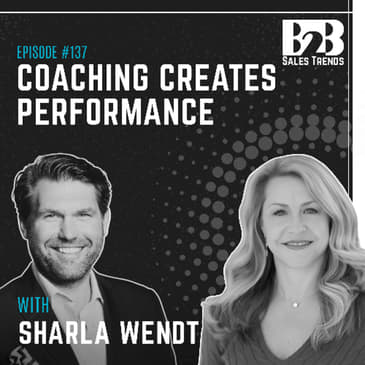
[00:00:00] Welcome my lovely people to another fabulous episode of the B2B Sales Trends Podcast where we give you a sneak peek into the strategies of the world's best CROs and go-to-market leaders, the systems, the playbooks, the thoughts and the leadership they are using and doing and implementing so you don't have to figure it out the hard way. So if you want to increase win rates, shorten sales cycles and learn from the best in B2B selling, this podcast is for you.
[00:00:29] Today we're getting into what it really takes to build a high performance sales organization, not just through training but through continuous coaching, mentorship and culture.
[00:00:45] I'm super, super pleased to have Sharla Wendt today on the podcast. Sharla is the SVP of US Sales and Marketing at BD and a pleasure to have you with us today. Sharla, welcome to the show. Thank you so much. It's an honor to be here.
[00:01:05] You have seen this whole B2B selling piece from multiple angles, right? From being in the field to now leading US sales and marketing at Becton Dickinson. And when you think of a world-class organization, world-class sales organization, should I say, give us some context on what it takes to build one.
[00:01:31] When I look at my sales team, we are really trying to create a, this to be a destination company, like where you can land here and build a career and stay. And we've done a really good job of that. And so it really starts with having a purpose. We're in medical sales. People get into medical sales because they want to help people. And a lot of companies, I believe, say that, but you have to live that from the top down.
[00:01:54] So my boss, who's the president of our business, all the way down to the field, all of us believe we are getting up every single day with a purpose to improve patient care. And we show, I show every month on my monthly all field call, a patient success story where we've helped someone. We bring that into our plants. We bring that into every part of the fabric of the, of the business because we want to really live that out.
[00:02:18] And then once you have that purpose, then you can also, how you hire, who you hire, how you train, all of the things that we all know to do are what make such a successful team and really make this a company that people want to stay at because they've got that, that same drive that they know they're waking up every single day and grinding and doing all the hard work to fulfill their purpose. It sounds purpose and culture is really big at your organization.
[00:02:47] Yes. Culture, especially we talk about it through every single, single step of the business through the interview process. And our culture is a really unique one, I think, because it's one, we actually enjoy being together, but we also executed a very high level. The expectation is we are going to compete with each other, but I'm also going to help you. So I may say to my colleague, I'm going to, I'm going to compete with you.
[00:03:16] I'm going to be number one because I'm competitive, but I'll help you be number two. And that's really what we instill throughout the entire organization. It's a unique place where people will help each other, even if it doesn't financially benefit them, because that's the culture that we have created. And we make sure we are high touch from leadership down. I'm high. I know all of the, all of the field. I'm in the field with them.
[00:03:43] My area vice presidents do my vice presidents do my region directors are in the field. And so it's such a high touch, kind of a family feel that has created this amazing culture that we want to help each other. While the expectations, because we also deliver, if you're not delivering, you also stand out. So it's, everyone's kind of pulling on the rope together. And we also have created a safe culture where you can ask questions.
[00:04:12] We assign mentors. We do everything in our power to make sure people have the resources they need to get the answers so they can continue to develop. And that all kind of rises everybody to the top. And so we really have a low turnover because of that and because people really enjoy working here. Sounds like a fabulous company to work for.
[00:04:35] Let's shift this a little bit to sales and the B2B selling space too. I would assume that that culture and purpose also translate obviously to the sales organization. We discussed a little bit in our pre-call to this, the fact that buying behavior has shifted quite a bit recently, especially in your space.
[00:05:01] What do sellers need to do differently today to stay relevant in those conversations? Yep. You know, everyone knows this. Gone are the days of selling a widget, of just going down and features and benefits. Those days have been long gone, but it's really hard to actually change that behavior. And the goal of my sales team is to truly become a partner to the clinician.
[00:05:29] And again, that comes back to if we're putting the patient first, they feel that as well. Because of course, clinicians got in this to help patients as well. So if we are truly uncovering their why, our goal is to become a partner with the clinician to understand what pain points they have, what their why is, what they're struggling with, and how do we provide a solution. So we are very rarely talking about actual products.
[00:05:56] And we're really talking about improving patient care. We're talking about finding out where they're struggling, what patients are having complications. We go in with a lot of data as well, knowing the hospital, knowing the surrounding area and how they compare in different service lines or surgeries. And so we can go in with a pre-call plan, knowing exactly what's going on in the facility.
[00:06:21] We go in knowing, we kind of rehearse before we go in and we make sure that we truly are curious and ask questions. Because everybody does spin selling or a version of selling of any kind or a combination of different kinds of types of selling. But if you just go in and ask a bunch of questions, it can be off-putting. You have to truly be genuinely curious with authenticity about what they're going through and what they're facing.
[00:06:49] And then you start to, you know, endear them to be a partner and they truly show you care. The other thing I tell my team is there are times when our product may not be the answer. And that's okay because it shows that you actually genuinely care and you genuinely want what's right for the patient. And when you can do that, they're going to be like, oh, they really, they're really authentic. They really authentically care about my patient. And this is not all about the mighty dollar or the, or the sale or whatever.
[00:07:19] And so that's really, we don't want to be much salespeople anymore. It's more consultants, support, partners, all of those kinds of things. And you've got to be an expert in your field. Like they have to clinically know hemodynamics, which is what we focus on, which is not an easy topic. And to really be the expert so they can truly provide solutions.
[00:07:41] And to put the patient care in the center of things, put that patient outcome in the center of things. And to treat a conversation and those relationships around that way, that it's not me pushing a box here or product.
[00:08:00] But that's really the trends that nowadays buying behavior should be tackled with 100%. It's interesting. Now, most teams, and this is always what sales leaders struggle a lot with. Because everything you have described just now, you know, is great in theory. And it's easy to understand.
[00:08:30] Okay, I've got to go in and I've got to uncover some needs. I've got to bring some value. I've got to act as a partner. I've got to act as a consultant. I've got to, you know, do all these wonderful things. A lot of people struggle with the how and how do you do this consistently to a level that, quite honestly, these days, an elite level is required to execute this way.
[00:08:53] How do you help your people to be consistent with those and also execute these skills and behaviors that may be intellectually, you know, straightforward? I understand it. But the how of doing it then, that's a challenge for people. How do you help them to do that? It is definitely a challenge. It's funny. I was literally just yesterday speaking to a new hire training class talking about exactly this because we've all seen it, right? Everybody wants to provide value and have these conversations.
[00:09:23] But, you know, when you first, especially when you first get out of training, you've got all this knowledge and you meet your first customer and you, you know, just talk and talk and talk about everything, how wonderful we are. And you haven't uncovered a single thing. And so, so much of what we do is it starts from the very beginning. It starts with A, who we're hiring. But then even more, we have continually honed our training program over and over and iterated it and iterated it.
[00:09:50] And we continue to do that and look at how can we get better? How can we get better? And so, so much of what we have done is we have our, everybody from our field is immediately when they're first hired is signed a field trainer. And that field trainer is one of our expert sales reps or we also have nurses on our sales team or they're an expert clinical field specialist, which is what a nurse is titled.
[00:10:14] And so, they immediately day one are assigned to that person and we assign them for 18 months to two years. So, it's a long process. Now, we also have our region sales directors who scope out the first 12 weeks of their onboarding that they will be with someone every single week learning the job. We've got two different sets of training. The first training is one week long. It's called PNC, product and clinical.
[00:10:43] It's when they really get into what the products do, all the anatomy behind what we do. But even in that phase, we're still applying real world of how you would utilize and sell those products. Then we put them in the field for about two to three months, working in cases, working with their region director, working with their field trainer and other people on their team to really understand how to have those conversations.
[00:11:09] Then we bring them back for a two-week long sales and application training. And we have completely tailored our sales and application training to real world scenarios based on real world conversations that have actually been had recently by some of our top sales reps. And then we continue that throughout the next 18 months before they walk into any big meeting. They'll have a role play with their field trainer.
[00:11:37] The region director goes with them in the beginning to make sure they can teach or jump in when that's going on. And then we continue to adjust our training throughout. So that's a big part of it. At the second part, too, is because of what we sell is very clinical, we found that we can't hire externally and be as successful because it's such a player coach job.
[00:12:03] So the majority of our region directors were salespeople that showed really good leadership skills. And so they know how to do the job, but they were very successful at it. And not every sales rep could be a leader, but the ones that we hire show great leadership quality. And so they're able to coach shoulder to shoulder. They've had those meetings. They've made the mistakes.
[00:12:30] And then our area vice presidents all came from the field. I came from the field. So that's kind of been our winning formula of really being an expert in this area. It links back to how you started out this recording with culture and purpose, right? That's how you get the tenure of these key people. How do you nurture them throughout the ranks, so to speak, for lack of a better term, actually. But to really nurture them into senior leaders.
[00:12:58] And that's a great way of doing it. Absolutely. It's been very successful. What do you pay attention to when you hire new people? You just said you spoke in front of a bunch of new hires that just joined the company. What do you look for when hiring future expert sellers, future leaders?
[00:13:22] We actually designed and have iterated multiple times competencies for each individual person that we're hiring. And originally, when we were looking for president's club winning, very successful sales reps, multi-presidents club. And we still do look at that. But really, because what we're doing is change management. We're truly changing practice. And sometimes for people that don't think they need to change.
[00:13:50] So that is a very difficult sale. So we are really looking for people that have proven in life, kind of life's winners. The ones that can give examples of, I have overcome something in my life and had to persist and pursue and can give detailed examples. Or can give detailed examples of, I've got that grit that continues to push forward when I get no's a thousand times.
[00:14:18] Because again, some of our best customers that are biggest advocates now were our biggest naysayers for years. And it takes a long time to change behavior. And so you've got to be truly persistent. You've got to have proven that you care and are passionate enough.
[00:14:35] And also are curious enough to get the clinical expertise to be able to stand your ground and respectfully push back on somebody who went through school for 10 years to get to where they are. And are supposed to be the expert in the room. And so those are the kinds of people that we're looking for is that natural curiosity that's got the grit, that is one, that has overcome things.
[00:14:58] And we've really honed in these competencies to understand what it takes to get this job done. And then we've trained our region directors on the interview skills to uncover those. Like you can't just ask the first layer of the question of, you know, tell me a time you overcame something. But you've got to then dig deeper down into that answer and then dig deeper down and really uncover what makes that person tick.
[00:15:25] And so that's kind of what we're looking for is that grit and drive. And the other thing is kind of an entrepreneurial spirit because you have to have command of your territory. We look at are you strategic? Are you process-based? Because we follow a process very clearly. And can you truly uncover needs? Are you naturally curious? All those kinds of things are some of the competencies that we're really trying to uncover in the interview process.
[00:15:54] Now, you mentioned uncovered needs now a couple of times. Just to take this conversation a little bit on a detail. A lot of the time what we hear from the field, what best practices with those new buyers, because as we discussed, buying has changed. And the needs of clinicians or the people who make the financial decision, they also have changed in a way.
[00:16:21] And a lot of the times what people are saying is that only uncovering needs and asking some questions about their needs is not always good enough. So the next level to that is how do we generate new needs in the mind of our customers? How do we share a more provocative conversation to not just find out needs, but to generate new thinking?
[00:16:50] Because we're the experts in what we can provide to them. And creating that new thinking on those needs, needs that they haven't appreciated before, can help them. We get very good feedback on that. Is that something that resonates with you? Yes. So it's really interesting because a lot of what we have done in my specific business unit at BD is develop markets.
[00:17:18] And so you can imagine you've got clinicians who don't think they have a problem. We're developing the market for the first time. And so, yes, while you want to understand their needs, absolutely. That's a big part of it. You also have to go in and sometimes tell them you have a problem that you don't even realize you have. And that is a challenge because, again, you're talking to doctors who went through school for a very long time and are doing wonderful work. Right. So that's a hard conversation to have. Right.
[00:17:49] But specifically on hemodynamic monitoring, which is what we specifically do, they don't always know what's available out there as you're developing a market. And so we spend a lot of money on actually looking at data so we can actually see how is this hospital performing down to which service line that this clinician is working in. How does it compare to its peers?
[00:18:10] And we have calculators that we can actually show because we've done the work and invested in the work to show, hey, in this spine surgery or cardiac surgery or OB situation, here is the outcomes that we can do within your facility. And so we will go in and say, hey, I can show you. Here's what your facility looks like. Here's how you compare to your peers. This is an area of opportunity for you.
[00:18:38] And so we can help you with that and we can provide that solution. And then we also have a whole separate team that will go into a facility that's actually carved out of sales. They are firewalled from sales. And they'll actually go in and implement protocols in the hospital and show the value of what our technology can do to change practice. And that is incredibly powerful.
[00:19:04] Our customers and a lot of people that we speak to, they face a challenge when they connect all the wonderful data they're investing in and connect that data with the behavioral how and the execution of how do we put that good data now to use? And then sort of package this up into the conversations that drives these new needs, that drives this new thinking.
[00:19:30] And again, it's one thing that's really good on paper and good in theory. But the execution piece is really difficult for salespeople to do this consistently. Is that something you see too? Yes. It is. Because first of all, your salespeople get in and what used to happen was we'd find one champion or one person that liked our product and they'd get excited and think that they've made it. And that is not the case anymore. You've got to build a groundswell.
[00:19:58] You've got to find multiple champions and multiple stakeholders from different areas. I mean, it can be for us, chief anesthesia, the chief surgeon, the head nurse manager, the quality officer, the CMO, the CNO. So there's all of these people you have to get on board before you ever even start a project.
[00:20:21] And then they're still like, we want to, yeah, you can tell me that data is something, but it doesn't mean anything to me because I know that I'm actually better than what the data shows. So what we've found out is that we actually have to go in and prove to them with their own patients that we can make a difference in their patient care.
[00:20:42] And we've done that, but that's a lot of work and it's a lot longer of a sale, but it also pays off in dividends if we do that the right way, because then it's sticky. Then it's protocolized. Then they actually show the results in their own real world example. And that way we can go back as it starts to drift over time because, you know, when you first initially do things, it's great. And then it starts to drift and you can go back and revisit that.
[00:21:11] And then you can take it to the next service line or the next area. It also helps us build a campaign and a story to tell other places. So it really is worth the investment. And then you're really being what you've described earlier, that advisor, that consultant that is required to, to is in it for the long game, right? In this case. Absolutely. Yeah. That skill set is not an easy skill set, A, to find. Oh, it's difficult.
[00:21:38] Or to expect people to do and to do it consistently. And so that's why it's so critical for our region directors to be in the field coaching and poking holes in their business and poking holes in their plan. And we've really defined our sales process and making sure before they move it to the next stage of the sales process that we've really uncovered all of these things.
[00:22:03] Because we've all been there where you've gotten, you thought you spent a lot of time in a sale and you missed some steps and you've wasted a lot of time. Absolutely. It's very interesting. Now, you mentioned coaching a couple of times already. A lot of coaching typically happens in pipeline reviews or on dashboards and at this stage of the sales process and so forth.
[00:22:33] In your opinion, what does effective coaching look like in real customer conversations? To me, it's shoulder to shoulder in the field with our reps, with our clinical field specialists, in the big meetings with our customers. To me, coaching is, and again, this gets back to who we promote.
[00:22:55] They've got to have been experts at the job and really understood how to do this thing that we're asking people to do, which is consultative selling and really being a partner to the clinician. And so coaching to me is truly in the operating room, standing at the operating board, pre-call planning with your reps. And then also it's coaching within the region. So each region, we have 16 regions.
[00:23:24] Each region is a little bit unique. And so the region has a culture of leaning on each other. And so they are quick to call before they go into a big meeting or to see if somebody's seen it before. And so it's not just coaching from region director to rep. It's peer-to-peer coaching. It's field trainer mentor coaching. It's coaching from the area vice president. So it's at every level. And it's in person as often as possible.
[00:23:52] And we still do our reviews, of course, monthly or funnel management and all those things. Of course, those are critically important. But I think the coaching piece has got to be shoulder to shoulder in person. I fully agree. A lot of companies don't have the size of the team to be able to do this. But when you have the opportunity to do this, this is the best way of doing it. There's no doubt. There's no doubt.
[00:24:19] So obviously, in B2B selling, you've won high performance. And high performance requires a certain accountability. And culture does link into that element a lot, right? So how do you create that accountability next to the great culture that you have as well? Or does it go hand in hand anyway? They do go hand in hand, in my opinion. Because again, back to the... We've got the culture and the purpose.
[00:24:47] But it's also the expectation to execute at a very high level is very much a part of our culture, which comes with accountability. But it's interesting because it's such a balance of... If you micromanage your sales reps, especially the elite ones at this level, if you micromanage them too much with too much process, then they're like, No way. I've been doing this a long time. I don't need to be... I don't want to fill out checklists and checkboxes and all of those kinds of things.
[00:25:14] I mean, you can do that some with new hires or you can do that some with junior reps. But those elite sales reps, they're not going to tolerate that very well. So it's really interesting how we've done it. It's a mix. We've done... Where, of course, we do, again, the territory reviews. We do region reviews with our area vice presidents. I do area reviews with my area vice presidents because I want to know what's going on in the business at all times as well.
[00:25:42] And so that's one way is kind of poking holes in the strategic plan and those kinds of things. So that's one area. Another thing we do is so much based on how we design our comp plans to create the behavior of accountability. And again, if everybody in the business has command because you're in the field, including the region directors, you can quickly see who is working with their customers, who knows
[00:26:11] exactly where to go, how many people they're saying hello to in the hospital, do they know where to go? So the accountability starts to come naturally if you're shoulder-to-shoulder coaching your people because you can't miss it. You're right there. And so that's a big part of it. We also have our reps. And this was new for us in the last several years. We also have our reps. Log what surgical cases they're in, but we made it as simple and easy as possible. It's not a lot of detail.
[00:26:40] It's a quick, I can say I went to, I did, I saw three spine surgeries today and I did two cardiac. And so it's very quick and easy, but we utilize that data to help us develop the market when we're finding new service lines or new surgeries to go into. And so if you make it simple and you make it common practice for it to happen on a regular basis, then it just becomes part of the job. And we don't do kind of the stick mentality. We're much more a carrot organization.
[00:27:09] We believe in compensating where we want growth and that's how we design our comp plans. And that's also just kind of how we set the expectations. Drives certainly not just expectations, but also accountability. And of course, you know, urgency is a big topic, right?
[00:27:30] Urgency to get stuff closed, urgency inside your teams, urgency on the customer front. And a lot of the times, and I'm curious to hear your take on this, a lot of the times in the industry, their urgency is created by, first of all, with the clinicians, right? That's one conversation to have.
[00:27:57] But also then ultimate decision makers, a lot of the times are the CFO type people, the financial people, maybe the hospital procurement and so forth. Now, typically sellers are not always comfortable with either side of the conversation. They're more comfortable maybe in the clinician conversation, but then the financial conversation is maybe not something that they're most comfortable with. Is that something that you see as well?
[00:28:26] Or is this that, you know, everybody's comfortable with everything? Definitely not. And I think that comes with time. Certainly, I wouldn't send a brand new rep into our market into a CFO conversation on their own, you know, because I think with tenure and experience comes those kind of conversations.
[00:28:50] You certainly have to change what you're talking about, tailor the message to a CFO or a CMO or a CNO or a CIO, certainly all the different, all the different stakeholders that we have. And so we tailor and train and coach and coach those conversations. But we send our higher end more veteran people or our region directors or area vice presidents in for those conversations in the beginning.
[00:29:18] And then we get, they get to watch it over time. And then we also do coach through some of those. We do podcasts a lot for our teams. So when they're driving, they can listen to them and we'll have some of our top sales reps kind of go through and interview a CFO. And so they can listen to it and understand what they're looking for. We do a lot of different things to get that level up because it's such a challenge.
[00:29:45] And those are such critical meetings and you can't mess them up when you're in them. And so it's really important. So we make sure the right people are in those meetings so we don't miss the opportunity. Love it. If you were looking at your strongest rep today, what are they doing consistently well that others aren't, in your opinion?
[00:30:12] Certainly they're starting with a very specific strategic plan of where they're going to go. And so for us specifically, there's a ton of hospitals you can go to. We really try to focus on two to three, we call them focus growth accounts. Because you can go to, with our products, you can go to a hospital and spend years going from service line, service line, surgery to surgery, ICU to ICU. And so, because some of these places are really big.
[00:30:38] So they have a very clear strategic plan that they are following and they have a backup plan. And they also follow a very clear sales process that has been proven to work over and over and over again. They are built great. Of course, we know building relationships. They are very good at going in and they're trusted as a partner and a consultant for this facility.
[00:31:04] And so their customers believe them because they've developed that trust over time. And it doesn't happen overnight. It takes time. We give our reps time to get up to that level before they get off a guarantee and those kinds of things because it's so important to establish it correctly up front. And they truly are answering and solving problems. But like you said before, they're going in and saying,
[00:31:33] hey, you may not have known this is a problem, but here it is. And I can say it in a way that's not offensive. And I can say it in a way because you trust me. And then I'll actually prove it to you by coming in and doing a project with real world with your own data. And they're doing that consistently over and over and over again. The other thing, too, is our teams are usually two people.
[00:31:57] So it's a veteran sales rep and a nurse that has sales DNA and usually a cardiac or an ICU nurse of some sort. And they partner and communicate regularly and always know what's going on with their customers, with each other. And so it just works out beautifully. And they've got to have great communication with each other and kind of be aligned on the goals and the purpose.
[00:32:27] You know, to build a team of reps like that, something has to change in how leaders think about enablement and development and all these wonderful things that you have clearly implemented. And may I say on the sideline, what a fabulous job you've done. If somebody is listening to this and say, I want to start that journey,
[00:32:53] what's the shift that they can do tomorrow to start that journey? That's a great question. First of all, thank you. I'm very proud of the team and the work that we've done. But gosh, you know, that's a tough one. So as far as like enablement, I do still think it gets back to culture. And the other part of the culture that I haven't mentioned yet is we're also a vulnerable culture.
[00:33:19] And that's that can be a buzzword that sounds, you know, floofy or, you know, some people don't love that word. And I don't mean vulnerability as I'm going to sit and cry in front of my people. But I mean a vulnerability of I don't always get this right. And it's OK to admit, admit that, hey, we're developing markets. This is going to be and we're a very innovative company and not everything is going to be perfect.
[00:33:45] Perfect. And that's OK, because it creates a space for your reps and your field team to be able to try things. It creates that culture that they feel safe, that if they mess up, it's not the end of the world. It's OK. And that's a little bit of enablement of it's OK to try and push these boundaries and try something new or go into a clinician.
[00:34:07] And if you've skin your knees, that's OK. So that culture piece is so critical of creating a safe place to really push the boundaries and try things new, new things. And and so that's part of it. I do think that, you know, for so many years, I've seen region directors coaching from the sidelines, coaching from behind the computer.
[00:34:28] I think that's the first thing you can do is get out there in the field with your people and truly understand the business. And if you are hiring from external, you've got to learn what they do every day, especially if it's a highly clinical or highly technical sale that you're expecting your people to know. You've got to be able to coach them through those tough conversations in real time.
[00:34:54] And so I think the first thing you can do is get in the field with your people and truly start to understand their their landscape of where they're selling. So that's one. And then sales enablement. Our team gets daily sales reports. They know exactly where they are. They get they get comp calculators so they can see what they can make if they do different things. And so, you know, if they reach different goals and reached and sell different numbers.
[00:35:21] And so our region directors are all coached on that and they utilize them regularly. So having, again, that data, but data that actually makes sense and motivates them. And you've got to poke holes in that, too, because you can overwhelm people with too much, too many reports and too much data. We've got like a handful of five that we look at weekly, monthly, daily, depending on what it is.
[00:35:45] And those are the tools that truly change behavior and we can truly use to actually make a difference. And so those are some of the things that come to mind initially for me. Absolutely love it. And what great tips. Thank you for sharing. The last question, Sharla, I always ask on every single episode is is always the same one.
[00:36:06] So what what in your opinion are the top three skills and behaviors that define top B2B salespeople today? And if you would rank them for me also in order first, second and third, that will be great. For me, it is. Perseverance. The second is a true natural curiosity.
[00:36:31] And then the third is like a grit or drive that that I'm not willing to take no for an answer component in your makeup. My lovely people, perseverance, natural curiosity and drive is what Sharla recommends you to be top elite level of Sharla. You've been a wonderful guest. Thank you for your thought leadership, for your insights.
[00:36:58] I know our listeners are very much appreciating all that leadership that you have shared with them. Thank you. Thank you so much. It's been a pleasure. My lovely people. What I take away from this conversation with Sharla is the following training doesn't create performance. Repetition, coaching, leading, leading with vulnerability and real application, real world application, should I rather say. They do create performance.
[00:37:28] The teams that get this right don't treat enablement as an isolated event. They build it from how they operate every single day. And if you're thinking about how this episode and how this shows up in your business, we've just launched something interesting that might help you out. It's called the Revenue Accelerator. It's in the show notes and it gives you a clear view of where you might be leaving revenue on the table and what to do about it.
[00:37:57] Also, we'll link in the show notes our latest research white paper called You're Entering the Deal Too Late. It's built on the patterns we're seeing across real deals where sales teams are involved but not early enough to shape the outcome. If you found this episode valuable, don't forget to follow the show. Share it with your teammates and members and subscribe on our YouTube channel or wherever you get your podcasts from.
[00:38:26] Until the next time, lovely people, take care of yourself, your loved ones and, of course, your B2B customers. Bye-bye.