[00:00:00] My lovely people, welcome to another fabulous episode of the B2B Sales Trends Podcast. For years, B2B buying was pretty straightforward. Buyers compared vendors, they negotiated on price and the lowest cost or the lower cost options or thereabouts often had a pretty good chance of winning. Today, the decision looks very, very different. Customers aren't just evaluating products anymore. They're evaluating outcomes. They're evaluating
[00:00:29] long-term value and the role a partner can play in helping them achieve their business goal. On the B2B Sales Trends Podcast, we give you a sneak peek into the strategies of the world's best CROs and the go-to-market leaders, the systems and the playbooks they are using so you don't have to figure it out the hard way. So if you're interested in increasing win rates, shorten sales cycles and learn from the best of B2B selling, this podcast is a great way to help you.
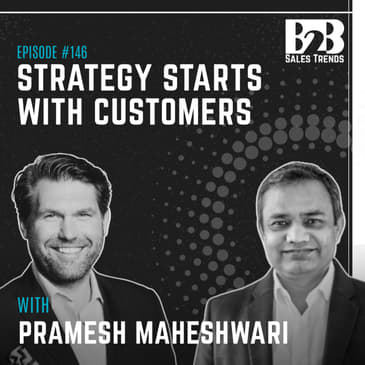
[00:01:00] Today, we're talking about how B2B buying has evolved from cost to value. My guest today is Pramesh Maheshwari. I hope I pronounced that right. He's the president of Lifecycle Solutions Services and Cyber Ed Honeywell. Pramesh, welcome to the B2B Sales Trends Podcast.
[00:01:26] Thank you. Thanks, Harry. Really nice meeting you and excited to share and discuss this topic. This is in top of mind for everyone. Wherever I discuss, I go. People talk about how to increase the whole sales effectiveness, how to increase the outcomes we are getting from customers. So this is in front and center in everyone's mind. So thanks for bringing this topic.
[00:01:52] Well, we appreciate your contribution. I know we had a pre-call to this recording and I know already this episode will be fabulous insights for our listeners. Now, Pramesh, you've spent more than three decades in industrial and technology businesses working across multiple regions and different leadership roles. Over that time, what are some of the biggest changes that you have seen in how customers buy?
[00:02:20] Really, the industry has come a long way from what we used to see three decades back, what we are seeing today. You remember a long time back, those few bids and a buy, not even three, those could be any number of bids and a buy, very transactional.
[00:02:38] Choose whomever is lowest cost. Choose whomever is cheapest. And that used to create a mushrooming of different technological solutions and options in any workspace. That slowly moved to more strategic partnership. Moving to select few. Oh, I don't need 200 vendors. I need to have 60 vendors or 40 or 20 vendors. So we started moving into less number of vendors and having more strategic partnership.
[00:03:07] The engagement moved to more C-suite. Start moving into more on what you can produce for me. That was the second move. Then started moving into more of internal strategic alignment based on areas and strength that, oh, this vendor can work for me in these areas. They are put here. This vendor can work for me in these areas. So that a strategic partnership even deepened.
[00:03:31] Then around 10 years back started the journey on outcome, the total cost of ownership. The decisions on the point sales moved into the whole duration, that how much owning this technical solution or owning this solution will cost to me. And what are the outcomes I will be achieving? Customers will still thinking about their outcomes, that what are the outcomes I will be achieving by this technology?
[00:04:01] And what will be the total cost of ownership? That again, and I was thinking, oh, this is a great shift and what will happen now? But very interestingly, these are the days when something very different is happening. Customers and vendors are no more vendors. They are partners. They are moving on a journey together. Customers and vendors are coming together to combine goals.
[00:04:28] Customers being part of vendor ecosystem, vendor being part of customer ecosystem. The innovations have started together and they both are deciding that how can we move on this journey? Many of the times even end users, customers are not fully, I should not use the word clear, but I should use the word. They are not because the technological options are not all available at the time of buying, but the journey is available, that this is the journey we will take together.
[00:04:57] And that is a big differentiation that is happening. So, and that's where outcome is coming. That's where total cost of ownership is coming. It's not that customers will just buy things at any price. You have to be price competitive, but then the decisions, final decisions are being taken on. Who is willing to walk with me in achieving my goals? That's where is the big shift. Let's unpack this.
[00:05:22] There's a lot of elements in your response and all highly interesting. So, let's unpack some of these topics. Now, for a long time, many purchasing decisions in a way came down to price as I started out this intro. Why was that model back then so dominant? And does it still show up today to a certain extent?
[00:05:50] See, there was nothing else in the common ecosystem to compare. End of the day, the decision happens based on what best you get out of different options. Price was the mechanism to compare that you are getting the best at most reasonable price. So, that was the only common denominator. And then customers used to think on, okay, these are the technical solutions. Anyone can provide me the solutions.
[00:06:21] Things were more on the hardware level. Things were not that configurable. So, okay, these are my specifications. I need things in these specifications. And who can provide me at the lowest cost makes sense. So, that was possible during that time when the software configuration, when SaaS, when do-it-yourself and all those things were not that prevalent. So, that was the model.
[00:06:45] I still see it in many or not many in few of the government sectors. And there is a reason for that. There is an accountability. There is accountability to public. You need to still go and show to public that, hey, we are taking all the right decisions because end of the day, it's public's money. Okay. So, they need to take the right decision. So, I still see that happening. But there is a change happening. Even though there is too much focus on lowest cost.
[00:07:11] But before coming to the decision on lowest cost, they do discuss the value. They do discuss the outcome. They do discuss the total cost of ownership. They do discuss the journey. But then they take the decision on lowest cost. So, it's not that the old model of just only deciding on lowest cost is there today and they are not looking into anything else. They still want to look in other areas. But then cost becomes important because they are accountable to the common public.
[00:07:40] And obviously, they own the money from the public. So, that's interesting. And then, obviously, afterwards, the conversation started to shift a little bit towards what you have mentioned already, total cost of ownership when you look sort of back a few years. What, in your opinion, has changed back then to total cost of ownership before we start to the next evolution, which you've referred to, total value of ownership?
[00:08:07] Now, with total cost of ownership, what has changed? What were customers starting to realize there? What was happening was when they started doing that initial buy, they started seeing that, oh, some vendors can give us extremely competitive solutions. But then owning those solutions is becoming a challenge. Maybe the life of that solution is not long enough. Okay, I'm getting the cheapest today.
[00:08:35] But things are getting obsolete in five years, in 10 years' time. Now, these – so, for example, when we are into the industrial space and these plants or any facility, any B2B facility is not there for five to 10 years. Those are for 30, 40, 50 years. And if you need to keep changing those technology solutions, then that becomes very costly. So, your first point of sale can be extremely cost-effective.
[00:09:03] But then later, things are either non-compatible with many other solutions or it gets obsolete. Or getting the solutions from the services sector might be too high or people not available to serve those technologies. So, customers did purchase a lot of things on the lowest cost in the very beginning point of sales. But later, it started becoming challenging. And then they came on, oh, no. That first point of sale is not that important.
[00:09:32] For me, what is the total cost of ownership is important. And that included not only just the total cost of ownership of services, that how much is the service cost. It included how much is the carrying cost of that solution. Carrying costs like what is the obsolescence cycle. Are there mitigations on obsolescence that when something gets obsolete, I have continuous migration options. I have continuous modernization solutions where I can move to latest technologies and all.
[00:10:02] Customers started looking into that. That was the shift. And then, obviously, the next evolution that you shared is something that I found very interesting. And I'd love for you to explain that to the audience, that idea of total value of ownership. Now, you've touched a little bit on it. But what do you mean by that? Go a little bit deeper on the topic. I think that's really interesting.
[00:10:26] That's where we thought of, if I'm having this solution with me, and then solution did not remain the point solution. Because when you're buying that in the very beginning, that stays with you as a point solution only for a very short time. But then you start increasing that value by adding your own standard operating procedures. You add more solutions onto that.
[00:10:52] You add your own workforce competency on that. You add your spare parts solutions onto that. You add a lot of things onto that initial solution. Its value keeps on increasing. Its value is not static. Now, that increase in value on that original solution, customers started looking into, am I getting the right increase in value over course of time?
[00:11:18] And now, when they have to get that increased value over course of time, suddenly due to some reason, suddenly due to technology change, suddenly due to obsolescence, suddenly due to some other things coming, will I lose that whole value? What is getting created? And that value was not alone by customers. It's not only created by the actions of customers. That value was being created as an ecosystem.
[00:11:46] So, multiple vendors coming together, the vendor and customer coming together, and how that value keeps on increasing. So, take, for example, you have purchased any system with you, and then after some time, your whole ecosystem revolves around that system. Your whole ecosystem revolves around that solution. And different vendors are coming and creating value to that ecosystem. Now, it's not that small.
[00:12:15] It has become big. And I think that the best suppliers today, they seem to be doing more than just solving individual problems, right? They're helping customers really achieve broader business goals. Now, that all sounds good. How does that look in practice, in your opinion? So, what is happening in practice is many vendors have learned this art.
[00:12:43] Many of them are still at the lowest cost sales. Now, those who have learned this art, they are more and more coming into customers' ecosystem. They are understanding the customer's problems. And instead of going and selling a product, this is what my product can do.
[00:13:08] They start talking about what are your problems today, what you want to achieve in future, and let's solve for that. and even many a times figuring out what we don't know today, what we don't know, we don't know. So what we don't know today, those could be the new things that are coming out in future, and we need to solve for those. So the solutions need to cater for today,
[00:13:35] and that platform should be wide enough, should be flexible enough to cater to the problems in future. So few of the vendors are coming out with those solutions. So, for example, in mobile networking area, you see that mobile companies are not only talking about that this is my mobile network, they're also talking about how it will cater to the future demands.
[00:14:02] And now we all start building our solutions based on that, what may come up in future. Same thing is happening in the whole supply chain. Same thing is happening in the whole manufacturing. Same thing is happening into the whole transportation. That what may happen in future, we've started thinking about that and solving for that problem today. You know, it's interesting. We always talk about it's the sales organization's job
[00:14:30] to create the outcome effect for their customers. Now, what does that mean, the outcome effect? Like the outcome effect means it's your job to create outcomes for your customers. Therefore, your solution that you will provide for them has real impact. And if it has real impact, then you will create economic value for your customers. Do you agree with that? Yeah.
[00:14:58] Your solution has to create economic value. Otherwise, why will customer buy your solution? Right. And to execute that, you really have to become a strategic partner, right? And a lot of organizations talk about becoming that, you know, trusted advisor or strategic partner. And so very few actually get there though, right? What separates the companies that do get there and be trusted advisors
[00:15:25] and strategic partners to their customers, you think? You know, strategy is one of the most, I say is most of the abused word in the corporate English. Everyone uses the word strategy the most. Everyone says that the most. So whether you are a strategic, you are not a strategic, but then everything is thought of being, oh, this is my strategy and this is what I'm doing for that.
[00:15:53] So people use this a lot that, yeah, I'm your strategic partner. This is my strategy. Let's work on multi long-term strategy and all. Very misused word. Now, to figure out whether you are a strategic partner or not, most important parameter is how much you know your customer and how much you know your customer's customer
[00:16:20] and what is important for your customer to be successful with your customer's customer. That is a piece which gets missed out. We think, so even the problem is not one prong. Problem is even far deeper. The problem is we take a strategy as my product strategy. We take many of the times, many vendors take strategy as, this is what I want to do as an organization.
[00:16:51] Vendors forget that, no, this is not about their strategy. This is about their customer strategy. This is about how will your customer win more customers? How will your customer win more outcome, more solutions? So making your customer successful, that is the clear thing. And if your strategy is making your customer successful,
[00:17:21] then only that's a true strategy. And for that, of course, you have to be, as you've outlined, you've got to know your customer. You've got to really understand your customer. And you've got to understand where the customer is trying to go before recommending a solution, right? How important is, and this sounds basic, I think it's these days even more critical than ever. How important do you think is listening to customers in nowadays environment?
[00:17:51] That was always important. That is super important. And I don't think there is anything more important than that. Listening, and I'll say knowing, it's not that you have to just go and sit and listen. It's more about knowing your customer. You need to understand the industry well. You need to understand the pain area as well.
[00:18:15] You should live yourself in that industry and live, breathe in that industry so that you understand the customer. If you do not know the industry, then we just go in one meeting. You know the very popular word VOC. Oh, I've done the voice of customer. But that also becomes very transactional. People just go in one meeting. They just ask those 10 or 8 or 5 open-ended questions,
[00:18:44] and they create a survey, and then you get the survey results. Many of the products fail after VOC. Why? The VOC was great. The VOC was, everyone wanted the solution. And everyone said, yes, if you give me, I'll love it. But the VOCs failed because we have not lived into that customer's environment. So we do not know many of the other factors what may impact customers. So we have not listened.
[00:19:13] We have just heard the customers. We have not understood the customers. That is the difference. You know, it's interesting listening to you. And I'm also thinking about the last couple of episodes we have recorded recently with also with senior leaders in the go-to-market space. And the word trust has come up a lot lately.
[00:19:41] I mean, this is not necessarily a new topic, right? You always needed that trust to your customer, those relationships and so forth, and vice versa. It seems, though, recently it has become, in the edge of AI and so forth, become even more important. What's your take on that? I'm curious. Will customers give you their insights? Will they try your new product and solutions? Because it's a journey.
[00:20:11] It's not something which is fully proven. It's a journey. Customer has to be with you as a journey. Will anyone come with you in your journey if they don't trust you or if you don't trust them? It's both ways. It's both ways. And it is based on credibility. There are so many great ideas. Many people bring those great ideas. Why those are not successful? Because that credibility is missing. Because someone has not done it before.
[00:20:40] And multiple times, it's not just once. Destroying a credibility, destroying a trust just takes a moment. Building a trust, building a credibility takes a long time. Sometime a life. It takes a long, long time. So obviously, buying behavior has evolved a lot. And sellers really need to evolve too there. What capabilities, when you look at sales organizations today, right?
[00:21:07] What capabilities do they need today that they may not have needed 10 years ago? 10 years ago was keep reducing the cost of your product. 15, 20 years ago was all about just keep getting more competitive. Move all the productions to the lowest cost locations. Keep reducing the VECE era. The whole value engineering. The whole component engineering. Just keep doing that. Keep redesigning.
[00:21:37] Which still, you have to do. It's not that you need not to do that. But that has become like a table stake. Everyone has done it. So that is no more your differentiator. You need to keep reducing the cost because you cannot run very costly solutions. But that was a differentiator a long time back. Then keeping your total cost of ownership low. Keep increasing the value high. That became like, oh, that's my differentiator.
[00:22:06] I will keep your total cost of ownership low. That became the differentiator. No, everyone came out with different solutions on that. That became a table stake. Then, similarly, things kept on coming and changing. But recently, many customers' critical decisions started happening on who is coming and creating my success today and tomorrow.
[00:22:31] On whose technology, whose solution I can put many eggs on that basket. I can create an ecosystem. I can create a platform. And then I can move on. Customer needs those solutions. Because these are not short-term decisions. These are pretty long-term decisions. So customer needs to have that trust. When will that happen? That will only happen if I know my customer.
[00:23:01] I know my customer's journey. Many people think, oh, I know my customer. I know that person. Okay, do you know the person? It's not about the person. It's about, do you know that persona? Do you know the needs of that persona today? And where that persona will go tomorrow and day after tomorrow? And what is that journey? And maybe, most of the time, there's an interesting fact.
[00:23:26] Most of the time, even customers may not be fully documented aware about where they will be in midterm or long term. They would like vendors to be part of that decision-making, that thought process, that ecosystem, to know where they will be going after five years or 10 years.
[00:23:45] And whichever vendor can give them that proper roadmap, that proper confidence, that proper trust, that with me, you will be achieving all these things in the next five to 10 years. They go with that. So not only knowing your customer, not knowing your persona, knowing the needs of the customer today and for a long-term future, that is a critical thing.
[00:24:09] That's a big change today from what we used to see around 10, 15, 20 years back. We looked in the past. We talked a little bit about the state today. Now let's pull out our crystal ball. I know you have one. I have one. Everyone has one, right?
[00:24:29] Looking into the crystal ball, how does a good sales organization, what do they need to do in three years' time from now, in the future? Same thing as today. How will it shift and evolve, in your opinion? The seller is becoming a consultant. That is happening. It's becoming a trusted advisor. That is happening. The seller is learning the customer more and more. That is happening.
[00:24:57] On one side, we are knowing our customers more. We are creating the C-suite relationship. Those things are happening as of today. But are we there yet? No. That has to progress much further. When we see the trusted advisor, the consultant selling, that is something like there is nothing like, oh, now I am a consultative seller. Oh, now I am a trusted advisor. That's a learning process.
[00:25:25] That cannot stop at any place. You need to keep learning more and more. And when you learn about customer, you need to learn about your technology. You need to learn about the industry, where the whole industry is going. You need to learn about what are the possible fallouts of if then else. Because nothing is in isolation. It's all about an ecosystem of multiple things. If this thing happens, then this will happen. If this thing happens, then this will happen.
[00:25:51] You remember the whole era of everyone jumping around the bandwagon of hydrogen, that hydrogen will be coming up. But then that got disrupted by different things. Then the era of how everyone will start producing the cells, the batteries, that got disrupted. So multiple things just came and everyone put a lot of money and thoughts there. But things are disrupted because we were not aware about the whole ecosystem, that how the whole ecosystem is going.
[00:26:21] That will be the future. Things will be disrupted so quick and so soon. Earlier, it used to take 5, 10, 20 years to disrupt something. These days, it's just taking a short time, very short time to disrupt something. So we need to know about the whole ecosystem. What are the dependencies? What may go wrong? That is something that is important. Pramesh, the last question on every single podcast I've asked now for many years is always the same. And I'd like to finish with the same question with you.
[00:26:50] What are, in your opinion, the top three skills and behaviors, in your opinion, that expert and elite sellers these days need to possess to be able to do all these wonderful things that you have just described? Being consultative, being an advisor, focusing on customer outcomes. What are the top three skills and behaviors, in your opinion, that a top B2B seller needs these days?
[00:27:17] This is, I think, I may repeat a few of the things that I have talked about. And for this, from a particular seller, top three things, I don't think has changed. That has remained the same. The first, the foremost thing, which one of my friends, when I moved into sales around 20, 22 years back, advised me, told me,
[00:27:45] the biggest, biggest, biggest, biggest thing is listening. Unbiased listening. Listen to customer. Listen to your people. Listen to the buyer. Listen, listen. Don't listen with a bias. As soon as you have a bias, you're not listening. You're here. You're not able, you're not even understanding the unsaid things. You're not understanding the story between the lines.
[00:28:13] You're not understanding the body language. You're not understanding the pauses. You're not understanding the unsaid story. So listen, that is the first thing. All the sellers, don't preach. Don't try to sell your products. Listen, first one. The second one is know your industry. Know your products. Know your solution. Know your customer very well.
[00:28:42] Don't just go there. Don't try to do a tick mark. Don't try to do a tick in the box that I have done the sales call. I have entered these things in my, the whole CRM. I have entered the court number. I have given the proposal. No. Those are just logistics. Those are just administrative things. Don't be an administrator. You are a seller. You are an account manager.
[00:29:11] The industry changed the name from a seller to account manager to trusted advisor. Many places it has changed. So that will only happen if you know your industry well. If you can speak with customer about the industry, you do not even sell the product. The product will sell on its own. If you know about the industry and you can talk to your customer about the solutions, about the outcomes, about the pain of the customer. So that is the second area. That don't try to sell the product.
[00:29:40] Try to know the customer and the industry and the pains and try to solve that. And third one, third biggest thing is be credible. Whatever you commit to customer, ensure that it is delivered. When you go next time to customer, customer will be asking you about those things. You will not be able to do another big sale if you are not credible. But if you are credible, the customer will come to you that, hey, I have this idea.
[00:30:09] You treat yourself as successful when customer comes to you not at an RFP, not as a request for quotation, not as an RFP, but with a phone call, with a meeting request that, hey, I have an idea. I need to talk to you about it. So that's when you can think that you know the customer, there is a trust, there is a relationship, and you both are sitting together and you have listened enough.
[00:30:33] So those three things, listening, not selling product, but knowing your customer industry and giving a solution, and then credibility. Those are my three big things, sir. I love it. Pramesh, you were a fabulous guest. I want to thank you very much for your time. I know our listeners will very much appreciate your thought leadership and insights to the topic. Thank you for taking the time. Thanks, Harry. I enjoyed discussing this. This topic is so close to my heart.
[00:31:02] I've always enjoyed this. I love our sellers. I love our customers. Just before I close, I want to say sellers do a great job. They are a front face to customers. So kudos to all the sellers, and really thanks to all the customers in that engagement. Me, myself, my leadership, we all, and the whole industry is so much dependent on these sellers, and a great thanks to keep doing the great job for customers. Thank you, sellers. Have a great day.
[00:31:31] Pramesh has stormed my thunder a little bit here with that wonderful closing. So thank you so much. My lovely people, one of the biggest takeaways for me is that customers aren't looking for vendors to simply sell them products anymore. They're looking for partners. They're looking for partners who understand where they're trying to go, help them navigate change, and create value long after the initial purchase has been made.
[00:31:58] And for those of you listening or watching, if you're looking to improve the way your team engages customer, articulates value, and uncovers new opportunities, you will find additional resources in the description below. You can explore our revenue accelerator, which is a free assessment designed to help sales leaders identify where opportunities are progressing and where they're getting stuck and where revenue may be leaking from the pipeline.
[00:32:27] If you enjoyed this conversation, I certainly did. With Pramesh, make sure you're following the show. Subscribe to us on YouTube or anywhere else where you get your podcasts from. Until the next time, my lovely people, take care of yourself, your loved ones, and your B2B customers. Bye-bye.