[00:00:00] Welcome my lovely people to another fabulous episode of the B2B Sales Trends Podcast. A lot of sales teams get comfortable selling the thing that made the company successful. Then of course suddenly the market moves. It always does at some point, right?
[00:00:16] The buyer changes, new risks emerge, new opportunities appear and suddenly the conversation customers want to have look very different from the ones your sales team has been having for years.
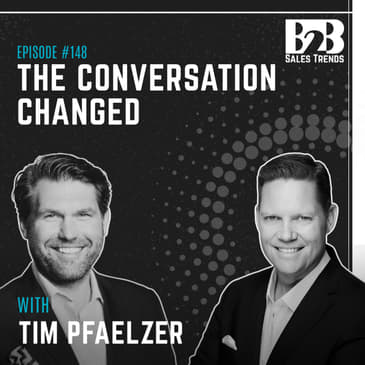
[00:00:30] My guest today is Tim Pfaelzer. He's the SVP and General Manager for EMEA at VM. He leads nearly a thousand people across the region and over the last several years he's been helping the organization evolve from selling backup and recovery solution to having much broader conversations around cyber resilience, data security and AI readiness.
[00:00:55] Today we're talking about what it takes to retrain a sales force when the market evolves and customers start buying for different reasons. Tim, welcome to the B2B Sales Trends Podcast. Harry, thank you for having me. Delighted to be here. Tim, if somebody looked at VM from the outside in, they probably still think of it as a backup and a recovery company.
[00:01:23] Today the conversation is much broader. Customers are thinking about cyber resilience, data security and AI readiness. I mentioned that already. How did you know it was time to start expanding the conversation? Well, I think the best answer is here simply the market changed. The world has changed. But if I compare where Veeam was 20 years ago when it was founded, we were in a very different era.
[00:01:45] That era back in the days was literally you needed to assume you need to restore in case something happens. You're losing your data on the way. You know, something happens to a backup when it's needed. All of these things. So you needed to assume anything that you need to do is you need to be able to recover. Now, that was for the first many years. And then since 2017-ish, I would say this whole thing about ransomware came up.
[00:02:08] So with then, you needed to assume that you got breached. And that, of course, had a difference to it of what you need to do to keep your data safe and secure. And what do you do when you get breached, right? So that was a very different discussion. And then guess what? Like 12 months ago, we would have been probably talking about AI will rule the world in the future. Now, those 12 months later, this is absolute reality. And now in this third era of the existence of Veeam, I'd say we need to assume that data can drift.
[00:02:37] And when I say drift, that means your data can move or do stuff without you touching it. And I think that's just a big change. It comes from an era where we as humans were trained to handle our data. And now AI is taking over control. And that, of course, makes it a big difference for everybody in commercial and public administrations to make sure that you're safeguarding your data and you're safeguarding your business. So the role of Veeam really had expanded from data protection to data and full AI trust.
[00:03:07] Not only ensuring data is available, but it also needs to be secure. This week, government got to need to be compliant and recoverable also in an AI-driven world. So I think there's been big, big change happening in the past 20 years. You know, organizations are investing a lot of money into AI right now. We know that we've had a number of shows already covering that. At the same time, many AI initiatives really don't deliver and fail in a way because different results people expect from that.
[00:03:37] Why do you think so many companies focus on the AI itself while overlooking the quality, the availability and resilience of the data that really sits underneath it? Why do you think that is? I think, first of all, what every organization out there is thriving to do is making sure they can win with AI because it's such a big topic. Everybody expects that. Every customer wants to see it. Every other of the company that you're working with, you would expect something AI and you always want to be first and foremost.
[00:04:07] But the trouble with this is really that you can have a trust problem with AI, not necessarily an adduction problem. You can adopt any agent. But what happens if something goes wrong with the data? What happens if AI gets access to data that it shouldn't have when it's overprivileged? And what happens actually when this AI data hallucinates and actually does harm to all of your data installments? That is where we will really have a big challenge.
[00:04:34] That's an enormous investment currently going to models, infrastructure and experimentation around AI. But the foundation, the data is such. That's what the one thing that's often overlooked. Our research currently shows 95% of organizations say data challenges have already slowed AI progress. Now, for EMEA, the reach I'm responsible for, 40% of leaders say data used for AI is their biggest blind spot. And that's something, you know, we all have to monetize.
[00:05:03] A blind spot, 40% of the data, that's what you never want to have. This is exactly when failure can happen. So what happening is simple. AI is scaling faster than governance. Visibility and resiliency frameworks need to support it. If you do not know where your data is, i.e. the blind spot, how it is being used or whether it's accurate and secure, how can you trust the outcomes? So companies focus on AI itself because it's visible and exciting.
[00:05:30] But the real limit of success these days is the quality, the control and the recoverability of the data underneath it. So the big question is, do you want to go fast and fail with AI? Or would you rather slow down a little bit and make sure that your AI is actually working safe so you can always have trust with your customers and partners that you're working with? Scary percentages that you have shared there really are. Thank you. It's an interesting world out there right now.
[00:05:59] Now, for years, of course, that sellers in your world were having conversations about things like backup and recovery and so forth. Today, they're expected to talk about, you know, the business risks, the resilience, the AI readiness and so forth. What's the hardest part that you think is most difficult for the sales force to make that transition? That is a very good question.
[00:06:27] And yeah, I think it comes logically with, hey, we're coming from a product spec and we're talking about products and features and version codes and what have you to really a completely different messaging. A messaging that now needs to resonate with board level and not with data center people anymore only. There will always be part of it. But data is the most important and the most cost thing that you can have in a company. With that, you need to talk differently. You need to talk business outcomes.
[00:06:56] But how would you be able to talk a business outcome if you're not changing the mindset around this? For many years, as I just said, sellers were having very technical conversations. But now the conversation at board level is about a business risk, operational resilience, AI readiness. And that requires a seller to connect very differently in between data to real business outcomes. Because now you need to prove to a CEO, to a CFO, to a CISO, to a CIO, any C-level member of what that cost is that they're facing.
[00:07:25] Not only the cost and hard dollars of a product, but the cost of the opportunity you have when something goes rogue. Now think about it, you couldn't produce anything for a day or your online store would be down for a day. That comes with large opportunity costs of losing orders, of being in downtime, but also losing the trust of the customers. And that's why it's a border of a priority. So the key shift that we have focused is helping them understand exactly the point that backup is not the product.
[00:07:54] Trusted data is the outcome. That is the point we got to set. But in an AI world, that trust becomes, as I just said, a board level issue. And this is important to always remember. And it's not just an IT issue anymore. When seminars can anchor this conversation in data, such as only 7% of organizations being truly AI ready, 95% seeing data challenges slowing AI initiatives, that reframes a discussion immediately.
[00:08:21] So the challenge is not about the capability, but it's more about the confidence to lead a broader, more strategic conversation of what's in it for you in that position that you have as a customer. And what is the amount that you have to pay when something goes wrong and trust and in dollars? Thank you for that response, because that's a big shift for sellers to make. Mindset is one thing.
[00:08:47] Obviously, connect the mindset with skill set, because if you have the mindset and not the skill set, that doesn't work. If you have the skill set and not the mindset, then you don't have the drive to do it either. So you really need a combo of both. So when these sales teams now shift the conversation to outcomes, they obviously also have a different stakeholder, right? You mentioned it's board level now.
[00:09:08] So from the technical expert to CIO or CTO and these levels out there, what did your sellers have to learn in order to earn that credibility with those stakeholders? Because it's not just the thing to turn up and say, hey, now I'll have a different conversation. They do speak a different language in a lot of instances.
[00:09:32] So how did you help your sellers to gain confidence and earn that credibility with those stakeholders? Yeah, you're totally right. And as I just alluded to it, right, sellers now have to shift from feature talk to a consequence talk. What happens if you don't do? So in IT, you can always talk about easy things, backup frequency and, you know, what is your recovery time objectives and that stuff. That was the old world.
[00:09:58] But now the executive level, as you just said, as I just said, the conversation becomes what happens if your AI, for example, makes the wrong decision? Can you prove compliance at every time? Can you recover trusted data, not just restore systems? So our research highlights also, and that's what I want to mention, why this matters. Only 28% of organizations are confident they can detect AI systems operating outside of proof parameters.
[00:10:23] So to earn credibility, coming to your point, sellers really have to learn language of risk, compliance and governance. And they also have to quantify business impact, not just tackling performance. We're giving lots of training to our salespeople to really understand the difference of why it matters. We are also giving them best of breed examples of what we've worked with successfully with customers.
[00:10:45] And we're also getting into these CIO boards and have them tell us on what is currently really their challenges so that every seller ultimately and genuinely understands of what happens. Because it is about helping leaders these days to understand without trusted data, AI becomes risk and not an advantage. And that only works when we know there are everyday challenges in managing executives. And that's where we invest in loss.
[00:11:08] And then, of course, you know, once you get sellers to that level of conversation, they create that urgency. People make decisions one out of two reasons, right? Either to get an outcome or to avoid a risk. And if I can have any of those two kinds of conversations, then at the right level, then a deal becomes much easier. It becomes about a case of how we're going to do this versus if we're going to do this.
[00:11:36] And that's a much easier conversation then. Absolutely. Yeah. Yeah. You know, still many organizations struggle with innovation because they're trying to balance sort of a couple of competing priorities here. They need to obviously keep growing the business that make them successful. Let's not forget the core piece while also making sure and preparing for where the market is heading next. Now, nobody has a crystal ball.
[00:12:05] Everybody needs to innovate, right? How do you strike that balance within your organization? Yeah. What you're telling is really often seen as a tension. But, you know, I think in our case, it's actually very aligned. The foundation of Veeam was always protecting and recovering data. And that now becomes even more critical in an AI-driven world. But it doesn't change the base of where we're coming from, which is what I just said, protecting recovering data. We want to keep our customers' business running.
[00:12:34] And this will always be the mission that we have. But what is changing is not the core capability. It is the context in which it is used. In the past, recovery meant restoring systems after failure. Great. But in AI, recovery may mean understanding exactly what data an AI use and how you can roll it back with precision down to a file only. So rather than competing priorities, protecting the core enables innovation. And that innovation increases the importance of the core.
[00:13:01] That is why we talk data and AI trust in an unifying layer. Just one layer which brings together the resilience, the security, the governance and the compliance into one trusted data foundation. So versus just saying this is, you know, just a very new thing versus there was an old thing. It's rather this is all built out on the base that we've been delivering as we since the past 20 years. So it's like a natural evolution. You've seen a lot of salespeople in your time. You've seen the market change.
[00:13:31] You've seen the stakeholder change. You see the narrative shift. You've seen a lot of different messages. The last question I ask on every single podcast is always the same is, what, in your opinion, are the top three skills and behaviors that an elite B2B seller nowadays possesses and need to execute at a senior elite level? What are those top three things?
[00:13:56] And if you can order them in terms of priority for me, first, second and third most important behaviors that a B2B seller need to have. Yeah, for sure. And it kind of makes me smile because it's exactly that number one thing that I'm repeating every day with all of the sales force. And I think some of them probably are already tired of hearing this. But it's all stemming from all of those years that I'm in this business. I can say the best B2B salespeople consistently share those three traits. First one, curiosity.
[00:14:26] They leave with understanding a business problem and not the product. And that always differentiates a seller in between being somewhat successful to be very successful. If you understand the customer, if you understand the business problem, you will always lead. And that you can only win when you're curious. Now, the second one is the credibility. They can operate confidently from tactical teams all the way up to the board, translating in between those two.
[00:14:54] But for being credible, you need to train yourself. You need to understand the customer. So the curiosity comes into the credibility game as well. And finally, it's all about courage. Sales is not for the faintly lazy of heart. It's all about courage. In courage, you're willing to challenge customers' assumptions. For example, you don't mind asking them whether the organization can truly trust the data that is running AI.
[00:15:19] And that is a tough question because I haven't seen one customer yet who can confidently say yes to it. So that is a courageous question. That is something where you kind of always get a no from a customer. And it's something you need them to be incredibly credible to make sure that you can help them from this point. Organizations that succeed are not the ones moving fastest. But they are the ones building strongest foundation of trust first.
[00:15:46] We need to build out that trust by leading with curiosity, credibility, and courage. And if those people show those three things, that's exactly where they will differentiate themselves from all others. So yeah, those will be my three in order of priority. And they show up at every stage of everybody's sales process, right? You got to be curious. You got to have credibility. And you got to be courageous in the process.
[00:16:12] My lovely people, if you want trusted data as an outcome, give Tim and his team a call. Tim, appreciate your time. Thank you for your contribution to the collective pool of knowledge and paying into with your wisdom and thought leadership. We appreciate your time. Thank you so much. It's been great fun, Harry. Thank you very much.
[00:16:35] Well, lovely people, what stood out to me in this conversation is that most companies, in a way, don't struggle because they miss the next opportunity. They do struggle because they recognize it too late. As Tim shared, the challenge isn't just about understanding where the market is heading.
[00:16:54] It's about helping customers see that future state, connecting data to business outcomes in this case, helping sellers have a different conversation with a different stakeholder, with curiosity, with credibility, and with courage to do that.
[00:17:15] That's a difficult balance to strike, but it's often what separates the companies that lead a market from the ones that spent years trying to catch up. If you like what you heard and learned in this podcast and want to know more about improving commercial performance and creating more effective customer conversation, you'll find a link to our revenue accelerator in the description below.
[00:17:41] If you like this episode, follow the show on YouTube, share it with your team and others, and subscribe wherever you get your podcasts from. Lovely people, look after yourself. Until the next time, your loved ones, and of course, your B2B customers. Bye-bye.