
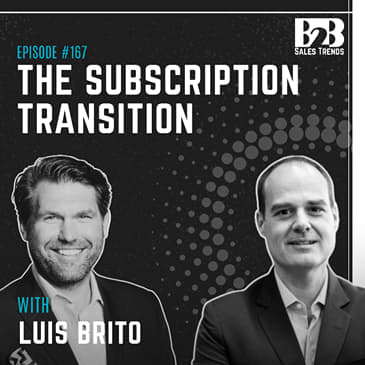
[00:00:00] Welcome to another fabulous episode of the B2B Sales Trends, my lovely people. A lot of software companies want to move to a subscription-based model. Nothing wrong with that at all. What they don't always appreciate is how much has to change behind the scenes to make that transition successful.
[00:00:19] On the B2B Sales Trends Podcast, we give you a sneak peek into the strategies of the world's best CROs and go-to-market leaders, the systems and playbooks they are using so you don't have to figure it out the hard way. So if you want to increase win rates, shorten sales cycles and learn from the best in B2B selling, this podcast is for you.
[00:00:40] My guest today has seen that transition firsthand. Luis Brito spent more than 30 years leading teams around the world and most recently served as CRO of OurPlan, where he helped lead the company's transition from a perpetual license approach to a subscription-based approach while reshaping the way the commercial organization is operating.
[00:01:06] Today, we're talking about what that journey looked like, what made it difficult and what other leaders can learn from it. Luis, welcome to the B2B Sales Trends Podcast. Hi, Harry. Thank you. I'm very happy to be here. When you stepped into the role of the CRO at OurPlan, the business was still heavily reliant on perpetual licenses. What convinced you in the first place that moving to a subscription-based model was the right move?
[00:01:35] Well, you know, the biggest signal really was customer behavior. So we understood that customers were looking for that model. It was already very prevalent in the industry as well. Also, by moving to a recovering revenue business, we would be creating a fundamentally healthier business over time, more predictable, closer to the customer, also easier to drive innovation.
[00:02:02] But also, I think really important was the realization that if we didn't move at our own pace, the market would force us to move and it would be much, much harder to do. So you took the proactive approach versus the reactive approach to the market, correct? Correct. Yes.
[00:02:20] Right. Right. So a lot of people think that a move to subscription is primarily, you know, or only, shall I say, a pricing change. What makes this so much more complex than that? Well, it's much more than that, right? It's far beyond what a pricing change is. It's really an enterprise operating model transformation.
[00:02:45] It impacts pricing, you know, your product packaging, the way you forecast, the way you compensate sales teams. Even when you look at cash flows, the way you recognize revenue, your support model. So everything, really the whole company needs to be involved to make sure that it happens well, you know, both internally and also then when you look at investors and the board and managing expectations, right? It's a massive change.
[00:03:12] And really what makes it hard is during the transition period, everything that is usually regarded as business as usual fundamentally changes, right? So deals become smaller because you move from large perpetual deals to smaller annual or multi-annual deals. The way you recognize revenue changes fundamentally. The way you compensate sales changes fundamentally.
[00:03:38] So every marker that you look at to understand the business fundamentally changes. And that makes it harder to manage and it requires courage and clarity to be able to keep forward. You know, it's interesting. When one makes that transition, one might assume that the biggest challenge in a transition like that is how are we convincing our customers?
[00:04:08] Customers on that switch. What's your experience on that? Yeah, so customers come in all shapes and sizes, right? But there's one common trend that I think gets customers together, which is at the end of the day, they are going to choose a provider that can credibly deliver outcomes. So when we approach customers and inform them about, you know, why are we changing to subscription?
[00:04:38] Where's the value in a subscription versus a perpetual license for customers? All the flexibility that they get in their models, you know, the way they can get innovation from the software much faster. It makes a difference, right? And some customers are ready to move right away. They see the value. They see, you know, how the new model in reality adapts to their business outcomes much, much better. And they just jump on it really quickly.
[00:05:06] Others take a little bit longer to make that change. But at the end of the day, value is really where the rubber meets the road, so to speak. Share a little bit about what has changed in the sales motion. You touched already on, obviously, the obvious things such as compensation.
[00:05:27] What had to change in the way sellers approach their customers, as well as how sales leaders are leading their sales teams on this? Yeah, well, there's a big change in sales, right? So in the organization, as it were, at Alpline, but even kind of looking bigger at other organizations,
[00:05:52] I would say that the main change is to change behavior around delivering the big booking versus moving to a more ARR-based business when you're thinking about customer lifecycle value versus one deals, you know, the type of fire and forget, older sales type approach. To do that, you really need to restructure the sales team.
[00:06:20] So there's a lot that comes into specialization. So traditionally, in enterprise software organizations, you would have, you know, independent field sellers that manage a business end-to-end from initial pipeline stages all the way through closing. One of the things that we did is, you know, driving much more specialization around that.
[00:06:42] So creating teams of inside sales, like, you know, SDRs, BDRs, wherever you want to call them, to drive the pipeline in the upper hand. Then account executives to go out and acquire new logos. Then we looked at, you know, having a sales rep specialized in expanding accounts and then a customer success team,
[00:07:06] making sure customers use the software, adopt the software and get value from it so that they keep renewing and buying additional, right? So there's a big change from KPIs and business thinking and how do we engage with customers together with a much broader specialization of roles. So you go from a generalistic sales rep, much more to a kind of a role focused player.
[00:07:34] And of course, I mean, with all of this comes the challenge of coordination and team playing, right? Which is not easy to grasp, right? Especially if you come from a total control type of environment where you kind of own the account from beginning to end in being able to not just trust the team around you, but really lead them, right? So how do you kind of take advantage of the whole company, not just the go-to-market organization,
[00:08:02] but even product, right, and others, and use that your advantage to drive value to customers and close deals, right? That's the big, big mindset change and also operational change that happens. What has changed in, and I know there's a variety of teams that in the sales motion that you've just shared with us, what has changed fundamentally in the customer conversation?
[00:08:28] The customer conversation, it's all about how can you better protect the value of your investment, right? So in a perpetual type model, customers are buying an asset, right? And they're saying, look, I just bought a perpetual license. It's mine, like buying a car. In the old days, I mean, today, people buy cars and leasing as well, right? And renting and whatnot.
[00:08:56] So it's a common model, but you go from kind of owning an asset that's yours to essentially being part of a partnership where you are using a system that keeps evolving and you have access to the latest and greatest in innovation, cloud, AI, right? Everything that comes with it. And you basically enter a partnership with the company, a business partnership, a true business partnership where we're working actively to deliver on your business outcomes, right?
[00:09:24] So that's kind of the central theme around moving from a perpetual license as a buyer, as a customer, to a subscription, right? Because you have an ongoing relationship with the company versus, you know, I'm buying something today and tomorrow I'm buying something from somebody else. What does that change in terms of customer journey and everything else? I would say there's a couple of things.
[00:09:52] You know, the main thing would be you're much, much more invested in the success of your customers and how they use their software because you want them to not only renew their subscriptions, but also expand, right? So the level of content, of support, of help that's provided is much, much different because you really want to make sure that customers get value from the software and use it, right? That's the key thing.
[00:10:22] And then operationally to orchestrate that is you need to move from, which is classic, right? Across all types of businesses, right? You need to orchestrate the customer journey, right? So you need to ensure that all these different organizations actually work together in an organized way where you have specific milestones, where you have kind of clear governance, clear ownership, and really work together as a team to deliver the best possible experience to a customer.
[00:10:51] Everybody says this. Of course, the downside is you move from one type of silo to a different type of silo, right? And that's the kind of the mistake or the, maybe mistake is not the right word, but that's the challenge that you have. It's the pitfall. But the way successful companies pull it off is to making sure that that governance exists. And that comes to me and from my experience with shared KPIs across teams, right?
[00:11:20] In making sure that those conversations happen and that everybody feels responsible for the customer at every point in time. Clearly, you had to make a lot of changes in this, right? You changed incentives, introduced new ways of selling, team structure and so forth, reinforced new behaviors across the organization and et cetera. How do you make sure that those changes actually stick? Yes.
[00:11:46] Well, you know, transformation is a great word, right? In the great business jargon and everybody talks about transformation. But look, at the end of the day, people don't really like to transform, right? They would like things to evolve. And of course, transformation fatigue is real, right? And resistance is real. The way you drive through it, in my view, is by doing a couple of things.
[00:12:13] So the first thing, really important, is to communicate division. So this is where we're going. And this is why we are doing the transformation, right? Here's the compelling event to do it. And essentially, the underlying message needs to be, we are in the current state here and we're making the transformation so we can grow and be better, right? And that needs to be better for the company. But then you need to bring it down to the people that work in the company, right?
[00:12:40] To the employees at different levels and make sure that that speaks to them, right? And to their opportunities. So that's really important. Second thing is you create, you show not only why are we doing this, you tell people also how we're going to do this, what are the different steps and the different milestones of transformation. And then you also need to be very, very clear about how is it that we know you're being successful.
[00:13:08] And that's all about KPIs, its structure, things like how you forecast, how you govern your pipeline, your TBR structures, the KPIs that you start following. So many new KPIs need to come in, need to communicate them abundantly, review them abundantly. And the different organizations need to own them and understand that achieving those KPIs at the end of the day is what's going to drive the transformation and making it happen.
[00:13:37] So a lot of communication, a lot of explanation, putting a structuring place that allows you to operationalize the transformation and then inspect, inspect, inspect, communicate, communicate, communicate, right? In keeping it real, right? As people say, what gets measured gets done, right? So it's a classic, you know, I had to say it, but that's, it's the reality of things, right?
[00:14:06] There's no magic here. How have your leaders, the leadership team and maybe the layer below manager on the team, how have they responded to the change and how, because they're driving that transformation too, right? On the day-to-day execution. How challenging was it to get them on board as well as making sure they're continuously coaching their people to it?
[00:14:34] So that's really, that's really important. I think that's, that's where the whole transformation hinges, right? Is with, with, you know, the mid-management leadership. The key thing is we need to communicate to them abundantly and listen. Listen to, to what they bring up from, you know, their sellers, their customers, their
[00:15:01] customer success people, you know, their technical support representatives. Making sure that those conversations happen is also a big thing. And because one thing is telling people, hey, you need to talk, you need to do this, you need to do that. Like, like, for example, performance reviews, right? I'm, everybody does performance reviews, I think in the last 50 or 60 years. And they are, as we all know, are varying qualities. Sometimes you do them because you have to do them right at the end of the day.
[00:15:29] So making sure that there's, there's time and there's a rhythm and a pace for those conversations to happen is really important. And also, you know, in a sense, institutionalize training, right? And, and making sure that the training's there. And when I say training, it doesn't have to be like formal classroom training. But if you can, you know, using an expression that I was told like a long time ago from,
[00:15:58] from a mentor, like if you can embed it in the water supply and it becomes part of the conversation. And for example, how do you do a deal review when a deal comes in, right? If you do a deal review using, you know, the light of a subscription business and the KPIs, and that just becomes part of, of what people do every day, becomes part of the culture. And it's, it drives, you know, that change, right? Right. And, and, and then it's also all about people need to see that it's better, right?
[00:16:27] The transition to subscription is fundamentally better for their customers, for themselves, and for the company. And, and when that belief is there and they start seeing results, it, people just get on board and, and, and the transition happens, right? For leaders who want to embark on that journey, right? On that, on that major commercial transformation on their own.
[00:16:52] What are the sort of the, the three lessons that you'd want them to take away from your experience? What are the, the, the three tips that you can give to them? Well, I would say the three tips. Well, the number one would be, um, plan, plan it beforehand. Um, it's a, it's a big shift, right? It's, it's not a pricing change. It's a fundamental business model change. So think about that. How are you going to organize yourself?
[00:17:22] Are you going to change the business? Um, the other big thing is, um, how do you communicate value to customers? Right. If your customers are not on board, this is, is going to, to fail, right? There's, there's no way you, you can be successful. You cannot force customers to adopt anything. They need to, to move on through it. Uh, there's, there's ways to incentivize them to move, you know, faster or slower or, you
[00:17:49] know, using cohorts and, and segment your customer base to make them move. But at the end of the day, the value needs to be there for customers to, to be able to, to move. And the, the final thing is, um, communicate, right? Communicate, um, communicate, communicate, communicate, keep. You know, keep telling them what you told them, right? Like, uh, Steve Jobs used to say and, and, and, and, and keep the focus on and, and push on. Right.
[00:18:19] So you can't, the biggest pitfall of, of, of, of all of this is there's a point in time when you're halfway through it where, where fear steps in, right? Because you're, it's much harder to get to revenue because you recognize revenue differently. Uh, your, you know, your total bookings, uh, amount might be smaller as well because the size of a subscription deal is smaller than a perpetual deal. Right. And you need to have the condition to push forward for that.
[00:18:47] You need to have, you know, the board behind you, the investors behind you. Um, and, but that confidence needs to exist. If you start peddling back, uh, it's all, it's, it's, it's all gone, right? Because he, you confuse the teams internally. You create huge confusion in the market because then customers don't understand where they are anymore. You know, you were told, telling me that this subscription thing was great and there was immense value here, but now you switched back what really happened. Right.
[00:19:17] So messages get blurred. So just have the confidence and the focus to push forward and you'll come out the other side and, and the business is totally different. So plan, communicate value to the customers and communicate within the teams, uh, the top three things you would pass on to somebody who is embarking doing that. Luis, the last question I always asked on every single podcast is, um, when you think of,
[00:19:42] uh, the elite sellers that you have come across, uh, your organization or in the past, what are the top three skills and behaviors in your opinion that elite sellers nowadays need to possess and execute to be elite sellers? What would those be? Good question. Um, to be honest, I don't think the top three, uh, traits of, of top sellers have changed dramatically
[00:20:12] over the years. I think they are the same, just apply different, right? So the, the number one, uh, or the number one, or let's start with the first one would be commercial intelligence. Uh, and, and that is really being able to understand customers' business problems, um, not just products, right? And being, being able to tie product value to business value, right?
[00:20:37] So being able to tell a customer, why is it that buying what I'm selling is good for you and it's going to help your business because that's what they care about. That's, that's number one. Um, the second one, um, is adaptability. I think this has always been relevant. Um, it's probably the one that's most relevant now because of all the changes we see, right? With AI, I mean, things are much faster now.
[00:21:00] Um, I mean, we are in a, in a, in a, in a kind of an exponential, um, uh, advancing, um, society. I mean, at all levels, innovation, business practices, everything. So this ability to adapt quickly, I think that's the thing that's, it's always been important as a seller to adapt even a hundred years ago, you know, you would move from selling horses to selling cars, right? Big shift.
[00:21:25] Uh, but today the, the pace of changes is so much faster that, that adaptability needs to be there. I would say the, the third thing, um, is, is a classic that that's been there all the time, which is credibility and trust building, right? So the, the, the most successful sellers in my experience are the ones who can convey confidence to customers because that's what customers buy at the end of the day, right?
[00:21:51] They're, they're buying confidence, especially when you're a new customer, new logo, you're buying trusts. Um, you're, you're talking to someone who is basically telling you and, and providing you the, the, the credibility and the clarity that what you're buying is going to help you. Um, and also that if things go wrong, they are there to make it happen and to make them right and to fix them, right? They're not just going to disappear.
[00:22:18] They're going to be there and they're really invested in your value and, um, and they know what they're doing at the end of the day. So to me, those are the, the three key things. Commercial intelligence, have it and use it, adaptability and credibility and a trust creating. Louis, you've been an amazing guest. Uh, we thank you to pay into the collective pool of knowledge in B2B selling. Uh, thank you for your time. Thank you, Harry. It's been great to be here and, um, anytime.
[00:22:47] Well, lovely people making the decision to move to a subscription model is, is really the easy part. The hard part is sticking with it when the numbers look different suddenly, when people push back and when old habits start creeping back in, as Louis shared today with us, successful transitions aren't driven by pricing changes or new systems alone. They are coming from having a clear plan, aligning the organization behind it and staying committed
[00:23:16] long enough to see it through. If you'd like to learn more about how leading organizations are improving commercial performance and creating more effective customer conversation, you'll find a link below to our revenue accelerator in the show notes. If you liked the episode, follow the show, share it with your team and subscribe to our YouTube channel or wherever you get your podcasts from.
[00:23:43] My lovely people, until the next time, take care of yourself, your loved ones and your B2B customers. Bye-bye.