
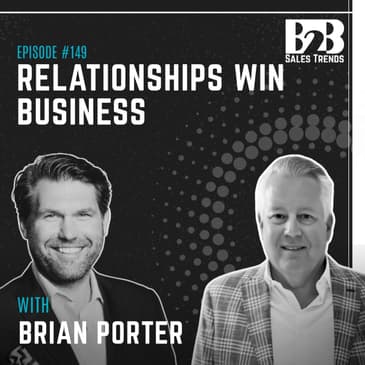
[00:00:00] Welcome to another fabulous episode of the B2B Sales Trends Podcast, my lovely people. Technology has made it easier than ever to reach people, but it also made it easier than ever to ignore them. And phone calls typically get flagged as spam, emails land in clutter folders. Buyers are overwhelmed with automated outreach and standing out has never been harder.
[00:00:28] On the B2B Sales Trends Podcast, we give you a sneak peek into the strategies of the world's best CROs and go-to-market leaders. The systems, the playbooks they are using so you don't have to figure it out the hard way. So if you are looking to increase win rates, shorten sales cycles and learn from the best in B2B selling, you are in the right place. My guest today is Marcus Houston and he has spent decades building sales teams around a simple belief.
[00:00:58] When everybody else is hiding behind technology, human connection becomes your biggest competitive advantage. Today we're talking about why face-to-face selling is still important and still matters and how to make every customer interaction count. Super pleased, Brian, for you to take the time to spend with us today. Welcome to the B2B Sales Trends Podcast.
[00:01:26] Oh, I was glad to be here, Harry. Thanks for having me on. Really appreciate it. Everywhere you look, people are talking about AI automation and digital selling. And I know you have a very different perspective, which I'm super pleased to dive into today. Where do you think B2B selling is or should be heading?
[00:01:49] B2B selling, I believe all indicators are everyone's trying to take the human connection out of it. Everyone's trying to get away from hiring human beings, I believe, because it's hard to train. It's a capital expense. How can we automate it? Things like that. You just touched on it in your opener. Your phone tells you it's a spam call, right? Your phone tells you immediately, this is spam, so I'm not going to answer it.
[00:02:18] Your email has a clutter box that immediately spams out all unwanted emails. So all the indicators that you're training the new next generation of salespeople on how to connect with a potential client or prospect is to email or to use the phone or to have a bot, AI bot, reach out and do all these things. It's counterintuitive because then you have other bots spamming all this information out.
[00:02:47] So I still believe more now than ever the human connection is still there because AI has to be driven by a human being telling it what it needs to do. So I think you can use AI to go through the internet, to find your prospects, to find the proper client that you're looking for, the profile, the right type of customer that you need to target based upon the services that you have to offer.
[00:03:17] That, I think, AI and the technology there saves a ton of time and energy for that. But I do believe going out to the physical location and seeing what they're doing still can't replace what you need to do in B2B selling. I do believe now in snail mail. I believe sending a personal note to a prospect to tell them what you want to do,
[00:03:44] what your goal is of getting a meeting with them is very important. Can I arrange a phone call to talk to you about what our services are and what I have to offer? And then don't deviate from what you're promising that you're going to do on that first call. That, I think, is another thing that people deviate from is they make a promise on what they want to do on that letter or on that card. And they get that opportunity to go in there.
[00:04:14] And then it's a quick shift and they get that moment of truth and they deviate right away from that. And then they blow that opportunity right there. So that's, you know, to get in with that card or to get that card to get you that phone call, to get you that moment to then send that email, to accept that email is the way to get that crack in there.
[00:04:43] But again, I still think, you know, I like to go by. I like to work with our reps to physically go by the building to see what it looks like. I mean, look, years ago when dot-coms were coming up, you could start with a beautiful looking website and be operating out of your home. So a website, you know, can look fantastic, but there's no brick and mortar. What are they selling? What are they doing? What's the cash flow look like?
[00:05:10] I mean, a building tells you a lot, especially, and it all depends on what you're selling. Look, we're in packaging supplies. So we have to know that there's a building that we're shipping to. We have to know what they're using those materials for. So I have to know that there's people that are going to be there to use that material. So I guess for me, it's even more so important that there is brick and mortar. So I guess it all depends on what the product is or the services are that you're selling for that.
[00:05:39] You might not need that. You may just need, you know, a conference room somewhere and some human beings to do the pitch. But you got to know where that person is residing. Are they domestic? Are they in your town? You know, or do they just have an address and use that address as a, you know, as a P.O. box and then they're offshore or something? I don't know. I mean, there's a lot that goes into where are they located and why.
[00:06:05] I do think now, more so than ever, people right now in the United States, they're onshoring. I've met with a lot of customers over the last four months that have moved things from the South Pacific or the Asian markets to be back in the United States because of the tariffs, because of the shipping times, because people are not issuing long-term P.O.s anymore.
[00:06:32] They're shortening the lead times that they're needing on their products. And they're onshoring. They're seeing that the cost of doing business domestically is now starting to equal out. That's really important now. So it's important to know where these people are located at and why they want to do business with you, what their reasonings are, things like that.
[00:06:58] It's interesting, the comment about snail mail and handwritten notes and sort of something very personal. I feel it's a great way, especially with senior level stakeholders that you may have in your sales process. It's really important to stand out this way.
[00:07:23] And that's one way of certainly that you'll be able to do that, stand out and build that credibility and that trust in the process. I think it's a great idea, great mindset, this. Absolutely. Well, you mentioned trust, Harry. I mean, how do you build trust from starting with nothing, right? Right. And the way you do it is doing what you say you're going to do when you're going to do it.
[00:07:51] How many people are sporadic all over the place on their process, on their pitch, on their go-to-market strategy? You know, the training we always provide is be consistent on your approach. Do not deviate from that. If you say you're going to be there on a Monday every two weeks, you are there on a Monday every two weeks. The second you show up on a Tuesday, for whatever reason, you've now blown that trust.
[00:08:20] They're not going to say anything to you because you're not interacting with them on doing business or anything. But the second you show up on a Tuesday, that little thing is a checkmark against you. They notice. They know those things. They, okay, I've got, you know, a multimillion dollar business. And you can't even show up when you say you're going to show up. People notice those little things. You say you're going to do that.
[00:08:47] And when you don't do it, it seems to be no big deal for you, but it is a big deal for them. So I always tell the reps, you better send a note way in advance. Like if you know you have car trouble, don't wait 15 minutes before your appointment. You that morning say, I've run into a situation. I'm not going to be able to come by. Even though you don't have an appointment, you may just be going by to leave information on your regularly scheduled route that you're going to do.
[00:09:16] And you're going to stop by every two weeks to let them know you're not going to be buying that area that day. And that you'll be back by in two weeks. You better let them know because you've got to keep that cadence. If you blow it, you've got to start all over again. So what I'm hearing from you is that element of reliability really is one that builds strong trust. Is that a little bit of a thing? In ours, we're a service industry.
[00:09:44] So if you don't have reliability, your word is everything. Right. What else builds that trust in your opinion apart from being consistent, being reliable in what you do? What else? Yeah, well, you have nothing else to show, right? I mean, I'm not even doing business with you. How else am I going to build trust except for my word? I'm going to show up in two weeks.
[00:10:12] I'm going to bring you a proposal on the information that you asked me about. You're giving me five minutes to tell you to sit down and for me to listen to what you have to say to me. Not for me to pitch you on my products. You know, I'm asking you for five minutes or ten minutes for me to tell you about your business and maybe how I might be able to fit in to help you guys out.
[00:10:39] Now, if I sit down and listen for five minutes about their business and the whole time I'm talking about my business, I just blown their trust. Because I asked for five minutes to listen to what they have to say about their business. So I've blown their trust. I mean, that was a quick lesson I learned from talking to a CEO, a couple CEOs. And I was listening to them and I said, hey, tell me about, you know, what's the biggest thing that can blow a call?
[00:11:08] And he goes, well, when they come in and they want to know about my business and they start trying to sell me on their business. Blows the whole call. I'm like, ooh. Yeah, I can see that. I think it has a lot to do also with this idea of, you know, if you can't help the customer nowadays achieve their outcomes, then you really don't have a place.
[00:11:34] You know, if you want to push your product to them, then, you know, that's one thing. But you're really going to make sure you either help them avoid a risk that they may be facing by not working with you or you're going to help them achieve an outcome. And anything else, it's just not interesting to the customer, right? Right. I mean, there's a million different companies out there that can probably offer the same goods or services you can.
[00:12:03] You got in there for a reason. They're giving you an appointment for a reason. They definitely now are willing to talk to someone. Now listen to them. And listen to them. And, you know, God gave you two ears and one mouth. So listen with your two ears. Take down a lot of notes. And then at the end, follow up and go maybe ask more questions on some of the points that stuck out to you.
[00:12:30] And then sit down with your boss, with your manager, and review the notes from that meeting. Send a follow-up email. Hey, from the meeting, these are the key takeaways I heard on your pain points. Can you confirm them to me? Great. I'll be back in two weeks.
[00:12:47] And let me sit down now and explain my offerings on what we can do and maybe how some of these pain points you have can fit in and how I might be able to provide some services back to you and what we can offer and how there might be a partnership here on how we can move forward. I mean, if it's a big enough deal, I want to establish a relationship first to have some common ground. Because I can sell, right? I mean, I can win on a transaction.
[00:13:15] I can build a, you know, I can get a transaction, but I'm also going to lose on a transaction. I'd rather have a relationship that's going to be long-term, that's going to be built on something that we have equal and mutual beneficial goals in mind. That they get a win and I'm going to get a win. And through that, we're going to have transaction. And a lot of times you're going to open the account open with a transaction. It's going to like, hey, look, while we're working on achieving these goals, can we get the account open on just some Me Too items over here?
[00:13:45] Oh, yeah, yeah, yeah, yeah, yeah. That's just like, let's get the account open, get the credit established, things like that. That's just, you know, table stakes type of stuff. But in that meeting, you said you had these problems and I think we can handle these problems with this. But as a rep, you don't know a lot, especially if you've only been in the industry for a year, two years. Don't try to handle it all on your own.
[00:14:09] I've always found that a lot of them try to do that because they've got egos, which is great. That's what you want. But get some advice prior to going back to that meeting. Get some other eyes on it. Get your manager to take a look at it. Go back on your own. That's fine. And, but make sure that you, you know, revalidate that you heard what you heard during that meeting.
[00:14:36] Because I've seen reps hear something with their ears and it was completely different than what that customer or prospect was trying to convey that information. And it was like so night and day when the actual presentation happened. And they're like, you did not listen to anything I said. And again, then it's done. You didn't hear me. I gave you your shot. And you didn't listen.
[00:14:59] In relationships, that's sometimes called selective hearing where one side of the relationship only wants to hear what they want to hear. That's a common thing, isn't it? Really? It's funny. My ex-wife used that word a lot. Selective hearing. That's right. That's right. You know, you've been in sales long enough to see customers move organizations, take on different roles, bigger roles, build their own careers.
[00:15:29] We talked about that a little bit in our pre-call. How has that sort of over the years shaped the way you think about prospecting and growing a book of business? Yeah. A good sales rep slows down their actual cold calls.
[00:15:50] Matter of fact, most of them don't cold call later in their years because they've developed such a strong network that the people that they deal with get bigger and better roles and go on to bigger and better companies. So it's a butterfly effect. They now are dealing with, you know, say that they started off and the person was a clerk in a warehouse and they opened that account up with that person.
[00:16:15] Well, now that person is managing three different buildings at a bigger company, but they still do business with that initial company that they opened up. And they've got 25 customers off of that one person because they've jumped three times in their career, always getting a better role as they went on. Now, through those three different companies, though, that person's dealt with three different other individuals that have gone on to three other different companies. And so it just keeps multiplying out.
[00:16:44] So there was a book out a long time ago from Diana Ross's manager called Life is a Contact Sport. And I truly believe that, that you meet people, you establish relationships with them. And if they're good, solid relationships and you work well with each other, they're going to keep using you and your company as they keep moving on in their career. And then people that backfill them as they get promoted will use you as well. And then so on and so forth. They will get a job somewhere else and hopefully they take you with them.
[00:17:14] And that's my belief is that your prospecting is just keeping the relationship with those individuals and keep networking as they keep moving. So it's not as much cold calling through the open market. It's just keeping that relationship. And they go, hey, man, this one company, a buddy of mine just started it up. They're doing this. I gave them your name. But here, reach out to them.
[00:17:42] Let them know I told you you call them. There's more of that type of cold calling, which is now warm calling, than there is now just, you know, the prospecting over the internet or cold calling, door knocking to open up business as you get more tenure in your career. Is what I personally feel in that type of business, in our business for sure. Yeah. And I think you're spot on.
[00:18:12] And of course, not every relationship is always going to have sunshine and rainbows in it, right? No. Sometimes there are tough spots in those relationships. And what would you recommend to the audience there when you say, you know, is a tough spot in their relationship actually an opportunity to even cement it more and build more trust? Or is it something that you just leave aside and move on to the next one? What's happened so often these days, unfortunately?
[00:18:41] I still have a personal relationship with a customer of ours that left us with over $60,000 in debt when they went BK. And it had, you know, he had nothing to do with it. He was the one going, Brian, we're trying to work through this and I'm going out there going, we got to get payment terms going. All these other things, we had to take him to small claims court. I felt horrible for this individual. He ended up getting another job somewhere else eventually.
[00:19:06] And hat in hand called us and I'm like, dude, you guys, you know, this was a bad, you left us really, this was a bad, bad, bad, bad thing. I don't know if I can trust you anymore. You know, did you know this was going to go south? You had to have known your company wasn't paying us. You had to have known these things. You just nailed us with $60,000 in debt. This is not good.
[00:19:35] So there was, I mean, I, there was tension, right? It was bad for a while, but we still stay in contact. And it's, he's like, look, at the end of the day, Brian, I had to, I had a job I had to do. You had a job you had to do. I had, you know, I'm trying to keep food on the table for my family while I'm still looking for another job for myself. You have to understand the position I was put into. You know, I'm freaking out, not knowing how I'm going to feed my family.
[00:20:04] And I go, at the end of the day, I get it. But man, you put us in a really, really tough position. And the sales rep had to eat that money. Don't you understand that? He was put in a really hard position. He was having to put food on his table. So what he, so then what he said is, hey, have the guy come over here. I'll take care of him. Right? Have that person come over here. I'm like, I don't think he wants to deal with you. You just royally screwed him. He goes, he's not going to deal with me. He's going to deal with this other person. But have him come over here.
[00:20:32] So he dealt with a different buyer. But the guy did him a solid, got him in there, helped him out. The rep, you know, he made the rep, he didn't make him whole right away. But he helped him out, getting him into this new company and got him, you know, worked with him and things like that. But I still have a relationship with this gentleman. You know, this is now 20 years later. But that was a hard situation. I mean, they stuck us with a lot of money. It hurt. That's not something that you get over quickly.
[00:21:02] But it's those type of things. There's many companies where these individuals, where you have to have those hard things, where they kick us out. You know, hey, we lost a bit. And they're like, I'm like, what are you talking about? I thought we were good. They went with someone else. And it had nothing to do with the dollar. It had everything to do with like, they wanted to go somewhere else because of service. And it was something we couldn't offer. And our contact did not know. They thought it was all going to be based off a price. 100%.
[00:21:31] But at a higher level, they had conversations that our buyer was not involved in. And that was shame on us because we were listening to our main contact. We weren't trying to go above them to make sure that all stakeholders were involved. And someone came in from a higher level, listened to what the ownership wanted, listened to what the investors wanted. And it was a totally different. The ball game wasn't the ball game that we were playing. We were playing checkers.
[00:22:01] They were playing chess. And we lost. And that was another hard one that we had to deal with. That person ended up losing their job. And the whole thing, the company sold, went to private equity. And years later, the guy ended up calling me saying, hey, I'm over here now. I'm like, oh my God, I can't believe you're calling me. He's like, yeah, I was just seeing we're over here. I'm not buying anything, but you guys are always a great company.
[00:22:30] You know, hey, have you talked to the sales rep? Sales rep had moved up to Northern California. And I said, yeah, he doesn't work for us anymore, but he's doing well. And he's like, well, if you hear of anything out in this area, let me know. It's just a weird, it was a weird thing. But yeah, the contacts that you make in this, it's, you know, they're, they're, they last a long, long, long, long time.
[00:22:54] Even tough spots in relationships, you know, if, if you treat these situations the right way, these relationship, regardless of how tough the spot was, they last typically. And, and that's a good thing. That's a good thing. The last question I ask on every single podcast is always the same. I'm curious to hear your response. When you look at the best B2B sales people out there that you have worked with
[00:23:23] throughout your career, what are the three skills and behaviors that the top elite sellers have in common? And think about it in, in prioritizing them in number one, number two, and number three in skills and behaviors and traits that they possess to be elite sellers. Yes.
[00:23:48] Um, I think the behaviors, the three behaviors I see in every top sales rep I ever come across is they're self-motivated. They are relentless. They, they won't give up and they've got true grit. They've just built differently. They're just, they grind it all, all day, every day. Um, they can just always grind it out. Um, as far as skills, they are very effective listeners and communicators.
[00:24:17] Um, their skill is emotionally, um, intelligent and they're, um, ambiguous as far as their personality. They can adapt to a room. So three different skill sets and then motivators. Brian, you've been a fantastic, uh, guest on this episode. I know our listeners will very much appreciate, uh, your tips and, uh, thought leadership on the topic. Thank you for taking the time.
[00:24:47] Harry, it was a pleasure. My lovely people, technology will continue to change, uh, the way we sell. That's for sure. And, uh, and transformation will always happen. But as Brian reminded us today, it doesn't change why people buy. Trust is still earned the same way it always has by listening, by following through and by still doing the small things consistently over time.
[00:25:14] The tools may evolve, but the fundamentals of building relationships haven't. If, uh, you'd like to learn more about how to improve commercial performance and creating more effective customer conversations, you will find a link below to our Revenue Accelerator in the show notes. If you liked this episode, follow the show, share it with your team members and subscribe on our YouTube channel to wherever you get your podcasts from until the next time.
[00:25:42] My lovely people take care of yourself, your loved ones, and of course your B2B customers. Bye-bye.