
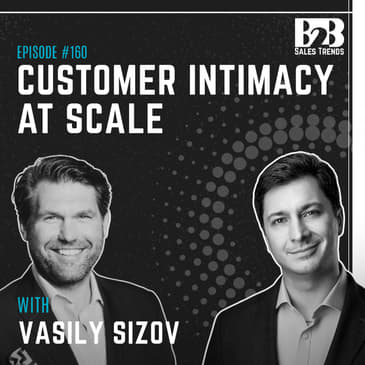
[00:00:00] My lovely people, welcome to another fabulous episode of the B2B Sales Trends Podcast. Now, most sales organizations face a difficult trade-off as they start or continue to grow. On one hand, you want people who know the customer inside out, of course, right? On the other, you need deep expertise that can be applied across multiple accounts.
[00:00:24] Now, the challenge is that scaling one often comes at the expense of the other. My guest today is Vasily Sizov. He is the Chief Revenue Officer at Grid Dynamics. And over the past several years, he's helped the company evolve its sales model by combining strong customer relationships with specialized practice expertise, helping the business expand within existing accounts.
[00:00:54] And engage more effectively at the executive level. Today, we're talking about how that model works and what other sales leaders can learn from it. Vasily, welcome to the B2B Sales Trends Podcast. Thank you. Happy to be here. As Grid Dynamics continued to grow over the years, what made you rethink the traditional client partner model?
[00:01:18] You know, when it comes to our business, it's usually two parts in it. The first one is relationships, essentially building customer intimacy. And the second is your capabilities, what you can bring to the table, how relevant you are to your customers. And therefore, you can bring to the table, how relevant you are to your customers. And therefore, you're trying to balance it out and figure out the best model, which would essentially allow you to make progress with both of these things.
[00:01:46] So when it comes to traditional model, and I recall the company around 2016, 2017, we were very geocentric. So our client partners were located in the regions, in the cities where our customers are. But now, if you think about it, like I'm located here in Dallas and, you know, around me, I have like Toyota headquarters here. Caterpillar is in Irving, McKesson, then there's Texas Instruments.
[00:02:15] I'm not talking about Neiman Marcus and JCPenney, which are retail. Now I think about it. It's like all the different industries around the same customer hub, you know, some geo spot. What kind of capabilities should a client partner have in order to, you know, ensure customer satisfaction be relevant to them?
[00:02:36] And it's really difficult. You have to be like a truly generalist, which means that you have to be quite shallow on the things, but good enough in building relationships. And once again, it's a trade-off, right? Therefore, we figure that actually the better model probably could be if you focus your sales personnel on specific verticals.
[00:03:02] And now you have, for example, a client partner who is focused on retail and would understand what kind of problems are typical for that specific domain, for that specific vertical. Let's say building loyalty systems or, you know, building better catalog and search. That's the problem which every big retailer and e-commerce company are trying to solve.
[00:03:28] The same for manufacturing, you know, how to do the proper production planning. That's the problem which is very typical for any manufacturer. And we came to conclusion that if you focus your client partners on those verticals, probably you can sell the same kind of pattern to different companies of the same vertical. The idea sounded right.
[00:03:53] But the problem here is that now you have a client partner who has to fly all over the U.S. Or even all over the world if you're a truly global company like we are, for example. And then you start losing customer intimacy. Because you cannot be at the office of your customer every day. You cannot drink coffee and having, you know, your stakeholders, you know, for lunch every other day.
[00:04:22] So that becomes a problem that you start losing intimacy even though you now understand better, you know, what to sell to the customer and be more relevant to them from the industry, you know, just solutions perspective. So that was the kind of the big trade-off here.
[00:04:43] And the solution which we found actually is to combine both to still keep your client partners geo-focused, have them close to your customers so they could, you know, just build real good, you know, friendly relationships. And at the same time, have people who are focused on verticals. It's a little bit of a kind of increased overhead if you think about it because now you have two people instead of one.
[00:05:12] But at the same time, it allows to close, you know, both issues, right? So relationships and the depths of the vertical. Interesting. I know you've also experimented with a more sort of centralized practice-oriented approach as well. What did that solve for you and where did it start to create new problems for you?
[00:05:33] That's what I mentioned when I said that you start losing a little bit of the customer intimacy given people have to travel quite often and you still, it's never enough, never enough to be in front of your customer. So these people, I would call them kind of practice sales. They have a good understanding of the domain. They have a good understanding of the problems.
[00:06:01] So they can fly in, you know, give a great presentation, explain to the customers, you know, the other companies in the industry solve this problem that way. And we can help you to build a system which would allow you to do this, this and that. Perfect. Perfect. But then you need to follow up. You need to meet all these people. You need to help them to get the budget for that and et cetera.
[00:06:24] And that's where it becomes a problem because that person that wishes a remote have to do it on his or her own and it becomes a problem. Was there a particular time, at a particular point in time, should I say, where you realized you really needed both? Was there an event that triggered that or did that just come later? I would say it's more of a natural evolution also with the growth of our company.
[00:06:52] When I joined Grid Dynamics in 2016, we were roughly talking about the headcount, roughly 500, 550 engineers total. Nowadays, we are close to 5,000 people. So it's 10 times growth.
[00:07:08] And of course, such a massive growth requires rethinking the approach, not only how you run operations, but also how you run sales because you are operating on a different scale. We are publicly traded. We work with Fortune 100, Fortune 500 companies. And given the industry is constantly evolving and right now, as you know, we are going through the AI revolution, I would say. Not evolution.
[00:07:38] It's a revolution which changes everything. It requires constant rethinking of the approach on how you sell. So these all things which triggered rethinking, you know, how to create a more effective organization, which allows to be relevant to your enterprise customers and at the same time go in depth.
[00:07:57] Because one of the goals when you focus on the Fortune 100 is to climb up to the very top to become a strategic partner for your clients. So they think about you not as another vendor who can provide good engineers, but think about you as a, oh, I have this technology partner who can actually help me to solve the business problem.
[00:08:24] And now, given you need both in order to climb up, you have to be relevant and have good level of intimacy. But at the same time, you have to be in depth into the vertical they are in, in order to be, once again, relevant. So they could think about you when they need some help. I absolutely agree. To become a strategic partner, there's a number of things necessary, right?
[00:08:50] Obviously, you've got to have a culture that gets sellers to focus on the outcomes that they can affect with their customers. You've got to make sure that the customer trusts you on the delivery front and so forth. You've got to make sure that sellers are really not there to just sell them something, but are deeply engaged in solving their issues.
[00:09:19] That's how you become a strategic partner, right? My question to you is, how do you scale this behavior? You shared about that growth that you guys have experienced recently. How do you scale that across the sales organizations and how do you make sure that this culture sticks? That's a great question with no simple answer.
[00:09:44] But I would say that finding the right talent, the right salespeople is the key here. And I would say that there are a few traits which I would be looking for in salespeople and great salespeople. The first one would be proactiveness.
[00:10:03] When you have a proactive person who is actually just focused and has energy and willingness to grind and to bring new business, to build relationships, it helps a lot. The worst thing can happen for the salespeople if you have to be a babysitter for your salespeople and ask, what's going on with this opportunity? What's going on with this opportunity?
[00:10:33] I would prefer a salesperson to call me and say, oh, Vasily, I've just got a meeting with a CIO. Can you fly in and just meet this person because I believe it will open a new opportunity for us? That's the ideal model of operations. The second thing would be probably commercial creativeness and overall, I would say business creativeness because the market is changing constantly.
[00:10:59] And sometimes you have to think out of the box when it comes to solution, when it comes to essentially pricing, discounts and those kind of commercial things. That kind of could be compensated a little bit by having my brain power in order to solve this.
[00:11:21] But it's great when even in the smaller decision making, we can go creatively about certain things and just find our way inside the organization. And the third thing I would say is, of course, amicability, because, you know, the person has to be amicable in order to build customer intimacy. And, you know, the customer would love talking to him or her.
[00:11:47] So having such salespeople, I think that's the best way in order to be successful in a sales organization. How to ensure consistency. I think it's more of a kind of reiterating the same framework and setting the model the way. So it's kind of naturally would, you know, stay consistent and stay kind of aligned with the way how you operate. Therefore, we have two organizations. One is a client partner organization.
[00:12:14] And another one is, of course, practice sales. Now, coming back to you hiring those right people to ensure you scale and get consistency for it. I'm curious, you shared those three things you need to hire for. How do you spot these things in the interview process? That's the thing which I'm trying still to figure out because it's such a difficult thing.
[00:12:42] Sometimes you hire a person with 30 years of experience and it's just not working out. Like, sometimes you are hiring a person who actually, you know, just got into the industry. And apparently this person is a rock star because has all the energy to, you know, to drive and get things done.
[00:13:04] You know, I am the example actually of a person who is self-built in the services industry because GridDynamics was the first services company in my life. Interesting. And I climbed up to wherever I am just by, you know, getting things done with growing several customers and growing my portfolio.
[00:13:25] So, I would say the good thing which you can check early on is, of course, asking questions of, to provide particular examples of end-to-end development of certain opportunities. Not taking an opportunity which the customer brings to you, but actually figuring out what is not right in the customer's business.
[00:13:54] So, you could approach the customer, explain that to them, get the budget, convince the management, get the project, sign the contract, deliver that end-to-end and capitalize on that.
[00:14:09] Such cases usually demonstrate, you know, how the person is thinking about it and also whether the person is responsible or feels he or she is responsible end-to-end for building this opportunity and delivering, you know, end-to-end to the customer, to the client's full client satisfaction, I would say.
[00:14:29] Another thing which helps a lot is also to have relationships with recruitment agencies on your own, not through your kind of proxy recruitment organization, but actually build relationships with the recruitment agencies yourself. Meet these guys, explain what you're looking for, explain the criteria, the background you're looking for.
[00:14:53] Because removing this intermediary between you and recruitment agencies helps a lot because they can hear your voice. They know exactly what you need. And then you suddenly start seeing a better pipeline of better people. So, that's another hint which I use. But it's still, I mean, I'm still trying to crack the code here because it's very difficult. It's very difficult. Once you cracked it, let everybody know. I will contribute.
[00:15:22] Maybe. To everybody's issue. Because a lot of people are facing that issue, right? The strategy is one thing. You have a reason why you lay out that strategy. And it needs to do X, Y, Z, whatever the strategy is. And you need people to execute it. And that's typically the weak link, shall I say, right? Sometimes.
[00:15:48] And then hiring for that capability is challenging. It just is. It's worth another podcast if I crack the code, I guess. Absolutely. We're game. We're game, Vasili. So, coming back to the model, though. You mentioned the model, client partners, practice leaders. What's changed since you've impacted it?
[00:16:12] I definitely see good progress nowadays with the way how we do sales. Because if you think once again about client partners, those folks are naturally generalists located in a certain region and working with multiple customers of different verticals.
[00:16:33] In that model, you rely on their creativeness and the depth of their understanding of different industries, which cannot be equally deep for every vertical. As I mentioned, here in Dallas, they could have a whole bunch of different businesses of different verticals. Therefore, typical client partner becomes a more of a kind of, I don't like this word, but let me say that, an order taker to some extent.
[00:17:02] Because the customer comes up with their own roadmap. They come up with an idea of a project or, oh, like we need to solve that. What can you bring? And then the person from our side, a client partner, can actually figure out what we've done for other customers, what we can bring to the table, and convince the client that we are the best partner for that. Very typical model. With practice sales, it's quite the opposite.
[00:17:31] It's very, very proactive because if the person solved that thing for another company of the same industry, he or she could practically pitch this idea to another customer and say, you know, most likely by our analysis, you have this issue and we can help you to solve that because we've done this, you know, 20 times for a good chunk of Fortune 500.
[00:18:00] And then you kind of create the project out of nothing, create an opportunity out of nothing. It's a little different model in combining both. Now we have a client partner who actually can approach any stakeholder, you know, build relationships, et cetera, and bringing in a practice person who actually can be relevant to the business, having two people in the box.
[00:18:25] Now you can actually, you know, create opportunities and maintain the higher level of intimacy. I can really see that change. I think it's a really smart model. Well, Vasili, the last question every single podcaster I always ask is always the same. And I think partly you have answered that, but let's go over that again just to finish our time here together.
[00:18:54] When you look at the best B2B sales people you've worked with in the past, what are the top three traits they seem to have in common? You mentioned earlier, proactiveness, commercial creativeness or business creativeness and amicability. Are these the three traits or skills and behaviors that you think B2B sellers need? Is there anything in addition? I would say this would be the three I would be betting on.
[00:19:22] And essentially, you know, one funny thing, which when I interview salespeople, I'm always saying one thing to them. If someone is looking for a great company to retire, Great Dynamics would be the worst company for that. If you are looking to be a part of the growth story, you cannot find a better company. And that's kind of essentially becomes a natural filter of what people are looking for.
[00:19:51] And I definitely need people who would be, you know, just growing with the company and helping the company to grow. Asili, we appreciate your contribution to the collective knowledge of B2B sales and leadership. Thank you for taking the time. We appreciate your input. My pleasure. Thank you so much.
[00:20:13] My lovely people, one of the themes that came through in this conversation is that growth doesn't always come from finding more customers. Now, sometimes it comes from serving the customers you already have more effectively. As Vasili has shared with us, that, however, requires more than strong relationships and more than deep expertise. The real opportunity comes when those two things work together.
[00:20:42] If you'd like to learn more about improving commercial performance and creating more effective customer conversations, you'll find a link to our website in the description below. Also, download our latest white paper that's called Day Zero, where deals are lost. If you like this episode, follow the show, share it with your team and subscribe on YouTube or wherever you get your podcasts from.
[00:21:10] Until the next time, my lovely people, take care of yourself, your loved ones and your B2B customers. Bye-bye. Bye-bye. Bye-bye. Bye-bye. Bye-bye. Bye-bye. Bye-bye. Bye-bye.