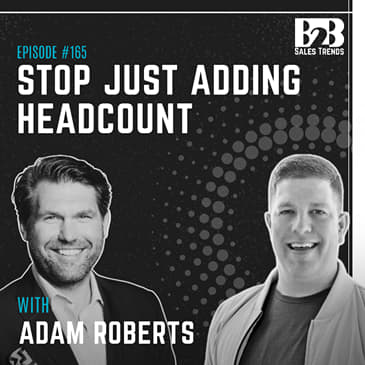
[00:00:00] My lovely people, welcome to the B2B Sales Trends Podcast, another fabulous episode. And today we're talking about how to build an outbound engine that generates more high-quality opportunities and converts them into more revenue. What we're all after, of course. On the B2B Sales Trends Podcast, we give you a sneak peek into the strategies of the world's best CROs, go-to-market leaders, the systems and playbooks they are using.
[00:00:27] So you don't have to figure it out the hard way. So if you are interested in increasing win rates, shortening sales cycles and learn from the best in B2B selling, this podcast is for you. My guest today is Adam Roberts. Adam is the SVP of Sales at Simplify, where he leads new business development and channel partnerships. And Adam has done a cool thing.
[00:00:50] He has been leading a transformation of Simplify's BDR operation with the goal of building a more effective outbound engine and improving its contribution to growth. So today we are going to unpack exactly that transformation, what prompted it, how Adam approached it, and what sales leaders can learn from the outcomes and the results. Adam, welcome to the B2B Sales Trends Podcast.
[00:01:18] Thank you very much, sir. Good afternoon to you. Morning here in Boston, but hope you're having a good day. We are having a fabulous day. Thank you for joining us and thank you for your contribution. So let's start with the business challenge in this initially. When you took a closer look at the BDR operation, what did you see at the time and what were you ultimately trying to improve to give our people, our listeners some context?
[00:01:45] Sure, absolutely. Yeah. So I came into the operation here a little just shy of a year ago. And in that process, one of the first things that I was looking at was our BDR situation. What was really unique about the way that we were going to market at the time is that we had two BDR teams. One of those BDR teams rolled up under me and was focused on what we call our national agency business.
[00:02:11] And then we had a separate BDR team that was actually offshore that was operating under one of my counterparts at the time and was really focused on what we call our local direct business. So a little more down market, in-market operation. And so, you know, when I inherited that, one, I had questions as to why we had two separate operations. Neither was cleanly connected to our marketing department, which is really important because inbound lead flow is part of the equation with our BDRs.
[00:02:41] Having a strategy that was consistent around cadencing and outreach and how do we want to get in front of these people and how do we want our brand to look in front of these people was very clunky, for lack of a better way of putting it. And with two different operations, that's just naturally going to happen because you have two different people looking at the structure.
[00:02:59] And so that was really the biggest business challenge was how do we bring these things together and how do we do it in a way that's both going to benefit us cost-wise, but also going to, most importantly, drive incremental revenue and get us to a better place from a pure closed one operation. And so that was really where we were focused and that's where we started.
[00:03:24] And now, of course, improving the performance of such an operation, of an outbound operation can involve a lot of different things, right? Everything from people and process to data and technology and so forth. How did you approach that transformation and what did you decide needed to change? Yeah, it's a really good question.
[00:03:48] And I hate to be the guy who says a little bit of all of that, but it was a little bit of all of that, right? We had this start, I think where we really started was what was the output that we were currently getting? Were we happy with the output we were currently getting? Meaning, were people getting enough activity? Were we generating enough meetings from the outbound outreach? Were we generating enough closed one revenue from what we were doing? And what we found is that in all those areas, we were coming up short.
[00:04:16] Now, some of the result of that was systems-based, right? Tools, we didn't have the right tools in place for people to effectively do their job. Part of it was that we felt that if we got the right tools in place and the right support within our CRM system, then we wouldn't necessarily need as many people to do the job effectively. So we looked at that as well. And then in addition to that, you know, we then looked at once they get someone on the phone, what exactly are they doing? What is their cadence to get them?
[00:04:46] And then what are they doing communication-wise to actually sell them on the value of what we do? And are they qualifying them appropriately enough so that we can actually bring in the people, get the meetings with our top sales reps with people that are actually going to convert? And so we really did look at it holistically. We started with the actual tools because I felt like if we could get the right tools in place first, then we could evaluate if we were maximizing the time of the people that we had. And once we did that, we realized pretty quickly we didn't have the right tools in place.
[00:05:15] Once we added that, we realized we could get a lot more out of the 12 people that were reporting to me in-house and to my team in-house. And so we maximized that as our first starting point and then kind of moved from there. So typically when sales leaders want more outbound opportunities, right? Adding more people isn't sort of the obvious choice or the obvious option. But it really isn't the only one.
[00:05:44] How did you increase the amount of work your existing BDR team could take on without simply increasing headcount? Yeah, listen, I'm one of those sales guys who's kind of a data nerd. I'll spend a little more time in the weeds than a lot of other salespeople will. And I think it depends on the person, but I really care about the numbers. I'm a big believer in B2B sales is a numbers game, right? It is about how many times do you reach out to these people?
[00:06:14] Do you hit them at the right time? All those things matter, but it's numbers-based. And so I dug into the numbers. So to give you context, our offshore team, we had about 30 people dedicated offshore. We had 12 onshore. When I looked at the numbers of the amount of volume meetings-wise that was being generated offshore, I was really disappointed. And I dug in deep. I went all the way down to deals that they said had closed one. I tracked those all the way through to see if it carried through and the total dollar value
[00:06:44] spent because we all know there's slippage in our business, especially in ad media. And so I looked all the way down the funnel to find out what was truly happening and found that it was really underperforming. On the flip side, when I looked at the 12 people onshore, what I found is that they were doing really well at maximizing the actual outbound that they were doing and the communication they were having with prospects. Where they were coming up short was they were spending a lot of time just finagling in our
[00:07:11] CRM system and trying to find the right person and then using the wrong tools that took them too much time. And so I thought, geez, if I could get these 12 people onshore to use a couple of tools a little bit more efficiently and effectively, then man, I might be able to eliminate these 30 people offshore because when I look at the pure numbers of it, my onshore team is grossly outperforming with actually less total outbound being done. And so how do I maximize that?
[00:07:40] And that was really like once I got into the weeds on the numbers, that's what precipitated me being like, okay, this is the move. We need to eliminate this equation, put in the right tools, and then have this smaller team maximize their effort. So that was kind of the starting point, just getting into the weeds on the numbers and making sure that you're making the right decision for the right reasons and not just because of a gut feeling, right? And improving who you target, I would assume is a big topic in that transformation as well,
[00:08:09] because greater capacity really only creates value if that effort is being directed towards the right prospects, right? So how did you improve the way your team identifies which prospects are the strongest fit and are really worth pursuing? How did you do that? It's a great question. It was kind of a twofold approach, right? When I got here, we had new leadership on board here with a couple of situations.
[00:08:37] And one of the first things our leadership team, our senior leadership team did as a whole here at Simplify, along with our marketing partners, was get clearly defined ICPs. Who does our business need to be going after, right? Where do we actually win and have success and create what we have? We have this term internally, and I'm sure other people use it. We have sticky deals and slick deals, right? Sticky deals being a customer who could stick and be here a long time because they're a great fit.
[00:09:03] And then you have slick deals, which, you know, hey, these are people that it's a little bit outside of our comfort zone, but we could probably deliver. You know, we want more sticky deals. So you do that by making sure that everybody in your building understands who your best ICP is, right? And so when we got that ideal customer profile laid out, that was starting point one. Starting point two became, how do I find more of those people for my BDRs so that they're not spending a whole lot of time just doing the searching themselves?
[00:09:31] And that's when we started introducing AI and tools around the AI sphere. And of course, AI is everybody wants to use AI. A lot of people, a lot of companies are struggling how to use it best. So where has, so you've created your ICP, you made sure you defined it, you made sure people understand it. And then you've brought in AI into this.
[00:09:56] So where has AI had the greatest impact on the way your team generates and, you know, works these outbound leads? Yeah, great question. So with AI, we are approaching it in phases. So what we've already laid out and run was we started with using AI just to first and foremost, go and identify for me the companies and the people within those companies that are a great target for my ICP. What I actually did is I worked with a company offline.
[00:10:27] They have a product called Quoted Dog. Offsite affiliates is, onsite affiliates, I'm sorry, is the company name. And, you know, I worked with them to start by just identifying all the ICPs that matter. So in our business, we're really strong in deals that matter in the real world. So if you have a business that actually has a physical location, what we do digitally is drive people to those physical locations. And so we looked at the ICPs that fit that, right?
[00:10:53] Whether it's, you know, think about where you go in the real world, whether it's restaurants or it's the dry cleaner or, you know, it's the bank, you name it. There's reasons that fit our profile. And so we built each one of those ICPs out with our AI partner. And what his tool does that I'm really in love with is it not only identifies these people from a company and a contact standpoint, but it then scores them against the detailed ICP that I provided.
[00:11:23] So when it provides that scoring mechanism, that is how I can get maximization out of my BDRs, right? Because if I give them just a list of 5,000 contacts, okay, great. They had 5,000 contacts, but who are the 2,000 that are scoring in the top third percentile? Who are the ones that are scoring in the middle? And who are the ones that are scoring on the low end? And so what we do is to maximize their time and maximize our return on investment.
[00:11:49] We really focus on that top third of scoring as a starting point. And when they run out of leads and they've already done their cadencing and then great, go to that middle third, right? Try down, down the funnel. Maybe we're missing something. What were some of the score KPIs that you have identified for that? Because it totally makes sense. And I think it's a great idea to use AI and whoever you partner with on this to identify
[00:12:17] these wonderful targets in combination with the scorecard. So what kind of KPIs did you score them against? Yeah. Yeah. So the first thing we actually did is we gave him a list of our current customers that are the stickiest, right? And so when you, there's so much information in the universe online that AI can tap into that the rest of us just don't have the time and energy to ever do on our own.
[00:12:45] And so by looking at who our best customers are, and within our walls right now, we have thousands of customers and tens of thousands of campaigns running in any given minute. So to be able to scale that's impossible without AI, right? It's not feasible. So what we did is we actually provided him a list of what we, you know, we basically pulled out our top 100 customers across all of our business units. And we said, Hey, here are the top sticky customers for us, right?
[00:13:12] And we knew that that those customers were a mix of verticals, right? So we had some restaurants in there. We had some agencies in there. We had healthcare in there, the places that we have a lot of success and that are really sticky. So it was a good mix. We married that with that ICP. And when someone, when he's, his tool is doing the research for us, when it goes out and actually searches the web and finds these right people, it's looking at those companies and how it compares to the ones that are our best customers.
[00:13:40] And that's a big part of what that scoring mechanism is. Just making sure that we're identifying the best possible contenders to be sticky customers for us. Um, so that was the main, that's the main precipice for what it does. And you marry that with that ICP detail that we provided. And that ICP detail isn't just like a one line sentence. It's a very detailed description of exactly the types of customers, what makes them good fits, what we do specifically to solve their problems.
[00:14:06] Um, and so we marry all that together to create the most optimal way to score possible. And when you think about the definition of ICP, just go to step back here now. Um, are you thinking, is it as simple as size of customer industry problems they may face, how we can help them readiness to buy stakeholder and get, is it as simple as thinking along these lines or is there some magic bullet to this?
[00:14:35] No, I think where you're at is right. You know what, the most important thing that you said in, in all of those examples is what problems do they have? Right? Like I'm a firm believer in, in the B2B, especially in ad tech media, which, which is our world. But there's a lot of people who do what we do in some form or fashion. That's reality. This is a business that has a lot of competition.
[00:14:59] And so I'm a firm believer that if you have a certain differentiator in the market and we do, what we believe in, in our ability to tie the real world with the digital world from a geo perspective. And so, you know, we, what we try to understand is what is the problem that they have? Cause if I can solve that problem, the rest of what you're defining, it's not as important. And that's why we, we do work with customers that are running in one town in America or
[00:15:27] one province in Canada or whatever it might be. That's a, that's scalable. And we have people that run nationally. Um, so size of the business matters a little less to us really more about, can we solve their problem? Uh, and I think that that's where, when we look at the different verticals that we solve a problem in, when you actually look at the problem statement, it's pretty similar, right? I, uh, the problem statement tends to be generally the same. It's really more about that in my opinion than anything else.
[00:15:57] You know, it's interesting. I heard somebody recently say that, um, ICP shouldn't really be overcomplicating, uh, that, that topic, what it should be. It should be really simple. Is there a problem? Can we solve it? Is it big enough for them wanting to solve that? And does it drive different outcomes for them if we help them solve it? And then all this stuff about is their budget, is that timeout, all of this falls onto these things.
[00:16:26] Is the problem big enough? If, if that's the case, it drives urgency for them. And if that's the case, you know, they will put budget behind solving that because it drives a different outcome. So I really like that simplicity of, of, of, of dirt. I couldn't agree more. Whoever said that, uh, we'd be good friends. I mean, I think that's spot on, uh, at the end of the day, it's, it's, it's just not that complicated. I think people spend a lot of time thinking about, oh, we want to go after this vertical
[00:16:54] or we want to go after that vertical because the total market opportunity is X. And it's like, well, that market opportunity is only what problems you can solve for them. So yeah, couldn't agree more. So Adam, you, you've clearly defined the ICP. You clearly define the tools that help the scale, uh, and identify great targets. Now let's talk a little bit about how do we convert those opportunities into revenue?
[00:17:24] Cause even when you've identified a strong fit prospect, let's say outbound is still cold. And a lot of people would argue that, right. And turning that prospect into a customer, uh, requires, you know, a number of different things, persistence being one of them and especially persistence beyond the initial contact. How do you approach converting those outbound prospects into opportunities and ultimately revenue?
[00:17:53] Yeah. So we, one of the things that I think is really important is, is you have to treat BDRs as if they're one of your outbounds or your, your, your outside sales reps. Like they need to have the same training and development around your go-to-market pitch. They need to understand the differentiation of the product. They still need to be, uh, experts. Now they don't need to know how every single campaign runs in house.
[00:18:21] They don't need to have connection to my CS team in that level of detail. But if you don't train them for the potential of what they, they could be down the line, you're missing out. I look at a BDR role in our building as a stepping stone for a bigger career here in sales. Right. And so I want them trained early on how to go to market the same way. In fact, we, uh, I'll give a shout out to my boss, Susan Rothwell. Uh, she came up with the idea of having a sales pitch contest.
[00:18:48] We revised our go-to-market pitch a few months back, kind of updated it. And we made every single salesperson in the company, including BDRs record their go-to-market pitch and actually have to put that recording up. And it got scored using an AI scoring tool, by the way, uh, to tell us how they performed on their pitch. And we ended up selecting a top five in the entire company. And one of those top five was one of my BDRs.
[00:19:14] And so the ability to make sure that they are trained and know how to understand what the differentiation is, is really important. And the reason that I think that has immense value is that when they do, and you and everybody in this market and B2B sales knows how hard it is to get a prospect on the phone and to actually have that one to five minutes where you actually have an opportunity to speak to them and try to get them on board.
[00:19:37] And what I've found is that our ability to, we, we use the standard BANT methodology, right? Budget, you need timing. In order for my BDRs to be able to do that level of qualification, they have to understand what problems do we solve and do these people have those problems or not, right? And so the way that they're positioning to a customer is more along the lines of, Hey, what problems are you having today? Is it getting incremental feet in the doors of your restaurant?
[00:20:06] Is it, you're trying to get more people to sign up online. You're trying to get more leads for your home services business. As they understand the problem, they know how our solution fits in and they can pre-sell that and get that customer to say, Hey, I'll take a bigger meeting to learn deeper about your product and how it truly works technically to make sure that it's a value for my business. And so when they finally get the person onto that next call with one of our senior sales reps, we're already halfway there, right?
[00:20:34] And they've already sold them on the general idea of what we can do to help solve their problems. Then it becomes my sales reps job to take that all the way home and they'll deal with the negotiation aspects and all the stuff that we don't want the BDR worried about. But I think that when you ask it, the crux of it, how do we make sure that it converts? How do we actually get it over the line? We get it over the line by making sure that they have the same training and skillset in terms of how we go to market as my sales rep.
[00:21:03] And so that's been a big part of it. And it's been a big reason why we've had a lot of success over the last six months as we've started to implement this go-to-market. I've got to tell you, this is very different thinking than usually because unfortunately, BDRs tend to be, and I know I'm on the plane this completely, a fancier version of appointment setters in a way. And I know I don't do them justice 100%. But unfortunately, that's the viewpoint of a lot of people.
[00:21:30] The way you view this, I think, is what is necessary. This is the first step in a really good sales career that they should be stepping into. And that requires intense training, intense onboarding, intense enablement. And they need to understand the full journey and need to understand where they fit in there so they can contribute their maximum to that. So I really like that.
[00:21:58] It's quite different to how other people are doing in another organization. I just think, I mean, look, that's how I came up, Harry. You know, I'm not in the position I'm in because I just happen to be a leader coming right out of college. You know, I started out my career and, you know, had to learn the ropes on how to operate. And then after I got the opportunity to operate, the first job before I could become a full sales rep was one where I had to do my own cold calling. I had to set my own meetings.
[00:22:27] I had to take it from there all the way over the line. And I think if I didn't have that experience, I don't think I'd be the salesperson I am today. You're the man, Adam. And the last question, and unfortunately our time is almost over. Our last question, every single podcast I always ask is always the same. And I know you have listened to a few podcasts, so you know what the question is going to be. So what are the top three skills, in your opinion, that every B2B salesperson needs to
[00:22:56] have to succeed today? What would those be? And put them in order for me in number one, number two, and number three in priority. You got it. So I have listened to a few of the podcasts. I had a feeling this was coming. I've got my three. I have them written down right in front of me because I was thinking about them again this morning. And this is hard to pick three. But when I really think about it, the number one thing for any B2B salesperson, I don't care if you're a BDR or you're the top sales rep in the company.
[00:23:23] My opinion is you've got to have a level of grit and tenacity that only exists in the best salespeople. The ones that I've seen go from the very entry stages to the highest points in their career, maximizing their earning potential and maximizing the potential of the company they're in, man, they just don't stop. They don't stop hunting. They don't stop trying to get in front of the person. They don't stop asking the tough questions.
[00:23:50] That level of grit and tenacity, I think, is really as much as I'd love to say every salesperson I've seen has it. They don't. And the best ones are at a slightly different level. Right. I always equate things. I know this is more of an American thing, but baseball is a big example of like there's major league players and there's AAA players. Right. Or if we're talking Premier League, it'd be like Premier League Championship. Right. Some teams are just never getting above that level and getting to the Premier League. Like that's how it is.
[00:24:19] But I think there's salespeople with grit and tenacity that they're going to make it to that top, that top tier and they're going to stay there. Right. A second that I think is extremely important and at times is overlooked because we think about a lot of other areas is communication. I really believe that in order to be an effective salesperson, you have to be an excellent communicator on a multitude of levels. One, you have to be able to present to be able to get in front of a room of 10, 20, 50,
[00:24:45] 100 people and communicate what the value is that you can bring to them and how you can make their lives easier. But two, I'm big on speed with my people. Right. You've seen that with you and me. When you email me, I'm quick to reply. It's important to me that you're communicating with people and caring for their time because if they're making an effort for you, you need to make that same effort back. And I think a lot of people overlook that because people get busy and look, we all do.
[00:25:14] But I find it really important that if someone's going to take the time out of their day to spend time with me, I'm going to make sure I prioritize that back for them. And the third and last one, I would imagine a lot of people are saying, but I think you need to be pretty savvy with AI these days to be successful in sales. There is a ton of value in being able to navigate those tools. I'll just use a stupid example for me in my day to day job.
[00:25:40] But literally yesterday, I had to build a business model for my finance team on some hiring strategies I have for one of my teams. Look, I'm not a finance guy. I don't know how to build a business model around that in two minutes. I don't know exactly what they need, but I had seen some examples of what they built in the past. And I leveraged AI and I built a model and I did it in about 15 minutes. Okay. That saved me something that historically would have taken me hours to figure out and probably
[00:26:07] another set of hours banging my head against the wall, wondering if I'm doing it right. So I think like in my job, that's something I use every day, but my sellers, the amount of research that they can do on a company, on a person, on the amount of news and information that surrounds a company before they make a call, man, you can consume so much information so fast that it allows you to actually be a better communicator with the customer because you've done your homework and you can just do it so much more efficiently.
[00:26:37] So I think that savviness is going to be critical for all of us and it's going to continue to be a thing that people need to focus on. Grid communication slash speed. I love the speed element, by the way. I fully, fully agree with you. And savviness with AI. Adam, you've been an amazing guest. I thank you for the contribution to the community of B2B sales leaders and sellers. We appreciate your time. Thank you. Thank you very much. Have a great day.
[00:27:04] My lovely people, building a stronger outbound engine isn't about generating activity for activity's sake. It's about creating more of the opportunities that can ultimately turn into valuable customers and, of course, revenue. As Adam shared today with us, that has meant rethinking the BDR operation, increasing the capacity of the team, improving how prospects are identified and prioritized, and using technology
[00:27:32] and AI to make the entire outbound motion more effective. If you have enjoyed this episode, follow the show, share it with your team, and subscribe on YouTube or wherever you get your podcasts. Download our latest white paper on. It's called DayZero on globalperformancegroup.com and learn more about our revenue accelerator. Both are linked in the show notes below. Until the next time, my lovely people, take care of yourself, your loved ones, and, of course,
[00:28:02] your B2B customers. Bye-bye.