
[00:00:00] My lovely people, let me say something that might sting a little bit and hurt a little bit. If your team isn't performing the way you want it to be, it's probably not a talent problem. It's how you're using that talent might be just the issue because most organizations hire people into roles and then spend years trying to make them fit.
[00:00:23] Instead of asking a much better question, which they should, what is the person's actually really good at and great at and how do we build around those items? On the B2B Sales Trends podcast, we give you a sneak peek into the strategies of the world's best CROs and go-to-market leaders, the systems, the playbooks they are using so you don't have to figure it out yourself.
[00:00:52] So if you want to increase win rates, shorten sales cycles and learn from the best in B2B selling, this podcast is for you. Today we're talking about a different way of building high-performing sales teams. One that starts with the individual and scales from there.
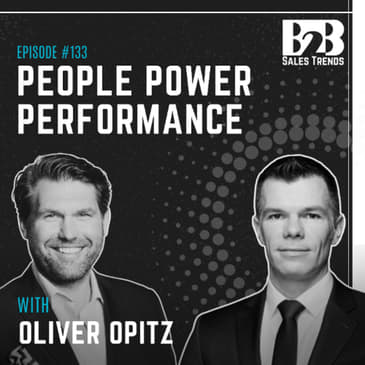
[00:01:13] And my guest today is Oliver Opitz and Oliver is the Global Head of Key Account Management at Wirt Electronic Group. Oliver, it's a super pleasure to have you with us. Welcome to the show. Pleasure to be here. Thank you very much, Ari, for having the time and taking me into consideration. Absolutely, absolutely. Oliver, give me a bit of context about your role and how we've gotten to this place. How we've gotten to the place is probably a longer discussion.
[00:01:41] My role is I'm running the Global Key Account Department, which is, I would call it an involvement in our company. I know as the Wirt Group is usually based on small and medium-sized customers. And we are now in that stage, we can't hide anymore with the bigger guys. And therefore, we decided one and a half years ago to make an involvement of our Global Key Account Management division. And that's what I'm building up together as my team.
[00:02:07] Fabulous. And I know from our pre-call in preparation to this recording, you've spent a long time building and leading key account organizations across regions. Now, a burning question for me is, what does your current setup, first of all, look like? And what are you ultimately trying to build with your teams?
[00:02:30] The setup is kind of a mix between, I would say, internal hires, you know, internal people knowing the system, knowing the company, knowing the values, but also taking talent from the outside. So having a good diverse mix, not only in terms of gender, but also especially when it comes to experience or newbies, experienced people.
[00:02:51] And therefore, we are building up that very, very good support organization to really architecture the talent and at the end, architecture or to architect the division of Global Key Account Management. If you look at key account selling today, especially in your space, what's fundamentally different about how customers actually engage compared to only a few years ago?
[00:03:17] I mean, a few years ago, it was clear, it was direct sales, you know, face-to-face meeting customers, counting, collecting miles on every different airline you could. Being at the end with the customer nowadays, probably also through COVID, we changed to more digitally. AI was a huge, tremendous change of processes, giving more transparency.
[00:03:44] Customers are asking because they have more transparency. So it was clear, more a digital way today to interface with customers, but we cannot give up the direct sales. This is clearly what we need to do. Probably more on really a focus, not as often as in the past. And therefore, I would call it today, we have this omni-channel strategy way, way more in place than we had it many years ago.
[00:04:11] Yeah, and a lot of sales leaders talk about that omni-channel and the fact that it's a key point in their strategy these days. Let's start with, clearly the situation has changed and there's a lot of evidence for that buying behavior and so forth. And like you have pointed out, talent is really key to tackle these challenges.
[00:04:36] A lot of organizations start typically with the role and then try to find the right person for that role. What's your starting point when you think about building a team? Because I know your approach is quite different. I mean, you need to have a good understanding of what the role should look like. Yeah. But you need to get away from that. You will find a person that fits 100%.
[00:05:00] People have a personal desire, a purpose nowadays, especially the next generations. They are looking at the end in something, what they want to do. And I see in our leadership responsibility to figure out what is that candlelight in your body, what you're burning for, you know, what drives you. And this is something we need to figure out in the interviewing process.
[00:05:25] And then there is a very, very good, I would call it capability or ability to adjust, to adopt the role description to that person, to that individual being. Because at the end, what we want to achieve is that comparing it with driving a car. I don't like people. We don't need people who are on the brake pedal. We need people who are on the accelerator the whole time.
[00:05:49] And it's sometimes easier to, you know, keep them in the environment, but hold them a little bit back instead of pushing people. And this is what we are looking into when it comes to hiring enthusiastic people. So you mentioned that candlelight, that fire that sort of slummers inside somebody to make them do something. Give us a little bit more context on that.
[00:06:17] And because I think it's a really overlooked and interesting direction now. Share more about that. I have a personal or in our leadership style, you know, we have an understanding that people usually don't wake up to with the desire to spoil someone's day.
[00:06:33] So if something goes wrong during the day, you know, if there's a fight, a conflict in the business with customer, in the team, in the company, as a partner, with a supplier, usually it's not that somebody really comes with the intention. Oh, this is that guy, this is Oliver today meeting with me, you know, and then I'm spoiling the meeting. Nobody gains anything out of that. But I would say in most of the cases, it's a misunderstanding.
[00:07:00] And the misunderstanding comes from that we do not really take care of the personal desire, what the people are actually having. And sometimes people, you know, they have a bad night. They, I don't know, they have a hangover from going out with friends. And maybe their wife or husband was just arguing about something. And then they come to a meeting with a way different mindset. And you believe you go to that meeting and can immediately knock it down to make the next deal.
[00:07:30] But your counterpart, even in your team, is probably not absolutely up to it. So you need to figure out first, what is it? What's going on in your mind today? Yeah. And I know you've brought up in our earlier conversation an interesting point about we have to hire for direction and not just for fit.
[00:07:53] So when you meet someone beyond whether they can do the job, let's say, what are you trying to understand about them really? It's what I briefly said before, the enthusiasm, someone is looking into it. This is where do the people really want to go to? What do they want to achieve with? Let's come back to the sales role. What do you want to achieve with your customer?
[00:08:21] Is it pure revenue or is it that you're looking into a way bigger goal? You want to be a partner. You know, imagine you're coming revenue-wise on a way smaller scale than your customer makes. So customer could easily overlook you. So what is it really? What drives you forward? What is the anchor we need to look into?
[00:08:45] And therefore, I would say a pure fit of, let's call it even competencies, is not really what we are looking for. What we look for is can you, together with us, grow this competency model of being a salesperson, a global key account manager to achieve our overall vision, our overall goal. You know, it's interesting. I think there are a lot of similarities, especially the way people used to sell.
[00:09:12] They used to sell on their agenda, on their own, what they are trying to push, what they want to gain out of it. And there's a big shift to, we talked about this in the past, about outcome selling. So how can I help you achieve your outcomes, my dear customer, right? And so there is a lot of similarity of how you approach the talent acquisition piece to think about this as, you know,
[00:09:39] how can I help you achieve your goals and your outcomes? And therefore, ultimately, you will benefit from that too, right? Do you see that similarity or is that just in my head? No, no, no, no, it's absolutely. I mean, you know, I had last week a presentation about, it was also called from talent judgment to talent architecture. And I was talking about four traps. And those four traps, one is the smartest in the room syndrome, what everyone knows.
[00:10:07] You try to make the best person to a leader. And at the end, what you gain is a gap in your technical side and someone who is not really good in leading. And on the other side, you also need to be careful to hire people who give you sometimes a hard time. Simply that, and I call it the mirror, the mirror. You don't want to people who are actually the same as you are.
[00:10:33] If it's the same analogy, if you drive a car, you're not watching or looking 100% in the rear mirror. You need to, you need to watch out what happens before you. But that means you need to people who bring you out of your comfort zone. That's, you know, one of the things. When you look past the CV that lands on your desk and sort of take a look on past performance and so forth,
[00:10:59] what signals tell you that this person is in the right place and will grow with you? Are there any signals that you can share with the audience that are obvious? Absolutely. I mean, one is, I call it radical adaptability. The world is running faster and faster and faster. AI accelerated that even by 10, 50, 100 times.
[00:11:25] So what your customer tells you today doesn't mean that it's correct for tomorrow. And if you're not able, capable of adjusting, being flexible, being able to adapt to the customer needs or being able to adapt to the needs of your team members, you will not survive in the future. Tools, digital tools are actually growing and growing. You get new tools from 10 AIs to tomorrow, you probably get 50. So which one am I going to use?
[00:11:53] You need to spend time with it and you need to adjust to it. If you don't do that, you will struggle. And we need people who have, call it also resilience in terms of, I know that more and more information is coming towards me, but probably in those cases when pressure hits you, go for a coffee, drink an espresso for five minutes, think about it and then start through.
[00:12:24] But don't just run after everyone else. Think about it. Stay resilient. Very, very important. So what's interesting to me when I listen to you is that when we talk about hiring and obviously hiring the best, you know, talent in commercial roles, that's the main topic today. We haven't talked about past achievements, past goals, past, you know,
[00:12:52] companies that were, well, but that's really our enthusiasm, desire, radical adaptability, resilience. It's really interesting that shift. And anybody who's listening to this, who's hiring salespeople, sales managers, I think that's the play. We really want to make sure we're watching out for these elements that's so often overlooked with this.
[00:13:19] I would call even say, you know, expertise is somehow the history of what worked. What we need to look for is the potential. The potential is the science of the future, what's coming next. Of course, that experience plays a role. Of course, that we need to look into the past. What have people done as this, everyone can gain from it. I usually say when we hire people, don't join us if you have been in the industry for 10, 15, 20 years and believe you started zero.
[00:13:49] Bring your knowledge from the past, help us to grow. But on the other side, what is the potential we are looking at? And that's where I sometimes try even to give the advice to other leaders. Take a person you probably overlook because he or she is not the loudest in the room. You know, who you obviously see when it comes to the next hire to a succession plan. Take someone who is quiet, who's maybe introverted.
[00:14:16] Give her or him a task for three months and see what's coming out of it. And believe me, you will be surprised how many people are hidden in the background, but they have a huge potential what we can elevate to the next level. Now, you were talking about radical adaptability. By the way, I'm going to nick this term. I really like it. So the roles within an organization don't always stay the same. They don't always stay fixed.
[00:14:46] They shouldn't. They shouldn't. Exactly. How do you create room for people to evolve inside these structures? You know, you are at a large organization. And so how do you really help to create that space for people to evolve? Feedback talks, feedback talks, feedback talks. It's probably easy set. But not only talk about KPIs and performance, really understand what drives the people.
[00:15:15] In the life cycle of a human being, things change. The same is for a customer. The same is for the organization. We need to figure out. And it's sometimes just a simple question. How are things going? And I mean it that way. I'm not just saying it. I'm trying to understand. And even when we talk about, again, about a salesperson or the global key account manager, I mean the global key account manager for customer A is a different role probably than for customer B
[00:15:42] because one is more in production, one is more in design, the other one is more on trading. Title is the same, but the role needs to be adjusted. And then we learn with the customer. If the customer organization changes, we need to collect the feedback from our own team, from salespeople, from supply chain management, from the logistics department, and figure out at any time. And I'm not saying every four weeks, every eight weeks. Every time we need to have, I would call it, you know, our antennas out there
[00:16:11] and understand what does it need probably to make a change, to evolve and to go with the customer. And for that though, also there has to be a certain leadership style, right? I mean, you're demonstrating it right now. But of course, it can't be all about the great Oliver. It has to be in a large organization. It has to, that leadership style needs to scale, right? It does, yeah.
[00:16:40] How do you ensure that your approach to leading and motivating teams look like that also in practice? Because it's one thing to do the theory, right? And it's another thing to put it in place and into action and scale that beyond you. How do you do that? One of the things I've already said, you know, of course, I'm looking out for people with a similar desire to develop people.
[00:17:09] This is probably the difference to get a balance between having the desire to grow an organization in terms of sales revenue, but also have the desire to grow people. And give people the room to be successful with their own personality. There are some basic rules in a company, what you call company culture. We call that it's about people. But you need to live that day in, day out. And you need to live it as an example, as a leader.
[00:17:39] And to be able to scale that, you need to further develop your team. You cannot inject it and say, this is now the new leadership style. You have to adapt to it. We also, as an organization, need to be able to adapt our basic principles of leadership style to the authenticity towards single individual. And that's why overall, I wouldn't call it it's the same, but it's being lived on a daily base in a probably different way.
[00:18:08] Because you would different manage and lead a different hurry than I would do it. But at the end, we want to represent an organization and have our company culture multiplied. So when you hire for a key account manager, somebody experienced who looks after some of your biggest accounts, what do you look for when you meet these people beyond the enthusiasm, the desire, the adaptability and the resilience?
[00:18:35] Is there anything else you're looking for when you hire them? Absolutely. There is the part of, I call it the entrepreneurial mindset. Yeah. Working with global customers, the same as on the supply chain with global suppliers. It's different than just having one or two locations of one customer. Simply due to the fact you need to coordinate and you just do not need to coordinate internally. You need to coordinate externally.
[00:19:04] So you're running like your own business. You need to be able to take decisions or I call it the decision-making skill. We need people who are looking for consents in some way, yeah, because we don't want conflict because of overruling. But at some point, we need to take decisions, either the global key account manager or with the customer or the customer. But if we don't take decisions, we are not moving forward.
[00:19:29] And that's where I would say decision skills, the entrepreneurial mindset, analytical behavior is very important to be able to look into the numbers. We are still talking about sales, you know, dollars, euros, sales, profit, brush profits. So those are the numbers you need to be able to find.
[00:19:49] And I would also say the persuasive impact that you have internally as well as externally. I mean, they're coming to basic things on top scale skills, negotiation skills. But if you really nail it down, I would say we are looking for the entrepreneur, the startup manager being able to manage your global key account in your somehow own way, being proactive.
[00:20:20] How do you find that out in an interview? Do you do some sort of assessment? Do you have specific questions you ask a candidate? How do you do that? A thousand of questions. No, kidding. Actually, it starts before the interview. If especially internally, you can have those people who wait that I reach out to them and all kind of, hey, Oliver, yes, that open position. Why? Why?
[00:20:46] Let's see when he's calling me because I told someone who could tell Oliver that I'm interested. So what I'm going to do. It starts actually before the interview. If people start to reach that borderline of being pushy, yeah, to be invited to maybe sometimes even if you refuse a resume and the person calls me back, it opens my eyes again because there's someone really trying to convince me that at least there is this desire, this
[00:21:15] purpose saying, you know, I want that position. And if somebody is really scratching more and more on my door, I will open it because then you really got my attention. And I'm not saying every time, but I'm not trying to run after applicants. They are the same. I don't want them to run after me, but I want to see the interest. Right. Right. Right. And that really shows the persistence that you want in such a role.
[00:21:44] And I need to look up what we always ask at the end of each podcast, the top three things. And I think persistence is the top three or four, what sales leaders said across a few hundred interviews now that we've done. So it's interesting. So persistence, persistency, and then also the action and how they react to whatever is thrown at you by your action or your non-action.
[00:22:13] And how do you really react to these circumstances? I find that very interesting. And that tells a lot about people's behavior on their day-to-day job then. If I quickly may elaborate on the persistence part, it's like in sports, you know, if you just go once for a run for, I don't know, five kilometers, you won't be able to run a marathon. If you do lift weighting or weightlifting, you won't be able to lift, I don't know, 100 pounds,
[00:22:42] 200 pounds if you just do it once. You need to do it every way. You need to push yourself beyond your border limit. I would even say my job as a leader is to figure out what is the borderline, what is the limit of a person? And in some cases, if you want to train your muscles, let's go one step beyond it. But we, me as leader, I'm there to help you to do that because then we really build the mass.
[00:23:10] I'm not really heavy in weightlifting, but this is where I would say it's very important. I fully agree. There's so many examples in sports and high performance that you can relate to the day-to-day sales jobs, a lot of rejection, standing up, coming back, fighting back and trying again and that persistence.
[00:23:36] And all these things that we've mentioned, I think are really good examples of how selling and how salespeople's behavior need to really be nowadays. Now, if we were looking at one of your strongest people, what are they doing consistently? I know we've talked a little bit about that already, but what are they doing consistently that sets them apart from others? Check the numbers in the morning. They have their routine. You need to have some kind of routine.
[00:24:05] It might be beginning of the week. Might it be beginning of the day? I do it myself every morning, waking up, going to the bathroom. And even before I get my breakfast, I'm sitting at the table on my iPad to check order income. I check the sales from yesterday. I check the gross profit, which customer. And this is what actually the most successful people do. They have an intrinsic motivation to have an overview day by day of their account.
[00:24:35] And then you can react immediately. Of course, they are building strategies. They understand the contact portfolio, the contact and the customer. They have an overview of the most important meetings over the next three months, six months. But at the end, once again, it's your routine or call it also persistence. Check every morning what happened yesterday. Because there are so many things happening around the world, which you need to be aware of on a daily basis.
[00:25:04] My last question, as I already touched on, is always the same. What, in your opinion, is the... What are the three top traits, the three top skills and behaviors, in your opinion, that define top B2B sales people? In number one, number two, and number three, in importance. Number one is, I'll go back to the entrepreneurial mindset. You need to be the boss of your own company, even if it's not a legal registered company.
[00:25:34] Second, decision-making skills. You need to be able to take decisions, if you like it or not. Otherwise, you're not moving forward. And last but not least, you need to be able to have a good leadership style, no matter if the people directly report to you or not, but you need to be able to lead and coordinate globally. Which is interesting. Those three, when we interview leaders, they're typical others coming up.
[00:26:04] But I think the three that you mentioned, entrepreneurial mindset, decision-making, and leadership style, I think are key to leading the efforts in sales, right? To all the things that you've mentioned, to organize yourself, to make sure you take ownership of what you do versus waiting for somebody to tell you to do something.
[00:26:30] And I think that's a really cool spin on it. I love it. Really good. Someone recently told me it's not about the pure sales, it's about outcome-based sales. Okay. Who might that be, right? I don't know who you're talking about. So Derek totally fits together. Yeah. Oliver, you've been a superstar. We appreciate your time. And I know our listeners super appreciate your insights
[00:26:59] and your thought leadership on the topic. Thank you for taking the time and contributing to the collective pool of knowledge. We appreciate it. Thank you. Appreciate having the time and being able to contribute to the sales channel here and looking forward to continue to collaborate. Absolutely. My lovely people would state with me from this very interesting conversation is how much performance comes down to alignment. You know, when people are in roles that actually match
[00:27:28] what drives them and they are given that space to grow into that, everything else starts to click. The way they show up, the way to build relationships with their customers, the way they perform. And if you got value out of this episode and this show, share it with your team, share it with your friends, with your mates, subscribe on our YouTube channel, wherever you get your podcasts from.
[00:27:57] Also, we've just launched something really cool that I want to share with you. It's called the Revenue Accelerator. It helps you to break down your pipeline and sees where revenue is actually being created and where it might be slipping away. If you ever had the feeling that deals are moving, but results aren't quite reflecting it, or that you might be leaving revenue on a table, this will give you really good clarity. It's free. It's in the show notes of this episode.
[00:28:26] So go through it and check it out. And if you want to go a level deeper, there's also a new inside paper called, You Are Entering the Deal Too Late. So download it, check it out, and learn. My lovely people, until the next time, take care of yourself, your loved ones, and of course, your B2B customers. All the best. Bye-bye. If you'd like to put yourself or someone you know forward to be a guest on our show, there is a quick form in the show notes to complete. It only takes a minute,
[00:28:54] and it helps us to find voices and opinions that shape the future of B2B selling. Thank you. We appreciate it.