

[00:00:00] Most briefs don't reveal the real problem they need to solve. Instead, they share what clients think they want, not what's truly driving their business. Now, respond to that on the surface and you may win the pitch, but you'll likely miss a big opportunity.
[00:00:22] Welcome to the B2B Sales Trends Podcast, my lovely people, where we give you a sneak peek into the strategies of the world's best CROs and go-to-market leaders. We explore the systems, the playbooks they use, so you don't have to figure it out the hard way. If you're looking to boost win rates, enhance deal quality and learn from the best in B2B selling, you are in the right place.
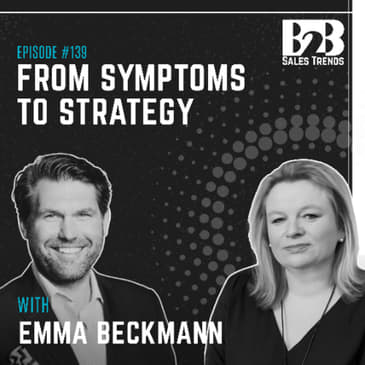
[00:00:46] Today, we'll discuss how to transform client conversations, shifting from merely responding to briefs, what's coming in, to really and truly uncovering the real business challenges behind them. Joining me today is Emma Beckmann. Emma is the Group Chief Growth Officer at Landor.
[00:01:12] She's reshaping currently the way opportunities are created and won, and I can't wait to have that conversation. Emma, welcome to the show. Thank you very much for having me. Why is it risky for sales teams to take client briefs at face value, in your opinion? Let's dive right into it. Well, I think there's a number of different risks. I think, you know, first and foremost, there is a missed opportunity for true impact.
[00:01:42] I think briefs often articulate symptoms, i.e. our brand is not applied consistently globally, rather than articulating the root causes, i.e. our branding is not culturally relevant in all markets, for example. So, I think taking them at face value really means delivering a tactical solution that might not address the client's core business challenge.
[00:02:09] And I think that leads to limited impact and superficial results. Secondly, I think a big factor here or big risk is the risk of commoditization and price pressure. When you only deliver what's asked, you become a supplier fulfilling an order. And obviously, it makes a price comparison or comparison on price alone much easier and devalues strategic expertise.
[00:02:35] Other risks, erosion of trust and that sense of partnership, which particularly in a professional services industry and a business like ours is really important.
[00:02:50] If the delivered solution doesn't truly move the needle and have impact that can be connected back to a business outcome, the client sooner or later will eventually feel let down, even if you've technically fulfilled the brief. And I think, you know, there the risk is that long-term trusted advisor relationships are undermined.
[00:03:18] And that's ultimately what we're striving for. It's interesting, the topic. I've heard people say that if you don't influence briefs in advance and you merrily, as you've alluded to, react to them, then you're actually only participating in a benchmarking exercise. Do you agree with that? Yes.
[00:03:43] And I think, you know, it's also an art skill or an art form to actually spot some of those RFPs that are actually just a benchmarking exercise and there's no prize behind it.
[00:04:01] And I think, you know, typically those benchmarking exercises, you know, happen or you run the risk of it becoming a benchmarking exercise when you really don't have the opportunity to engage in dialogue.
[00:04:19] You know, if a client or a prospective buyer, you know, just wants you to tick the boxes, complete the forms and submit your pricing in it, that's a benchmarking exercise, whether intended or not. So it's really a case of how do we share the unique value that we can bring to the table?
[00:04:40] And in a way that's sort of coupled with some of the research that's out there right now that says that, you know, buyers are much more informed these days about your solutions that you can provide. They know a lot about the techs and specs of things. And so if we merrily respond to what they're asking for, we're sort of asking for that commoditization that you have referred to, right? Yeah, absolutely.
[00:05:10] Absolutely. Can you share the kind of conversations that your teams are currently having where you see that gap between a request that comes from a client and the actual needs that they may have? I think, you know, one gap is often the tactical fix versus the strategic transformation.
[00:05:36] So what I mean by that is clients often approach us saying we need a new logo or we need to review our brand architecture, for example. We try to shift those conversations quite quickly into actually what is the business challenge that you're wanting to solve with this? You know, what is your growth strategy?
[00:05:59] Is your brand architecture, you know, or your current portfolio structure, you know, stopping you from being able to, you know, grow into this geography or that kind of like product adjacency? So quite often the brief will read like it needs a tactical fix, but actually, you know, there is potentially a much bigger need behind that.
[00:06:28] I think, you know, the other gap that, you know, we often try to tease out in a conversation is between, in its symptoms and root causes. And I touched on that a little bit before a client might say, our sales declining. We need more share of wallet, et cetera, or we're not selling enough product in store.
[00:06:52] In that example, in the case of CPG, our response would be to explore, you know, is it a brand perception problem? Is it a relevance issue for the audience? Is it a differentiation or a standout problem on shelf?
[00:07:09] Is, you know, the actual need might be a brand restage or it could be portfolio optimization or a more expansive brand world that enables a brand to be memorable, not just on shelf on a pack, but also in the, you know, the social and digital context that brands live in today.
[00:07:33] But I think, you know, probably, you know, the biggest gap is often uncovered when, or the most common gap is often uncovered when, in the absence of the articulation of why. I think clients know what they want when they write these briefs, but sometimes struggle to define why it's important.
[00:08:03] Just to make it a little bit more concrete, perhaps to give an example there, a request for a brand refresh often uncovers a need for a full brand reinvention due to market shifts or because of M&A activity or new competitive pressures from different competitors,
[00:08:26] which requires a much deeper strategic engagement before getting to brand refresh. Yeah. Yeah. So it's clearly highlighting the need behind the want, the why behind the ask. Now, it's, it's, it's, it's really challenging sometimes for client facing people to make that shift, right?
[00:08:54] Because a lot of the times, you know, relationship gets in the way so much, you know, we want to have a good relationship with our prospects, our clients. And, and, and, and basically for us to dig deeper into the why and how the, the impact it can have and so forth, that's pushing back a little bit on what the client is asking for. Do you see that as a challenge for, for client facing people typically?
[00:09:22] I think it's important to acknowledge the challenges that a client sees, the brief that they've written, you know, and, you know, start by demonstrating, you know, that we've heard and understood, you know, their initial request. You know, we, we, we hear you're looking for this. We understand that. I think that builds rapport. It shows respect.
[00:09:46] Um, but then, you know, techniques to introduce, um, an informed, empathetic, um, perspective, you know, based on experience, learnings from other categories. I mean, I find that many, and it's, it's one of the luxuries that we have working in, um, an environment like we work in, particularly on an agency side.
[00:10:14] You work across so many different categories and sectors, you know, many clients in these situations, um, in it, particularly if they have been with companies or brands for a long time. And it doing a complete rebrand or a big brand transformation program is a once or twice in a career, um, uh, project or, um, opportunity.
[00:10:42] We work on three, four, five, you know, as individuals at any one time in multiple sectors over multiple years.
[00:10:51] So I find, you know, reframing some of those experiences and, you know, using them to demonstrate how, you know, other clients have, you know, navigated, uh, or how we've helped clients to navigate through similar challenges and help to reframe that way is a much better, um, way than, I mean, obviously we would never do that.
[00:11:19] But, um, a much better way than saying, yeah, this is not what you need brief is, is wrong. Because, you know, very often it is, you know, through that conversation, through that, um, through that interrogation that we'll get to, um, and the client will get to, um, you know, the heart of the challenge.
[00:11:42] And, and, and I think this, the way you've described this, uh, uh, I think it's important to, to, to do it in this way because it builds trust. It builds confidence that yes, you are helping me with something that I'm not doing day to day, but clearly you are, and you bring in your expertise to it. So you are in a way de-risking that project for me, um, by, by going deeper into this.
[00:12:10] And this gives me confidence that builds that trust that I need, um, uh, uh, for that. So I think, I think when done well, that reframing exercises is, is, is really important for people to do. I agree, fully agree. And, and if I could just add to that, you're also framing it as, um, a shared, shared success as well.
[00:12:33] I think you're not positioning it as, um, you know, the brief is not quite right or the problem is not clearly defined. It's, you know, positioned as, you know, let's ensure that we achieve the best possible, you know, business outcome together.
[00:12:50] And, um, I think that's, you know, one of, one of the, um, you know, the biggest roles that we, we play, um, particularly in these, these early conversations in agency, um, selection, um, chemistry is so important.
[00:13:11] You know, clients in today's world are looking for partners who are going to, um, you know, make them not just successful with the tasks that they've been given, but also make them look good in a very pressurized environment, um, which is, you know, challenged on so many fronts and that they have to represent to their C-suite.
[00:13:35] Yeah. And this idea of how do we co-innovate that solution together, uh, that already creates the level of partnership that, that, that both sides are actually looking for, not just one sided, uh, for sure. Yeah. Yeah. How, so great. You've, you've now had the skill to reframe this, right?
[00:13:57] Right. Reframe this around, uh, the impact that you can help them drive, reframe, uh, this on, on, on you being an expert, uh, expert in what you do, the expertise you can bring to the table. Therefore you build trust. Therefore you build confidence in, in you and your solution. That's good.
[00:14:15] But how does the reframing or, or shall I say, how does reframing the problem in a way influences the way now, uh, you structure your response to these briefs? Traditionally, people would start with, um, you know, talking about themselves and, um, you know, this is all of the expertise that we have and that, you know, the client and, um, uh, you know, would, would often be second.
[00:14:45] I think the way we reframe that is, you know, really, you know, avoid talking about ourselves as, as much as possible and really, you know, start the response with, you know, what's at the heart or the strategic problem. What really the opportunity is, um, that's at the heart of the brief.
[00:15:08] So I think articulating in as concise a way as possible, um, uh, understanding of the real business challenge, um, or the real opportunity, perhaps rather than challenge, um, that we have uncovered through the reframing.
[00:15:27] I think that is the important basis that then allows you to, to secondly, then go into, you know, and this is how we would help you to solve, um, you know, this challenge, talk about approach, recommended approach, um, and deliverables and timelines and budgets then become always kind of like a distant kind of like. End to, to, to the document.
[00:15:56] And when we do it really well, when the, um, strategic opportunity has been, you know, framed really early on with a strong point of view, underpinned through deep understanding of the client, but also, um, the sector or, you know, out of, um, category, um, similar, similar challenge, challenges.
[00:16:19] And that leads through and flows through into the recommended, um, approach more often than not. In my experience, we rarely even get into then talking about, you know, deliverables. Yes, they're important. And at some point, of course, you will have a conversation about deliverables, but it's not the focus of the conversation.
[00:16:39] And I think that is, um, and that's important, but also connecting deliverables directly to, to outcomes. So to avoid deliverables feeling like a, you know, a, a line item and therefore there's a cost, um, attached to that.
[00:16:59] Um, but each deliverable explicitly linked to how it contributes to solving the problem or the challenge. So, um, you know, I think that makes its inclusion or justifies its inclusion, uh, inclusion, which also when you then do come into, you know, cost negotiations, et cetera,
[00:17:27] it's very difficult then for a client to say, yeah, but could we just remove that to cut this budget? Because it logically all builds on each other and each step, each, each, um, part of the deliverable responds to a question that needs to, to be solved. I think, um, another thing that is important is strategic road mapping as opposed to, you know, timelines.
[00:17:54] And, you know, and, um, linear timelines that just look like things that happen, um, one after another, but also, um, bringing that, you know, at this stage in the process, we will have solved, we will have answered collectively this question. At this stage in the process, we would have collectively answered this question.
[00:18:18] So that, you know, the critical milestones are represented, um, in, in the time timeline. And I think all of that, um, you know, helps to really, um, build a consistent or build a red thread through the entire response,
[00:18:42] which if you've got the strategic reframing right, is very difficult to argue with when you get to, um, the end. Uh, I think the final, the, the, the, the other point that I think I would make is, you know, emphasizing value over, um, cost, uh, as well.
[00:19:08] I mean, where we can, and it's not always possible, um, pricing is presented within the context of the potential, um, return on investment and the strategic transformation that's being delivered as opposed to a line item cost that can be, um, question or removed.
[00:19:29] It's not always possible when we do have to present costs as, as line items, then demonstrating, you know, added value in other ways with a zero, um, against it to highlight that, you know,
[00:19:45] and we will be doing quarterly inspiration sessions with your teams and things like that helps to, um, helps to, um, justify value rather than just have a cost discussion. That was probably a very long answer to that question, but I think it is a bit of a sequence. And if you get the sequence flow, right, um, the client might still not like you or not like, you know, the chemistry might not be right.
[00:20:14] The answer might be wrong. Right. Um, they might be looking for something different, but I think it makes it a much, a much more connected story, which is difficult to unpick. I agree with you. It's, it's a sequence of events and, uh, it's, it's that flow.
[00:20:33] And, you know, one of the things that we always hear is that, that, that, that client facing people tend to be, they, they sometimes know what to do intellectually. They know what to do and how to behave then in that situation. But when it comes to doing that actually in front of the client, it creates quite a bit of tension and, and that has them shy away and sort of fall back into that comfort zone.
[00:21:00] So how do you help teams really deal with that tension between these different elements that you have just shared, uh, between, for example, challenging a brief and, and to simply delivering what's requested. Now that's pushing back in a way. And that's, that's adding to how you phrased it. Uh, the, uh, client may not like you, but that creates that sort of tension. How do you help your teams to deal with that?
[00:21:30] Cause that can't be difficult. That can't be easy. Excuse me. No, it's, it's, it's not easy. And I'm not sure if I'm, I'm not sure there is a, you know, one cookie cutter way of doing it. I think, um, depends a lot on, on personalities as well, you know, within the team. Um, you know, we don't win pitches as individuals.
[00:21:55] We win pitches as teams, but you know, my role, um, as a growth lead and the role of my teams who are, you know, supporting leading, um, the, these types of pitches, um, is to, to, to, to help through frameworks, through, um, through tools that we have to, um, to almost, you know, coach teams, um, through this.
[00:22:25] I mean, we tend to, you know, build teams that have, um, a mixture of different skillsets. So, so training and frameworks, um, is of course important. I think, um, you know, leadership and leadership sponsoring and coaching, um, is important. Uh, senior leadership really need to actively champion that. And that is something that is big at Landor.
[00:22:54] I mean, we, we, we, we have a, a, I hate to call it process because it's not a process, but you've got to kind of put it down as a process, um, on a page. We do have a, a process straight framework, um, that we champion all the way from the CEO down across, um, the business. And I think that is really, really important.
[00:23:18] And again, this whole reframing of briefs is not just important in pitch processes, but also, you know, when you're then working with a client in, um, ongoing relationships, because it's that, um, mindset. So there is a lot of mentoring and coaching that we do around that. We also, I think another way is also demonstrating through, through doing, we have a lot of internal
[00:23:46] sharing forums, um, you know, globally, but also locally where we, we highlight, um, you know, particularly successful, um, cases or pitches. We also highlight and talk about and discuss the ones that haven't gone so, gone so well and why they didn't go, um, so well and use those as learning, um, opportunities.
[00:24:09] I think, um, you know, also a culture, um, what's also important is a culture where people feel that they can, you know, escalate or ask for help if they can see something going off track or they're not being, you know, that, that, they're not sure that they're doing the right thing or there is tension, you know, with, with the client, um, is, is important
[00:24:36] that people come and ask for, for the right help. And I think, you know, where possible in, in, in whichever, you know, small or not so small way that you can do, I think aligning, you know, aligning, um, incentives and recognition with the strategic impact that people are having versus the tactical, um, you know, tactical,
[00:25:07] um, working through projects, briefs at speed. So, um, recognizing behavior, whether it's through internal awards or we have a system of the heroes of the month where, you know, internally in our studio meetings, people across all levels of the business are recognized and those are good moments and opportunities.
[00:25:29] So there's a, there's a lot of, um, different things in place, but I think ultimately, um, leading through example, um, is certainly something that, um, you know, I found in my role, but also my role as leader within the business is to practice what I preach and in it and demonstrate
[00:25:55] um, the behavior, um, the behavior model, the behavior that we want people to, to be able to, um, demonstrate and, uh, and execute in these types of processes. It sounds like you have, uh, implemented a really, um, uh, strong, uh, leadership and coaching culture within your organization, which is something that a lot of companies always are striving for and sometimes find it actually very challenging to do that.
[00:26:24] Um, what's, what's a couple of actions. So let's say a leader is listening to this. What are a couple of action points that a leader who wants to implement a similar strong leadership and coaching culture that you have implemented, uh, especially in relation to how do we handle these briefs effectively?
[00:26:45] How do we go beyond, uh, the, uh, the initial, uh, sort of surface and how do we really dig down into, uh, the impact that we can have for, for these prospects, for these clients. Uh, and then the connection of how do we now coach the sales, uh, or client facing people to that. So let's say I'm a leader. I'm listening to this and I'm thinking I need to have that same culture. I need to have the same culture of coaching.
[00:27:14] I need to have the same, uh, same culture of, uh, of client facing people's behavior. Let's say, um, what is the one thing that I should immediately start doing tomorrow? What's the one thing I should stop immediately, uh, tomorrow? And what's the one thing I should be keep, uh, I should keep doing if I want to implement that, that culture. I'm just trying to think which order to go on this in terms of the start, stop, keep.
[00:27:45] Let's start with start. Um, because I, I mentioned that and I think it builds on the point that I said before. I think that it is, you know, actively modeling the behavior that, um, uh, that you want to see publicly. Um, but also, um, with your teams, but also with clients in those, um, scenarios and, you
[00:28:10] know, respectfully challenging or questioning, um, uh, client, client brief. So I think behavior for me, um, is modeling the right behavior is, is, is, is really important. And I know a lot of that, some of that will be linked to individual leadership style as well, which obviously comes into this, but modeling behavior.
[00:28:36] I think for me, you know, show don't just tell is, um, probably my, my biggest take out my biggest word of advice. Um, in terms of keep, I would say, you know, celebrating, celebrating strategic wins, celebrating, celebrating those moments where, you know, everything has, you know, come together in the way that
[00:29:04] you, you, you, you want it to explicitly highlighting, um, you know, those moments and how it happened and sharing those stories, um, of when a team has successfully, you know, refrained a brief and what the outcome was. And the outcome doesn't always need to be, you know, we won. We often, you know, demonstrate great behavior and the outcome was we lost for many, you know, potentially other, other reasons.
[00:29:33] I think, you know, we can learn equally from, from the wins and the losses. And there are many different things that, um, come into that. But I think, um, you know, sharing, sharing those, sharing those stories in different forums, um, and having the forums to be able to do that, um, as a global business, we have global forums, we have local studio forums, we have regional forums, multiple forums where things can be
[00:30:02] shared and repeated would be, um, the one thing that I would probably, um, uh, say, you know, people should certainly keep doing if they're already doing that. Um, and the stop, stop, I think, you know, agency life is quite, you know, fast paced. Right.
[00:30:31] Um, uh, is a demand for high performance. And I think there's a danger of, um, you know, rewarding and recognizing busy work, people who are extremely busy working late night on the pitches, fast turnaround, um, on, uh, on, on more tactical kind of like briefs rather than, you know, taking a moment to pause,
[00:30:59] um, the slightly slower, more strategic work, which, um, you know, perhaps happens over, you know, a period of two, three months and can be a marathon to, um, reframe a brief rather than, you know, a quick pitch win that came in and was turned around in a week. You know, both should be celebrated, but I think in the, in the, um, in the context of
[00:31:27] this type of mindset, um, change that we are trying to achieve, I think consciously ensuring that those slightly longer, more strategic, um, processes are equally celebrated, not just the fast and furious. Right.
[00:31:48] So you've got to, uh, start actively, uh, model good behavior, uh, in front of, uh, your teams and in front of your clients. And that will hopefully start with the journey of creating a culture. You've, uh, you have to, uh, keep celebrating, keep celebrating the win. I love that point. And, uh, and, uh, stop rewarding busy work and really start rewarding outcomes.
[00:32:18] Um, that's, that's, that's, that's great. Three, three tips. Um, Emma, the last question in every podcast, this has been an amazing insight for our listeners. So thank you for doing that. Uh, the last question on every single podcast I've asked now for, for many, many episodes is what, in your opinion, are the top three skills of behaviors that truly effective client facing people need to possess and really do well today?
[00:32:47] What are those top three skills that client facing people, uh, need to do and execute really well today in your opinion? Quick fire or with explanation? Quick fire. No, you can explain. That's good. Um, strategic acumen is this insight. I think they need to be able to not just know their product or their discipline or their, um, their, their, their work.
[00:33:16] They deeply need to understand the client and the client's business industry strategic object objectives, um, in the context of our world. I think number two, I would say, uh, in today's world, radical empathy and insightful curiosity, I think is critical.
[00:33:40] Not just listen or listen, um, not just to respond, but to truly understand the client's unspoken needs, fears, aspirations. Um, there could be a bit of everything in there. It's the asking the probing thoughtful, um, questions that really undercover, undercover the, um, underlying issues. And last number three, value articulation and storytelling.
[00:34:09] I think those two often go hand in hand. They translate, uh, complex solutions into clear, compelling narratives. And that vividly demonstrates, I think, tangible, tangible business impact and, and value rather than just presenting, you know, features or, um, you know, talking about the benefits of your approach versus someone else's, um, approach.
[00:34:36] I think if you can combine value articulation, you know, through the lens of storytelling, you can really paint a picture, um, of transformation and, you know, real outcome and impact. Strategic argument insights, curiosity, and listening to understand versus to respond as well as value articulation through storytelling. Emma, wonderful insights.
[00:35:04] Uh, thank you so much for taking the time. Uh, I know our listeners are very much appreciating, uh, your insights and thought leadership on that topic. Emma, thank you for taking the time. Thank you very much for having me. It's been a pleasure. My lovely people. Many teams believe that winning is all about responding and responding better, really better decks, better ideas, better execution and so forth.
[00:35:30] But if you're solving the wrong problem, the wrong issue, none of that really matters. The real edge lies in how you interpret the brief, challenge it. As Emma said, reframe the conversation for better impact and outcomes. The teams that consistently win aren't the ones who respond best. They are the ones who define what gets solved in the first place. And I think that's really, really important.
[00:36:00] For more insightful conversations like this, my lovely people, subscribe to our YouTube channel or tune in wherever you listen to your podcast. Don't forget to download our 26 sales trends for 2026. If you haven't already, the link will be in the description below. Until the next time, take care of yourself, your loved ones, and of course, your B2B customers. All the best. Bye-bye. If you'd like to put yourself or someone you know forward to be a guest on our show, there
[00:36:28] is a quick form in the show notes to complete. It only takes a minute and it helps us to find voices and opinions that shape the future of B2B selling. Thank you. We appreciate it. Thank you.