
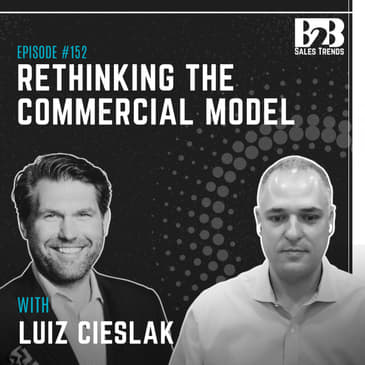
[00:00:00] Welcome to another fabulous episode of the B2B Sales Trends Podcast, my lovely people. For years, technology services have been sold in a fairly predictable way. A client defines a project, a vendor estimates the work, and both sides agree on a budget and a scope.
[00:00:19] But as AI reshapes, industries and organizations look for faster return on their investments. Some companies are starting to rethink that model entirely. My guest today is Luiz Cieslak. He's the Senior Vice President of Healthcare and Life Science at CINT.
[00:00:41] In addition to leading the business, Luiz works closely with sales teams and customers to help organizations turn AI investments into measurable business outcomes. Today, we are talking about a different approach, one where vendors take on more of the risk and tier their success directly to customer outcomes. Luiz, welcome to the B2B Sales Trends Podcast.
[00:01:11] Thank you so much for having me. Very exciting topic and very, very top of mind right now. Absolutely. It is indeed. Luiz, many organizations are investing in transformation initiatives, but they also are facing increasing pressure to justify that return. What made you start questioning whether traditional project-based engagements were still the best way to serve your customers?
[00:01:42] So, historically, we have been, like you just said on the introductions, got a project, define what the scope is, estimate, execute, because you don't have a lot of chances. You have one shot of getting this thing right. Getting that thing right means you get the scope, you have your hypothesis right, and you need to be very precise on doing this.
[00:02:07] With the advent of AI and implementing AI throughout the development lifecycle of the product, you don't have one only chance. You don't have only one shot of getting it right. The bottleneck is not the development phase anymore. It's not just the execution. So, we can test multiple hypotheses.
[00:02:34] The moment where we start rethinking this was this realization that just like marketing campaigns that everybody is very familiar with, the whole A-B testing concept starts becoming a reality into the development world. I've always had to be very precise because I had to do my biggest part.
[00:02:59] The biggest part of the bill was related to the developers, to the resources, to people doing the execution. Now, because I can augment those people with AI doing it fast, I don't have only one chance of getting it right. I can test it. I can do the MVP. I can do the whole truly an MVP. And I actually like the expression, the minimal lovable product much faster. I can test it.
[00:03:29] I can build it. And in doing this, it's not just a matter of do I do this whole shebang. I don't need to do this whole thing all at once. I can try different five, six different iterations because it can tweak, it can fine tune what is going to resonate with the clients, the customers, and then execute on that.
[00:03:53] So, that requires a different approach, a different mindset, a shift in how we approach products being built. So, really, we're talking about more of a risk-sharing model, which is interesting. At what point did you realize a different approach, a different commercial approach was needed? So, historically, going back again, right, everything has been reinvented.
[00:04:22] AI has been the center of everything, the whole attention. You mentioned one traditional model, which is what we define as the fixed project, fixed scope. I know what you want to build. I know exactly what your requirements are. I know how long is it going to take, how many resources I'm going to need. I give you a bill. As long as your requirements are not changing, you know what you're going to spend, how long is it going to take. Typically.
[00:04:51] In technology, there's always something that comes up. When you start digging in, the clients start getting up and figuring out, it's like, well, this is not quite that. That's not quite that other. So, it just needs to be adjusted. That's one model that where the risk was always on the provider side. Then, as a reaction to that, the industry shifted to the time and material models, where you have the resources, you have a capacity.
[00:05:21] Now, you have a team of 10 people. They all have the resources. You're paying based on the hours that the teams are working, the resources are allocated. That shifted all of the risk now to the buyer. Because if I have a team and you can't keep them busy, you can't keep them allocated, guess what? I'm still bailing. It's the taxi, right? The moment I jump in, I can be stuck in traffic.
[00:05:49] I can be moving towards my destination. The meter is running. It's the time and material. So, it's the two extremes where somebody is always getting or bearing the brunt of the bill. Where with AI, and because of that speed, if I'm on a time and material model and I'm being five times faster, guess what? Now, I'm paying the price.
[00:06:17] I'm being penalized because I'm doing things faster. So, my meters is stopping faster. On the fixed price, if I'm using AI, I'm doing things a lot faster. The client is getting penalized and saying, well, hold on. You said you're going to take six months, but now you did this in AI and you're doing this in three. So, it's half of the cost, right? Back of the napkin, back of the envelope math.
[00:06:45] So, neither one of those scenarios end up being fair or a true partnership. So, that's where the risk sharing came in. And we have more possibilities. We can test different ideas. And we all can benefit from this. One, because now you have ideas and ability that we didn't have a few years ago. So, there's no lack of project coming around.
[00:07:12] It is the lack of attention and focus that we can have from the client perspective. But if I do get the project right, there's a huge upsell from the client perspective. And there's also an upsell for me because if I'm doing it faster, I can do more things for you. So, that risk sharing came in as the common ground of both extremes. Where everybody was trying to protect or make the gains for themselves.
[00:07:41] We're coming together and building a different level of partnership where everybody tends to win in this scenario. Interesting. And how did customers responded to that when this new model, when your people presented that new model? How did they react to it?
[00:08:01] Well, in being very, very honest, everybody thought it was, there was a big pushback at first. Nobody likes change. Nobody does. But, so the first reaction, the gut reaction was like, well, hold on. This is a different animal. This is a different beast that you're putting in front of us.
[00:08:28] As we go along, the conversation starts shifting. Like when we talk to the business, that became, to business owners, product owners, that became a very much, very natural conversation. Because it's like, wait a minute. This is also kind of what happens to my product.
[00:08:48] It's like, it's thinking of, from our position, being a services provider, we work with the customers that build products as they serve their customers. So when they looked at it, it's like, okay, the product owners always have this two-sided view. One internally, what they need to build. And one of the products that they're building, how they're positioning that to market. That clicked to them because it's kind of the reality that they see.
[00:09:17] If they can put the product faster to market, there is a risk. They need to find what the right levers are just to balance the speed, to balance the market reach being the first, the first mover's advantage and all of that. So that became a very natural conversation when that whole reality clicked.
[00:09:42] Where we're still going through the education and the learning is from a buying perspective, like legal, procurement, contracting. Because it's a different construct of how you engage. We're not talking about, this is your project, this is your scope. I say I'm going to pay X for Y project or Y product. And it's not a resource-based either. It's not like, oh, I have five resources. Here's their rate card.
[00:10:12] Here's how much I'm going to bill you for their hours worked. You need to validate their timesheets. And I send you an invoice at the end of the month. It's a different construct now. It's changing processes, changing contracts. How do you define what that risk-reward is? And there's a factor of, well, one is it's a different contract, different way of putting that into a system.
[00:10:40] So even the guardrails in place are different. So we need to change. But it's also the unknown. There's an element of unknowns. Like you have, what we've learned is there needs to be an expectation setting of what is your level, what is your floor, what is your ceiling of what the cost is going to be.
[00:11:07] Because that brings in a bit of a peace of mind and helps continue the conversation. Because nobody wants to tap into an unaccounted pool of money. That's, at least my experience has been where people tend to get stuck a little bit more. It's interesting.
[00:11:32] And I would assume because of the different motions in terms of contracting and you have to engage differently with your stakeholders, I would imagine that there is quite, you know, I don't want to say pushback, but there are a lot of questions and concerns. And why is that, especially from the contracting people, maybe from procurement even, when you work with an organization, pushing back on, this is not how we have done that, right?
[00:12:01] Explain that to us. And it's a little bit more difficult to explain, isn't it? It is, for sure. Your phrase is the perfect definition. We've heard a lot. It's like, well, that's not how we've done. This is not how we do the contracting. So it's the old adage of Ford, right?
[00:12:25] If we can't, people are expecting to do the same way over and over and continue to innovate and being disruptive. So because we've been doing this or contracting it this way, it doesn't mean it's the way moving forward.
[00:12:43] So this has been an interesting change in relationships even where we're seeing business people getting more involved on the contracting because of that nature. We haven't done this. That's not how we do the contracting. That's not how we do the operations.
[00:13:02] And the business partners actually being more interested on, hey, we want to see something different so we can innovate, so we can continue to be the innovator in the process. And I would assume that, you know, really reframing these conversations with those stakeholders, not on a per project basis, but really reframing for the outcomes that this can help your customers achieve is going to be really essential.
[00:13:32] That's 100% right. If we just fall back for the, we're doing this the same way we've always done, then we're back to time and materials, fixed scope, and everybody's losing. I think the driver and where people are being more open to it is everybody's seeing the impact. Everybody's afraid of being disrupted.
[00:14:02] There's no one particular industry that we're seeing that is not afraid of somebody coming in that they're not mapped. It's not their traditional competitor. It's somebody that is a startup or somebody that's in a stealth mode. It's a division within a large organization that's doing something unique.
[00:14:23] And when they become public, they are much, much, much, much ahead than your organization. So everybody's afraid of being caught off guard. So that's where we're seeing business partners getting more involved, more hands-on, and helping figure out what that new construct or the new contracting process is going to look like. Hmm.
[00:14:52] And that model, and by the way, I think it's exactly the right decision to go for what it's worth. This model does require change internally, right, from a selling motion perspective. It requires, in my opinion, a different mindset, a different skill set for your sellers to really reframe that with confidence. What were the changes you had to go through internally to make it work?
[00:15:22] So the first and I think the most important one is really truly living and breathing the consultative selling. Every playbook talks about, oh, we're the most effective sellers are the consultative ones. The most, like we need to be, especially in the services industry, right? We need to be an advisor to the customer.
[00:15:48] We need to be more helpful to the customer. If we're changing the model, this really truly needs to be first nature, natural, my living and breathing of that experience. Because if we're reframing this, if I'm changing how I'm selling, and I don't want to fall back into either one, which is the comfort zone,
[00:16:17] I really need to be an advisor, I really need to understand what you're trying to achieve as a customer, so that we can build a construct that makes sense for both sides. Otherwise, we're just covering up a fixed project. I'm covering up a time and materials and trying to disguise it as this new model where we're sharing the risk.
[00:16:43] If we're not truly being that, that was the very first and the most important change we had to embrace as part of the sales organization is, I need to figure out what it is that my client is trying to achieve. What is beyond the question? What is beyond the ask? And how we help put the best construct around to get to that result. That's interesting. That really is the next level of selling, right?
[00:17:08] I always frame it around the fact that it's not good enough anymore for sellers to go in and ask a few questions and finding out the pain points or what the customer is looking for. At this stage, with the big AI solutions and things we can do with it now, the customer doesn't know what they need.
[00:17:32] So you really need to come in a way with a point of view and make sure that you are generating these unconsidered and underappreciated needs in the mind of the customer because they're not aware of that. So that motion, I believe, is also changing. Does that go in line with your thinking? Absolutely. Absolutely. The customer is not looking.
[00:17:59] I would say that the customer has an idea, but it's always that, it's a diamond in the rough, right? If you need to get the idea, you need to ask the questions, you need to polish, it will come out as like that beautiful, shiny product at the end. But when you first get it, it's a pocket. You have to ask a lot of questions. You have to understand.
[00:18:27] Because otherwise, you're just going to be going through the motions and you might not actually get to your full potential. And that ties back to the consultative selling that we were talking about. So there's an idea, people have a vision that if you just execute on it, yeah, it'll be a vision. It'll be a, let's say, 70%, 60% there.
[00:18:52] How do you get from that okay, good to something great is with that interaction, that asking the right questions. Yes, it's interesting. I think there's different terms, obviously, flying around, consultative selling, being an advisor, outcome selling and so forth. I really believe it doesn't matter really what you use, right, in terms of a method.
[00:19:17] The key is always to have sellers really create what we call an outcome effect or the outcome effect, right? How do we affect our customers' outcomes? Now, if we're successful doing that, it will have an impact on their business. And therefore, it will create economic value for our customers. So, and it's literally in that sequence, right?
[00:19:43] Outcome, impact, and value if sellers are doing that right, in our opinion. How do you feel about that? I think you're absolutely right. It's, at the end of the day, it's about the value, right? It work, you need to work backwards from the value that you're creating. There is, like you said, there is an aspect of, there's no lack of ideas.
[00:20:13] There's no lack of ability to execute. What there is a constraint, though, is focus, how much mental bandwidth we will get from people in the organizations. So, I think this realization came to me, to the team not that long ago, where it's, we're, there's a sea of people trying to sell something to the customer, right?
[00:20:43] They're, just as much as we're talking to them, they're talking to a handful, more than a handful, maybe a dozen people all at the same time, all about different things and different challenges. There's only one person, one stakeholder on the other side.
[00:21:03] So, they're balancing all of the things that they need to do, their day job, the extended day job, all of the challenges that they're getting by their bosses as well. Once, how much time they can dedicate, how much mental bandwidth they can dedicate is what the constraint is. So, they're going to prioritize what the biggest value they can drive for their organization and for themselves.
[00:21:30] So, if they're looking to build, their company is looking for that turnaround, what is that value driver back to them in terms of product, priority, execution that they can get to, which will help them lead, picking the leading product that they will focus on their attention. Last question in every single podcast is always the same.
[00:21:54] When you look at the best B2B salespeople out there, the ones that you've worked with or you have observed, what are the top three traits they seem to have in common? In other words, what are the top three things you believe B2B expert sellers need to have to sell based on outcomes, outcomes, impact and value, should I say? What are those three?
[00:22:20] The first one that I've seen the most successful people is the genuine listening. It's the listening ability. People have seen a lot of sales leaders that they hear, they don't listen. That is a big distinction in my view there. So, I think that's one, the ability to truly listen and understand what's being said on the other side.
[00:22:47] The ability to engage and drive the conversation. So, not being the one forcing and being not interested. It's like I heard this from a colleague that I think resonates well is while they're talking, they're buying. While I'm speaking, I'm selling.
[00:23:09] So, to me, translates really in really we have an ability to have that conversation and get you to be on a comfortable position to tell me truly what's on your mind. So, that's the second one. The third one is the ability to rally the troops around to get people invested and drive the best outcome.
[00:23:37] So, that ability to mobilize people and get the troops behind what needs to get done. Fabulous. Luis, you've been an outstanding guest. We appreciate your time. Thank you for your contribution to the B2B selling pool of knowledge. Thank you for taking the time. Thanks, Harry, for having me. It was a great conversation. My lovely people, one of the themes that came through in this conversation with Luis is that technology really evolves.
[00:24:05] Commercial models have to really evolve with it as well. As Luis shared, many organizations are not longer looking for more projects. They're looking for partners who are willing to share accountability for results. Where the risk-sharing models become the norm remains to be seen. We'll see that. But they're certainly challenging some long-held assumptions about how technology services are bought and sold.
[00:24:33] If you'd like to learn more about improving commercial performance and creating more effective customer conversations, you'll find a link to our revenue accelerator in the description below. If you liked the episode, follow the show, share it with a friend or a colleague in your team, and subscribe on our YouTube channel or wherever you get your podcasts. Until the next time, my lovely people, take care of yourself, your loved ones, and, of course, your B2B customers. Bye-bye.