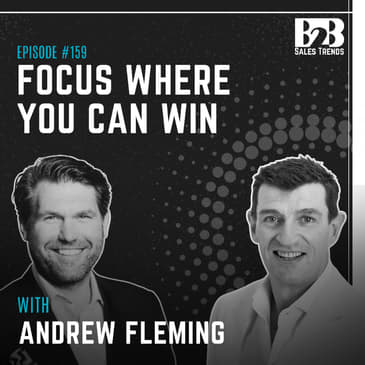

[00:00:00] My lovely people, welcome to another fabulous episode of the B2B Sales Trends. Today we're talking about targeted customer profiling and what it takes to build a healthier pipeline in the process. On the B2B Sales Trends, we give you a sneak peek into the strategies of the world's best CROs and go-to-market leaders, the systems, the playbooks they are using so you don't have to figure it out.
[00:00:28] So if you're looking to increase win rates, shorten sales cycles and learn from the best of B2B selling, this is for you. My guest today is Andrew Fleming. Andy is the Senior Vice President, Global Head of Sales and Enterprise Client Solutions and he leads generally the global commercial organization at Labcorp.
[00:00:50] With more than 25 years of experience in B2B Sales Leadership, Andy has been leading a transformation in how his teams build pipeline by becoming far more deliberate about where they focus their time and resources. Andy, welcome to the B2B Sales Trends. Thanks, it's great to be here, Harry.
[00:01:10] We're going to kick this off with the topic of rethinking pipeline health. Now, there is a lot of discussions out there, especially with senior go-to-market leaders around how do we create predictability in our forecast?
[00:01:28] And pipeline health is a real key aspect of that, of course. Many sales teams still measure pipeline health by the number of opportunities they have created. Why do you think that's the wrong way to look at this?
[00:01:43] The problem with measuring pipeline health by the number of opportunities is that it kind of rewards activity rather than outcomes. A large pipeline can kind of create the illusion of success, but at the same time, it's consuming an enormous amount of time and resource and organizational focus on opportunities that may never go anywhere, never likely to convert into work.
[00:02:13] And that results in the future.
[00:02:44] So, not all opportunities are created equal. So, not all opportunities are created equal, but if we spend the same amount of time and effort pushing low probability opportunities as we do high potential opportunities, we dilute our effectiveness and lower, you mentioned win rate at the start, we lower our overall win rate.
[00:03:04] So, for us, pipeline health is measured by quality and not quantity. So, we're looking for customers and opportunities that align with our organizational strengths, our expertise, kind of have the funding and have a desire to partner with us to help them advance towards meeting their goals and where we as an organization can create meaningful value.
[00:03:33] So, the end result is a smaller but more targeted and high quality pipeline that gives us more confidence in our, you know, drives our win rate up, actually, than a bigger by volume pipeline filled with kind of those long shot kind of opportunities.
[00:03:54] That's an interesting approach because, especially in the day and age of AI with all those wonderful sales supporting tools that are out there. The idea is we can scale our efforts and we can, you know, especially in our business development motion. We can contact now, you know, many, many more people through this.
[00:04:19] So, your statement kind of, you know, goes and contradicts that thinking. Initially, yes. But I think if you, if, I'm always mindful, I can't remember which supermodel it was. I think it was Naomi Campbell. They said she wouldn't get out of bed for less than a million dollars. Same approach for our sales teams, right?
[00:04:41] I want them to be investing their time, therefore the organization's time, in the opportunities that we have the highest chance of success. So, I want them getting out of bed for those right opportunities. Now, with AI, as you mentioned, it gives us a huge opportunity to actually scan the universe for many more of those ideal opportunities
[00:05:08] and many more of those ideal clients if we program AI in the right way. So, the dream would be that we do have a, you know, a high volume pipeline, but it's a high volume of winnable, high probability opportunities versus what we see today, which is a kind of more scattergun approach where we just, you know, the reward is in how big the pipeline is regardless of the quality of those opportunities.
[00:05:37] So, you know, both would be ideal, right? But it's difficult to achieve. So, let's define the right customer to get out of bed from, right? If the goal isn't simply to obviously build the bigger pipeline, where do you start? How do you define the customers your business is best positioned to win? Well, what we did was start by looking at the customers that we were winning business with
[00:06:06] and try to identify what was common across those customers? What kind of traits did they display? Why were they awarding work to us? And why did they see value in the service that we were offering? So, we were able to kind of start to build a kind of ideal client profile. So, what does a great customer for our organization look like?
[00:06:31] And we were then able to kind of, with some very kind of clearly defined parameters, and I mentioned a few of them earlier, you know, do they have a pipeline that matches our areas of expertise? Do they have sufficient funding? Do they have a desire to partner longer term versus a kind of one and done approach? There's all sorts of different kind of things that you can put into those parameters, whatever works for your organization.
[00:07:03] But then you've got a set of criteria against which to measure every client in your universe. And you can score them, you can rank them based on how they match up to those, you know, ideal criteria that you think make them good customers for your organization. So, once you've done that, you can then start to kind of segment and stratify your universe of customers
[00:07:28] and ensure that you're targeting your resource on the right areas. And so, you're looking at those right customers where you have the highest chance of success based on those pre-identified parameters. And that's a subjective approach. You obviously have to overlay that with a degree of objectivity as well and say, okay, you know, what else is going on in the environment? What else is happening with these customers that might, you know,
[00:07:56] prevent them from being an ideal customer for us? Or conversely, are there strategic reasons why a customer who is not, you know, meeting exactly those ideal criteria is someone that you want to work with? But as you go down that route, you've also got to be very stringent on keeping those criteria rigid. Otherwise, you run the risk of everybody being an ideal client.
[00:08:23] And, you know, and then as we know, if everything's a priority, nothing's a priority. So, you don't change your approach. You said something interesting earlier. You framed it as the right to win. I'm curious to understand a little bit more about that. What do you mean by that? And how does this play into what you have just shared? It plays to, you know, what you think your biggest differentiators are, first of all.
[00:08:52] So, what makes you special in your space? What makes you stand out from the crowd? Now, that to me is not just a list of capabilities or a list of, you know, experts you have within your organization. It's actually matching those capabilities and those strengths and those people with a real-life problem that the customer is facing and experiencing.
[00:09:20] And if you can do that, you start to demonstrate value for the client. And they will see value in the services that you're bringing to the table. And, of course, that also then, in a way, to tag on this, it's sort of changing the customer conversation too, right?
[00:09:39] Because in many industries, customers are under constant pressure to do a number of things, to reduce cost, which can quickly turn into sales conversations, into price discussions, and so forth. So, how do you then help your teams shift those conversations towards broader value your organizations can create and help them then to win? Well, you're right, Harry, that cost is always going to be a consideration.
[00:10:09] Right. But really, most customers are ultimately trying to reduce risk. They're trying to accelerate timelines and improve study execution and increase the probability of their development success. So, the first thing that is important, our teams are trained to understand what that particular burning platform is for the customer they're talking to.
[00:10:36] If you can evaluate what the challenges that the customer is trying to address, you can start to tailor and match your solution to that specific challenge. And the best thing of all is if you have those kind of discovery-type conversations with your customer before they have an idea of a solution in their mind, you can start to bring them towards the solution that you have.
[00:11:06] That will help them to address that problem that perhaps they didn't even realize that they had. So, again, that's the kind of ultimate. That would be the goal. Before the customer decides what they want to buy, you identify for them what they need to buy to match or to address the particular challenge that they have. And that way, they will perceive value in the solution that you're offering.
[00:11:33] You know, and that's really interesting because I've had this discussion recently with somebody where we discussed about how discovery needs to change nowadays, right? Especially with this idea of that decision-making or customer decision-making. If they decide for you or not, if they decide to move off their current situations, they're really deciding one out of two reasons, right? Either to gain an outcome.
[00:12:02] If you can help me achieve an outcome, great, we're game. Or, as to your point, to reduce the risk. If you can help me reduce a certain risk in the future, then we're game, right? But that requires a real different type of discovery. Not this asking 20 questions and asking what keeps you up at night sort of type of discovery conversation.
[00:12:27] It's really about coming with a point of view to really generate these new needs in the mind of the buyer. Exactly to do what you've just said is to help them identify really what they need to achieve that. What's your take on that? Well, I think that's the – you encapsulated the consultative sell from my perspective, right?
[00:12:54] We don't want to be – especially in a business-to-business environment, we don't want to be like a car salesman or a double-glazing salesman, right? Push a product. We want to be problem solvers. We want to be able to help the customer address, like I said, a particular challenge or risk. And that way demonstrate value.
[00:13:18] That way they will see value in the product or the service that we're offering. So I'm completely aligned with that approach. Now, let's go back to the pipeline transformation in a way that you've embedded. And you have changed that commercial strategy. And of course, changing that is one thing.
[00:13:47] Changing how an entire sales organization, especially management's perception of it, is another, right? Sort of how do we re-educate management on this is the strategy we all need to strive for and achieve. How have you embedded this more focused approach across the leadership team and the perception of the management's?
[00:14:13] Well, in a similar way to we were just talking about having our customers and our clients perceive value in the solution that we're proposing, you take a similar approach. Well, I took a similar approach, first of all, with the sales team. What's the value changing this mindset? What's the value in moving from having 100 opportunities in my pipeline that I only have a hope of winning 10
[00:14:37] to moving to having 50 opportunities in my pipeline that I hope to win 30 or have a high chance of winning 30? The wing for the salespeople in that regard is more targeted effort, less demand on the organization to deliver high-quality solutions for proposals for those particular opportunities. And therefore, as a salesperson, I'm going to hit my goal faster.
[00:15:06] So I'm a believer in the philosophy, work smarter, not harder. And that's kind of the way that we're able to get our sales teams to buy into it and reminding them of the kind of Naomi Campbell approach, right? So the way to that success is to see the increase in win rate, okay? I'm going to win seven opportunities out of 10 rather than three opportunities out of 10.
[00:15:33] So to hit my goal, I've only got to win 20 opportunities rather than bid on 60 or 70. So, and that is very, very similar when we go to management because we have to change their perception of how they're viewing the world, right? They've gone from looking at a pipeline that tells them a story that in order to achieve a billion-dollar target,
[00:16:00] we've got to have $3 billion in our pipeline if we've got a 30% win rate. So if we change the philosophy and say we're going to get more targeted, the offshoot is that $3 billion pipeline that falsely gives management comfort is going to reduce initially to maybe $2 million. But our win rate is going to go up.
[00:16:22] So the way to get confidence is actually to deliver and say, look, you know, provide the evidence that through this targeted approach, we've invested our organization's resources more effectively. Our win rate's gone up. And we've hit our goal with, you know, with that reduced pipeline.
[00:16:42] Then as you highlighted, with some of the tools that we can use now, we can target, we can help to identify even more opportunities and clients that are going to fit the model that we put together. And so not only will our win rate go up, but ultimately our pipeline will go up and our backlog will go up as a result.
[00:17:01] And of course, nobody changes the strategy or implements this new thinking or this new way of going after business for the love of it, right? We're all doing it because we need to create different outcomes, right? And different outcomes need to be measured and the success needs to be measured of this. And any commercial strategy is only as good as its execution.
[00:17:25] So how do you reinforce this way of thinking so it becomes part of your team's qualification efforts of opportunities effectively? So I go back. We talked about identifying ideal customers. I've also spoken about opportunities, but I didn't kind of highlight that even within those ideal customers,
[00:17:52] every opportunity they have does not tick the box of being ideal opportunity. So there are really two levels of selection that our salespeople have to go through. One is identifying the ideal customer. And then within that, what is the ideal opportunity to chase?
[00:18:10] So our teams are encouraged or expected to consistently assess opportunities against, as well as an ideal customer profile, a similar ideal opportunity profile and articulate why a particular opportunity warrants the investment of our organization in supporting.
[00:18:34] And then managers are regularly challenged those teams to explain why these opportunities are worthy of the investment that they want us to put into it. And again, I think it becomes reinforced over time. If we're winning those opportunities that we are investing in and through that kind of filtering process, it begets success.
[00:19:00] The other factor is that with our teams have to feel that they're in an environment where they can say no as well. So part of the strategy here is in targeting opportunities is to identify the right ones, but find a way and a safe environment to say, okay, we're not going to pursue this opportunity.
[00:19:22] What is the message that we give to the customer or what repercussions are they going to be for me within my organization? If I tell my manager, I've turned down this opportunity. We actually want to kind of celebrate that in a way and say, well done, right? This was not a good fit for us. So you turned it down. So the management team has to be very supportive of that approach.
[00:19:45] And if we go through that kind of approach with alignment with that ideal customer and opportunity profile, our win rates go up. You talk about forecast at the start. Our forecast accuracy improves. We get more penetration in our target accounts. Our relationships grow overall. We're utilizing our resource better. We're driving longer term customer value and getting greater revenue predictability for our organization.
[00:20:14] So over time, people see the value in that and qualification stops being viewed as a gatekeeping exercise and becomes a real strategic discipline and the core of what we're doing to achieve our success. When you think of the best B2B sellers that you have come across,
[00:20:34] what are the top three skills and behaviors that you believe a top B2B seller these days need to possess and execute to tackle changing buying behavior? What would those top three skills and behaviors be in your case? I think I'll give you the three and then I'll tell you the reasons why. Integrity, vision, and collaboration.
[00:21:04] Integrity for me is about building trust through honesty and transparency, gaining credibility. So the high-performing sellers, the high-performing sales leaders have always done what they say they're going to do, whether that's to a customer, to colleagues, or to their teams. And trust is absolutely fundamental in long-term business success.
[00:21:35] From a vision perspective, I think vision is essential to give clear direction. And it's direction about not what to do, but why we're doing it.
[00:21:47] So the ability to connect our day-to-day activities with that bigger picture and drive alignment across an organization allows us to manage change with confidence and be very, very effective. The final one was around collaboration. And believing in the team over the individual is something I personally feel extremely strongly about.
[00:22:17] I believe that it's essential to try and eliminate silos within your organization to listen to and incorporate diverse perspectives. And as I mentioned earlier, create an environment where teams can challenge, teams can take risks, and work together to meet goals and achieve collective success over the individual success.
[00:22:44] And I think those three, integrity, vision, and collaboration, create high-performing organizations. As I mentioned, integrity builds trust, vision provides direction, and collaboration leads to successful execution. Love it. Andy, I believe that listening to you, and I do a lot of these, you've built a great culture at LabCorp. Congratulations.
[00:23:10] Sounds like your sellers are really thriving under that culture that you have started. We appreciate you sharing your thought leadership with the community. Thank you for taking the time. We appreciate it. Thanks, Andy. Thanks. It's been a pleasure. I appreciate it, Harry. My lovely people, building a healthier pipeline isn't about creating more opportunities. It's about focusing on the right ones.
[00:23:35] As Andy shared today, that starts typically with defining the customer, defining who you're best positioned to serve, focusing your efforts on the opportunities you can generally win, and helping your sales teams lead conversations around value instead of price.
[00:23:58] If you enjoyed this episode, follow the show, share it with your team, and subscribe on our YouTube channel or wherever you get your podcasts from. Download our latest white paper and learn about more of our revenue accelerator. Both are linked in the show notes. Until the next time, take care of yourself, of course, my lovely people, your loved ones, and your B2B customers. Bye-bye.