
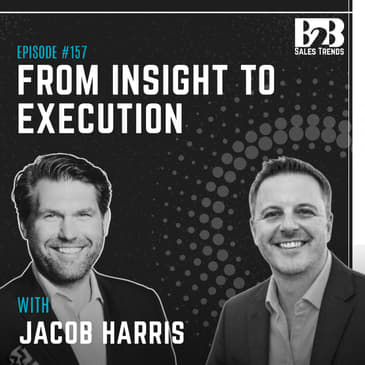
[00:00:00] Welcome, my lovely people, to another fabulous episode of the B2B Sales Trends Podcast. Now, most sales leaders are being told that technology and AI will help them grow faster and, of course, improve productivity and make better decisions. And all in all, a wonderful thing. But what happens when the real problem really isn't the tech?
[00:00:22] What happens when the challenge is a lack of visibility, for example, inconsistent execution and weak sales discipline? One begs to ask. Today's guest is Marcus Houston. He's the Chief Sales Officer at TestEquity.
[00:00:42] He currently is leading a company-wide sales transformation focused on improving customer segmentation, territory management and sales performance. Super pleased to have him on the show today. Jake, welcome to the B2B Sales Trends Podcast. Thank you. It's great to be here. Jake, every sales leader is being asked to invest in new tech these days. And, of course, that means AI tools left, right and center right now, right?
[00:01:12] As someone in the middle of transforming a sales organization, what's the biggest misconception about what those tools can actually do? You know, it's actually, it's interesting because like the breadth of things that tech can provide today is, you know, it's pretty crazy in terms of the things that we can accomplish with technology today. And I find like one of the bigger challenges that we face all the time is staying on the front foot with regard to understanding
[00:01:39] kind of what's out there because there's so much that changes every day. And so I think that, you know, I look at it from an enabler standpoint if it's used correctly. So whether it's, you know, customer insights or territory management or whatever it happens to be, like there's so much out there that we can take advantage of today. But I'd say the thing that, you know, what we misconceive on is that, you know, can't system away performance.
[00:02:07] You know, and you still have, you still have a salesperson or a customer as part of the conversation. They have agency and, and, you know, the hard part of engaging customers in a meaningful way, especially on the business to business side of things, like that's where it gets pretty difficult. Like tech cannot, tech cannot replace that to us, at least not yet with regard to engaging people. And when it comes to just measuring performance and driving performance,
[00:02:35] like there's still the hard graft that has to be done in front of the customer. And I don't know, I don't know yet how to replace that. Right. Let's take a step back. I know you were in the middle of a sales transformation and, and in general, before sales leaders really can improve performance, transform their organization and so forth, they really need to understand what's happening inside of the business.
[00:03:04] How do you assess the health or the state, so to speak of a sales organization and identify where those big opportunities to improve really exist? How do you do that? Yeah. So I've been, you know, I've been hearing distribution for my entire career and I grew up in a really kind of disciplined, detail-oriented sales environment where, you know, leaders are expected to be in the details and, and, you know, their player coaches, et cetera.
[00:03:34] And so, you know, when it comes to assessing the health, um, you can get a lot of false positives and false negatives. You know, you're always going to get market tailwinds or headwinds. Um, you know, you can't necessarily buy into those things because, you know, they can, they can confuse you in terms of what actually is happening. But, but for me, I mean, ultimately it's in the details and, you know, sales leaders have to be
[00:03:59] willing to engage at a field level to understand, you know, specific detail-oriented performance metrics like, you know, new customer accounts, SKU count, you know, the number of things that you sell the customer, different types of services that you sell the customer. And, and when you engage with your teams in a meaningful way and you're asking the second and third question, um, you're going to get a sense pretty darn quickly, uh, in terms of, you know, the strength of your leaders and the strength of your salespeople.
[00:04:26] Um, now there's, there's other things that go into this, right. In terms of, you know, your, you know, your technology stack and how you're, how you look on the internet and, you know, the experience that customers have with you overall from that perspective. But, but ultimately, you know, health of a sales organization comes down to the health and capabilities of your individual contributors who are the ones who, you know, do the hard work in front of the customer every day. Um, do you use a tool that you can recommend to some of these sales leaders to assess it?
[00:04:55] Or is it more sort of the, uh, old, old good fashioned way to interview people and so forth? You know, I don't know if there's a tool. I think it's all about just your personal energy and commitment to the business. Like I, yeah, there's stories I can tell you, which I won't write in terms of, you know, things that people have said to me over the years. But, you know, the tool for me is, like I said a minute ago, like the second and third question. You ask a person a question, you get the answer.
[00:05:24] You ask the next question or you ask the same question twice because you're going to get a sense pretty quickly for, you know, for who's engaged in their business and knows what's going on. But I mean, ultimately, you know, you've got all kinds of, you know, technology tools out there that allow you to look at data in a meaningful way. It's really how you organize it. Now you touched on that a little bit in my opening question. I'd love to go a little bit deeper here.
[00:05:47] Now, many of our customers, many organizations in the space are investing in those tools, platforms, in this AI tech and so forth. What are some of the things, and you touched a little bit on it, but I would love it if you could elaborate a bit. What are some of the things the tech can't do for a sales organization? Yeah, I mean, at risk of kind of repeating myself, like, I mean, you know, what tech,
[00:06:16] also what it can do, right? Because I think that's important. So, I mean, obviously, you know, in a business to business sales environment, you know, it can diagnose problems that you have organizationally. It can enlighten you in terms of, you know, customer trends and where the market's going and, you know, pieces of business that you don't have. It can inform you in terms of, you know, territory management with regard to who are the companies out there that you're not calling on effectively today.
[00:06:45] Um, and so it can guide you to the places that you need to go to with regard to, you know, things to sell customers to call on, etc. But what it can't yet do for a sales organization is, you know, having that, you know, that brave salesperson knocking on a door where, you know, she or he may get rejected. Um, you can't replace that yet. I mean, there's, you know, because people have become so savvy to, you know, non-human contact.
[00:07:15] Uh, I mean, I'm sure you get all kinds of emails every day. That is not from a human. That's from a bot. And you can tell. Um, so that's, that, that for me is probably the, the single biggest thing. Cause I mean, you know, we, we've grown up in a time when, you know, communication styles are very different from what they used to be. Um, and I find that, you know, finding great salespeople who are able to connect with people in this day and age, um, is becoming harder and harder. And so you can't replace that.
[00:07:44] I think the other thing is he can't, he doesn't replace, let's call it leadership courage or managerial courage in terms of, you know, sales leaders who are willing, you know, to, to dig in from a performance management standpoint or spending a lot of time in territory management or whatever it happens to be. So, so the people, the people factor, well, you know, I do worry about what AI does for, you know, the workforce of the future.
[00:08:07] Um, currently technology doesn't replace that brave, capable individual, you know, who's out there driving every day, um, to find new customers and new programs and the customers that you call them. When you think about the brave, capable individuals, do they have to deal these days with, uh, with different buying behaviors? Yeah, of course. You know, I mean, I think it's, it's interesting because, you know, COVID obviously, and this is not, it's nothing you don't know.
[00:08:36] I mean, COVID changed the role of the outside salesperson, uh, and changed the role of really anybody who's involved in a, in a sales organization, just in the sense that companies became decentralized in terms of how their decisions are made. Um, and where it used to be that, you know, you could drive to your customer location, walk the floor, you know, see the folks that you want to see all the time. Now those people might live in a different, you know, state, province, continent, whatever it happens to be.
[00:09:05] And so, you know, that's probably the single biggest thing for me is the decentralization of customers has made it harder, you know, for our teams to connect because you've got more people who maybe you don't know, um, that are really involved in decision-making that can impact your business overall. And I will go into the companies that we call on, um, you know, who that would be, but it's, you know, it's more the norm now than it's not. Um, and, and frankly, I guess to build on that to you, I think that people, you know, buyers
[00:09:35] are, and they, they want, you know, they expect different things in terms of how you communicate with them. They consume information in different ways. And when you're not in front of them all the time, you can be pretty imaginative and intuitive in terms of how you engage people, um, in a meaningful way. Elaborate a little bit on the expect different things. What are the, some of the different things that they are expecting? I think, you know, in terms of like that decentralized model that I just referred to, like if he, if
[00:10:04] you think of it in a traditional sales environment, like, you know, where you would call on the customer personally, I mean, people generally deal with people that they like and people they trust and people who have helped them in the past. You know, when you're, when you're in a, a remote kind of environment, you know, it becomes more transactional. And so the things that people expect in that transactional environment are very different from what, you know, they would have expected in the past.
[00:10:31] So, you know, absolutes become more, you know, they, they, they take on a, a bigger mean absolutes. I mean, in terms of, you know, cost reduction or contract terms or whatever it happens to be. And if you're not able to react well in that situation where you've got somebody who was in a different city from you and you're trying to negotiate something that that's where it gets, that's where it gets difficult. It's an interesting world out there right now.
[00:10:57] You mentioned that the tools are good to diagnose situations, diagnose the market, understand territories and so forth. Let's assume you've understood your market. Now you've, you know, acquired all the information that that's out there on a potential customer, on a prospect. Perfect. Um, what separates now the organizations that actually act on that information from those that don't?
[00:11:26] And you mean like the traits of that organization or something else? Exactly. I mean, it's, I think it's the personalities and the drive of the individuals who lead. Um, you know, I would say that it's, you know, it's, it's a, it's a separation between those that do the work and those that talk about the work. And, you know, like I said, there's, there's, there's more information than you can handle
[00:11:52] today in terms of, you know, telling you where to go from a customer perspective. But, you know, those that are, you know, brave enough to invest in people in process or those that are brave enough to redeploy people in process to, you know, growth areas, those that are, you know, willing to transform their organization. Like it's hard work and it takes courage, right. In terms of as you're, as you're transforming an organization, but in terms of like the, the major traits, it comes down to drive and those that are willing to do the work.
[00:12:22] Um, because that's the hard bit, like the inspection, the accountability, the performance management, that's where I think people tend to go off, off track a little bit. Um, cause I mean, it's, I mean, you know, as well as I do, it's easy to talk about the customer that you want to call on, you know, that you're not today. Um, it's a whole other, it's a whole other thing to actually go do it. And so groups of people who think that way, um, that's the big difference for me.
[00:12:48] Uh, you talk about drive, um, people who, um, do the work, not just talk about it. Do you hire according to these traits also? I try to, I mean, I, my view on things when it comes to hiring from a leadership standpoint, I'll start there and I can get to individual contributors after that, you know, for leadership, you know, I'm looking for attitude more than anything else.
[00:13:13] And, and, and attitude and personality will tell you all you need to know about somebody's willingness to, you know, to, to drive an organization. And so, you know, educational pedigree, you know, experience is important, of course, but you know, if that person doesn't have, you know, the ability to, to speak up when they need to speak up, like that's, that is the single biggest thing that I look for when it comes to leadership overall on the individual contributor standpoint.
[00:13:42] I mean, it's you're, if you're, if you're carrying a bag or if you're, you know, you're calling customers, you know, a certain level of fearlessness is important because that's, I mean, it's a hard job. Like, you know, you're, you're looking to get people to do business with you that maybe otherwise wouldn't. Um, and, and your reputation and the service that you provide them is what's going to define how well you do or don't do obviously in that space. So it's, it's fearlessness and somebody who's in the details and, and it's a cliche that somebody
[00:14:10] who takes the customer's interest and makes it more important than their own. Right. Right. Um, it's interesting. Will, um, you mentioned earlier that, uh, a lot of these, um, digital tools, AI and so forth are nowadays used to get in touch with customers and that everybody's inbox is filled up with, uh, that junk, if I may say that, um, because I'm getting enough of those too.
[00:14:36] Um, it's obviously harder to get a customer's attention these days. What are some of the sales leaders? Let's focus on the, the, the sales leaders here and the tips that you can provide to them. What are the sales leaders getting wrong when it comes to engaging and influencing today's buyers in your opinion? I talked about decentralization earlier a little bit.
[00:14:59] Um, I think that things that people are getting wrong is that they are making the assumption that technology becomes the central part of how you engage a customer. And, and by the way, like, I don't, I don't want to overstate that because like what it can do for you as an organization is significantly beyond what it used to be able to do. And, you know, ignore it at your peril.
[00:15:25] Um, but to, to, to write off or make an assumption that, you know, people dealing with people, um, it's not really a thing anymore. Um, is I think misguided. Now I don't want to sound like a dinosaur in the sense that, you know, you know, I think when I listened to what I just said, I could maybe, maybe think that, but you know, for
[00:15:49] me, like when I, when I look at our best engagements across all the test equity customer base, the common factor is a great salesperson, right? A great salesperson into the customer trusts and values. Um, and while it gets harder and harder today in like a transactional type of world to, to get to that point, um, you know, you can have a whole lot of small customers with technology or, you know, where you can combine that with great sales folks and have some pretty darn big ones too.
[00:16:18] So that's, that's the way that's, that's what I would say in terms of what, what people get wrong in terms of their attention. I think the other thing I would say, and this is maybe a little bit separate, Harry, but you know, a lot of the things that when, when we talk about, you know, when you go see a customer, you talk about kind of who you are, right. And I think a lot of what we talk about with customers has a bit of kind of inherency bias in the sense that you're always willing to tell them how great you are as a company. Um, as opposed to thinking about it from the sense of, you know, what does that customer need? What do they value?
[00:16:48] Um, and how can you be successful? So communicating, you know, with, with fat in mind, like that's, that's probably the second biggest thing that I see that people kind of get wrong today overall. Um, I think the third thing, and this is maybe a little more, you know, tactical is that, you know, people tend to think that when the market's really strong, they're doing a good job. And when the market's not strongly doing a bad job, um, I think you have to make sure you're, you're clear on market sharing where you stand in the market.
[00:17:17] I think that's the most important thing that you're looking to look at, um, to gauge how
[00:17:47] things that they seem to have in common. You know, I'm going to answer that question in two ways, you know, from a, from a sales, my, my, our best salespeople are usually our sales leaders, right? Cause they've, they've done the job and that's kind of trait number one, you know, they're, they're player coaches, you know, they're willing and able to go coach the next generation of sales people.
[00:18:12] Cause you know, no, most, most folks join an organization, um, without a knowledge necessarily of what that company does. Um, and so having a group of, you know, senior sales leaders who are player coaches for me is trait number one. Um, the second thing for me, and this is, it's linked is that, you know, they're in the details of their business and they're fearless in terms of performance management.
[00:18:36] Um, and when I say in the details, I mean, you know, most, most sales organizations or most companies are a sea of details and, you know, not being involved in the details means that you get surprised sometimes and surprises lead to underperformance and underperformance leads to, you know, places that you don't want to necessarily think about. And so, you know, somebody who's always on the front foot with regard to understanding the details of their business is probably trait number two. And then the last thing I would say, and this is, this would span across really,
[00:19:05] you know, any role is, is intellectual curiosity. Um, and while, again, that's, that's probably an overused statement these days or overused term these days. Um, you know, for me, it's always being skeptical about your business and questioning, you know, where you are. Um, you know, one of the things that I've noticed over the years is that people tend to be really good where they're good, but they tend to not be aware of the customers that they don't call on necessarily.
[00:19:34] And in an organization like mine, where you've got, you know, people that are responsible for a territory, you can't afford to add people who are not intellectually curious in terms of the places that they're not being successful today. Um, so that for me is, is trait number three. Um, when it comes to leaders in terms of salespeople, a lot of the similar themes, but I mean, fearlessness is one. And that's, again, that's a subjective thing to say because, you know, your fearlessness
[00:20:01] may be different from, from mine, but, but the motor, the motor of that individual has got to be on high all the time as well. Um, because, you know, success for an individual salesperson means always replacing, you know, your business. Because I think if you look at it, you know, there's a good chance that, you know, a salesperson's top five customers today are not the, you know, they weren't the top five, three or four years ago. And so you're always having to be on the front foot with regard to finding new things. And that's where the electrical curiosity comes in as well. Fabulous.
[00:20:30] Um, our listeners have just gotten the bonus and not just the, uh, top three traits of the best sellers, but also the top three traits of the best sales leaders. Jake, you've been an awesome guest. I thank you for your time and, uh, our listeners will very much appreciate your insights and your thought leadership. Uh, thank you for taking time. Thanks, Harry. Appreciate it. Lovely people. The lessons from this conversation with, uh, Jake is, uh, uh, it's pretty simple.
[00:20:59] Technology can expose these opportunities, but it can create execution. The sales organizations that win still know their market. They understand their customers and apply their discipline required to turn insights into outcomes and results. If you like to learn more about how to lead a sales organization and how to improve win rates and commercial performance, take a look at our revenue accelerator tool.
[00:21:27] There should be in the show notes below. If you like the show, share it, subscribe to it. So you don't miss an episode until the next time. My lovely people look after yourself, your loved ones, and of course, your B2B customers. Bye-bye.