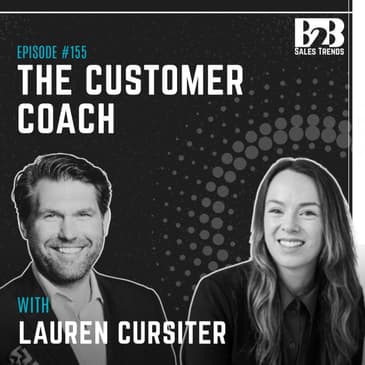
[00:00:05] Welcome to B2B Sales Trends, the podcast dedicated to sales leaders in the B2B space, where we share conversations about innovative and successful sales transformations to keep you up to date on the latest trends. This podcast is brought to you by Global Performance Group.
[00:00:22] Welcome yet to another fabulous episode of the B2B Sales Trends podcast, my lovely people, the show that brings you hacks, tips, thought leadership for sales, marketing and customer success. It's brought to you by Global Performance Group. We are a revenue improvement boutique that implements behavior change for salespeople to gain the competence of the skills, the confidence to execute these skills well and the courage to sell and negotiate based on the business.
[00:00:52] on customer outcomes. My name is Harry and today I have with me Lauren Cursiter. Lauren, welcome to the B2B Sales Trends podcast. Thank you so much for having me. I'm so privileged and excited to be here with you. Absolutely. I know, Lauren, you will be sharing amazing insights and tips and tricks for people.
[00:01:18] So, as a sort of to kick us off, give us an introduction about yourself, your role and so forth. Yes, great. So for the past, I've worked in sales enablement for around the past 10 years. So all different veins of sales enablement, but really for the past five, I've been deeply focused in sales skills.
[00:01:42] So thinking about how can we ensure that sellers at the company that I'm working for are armed and prepared for the sales skills that they need. Currently, and for the past three years, I've been doing that at Google first within measurement and analytics lens.
[00:02:01] So really using big data to understand what are the skills that sellers need and then analyzing what do they do that causes the greatest amount of impact. And then for the past year, I've been focused on actually activating those programs.
[00:02:19] So I guess my formal title is marketing and communications manager, which essentially means like, how can I make sure that sellers have the right information and enablement programs at the right time? Fabulous. And let's continue on that first thought that you've had, that you focus on sales skills and what the needs are, shall I say, for these customer facing people.
[00:02:49] You know, 2025 again, buying behavior has changed again, and we see lots of data out there and the reasons why and so forth. What do you see as the critical challenges for client facing people in 2025 and sort of, you know, what are the sales skills necessary to tackle those challenges? Yes. Great, great question. And first, I'll say that anything I share today is purely my own and not of Google where I'm currently working at.
[00:03:19] But yes, every year we see a massive shift in what client facing people need to be thinking and how they can develop themselves. I think two key challenges that I see, which kind of will then lead me to say the skills that I feel are most important. I think, first of all, a challenge that client facing people are facing is actually really around attention.
[00:03:43] I think that everyone, whether you're working in a company or like just in general life, our attention span is declining. So I think for sellers who are going into conversations and they want to get some key messages across, they really need to be very curious, thinking about how can I ensure that I keep the attention span of who I'm talking to. And a really good way to do that is via storytelling.
[00:04:12] So you know that stories are remembered 22 times more than facts themselves. So I think that if you are able to really develop some effective storytelling skills, you can infuse that into your pitch to make sure that you're holding attention of who you're trying to talk to, who you're trying to build a relationship with, and who you're trying to build a solution for.
[00:04:38] The second challenge is really around complexity. And there's some good news and bad news here. I was reading that actually 2025 is companies, the World Economic Forum believes that the market conditions are right for companies to actually take higher risks. So I think that it's actually a good thing.
[00:05:07] However, I think where that there's a challenge there is that there's more options in any kind of like environment, majority of environments, there's more options than ever before. And that people have more information than they've ever had. So if you're a buyer, you have like many more options, you have many, much more information for you. So what that will look like for a salesperson is that they will likely receive more objections.
[00:05:36] So I think objection handling is something that sellers or any client facing person really needs to be clued up and ready for. So I think the good news about objection is that it can actually lead to a greater degree of discovery.
[00:05:56] So for you to really understand more about your client, their needs, and that should really then lead to a better outcome and conversation. That's an interesting piece. You know, the objection handling path.
[00:06:16] I like the how do we grab attention, your first point, right, which is it's such a crowded marketplace for everybody out there, right? And how do you not just gain somebody's attention and get somebody's attention, but how do you maintain it?
[00:06:35] And we see salespeople being, you know, really struggling with that and at the different stages of the sales process, because it's not just gaining attention quickly to say, hey, are you interested? Are you raising your hands? But how do you provide and in our mind sort of nuggets of value and little pieces of interest that you can keep that attention going throughout the sales cycle?
[00:07:03] And of course, storytelling is an important part of that too, right? Yeah. And then to your other point in terms of objection handling, you know, I like what you said about objection as a discovery tool. Yeah. Share more about that. How can salespeople really reframe objections and use them to uncover deeper client needs, in your opinion? What is it? It's an interesting concept. Yeah.
[00:07:32] Yeah. So I think that when someone objects, you're actually getting a piece of information about them that you didn't know before. So I think that's actually a really great opportunity because with information, that is how you can actually really work to solve problems, understand a client better, which will mean that your solution will then be more tailored to them. Right. Right.
[00:08:00] So I think an objection is sometimes scary, but I see it as an absolute wonderful way in which you can understand more.
[00:08:09] So I think that when you're in this vein and you receive this piece of information, I think you can use it to really probe that specific objection to understand why they're having this concern, what is leading to it, and really identify more about their world.
[00:08:33] I think with this, then in response, you have to really understand your solution to understand the benefits of that. I think a common objection is around cost. So I think that if you receive that type of objection, you can really dive in to see what is the constraints? Is it a budget? Is it because your solution is too expensive?
[00:09:03] And then I think with that, to use the benefit example, you can then reframe the objection to say, well, this is actually how our solution can help you with those costs or budget constraints because our solution will lead to greater degrees of productivity, which we know can lead to X amount of returns.
[00:09:26] So I think to summarize, really diving into the root of where that objection has come from and why, and then using that information to position your solution in a way that benefits that objection rather than harming it. Yeah. Yeah. Yeah. It's so interesting what we find, and I think you're spot on.
[00:09:52] It's really critical to shift that mindset to say, well, an objection is not just me giving you additional information or answering your question. And I think there's a critical point in any sort of objection handling process that salespeople are not starting to premature problem solve. Yes. So you give me an objection. Okay, great. I have to solve that quickly. Let me give you the answer to your objection.
[00:10:18] They need to, in a way, resist that temptation to go down that path, but then to really, like you said, dive into the objection more, really understand what is the need behind the ask or the pushback or the objection. And then, you know, in our terminology, we always call it reframing for client outcomes. Does that resonate with you and what you guys are doing?
[00:10:47] Yeah, absolutely. And I think it's like anyone receiving an objection can feel like a hard hit. I think you're right. It's like a reframing mindset to really take it as an opportunity to pause and reframe. I think that's 100% spot on. But yes, recognizing that it's never, it feels like a hit to receive that.
[00:11:15] You've kind of got to train yourself to think, okay, nope, this is great. An opportunity, pause, I might dive into this. But easier said than done and takes a lot of practice to get there. Yeah. And I think it's also talking of reframing, which is obviously reframing for outcomes to, in terms of the objection and the response. But I think we have to, in a way, also reframe our mindset to say, you know, it's not us to jump in.
[00:11:45] And the customer, you know, this is actually a positive thing. If there is an objection. I heard the other day, I forgot who said it, but they were saying that an objection is the first sign of buying. Yes, I love that. Buying signal, right? So don't use it as a, oh, no, I don't know what to do. I better give them what they're asking for versus this is good. This is where we need to be. This is a natural part of that process to work through it.
[00:12:14] But I really like your reframe of an objection is really an opportunity and really a discovery tool, which I really like. That's a nice frame. You know, the other thing that you mentioned earlier is that complexity that salespeople really have to deal with in a way. And there's a few stats out there.
[00:12:42] I seem to remember there's an average on 11 or 12 different stakeholders in each sales process nowadays, on average, right? And Afako who got out there, I think it was Gardner who brought that out. But, you know, these multi-stakeholder sales, you know, what are sort of your strategies that you recommend to really aligning these different needs,
[00:13:08] these different stakeholders and navigating your way through that bit of a jungle, really? Yes. I have seen that it feels like the people, number of people who are in meetings and making decisions is getting greater and greater. And it is very, very, very challenging.
[00:13:29] I think a couple of things of how I'm thinking about how to navigate this is, I think, research before, like understanding who is in the room. Right. You can, you can understand like what are their roles. But then I think like with that research, whether it's via like LinkedIn online, speaking to like a trusted partner at the company,
[00:13:53] I think you can really start to build out a map of who are these people, who holds the kind of power and the conversations in the room. And then who is the true decision maker? Who is the one who is going to sign on the dotted line and or be like, this is, this is no go or no go. Yeah. So I think research is key.
[00:14:17] And then I think this can be during post, like ongoing as you're having that conversation is really identifying what is the common ground? What is like the common challenge? And really, if you're in a complex room where there's a lot of different competing pieces of like energy, what, what is that common ground?
[00:14:42] And bringing the room back to that common ground and then how your solution is solving for that. It sounds very kind of basic, but I think it's very easy in any kind of large conversation to go down all these different paths. And the solution that solves for all is a solution that solves for, for no one.
[00:15:07] So I think it's okay if there's a loud voice in the room and your solution doesn't solve for their unique need. That is okay that you're never going to be able to do everything, but you have to figure out what is that common ground and how can I continue to be value-based selling on that specific challenge? And then be able to navigate that highly complex situation. Yeah, it's interesting.
[00:15:35] It, again, it goes back to this intuitive part and you almost as a, when you, when you're in a situation like you've just described, you almost have to be a facilitator. Yes. Of how, how, how do you facilitate the room in for the best possible outcome? Um, but of course that's, that's not easy. And, and, and our experience says that, you know, salespeople tend to gravitate to the conversations that they feel most comfortable with.
[00:16:05] So let's say if we have a technical buyer in the room or, you know, somebody who's very good with the product or, you know, uh, then, and if the salesperson is sort of a product person, then they, they gravitate to that, to that conversation more. Or then if I have, uh, you know, a procurement person in the room where you think, oh, okay, then only going to squeeze me on price. This is going to make me uncomfortable. They're going to ask me questions that I don't want to answer. So let me just steer the conversation to this.
[00:16:34] But the reality is I really need to facilitate all the different, you know, needs and outcomes that, that we need to have a conversation with. Right. Yeah, absolutely. No, I think that, um, yeah, we do gravitate towards people who are, who are like us, but I do think it's so important to take that step back.
[00:16:56] And as a salesperson, you have the opportunity that you're an outsider coming in and you have a unique, um, a neat, a unique point of view that can really benefit the company. Whilst you're facilitating that conversation and allowing them to speak, not just you speak at them, facilitate that conversation all around the table. Um, it's a huge benefit for a company to, to be able to have that perspective. Right.
[00:17:23] You, you, you emphasized a little bit value selling and, and, and I heard you say in preparation to this meet, uh, to this recording, uh, the term collaboration over traditional selling. Uh, I noted that down because I thought it was an interesting, uh, interesting twist of things. How can sales teams create a more sort of a collaborative environment with clients that really focus on problem solving? Yeah. What do you think? Yeah.
[00:17:50] I think it does, it goes back to that unique position that salespeople have that can really. Be very beneficial to, to companies. And I think that in collaborative selling, um, I think the, one of the reasons why it's so powerful is because it actually leads to deeper discovery and understanding. And that is how you can craft a fantastic solution that benefits both sides.
[00:18:16] I think, um, how can sales teams do this and have this approach because it is so powerful. Right. I think it all begins with trust. I think in order to, um, to have really great deep problem solving, you need information. Um, and for a company with an outsider, it's really hard for them to give that up because if they don't trust you, they'll think, are they going to be a good idea? Are they going to use this with the competitor? Are they going to use this against me?
[00:18:44] Um, and you're never ever going to be able to have that collaborative problem solving environment with that. So I think in terms of building trust, I think that you can make sure that in the initial stages that you prove your credibility, um, that you know what you're talking about, that you've been in the industry. And that I think the other thing is, and this is, this is a challenge with any type of selling relationship you have is that you're not just out for yourself.
[00:19:11] Like that you have, you really care about the company and the people that you're working with, because I think if you are very clearly out for your and your own company's objectives, people see through that. Like everyone can see through that. So showing that you have, um, your self disposition is, is low, um, or what you're going to get yourself orientation is low.
[00:19:37] Um, I think that you, um, will, will be able to build that, that feeling of, of trust and then you can really start to have those deeper conversations, get more information. Um, and then be able to really craft something that, as I said, is a win-win for both, for both sides. So big fan of this kind of collaboration, relationship building relationship where you can have.
[00:20:00] And, and you touched on that, you know, the development of needs, asking the right types of questions, uh, questions. And, and of course that, that sort of process leads to trust in a way. Um, what advice do you have for crafting the right types of questions? Those questions that really dig deeper and, and reveal unspoken or what we in our terminology call underappreciated needs, undiscovered needs.
[00:20:29] Uh, what sort of is your advice, uh, to come up with those right questions? Yeah, I think really listening, um, and actually not just listening to, to verbal cues, but also non verbal cues as well. I think we actually receive more information.
[00:20:49] We receive more information from non verbal cues than we do, but, um, verbal, but I think in order to acknowledge that you actually have to pause and really listen and, and think about, um, about the person that you're, you're selling to. So I think that has, as a, as a degree of kind of like empathy as well and understanding what is like in their shoes.
[00:21:12] Um, I think then you can really craft some great probing, um, open questions, um, to understand like what is going on in their world. Um, offering, um, um, um, being more like a coach than you are like a delivering facts.
[00:21:34] So I think that like crafting those questions is, I think a lot of, yeah, empathy and listening, um, to, to really try and undercover what is going on and how a solution of yours can, can solve for that. I, I really, I'm gonna nick what you said here. Cause I really like it be, be more like a coach versus delivering facts. Yeah.
[00:21:56] That's, that's a really nice, uh, cause in the end of the day, I mean, uh, you know, we come across a lot of salespeople, but most of them are just delivering facts. Let's face it. Right. And, and everything else is sort of counterintuitive to what they do. Oh, okay. Wait, you want me to, uh, to ask the types of questions. You know, what we find also it's, it's, it's interesting.
[00:22:18] And when you, you just have to think about yourself in a way, when somebody tries to sell you and they ask you the same or boring questions that everybody else is asking in a way that doesn't provide any value to you. That just confirms the other person's assumptions. Yeah. And that's not good enough nowadays. So how, how do we create a thought provoking dialogue that gets them to think about things that they haven't thought of before.
[00:22:45] And in a way it goes into the direction of I, as a salesperson, what is a need that I want to generate in the mind of the other party? And then sort of come up with the questions that lead us to that, to that discovery. Yes. Um, it's a really interesting way of doing it, but I like being a coach versus delivering facts. Like completely. That, that is very cool. I'm going to Nick that. Okay. I want to have that on tape that I will. Yes. Yes.
[00:23:15] Yeah. It's that reframe, which is important and make, yeah. And that low self orientation as well. It's like, if you go in with a question about like, what's your budget? It's very clear that you're trying to understand, okay, how much, you know, money can I get out of this person? So you really got to have that empathy and mindset shift and put that on and think, how can I help this person? Exactly.
[00:23:42] Um, talking of sort of the more generic sales approaches, you know, I always believed that tailoring your approach, or your solution is really key to a good interaction. You know, what, what, what steps do you think can sales teams take to move away from those generic sort of approaches or generic pitches and offer really solutions that resonate with specific client challenges? What, what, what do you think there?
[00:24:12] Yeah. Yeah. And also acknowledging that, like, of course, that like, we can't have, like everything tailored every day all the time. Like we just don't have the time to do that. So I think it's always important to like, have great shells off like the key about your, about your product, about your solution and have an approach that you have refined and, and work. But I think there's small touches that you can make to move away from that generic pitches.
[00:24:41] I think like just small things like adding their logo, adding like a company, um, like, you know, um, uh, company visions or, or, or whatnot that I think will make people see and understand that you're, this isn't something that everyone has seen a thousand times before. And then I think there's like larger touches as well, um, such as like giving them data or perspective that they.
[00:25:09] Haven't had or seen before. Um, so I think that this can show and prove to your buyers that you have taken the time to understand their business, um, and their challenges. Um, and I think that there's tools that can, that can help with this. Like I think AI is a fantastic tool that can actually really help you build out more information that you didn't have before.
[00:25:36] Um, and I think adding those kind of like elements of surprise and, um, and having like a space for that within them, maybe shell deck that you have, um, is like a really nice way, especially in those early stages where you don't have some of those. Um, like untapped questions like your art kind of going in from a blank slate.
[00:25:56] I think there's like really nice soft touches, but then also these larger touches as well to, to set that standard that, you know, you know, they're company and you know what you're talking about. Right. Fabulous. Um, very interesting insights, Lauren, my final question with every podcast. And, and you may know that is, is always the same cause I want to get some consistency in it. And it's always interesting to get different people's opinion on this.
[00:26:24] So we started out with the top 2025 sales challenges and what people can do about it. Share with us the, um, in your opinion, what are the top three skills and behaviors that salespeople need to have in order to be elite salespeople? So the best of the best, or what are the top three things that those people are doing? Number one, number two, and number three in order. In order. Okay. Wow. That's hard.
[00:26:53] Cause I think that three of these are all important. Um, and they'll probably touch on what I have just spoken about in this. Oh yeah, absolutely. Um, I think number one in 20, 25 is leading with empathy. I really think that there's a lot going on in the world right now. And I think at the end of the day, we're all humans here, trying to, trying to make it work.
[00:27:16] So I think when you lead with empathy, um, I, that is an excellent way to just establish that rapport, establish that trust. And really then put yourself in your client's shoes. And I think that will force you to craft better questions and solutions and really get to a great outcome. So I think lead with empathy, I think curiosity, this goes like, this is a leading with curiosity as well is, I think this will lead you also to what I kind of spoke about before.
[00:27:46] It's like that objection handling. I think all of that is core, um, just being a curious person and like avoiding those, those traditional sales that like moving into more tailored solutions, curiosity. So putting your curious curiosity hat on at the start of the day. And then I think leading to that, um, is, um, being, uh, is research.
[00:28:11] Maybe that one is such a, such a, uh, uh, uh, exciting seeming term, but I think that all the things that I think we're leading into in 2020, 2025, um, it really comes down to like doing your homework and understanding who are those decision makers. What are the challenges that this company is facing? Right. And like, what can I do and my company do and the solution do to really solve for those?
[00:28:39] Cause that's what it comes down to at the end of the day is someone has a challenge and you were trying to solve that challenge with their, with your solution. So how can you really understand the specifics and ins and outs of that challenge? So empathy, curiosity, research. Love it. Uh, those three points. It's interesting. Obviously curiosity, a lot of the times comes up when I ask a podcast guests on that leading with empathy hasn't come up yet.
[00:29:07] And, uh, we've done, I don't know how many, uh, now, uh, and, uh, and research really hasn't come up either, but I fully agree with you. If you don't go in with the research and the preparation, the data that you know, what's going on in people's industries and in their business. You know, that's half of the rent, right? Yeah. That's really important. Really important. Fabulous. Uh, Lauren, thank you.
[00:29:37] Uh, you've been a wonderful guest. Uh, I know our listeners very, very much appreciate your insights and your thought leadership. So thank you for your time. Thank you for having me. It's been a great conversation. Absolutely. For our community of listeners, my dear people, two calls to action. Uh, first of all, if you like this podcast, share it, like it, I'll pass it on, get other people to listening. It that will be fabulous.
[00:30:04] The other pieces in the words of the great Lauren, she said that be a customer coach versus delivering facts. So until the next time, my lovely people look after yourselves and happy selling.