
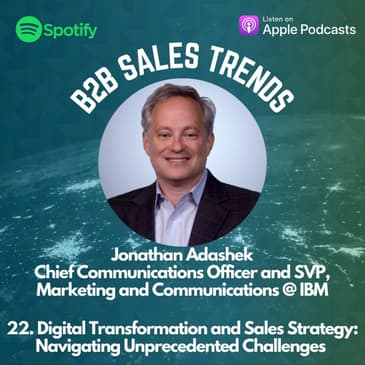
[00:00:05] Welcome to B2B Sales Trends, the podcast dedicated to sales leaders in the B2B space. Where we share conversations about innovative and successful sales transformations to keep you up-to-date on the latest trends, this podcast is brought to you by Global Performance Group.
[00:00:22] Welcome yet another fabulous episode of the B2B Sales Trends podcast. These show that brings you tips, tricks, hacks, thought leadership for sales, marketing and customer success. It's brought to you by Global Performance Group and revenue improvement,
[00:00:40] but take that implements behavior change to provide sales people and customers success people. The competence of the skills, the confidence and the courage to sell and negotiate based on customer outcomes. My name is Harry Kenne-Bacher and today I have with me Jonathan A. Deshack from IBM.
[00:01:03] Jonathan is the Chief Communication Officer and SVP of Marketing and Communications Head, what I said IBM, welcome to the B2B Sales Trends podcast, Jonathan. Harry, thanks for having me. I am thrilled to be with you today. Looking forward to this conversation.
[00:01:23] Thank you for making time. I know how busy you are. As a way of starting the interview, Jonathan, tell us a little bit about yourself if you would and how you'll pass let you to become into CCL and CMO at IBM.
[00:01:36] Yeah, you know, I joined IBM in January of 2020 just before the world took a turn with COVID. But I was fortunate to join the amazing company at that point. I joined as Chief Communications Officer at that point in January of 2022.
[00:01:59] I was also appointed as the head of Marketing for the company. So with all of that, I oversee the Global Marketing Communications and CSR organization that also includes our ESG work, our analyst relations, to man generation, some branding work, business development for governments,
[00:02:24] social media sponsorships, events across the company. I'm the executive advocate for our executive sponsors. Excuse me for our work across the Middle East and Africa as well. So lots of various pieces in the world, but I consider myself a lucky guy.
[00:02:40] I think the best job in the world. Well, just a couple of responsibilities for them, wow, really amazing. Really amazing. Thanks for that introduction. So Jonathan, as a leader in Communication and you know, corporate affairs,
[00:02:58] can you shed some light on the role of communications and marketing in particular in relation to driving the sales success? And really how does storytelling and conversation skills contribute to building stronger relationships with customers and drive business growth while I'm here?
[00:03:19] You know, the way I think I start looking at this is through the lens of demand. I think there's a myth inside of a lot of organizations that one team or one function owns demand. And in reality, I believe that demand is everyone's business.
[00:03:41] And as marketing and communications, it's our job to create demand. But there's no end without a beginning in this place, right? So 100% of opportunities start with the IBM brand.
[00:03:57] But in order to capture the demand, we have to have a close partnership with sales and with our consulting colleagues. And in terms of storytelling, I think every brand has a story. But it's not just how you tell the story, it's how you really show the story.
[00:04:16] I like to think of storytelling and storytelling showing. And I think for B2B companies like IBM and we sell hardware, we sell software, we sell consulting services, and other pieces. Marketers and communicators are often tasked with bringing intangible products and capabilities to life.
[00:04:41] And we're asked to also bring clarity to complex concepts. And do that and just show some value and purpose and break through the noise of always on content machine. To connect with our current clients and help prospect for future clients.
[00:05:02] And I think more than ever today, B2B companies need to be thinking about how we can show our stories rather than simply telling them.
[00:05:11] We need to bring our audiences, our clients, our customers along on the journey and make it human centric and personal to them in our storytelling and story showing.
[00:05:23] And clearly communicate the who, the what, the where, the how and the why of our company and our products and our services. There's so many nuggets in what you have just shared. I know our listeners will really appreciate that.
[00:05:41] You know one of the things that we hear a lot from our clients and the clients that we're working with is that they experience sometimes a disconnect between marketing and sales.
[00:05:55] Is this something you have an opinion on specifically that, you know, that that that that disconnect of of how marketing behaves and how sales behaves is that something. Yeah. It is something I have a really specific opinion on. And I said it to everybody in my team.
[00:06:17] And anybody in the order cool listen, there should be zero daylight between sales and marketing zero daylight and the head of sales our chief commercial officer and I.
[00:06:30] We've got a great relationship and we've got a great mutual understanding of the business and what we're trying each other are trying to do. And I would say nine times out of ten, if not even more than that you will not find.
[00:06:48] Separation between the two of us even if we haven't talked about something before meeting if something comes up in a meeting it is natural we sort of have a natural extension of each other's functions in our space as well.
[00:07:05] That's great to hear something that a lot of companies are struggling with for sure that that's great that you have been alignment internally. Let's shift in a little bit to the, you know, that digital transformation that's been a real major focus for businesses across a variety of industries.
[00:07:24] How do you see digital transformation impacting sales ops and its strategies and what are sort of. You know, the key challenges and opportunities that sales need to should consider in this process. You know, I think that the macro challenges that enterprises are facing today are really unprecedented.
[00:07:45] Whether you're looking at talent gap or inflation rising economic growth slowing cybersecurity issues geopolitical. And the fact that IDC, I think if we can remember correctly, he says 50% of enterprises future revenue will come from businesses that don't even exist today.
[00:08:13] So that's a massive transformation and business leaders really need to be prepared on a variety of fronts to ensure their organizations that they have the resources in place to not only survive. In this environment and in a bit of an environment of uncertainty.
[00:08:34] You know, modern day technology investments with AI, hybrid cloud technologies at the core are really driving more productivity. Advancement and technology and in businesses and growth enterprises around the world. If you look at something like hybrid cloud which is a place we spend a lot of time focusing.
[00:08:59] I'm cloud generates two and a half times greater business value than just having a single cloud on AI if you look at that network processes and what's going on with automation.
[00:09:14] The numbers are great. I mean, if you look at 54% of enterprises will realize cost savings and efficiencies by deploying AI. And 53% will experience performance improvements and better customer experiences.
[00:09:31] So the digital transformation is huge and it is changing the way all of us are doing business say and interacting with each other.
[00:09:41] But we have to keep in mind the technology will define the winners and the future ready organizations and the data driven predictive organizations that have intelligent automation. Look at risk and really focusing on that great capability that can come with that around agility around speed and sustainability.
[00:10:07] I think those are the organizations that are going to thrive and excel in this digital transformation.
[00:10:14] Right, and you mentioned talent gaps my daughter's 18 and she's just selecting which direction she's going to go she heard is that nine out of ten jobs that will be relevant in the next 10 years they don't exist yet.
[00:10:31] So it's really interesting that lens through everything you've talked about just now it's fascinating. But that idea it's that IDC point that I talked about 50% of revenue will come from things that don't exist.
[00:10:45] Right, and it's sort of an exciting you know some people may be don'ted by but I think it's exciting because you can be part of that journey and part of that creation of what's going to happen in the future.
[00:10:56] Now talking of AI can you share some of the insights on on the current state of AI, you know, adoption currently in sales. How do you see AI technologies sort of shaping up the future B to B sales?
[00:11:15] You know, I think that despite the media narrative around generative AI many global business leaders are still not a hundred percent sure about the real transformer transmitted transformative excuse me. Power of AI and how to really leverage it.
[00:11:37] You know for us at IBM we launched in 2022 the Lex Create campaign which is our most significant brand initiative in more than a decade and it really aligns with the vision and the strategy of today's IBM.
[00:11:54] And we've been able to take that campaign and help differentiate the company for an AI business and a lot of the reason I bring that up is because a lot of what AI is going to the adoption and the proliferation of AI is going to come through that co creation.
[00:12:16] And it would we're trying to bring that to life so people can see use cases and understand how they can scale it.
[00:12:24] And I think a lot of people are still looking at how do they get started they understand the basics of what it can do, but they're looking more for use cases today.
[00:12:34] They're looking for how do they scale it, how do they get started in a new way because in many cases they're starting from scratch. Right right.
[00:12:46] What what trends do you envision for the future of AI within marketing communication and sales specifically and for our audience mostly be to be sales leaders. How should they prepare and adapt to stay competitive in this environment.
[00:13:05] You know I think that the latest advancements in AI have really created an amazing wave of awareness and excitement. And it's going to bring the full potential is going to come before too long and I think the way I look at it is this net scape moment.
[00:13:22] The chat GPT is doing for AI what net scapted for the internet years ago and AI is in this it's one of these moments of it's a cycle is going right.
[00:13:36] And I think that as we look at it, it is going to really change the way people approach it. I think the number we just did some studies inside of IBM and 41% of IT for 41% of IT professionals say their company is exploring it.
[00:13:56] Well, each 27% say they're really using it. So there's a great opportunity for as we talked about just a minute to go to help shape that future and to get in at the beginning and understand what's going on.
[00:14:09] And as of adoption comes quicker, I think there's going to be even more insights and more learnings people get new ways to apply it in their business. I think there's so much information right now.
[00:14:25] A lot of organizations are overwhelmed and unsure how to implement and that's the AI. And I think it's like many technologies that have rapid deployment. It can be hazardous. It has to be done properly and responsibly and ethically.
[00:14:47] And we've got to make sure that we're all following the rules of the road for however AI is going to be used. But I think that the deployed across across your business across your company. But I think that the concept of AI.
[00:15:05] Not permeating itself into various places where the audience in this podcast works is crazy. And I think that the people who use AI is going to be there to augment people and what they're doing.
[00:15:20] And I think that the people who don't use AI, they're going to lose out to people who do use AI and understand how to use it.
[00:15:29] So one of the key things that people need to do is take some time to get smart and to learn about it and understand how it is going to be used. And it's not just how it's going to be used.
[00:15:43] It's going to be how you work differently with that AI and with that automation in place. I think there are two distinct things that are very, very important. Right.
[00:15:54] I just did a webinar the other day on how AI will disrupt sales and sales processes and also behavior sales people. And a lot of feedback we've received that a lot of different roles within sales people basically scared of what's happening.
[00:16:11] But I think the different to your point we really need to embrace the opportunity in this and how can it enhance what we're doing well right now. Will there be some roles replaced and some activities you know maybe.
[00:16:25] But again, I think it's an opportunity for people to get to an elite level and to really see this differently and see how this automation can help us. I'm going to throw an interesting one in there for especially the sales audience if I may be cheeky here.
[00:16:44] In your opinion, you've seen a lot of successful people out there right. Yeah, what are the top three things that sales people need to execute in the future to be elite. I think number one is propensity to learn. Right.
[00:17:06] Continue your learning, continue learning from every opportunity, every interaction you have with your clients, your partners, your colleagues and figure out what's that nugget you take away. To I think speed. I think more and more people are looking to move faster and faster.
[00:17:28] And the ability to move quicker and navigate through situations to get things done is going to be really important. Learning speed. I think agility.
[00:17:45] I think agility is key because we're seeing technology change the landscape fast and something you might be talking about this week could be out of date next week.
[00:17:57] And how do you get in front of that and make sure that you are understanding that you're creating solutions or delivering solutions. That are going to be able to operate no matter the construct that they're in. So I think those are the three things, learning speed agility.
[00:18:18] I love it. Absolutely. I couldn't agree more with you. Are you up for a quick lightning round? A couple of personal questions about you and your role? Fire away. All right. How would you describe your leadership style? I try and be very transparent.
[00:18:38] I try and be very direct about what I'm looking for and what I'm expecting. And I try and be a servant leader. Try and be there. More than right alongside everybody else. My success is really the success of the broader team.
[00:18:57] So the leadership style nowadays needs to be fabulous. What are you reading right now? When I'm reading, if it's not a work paper or the middle of our planning cycle, so I'm reading all of our plans for next year.
[00:19:14] I try and unplug and read usually a lot of fiction thrillers. Daniel Silva has a new book that I just finished over the weekend. I read that every year. So I'm about to pick up my next one. I'm debating what that one is yet. Fabulous.
[00:19:32] Any podcast anything you're listening to right now? The good old grateful dead pod cast that I am a giant fan of the grateful dead. And I'm always listening to what they've got, what they did and background. To me it wasn't just the music on the stage.
[00:19:51] It was always the story around what was going on there. The production, how they got there and what happened. So I love that. Fabulous. Finally, how can a listener's find? Find you. Why not about you? Very easily. I'm on Twitter or X at Jonathan Atasheck.
[00:20:10] I'm on LinkedIn and my email is Jonathan.Atasheck at IBM.com. Very easy to find. Jonathan, thank you so much for your fabulous insights. I'll thoroughly enjoy getting to know your little bit and learning from your insights. I know our listeners really appreciate you input. So thank you.
[00:20:34] Thanks for having me, Harriet. It's been a thrill to be here. Thanks everyone for tuning in again. Until the next episode, I have been selling it. Make sure you engage well with your customers, prospects and everybody else around you. Look after yourself. Thanks.